CBSE Class 8 Exam Pattern 2026-27: Marking Scheme Explained
CBSE Class 8 Exam Pattern 2026-27 follows a school-based two-term assessment system with periodic tests, half-yearly and annual exams, along with internal assessment, helping students build strong fundamentals before transitioning to the structured Class 9 exam pattern.
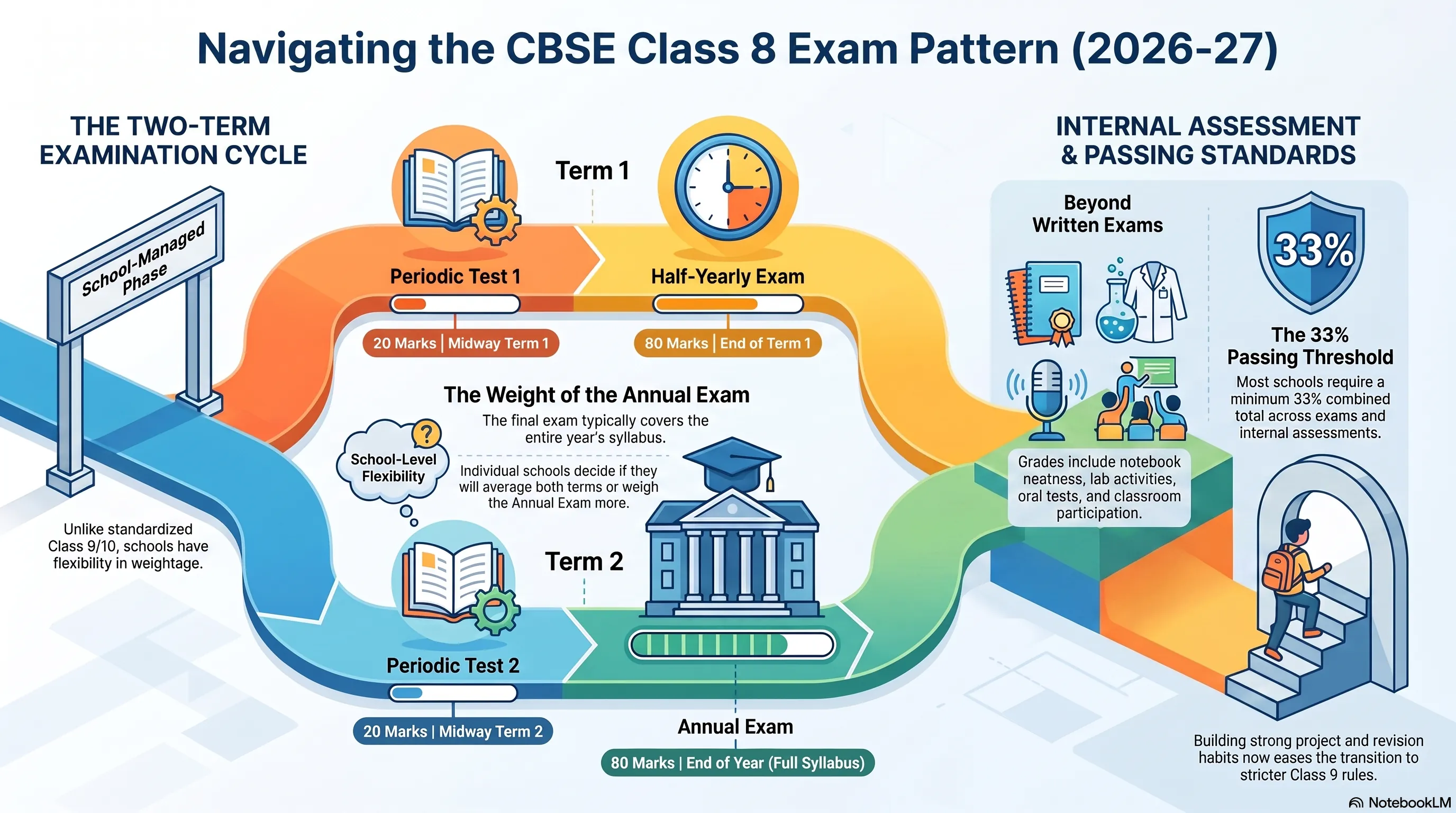
Table of Contents
- What Is the CBSE Class 8 Exam Pattern 2026-27?
- Term-Wise Structure of the Class 8 Exam
- What Counts as Internal Assessment in Class 8?
- CBSE Class 8 Passing Criteria
- Does CBSE Set an Official Marking Scheme for Class 8?
- How Class 8 Prepares You for Class 9's Exam Pattern
- How to Prepare for the Class 8 Exam Pattern

eSaral ›Foundation courses ›CBSE Class 8 Exam Pattern 2026-27: Marking Scheme Explained

What Is the CBSE Class 8 Exam Pattern 2026-27?
CBSE doesn't mandate a single, fixed marking scheme for Class 8 the way it does for Class 9 and 10. Instead, it leaves the exact structure to individual schools, within a broad two-term framework most CBSE-affiliated schools follow.
| Assessment Component | Typical Marks | Conducted When |
|---|---|---|
| Periodic Test 1 | 20 | A few months into Term 1 |
| Half-Yearly Exam | 80 | End of Term 1 |
| Periodic Test 2 | 20 | Midway through Term 2 |
| Annual Exam | 80 | End of Term 2 covers the full syllabus |
Most schools weigh the final annual exam more heavily toward the overall result, since it's the assessment covering the complete year's syllabus, while periodic tests and the half-yearly exam feed into ongoing internal assessment.
Why Doesn't CBSE Standardise the Class 8 Marking Scheme?
CBSE treats Classes 6 to 8 as a school-managed phase of assessment, giving individual schools discretion over exact weightage, while reserving its detailed, uniform marking scheme — the 80-marks-theory-plus-20-marks-internal-assessment structure — for Class 9 onward, where results start feeding directly into board-exam readiness.
Term-Wise Structure of the Class 8 Exam
Most CBSE schools split the Class 8 academic year into two terms, each worth 100 marks per subject, and combine both terms into the final result.
- Term 1 — Periodic Test 1 (20 marks): A short, syllabus-limited test held a few months into the session.
- Term 1 — Half-Yearly Exam (80 marks): Covers everything taught in the first half of the year, usually held around September-October.
- Term 2 — Periodic Test 2 (20 marks): Another short test, held midway through the second term.
- Term 2 — Annual Exam (80 marks): The final written exam, covering the full year's syllabus, sometimes with slightly more weight on second-term content.
💡 Expert Tip by eSaral Academic Team: Don't treat periodic tests as low-stakes. Even though each is only 20 marks, they add up across two terms and often carry more combined weight than students expect — consistent periodic test performance is one of the easiest ways to protect your overall grade.
Some schools weigh the Annual Exam as the sole determinant of the final result, using Term 1 marks only for report cards and progress tracking; others average both terms directly. It's worth confirming this specifically with your school, since it genuinely varies.
What Counts as Internal Assessment in Class 8?
Beyond periodic tests and term exams, most CBSE Class 8 report cards include a separate internal assessment component built from ongoing classroom activity.
- Project Work — assignments and subject-specific projects throughout the year
- Class Participation — engagement in classroom discussions and activities
- Oral Tests — reading, speaking, and listening checks, especially in languages
- Notebook Submission — regularity and neatness of classwork and homework
- Lab Activities — practical work and simple experiments in Science
How Much Does Internal Assessment Affect the Class 8 Final Grade?
Internal assessment components like projects, notebooks, and class participation are typically factored into the overall grade alongside term exam marks, though the exact percentage weighting is set by each school rather than a fixed CBSE-wide rule, unlike the standardised 20-mark internal assessment used from Class 9 onward.
This is exactly why a student who "does fine on tests" but skips projects or submits notebooks late can still see a lower final grade than their exam scores alone would suggest.
CBSE Class 8 Passing Criteria
While CBSE doesn't mandate a single fixed passing threshold for Class 8 the way it does for Class 9 and 10, most schools apply the same 33% minimum logic used across the CBSE system, calculated on the combined total of exams and internal assessment.
| Component | Typical Minimum Required |
|---|---|
| Combined Term + Internal Assessment | Around 33% per subject |
Since Class 8 falls outside CBSE's formally published marking scheme, schools have some flexibility in exactly how this 33% is calculated — some apply it strictly per term, others to the combined annual total. Checking your own school's exact promotion policy is the only reliable way to know for certain.
Does CBSE Set an Official Marking Scheme for Class 8?
No, CBSE's officially published, uniform marking scheme documents apply specifically to Classes 9 through 12, not Class 8. For Classes 6 to 8, CBSE provides broader curricular and assessment guidelines and leaves the specific term structure, weightage, and passing rules to each affiliated school.
This is a genuinely important distinction, because it means two students in different CBSE schools can have meaningfully different Class 8 exam experiences, even while studying identical NCERT textbooks. What stays constant across every CBSE school, however, is the underlying NCERT syllabus and chapter content — which is exactly what this year's new textbooks (Ganita Prakash, Curiosity, Exploring Society: India and Beyond, Poorvi, and Malhar) have standardised.
How Class 8 Prepares You for Class 9's Exam Pattern
Class 9 replaces Class 8's school-discretion model with CBSE's fixed 80-marks-theory-plus-20-marks-internal-assessment structure, competency-based questions, and a strict 33% passing rule applied independently to both components. Students moving from a relatively flexible Class 8 system into this fixed structure often need a term or two to adjust — which is exactly why building strong study and internal-assessment habits now, even in a less rigid Class 8 system, pays off directly next year.
Treating Class 8 periodic tests and projects seriously, rather than as "practice that doesn't really count," is the single best way to enter Class 9 already comfortable with consistent, structured assessment.
How to Prepare for the Class 8 Exam Pattern
- Confirm your specific school's term weightage early. Since CBSE doesn't standardise this for Class 8, ask your school directly whether the Annual Exam determines your final result alone, or whether Term 1 marks are averaged in.
- Take periodic tests and projects seriously. These smaller, ongoing assessments often carry more combined weight than a single term exam, and they're the most controllable part of your final grade.
- Build NCERT chapter by chapter. Since Class 8's new textbooks form the entire basis of the syllabus, working through NCERT Solutions for Class 8 Maths and Class 8 Science chapter by chapter is the most reliable way to stay exam-ready.
- Download the correct edition of your textbooks. With NCERT's new Class 8 books this session, check NCERT Books for Class 8 to confirm you're studying from the current edition, not an older one.
- Start building consistent study habits now, not in Class 9. Since Class 9 shifts to a much stricter, CBSE-standardised exam pattern, using Class 8 to build steady revision and notebook habits makes that transition considerably smoother.
If you want structured Class 8 preparation that builds strong fundamentals ahead of Class 9's stricter exam pattern and eventual JEE or NEET preparation, eSaral's Foundation Courses are worth exploring alongside your school syllabus. Bookmark this page, and take a look at what changes once you move to the Class 9 exam pattern — the shift is bigger than most students expect.
Frequently Asked Questions
Find answers to common questions.
What is the CBSE Class 8 exam pattern for 2026-27?
The CBSE Class 8 Exam Pattern 2026-27 is set by individual schools within a broad two-term framework, typically combining a 20-mark periodic test and an 80-mark exam in each term, with internal assessment components like projects and notebooks also factored in.
What is the passing marks for Class 8 CBSE?
Most CBSE schools apply the same 33% minimum used across the CBSE system, calculated on the combined term exam and internal assessment total, though the exact calculation method can vary by school since Class 8 isn't covered by CBSE's standardised marking scheme.
Does CBSE set a fixed exam pattern for Class 8?
No, CBSE's officially published, uniform marking scheme applies to Classes 9 through 12. For Class 8, CBSE provides general assessment guidelines and leaves the specific term structure and weightage to individual schools.
What is included in Class 8 internal assessment?
Class 8 internal assessment typically includes project work, class participation, oral tests, notebook submission, and lab activities, factored into the final grade alongside term and annual exam marks.
How many terms does the CBSE Class 8 exam have?
Most CBSE schools split the Class 8 year into two terms, each with a periodic test and a term exam (half-yearly in Term 1, annual in Term 2), though exact weightage between terms varies by school.