JEE Advanced Previous Year Question Paper PDF (2019–2026)
Table of Contents
- JEE Advanced Previous Year Question Paper
- What Is the JEE Advanced Previous Year Question Paper Used For?
- JEE Advanced 2026 Exam Pattern: What's Confirmed and What Changes Every Year
- How to Use JEE Advanced Previous Year Question Paper Sets Effectively
- JEE Advanced vs JEE Main Previous Year Question Paper: Key Differences
- JEE Main Previous Year Question Paper

eSaral › JEE › JEE Advanced ›JEE Advanced Previous Year Question Paper PDF (2019–2026)

Reviewed by Senior JEE Faculty
JEE Advanced Previous Year Question Paper
Every JEE Advanced previous year question paper from 2019 to 2026, Paper 1 and Paper 2, is available below as a solved PDF — along with the updated JEE Advanced 2026 marking scheme.

What Is the JEE Advanced Previous Year Question Paper Used For?
A JEE Advanced previous year question paper is the actual paper set by the conducting IIT in a past year, used by aspirants to practise the exact question types — single-correct MCQs, multi-correct MCQs, numerical answer type, and list-match sets — that appear only at this second, tougher stage of the exam. Unlike JEE Main, where speed matters most, JEE Advanced previous year papers train precision under partial-marking rules, since a single wrong option in a multi-correct question can cost you marks even with a partially right answer.
Since 2024, the exam has held steady at 51 questions per paper (17 per subject) and 180 marks per paper — but the section-wise marking scheme still shifts slightly each year, so always confirm the current year's rules before you start solving. This page separates every JEE Advanced previous year question paper by year, so you can practise against the format closest to your own attempt first.
JEE Advanced examination pattern consists of two papers - Paper-1 and Paper-2, and the duration of each paper is 3 hours. The JEE Main-qualified candidates must appear for both papers.
The JEE Advanced 1st paper is conducted in the morning shift (9 am to 12 noon), while the 2nd paper is conducted in the afternoon shift (2:30 pm to 5:30 pm). Each paper consists of 3 subjects - Physics, Chemistry, and Math.
It is noticed that generally the questions in Physics and Math are tough, while Chemistry is moderate. The exact number of questions, sections, and marking scheme for each paper are prescribed by the conducting IIT in the official information bulletin released closer to the exam, so candidates should always check that year's brochure for confirmed details. The languages of the examination are English and Hindi.
For chapter-level drilling instead of full papers, use the JEE Advanced chapter-wise PYQ index.
Haven't Cleared JEE Main Yet? Start With the JEE Main Previous Year Question Paper First
If you're still preparing for the qualifying stage, jumping straight to JEE Advanced papers can be discouraging — the difficulty and question style are noticeably different. Build your foundation first with the jee main previous year question paper archive, which covers 2019 to 2026 in the current MCQ-plus-numerical format, before attempting Advanced-level list-match and multi-correct questions here.
Still targeting JEE Main qualification? Explore eSaral's JEE Online & Offline Courses — IIT Bombay faculty-led batches built to take you from JEE Main basics to JEE Advanced readiness.
JEE Advanced 2026 Exam Pattern: What's Confirmed and What Changes Every Year
JEE Advanced 2026 Paper Structure
| Particular | Detail |
|---|---|
| Mode | Computer-based test (CBT) |
| Number of Papers | 2 compulsory papers — Paper 1 and Paper 2 |
| Duration | 3 hours per paper (4 hours for PwD candidates) |
| Subjects per Paper | Physics, Chemistry, Mathematics |
| Questions per Paper | 51 (17 per subject) |
| Marks per Paper | 180 |
| Total Marks (Both Papers) | 360 |
| Question Types | Single-correct MCQs, multi-correct MCQs, numerical answer type (NAT), list/match-type |
What Stays Constant vs What Varies Every Year
Constant since 2024: 51 questions per paper, 17 questions per subject, 180 marks per paper, 360 marks total — this structure has held for three consecutive years (2024, 2025, 2026).
Varies by year: The exact section-wise negative marking (whether a wrong single-correct answer costs −1 or −2, and how partial marking is awarded on multi-correct questions) has changed almost every cycle. Always cross-check the current year's official information bulletin before assuming last year's scheme carries over.
Why JEE Advanced Previous Year Question Paper Practice Matters More Here Than in JEE Main
Because marking rules shift year to year, solving a JEE Advanced previous year question paper isn't just about learning content — it's about learning to read that year's specific instructions carefully before you attempt a single question. Many aspirants lose marks not from wrong concepts but from misreading a section's marking rule under time pressure.
For the full breakdown of sections and timing, see the JEE Advanced exam pattern page.
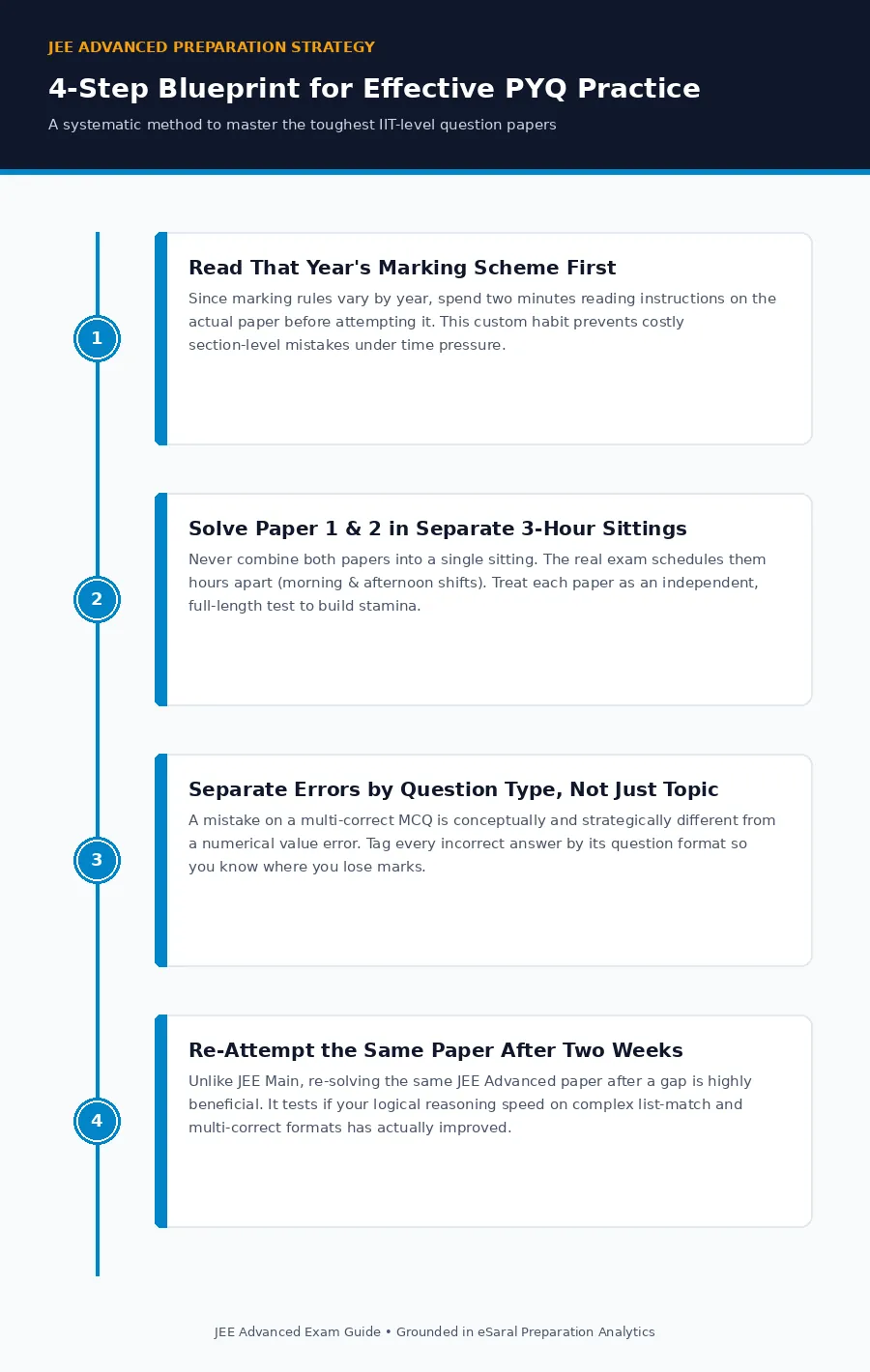
How to Use JEE Advanced Previous Year Question Paper Sets Effectively
Step 1: Read That Year's Marking Scheme Before You Start
Since partial and negative marking rules vary, spend two minutes reading the instructions on the actual JEE Advanced previous year question paper before attempting it — this habit alone prevents costly section-level mistakes on exam day.
Step 2: Solve Paper 1 and Paper 2 in Separate, Full 3-Hour Sittings
Never combine both papers into one sitting during practice, since the real exam schedules them hours apart. Treat each JEE Advanced exam paper as an independent full-length test.
Step 3: Separate Errors by Question Type, Not Just Topic
A wrong answer on a multi-correct MCQ is a different mistake from a wrong numerical answer. Tag every miss by question type so you know exactly which format is costing you marks.
Step 4: Revisit the Same Paper After Two Weeks
Unlike JEE Main practice, re-attempting the same JEE Advanced previous year question paper after a gap is genuinely useful — it tests whether your reasoning speed on list-match and multi-correct questions has actually improved, not just your memory of the answers.
JEE Advanced vs JEE Main Previous Year Question Paper: Key Differences
| Aspect | JEE Advanced Previous Year Question Paper | JEE Main Previous Year Question Paper |
|---|---|---|
| Eligibility to attempt | Only after qualifying JEE Main | Open to all eligible aspirants |
| Question types | MCQs, multi-correct, numerical, list-match | MCQs and numerical value only |
| Marking style | Full, partial, and zero marks; varies by year | Fixed +4/−1 across all questions |
| Number of papers | 2 compulsory papers | 1 paper (Paper 1 or Paper 2 based on course) |
| Difficulty focus | Deep reasoning, multi-step problem solving | Speed and syllabus coverage |
If you're unsure which to prioritise this month, solve two jee main previous year question paper sets for every one JEE Advanced set until your JEE Main mocks are consistently above your target percentile — then shift the ratio toward Advanced practice.
.webp)
JEE Main Previous Year Question Paper
Complete year-wise archive of JEE Main previous year question papers from 2019 to 2026, with solved PDFs for every shift and session.
Frequently Asked Questions
Find answers to common questions.
Where can I download JEE Advanced previous year question papers with solutions?
You can download JEE Advanced previous year question papers with solutions for 2019 to 2026 on the eSaral website and app. Both Paper 1 and Paper 2 are available in PDF format with detailed step-by-step solutions.
How many questions are asked in JEE Advanced?
Each paper contains 54 questions — 18 from each of the three subjects: Physics, Chemistry, and Mathematics. Across both papers, a total of 108 questions are asked.
What are the types of questions asked in JEE Advanced?
JEE Advanced includes five types of questions: single correct MCQs, multiple correct MCQs (with partial marking), numerical value answers, list match sets, and single-digit integer type questions (answers between 0 and 9).
Is there negative marking in JEE Advanced?
Yes. JEE Advanced follows a marking scheme of full, partial, and zero marks depending on the question type. Incorrect answers in certain sections attract negative marking, so accuracy is just as important as attempting more questions.
Which subject is toughest in JEE Advanced?
Generally, Physics and Mathematics are considered the toughest sections, while Chemistry is regarded as moderate. However, difficulty varies from year to year and depends on individual strengths.
In which mode is JEE Advanced conducted?
JEE Advanced is conducted in CBT (Computer-Based Test) mode, i.e., it is an online examination. The medium of the exam is either English or Hindi, as chosen by the candidate.
How many years of JEE Advanced PYQ should I solve before the exam?
What types of questions appear in a JEE Advanced previous year question paper?
JEE Advanced papers include single-correct MCQs, multi-correct MCQs with partial marking, numerical answer type questions, and list/match-type questions — a wider variety than JEE Main's MCQ-and-numerical-only format.
Is the JEE Advanced 2026 pattern different from 2025?
The core structure — 51 questions per paper and 180 marks per paper — has stayed the same since 2024, but the exact section-wise negative and partial marking rules can still shift, so always check that year's official bulletin.