JEE Main Practice Papers & Sample Papers (With Solutions) | Free PDF Download
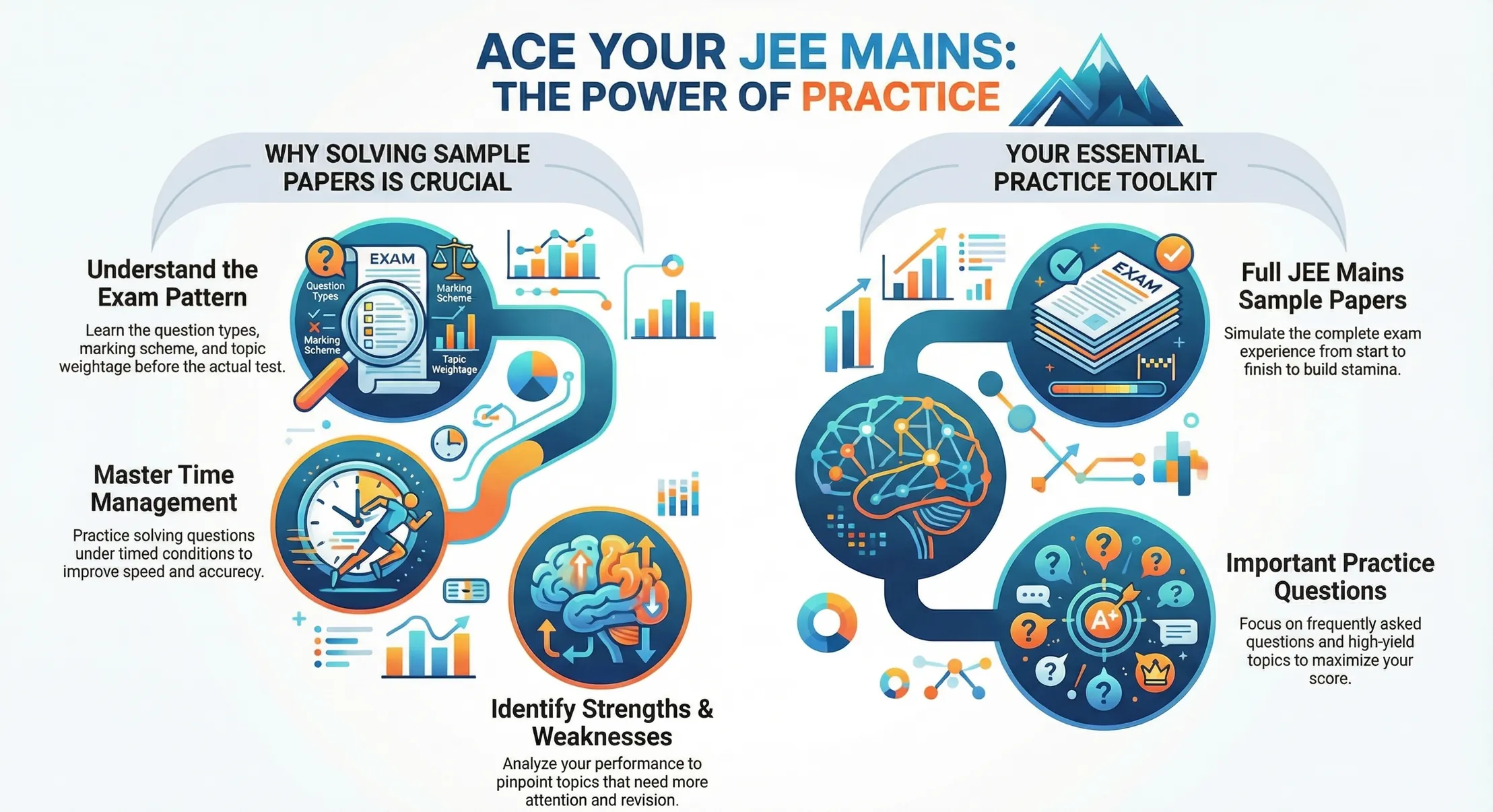
Table of Contents
- Free JEE Main Sample Papers with Solutions [Download Now]
- The JEE Main Battle Plan: Exam Pattern That Decides Your Rank
- Why JEE Main Sample Papers Change Everything
- When and How Often to Solve Sample Papers
- The Smart Way to Solve JEE Main Sample Papers (And the Dumb Mistakes That Kill Ranks)
- Your JEE Main Journey Starts Now

eSaral › JEE Main › Important Questions › JEE Main Important Questions

How do I know if I'm actually ready for JEE Main?
If this question is running in your mind right now, then JEE exam sample paper are about to become your best friend. These aren't just practice sheets — they're your reality check, your weakness detector, and your confidence builder all rolled into one.
JEE Main remains one of the most brutal engineering entrance battles in India. Every year, over 12 lakh students compete for limited seats in NITs, IIITs, and GFTIs. The exam doesn't care about your coaching institute's reputation or how many hours you claim to study daily. It only cares about one thing: can you solve 75 questions correctly in 180 minutes under pressure?
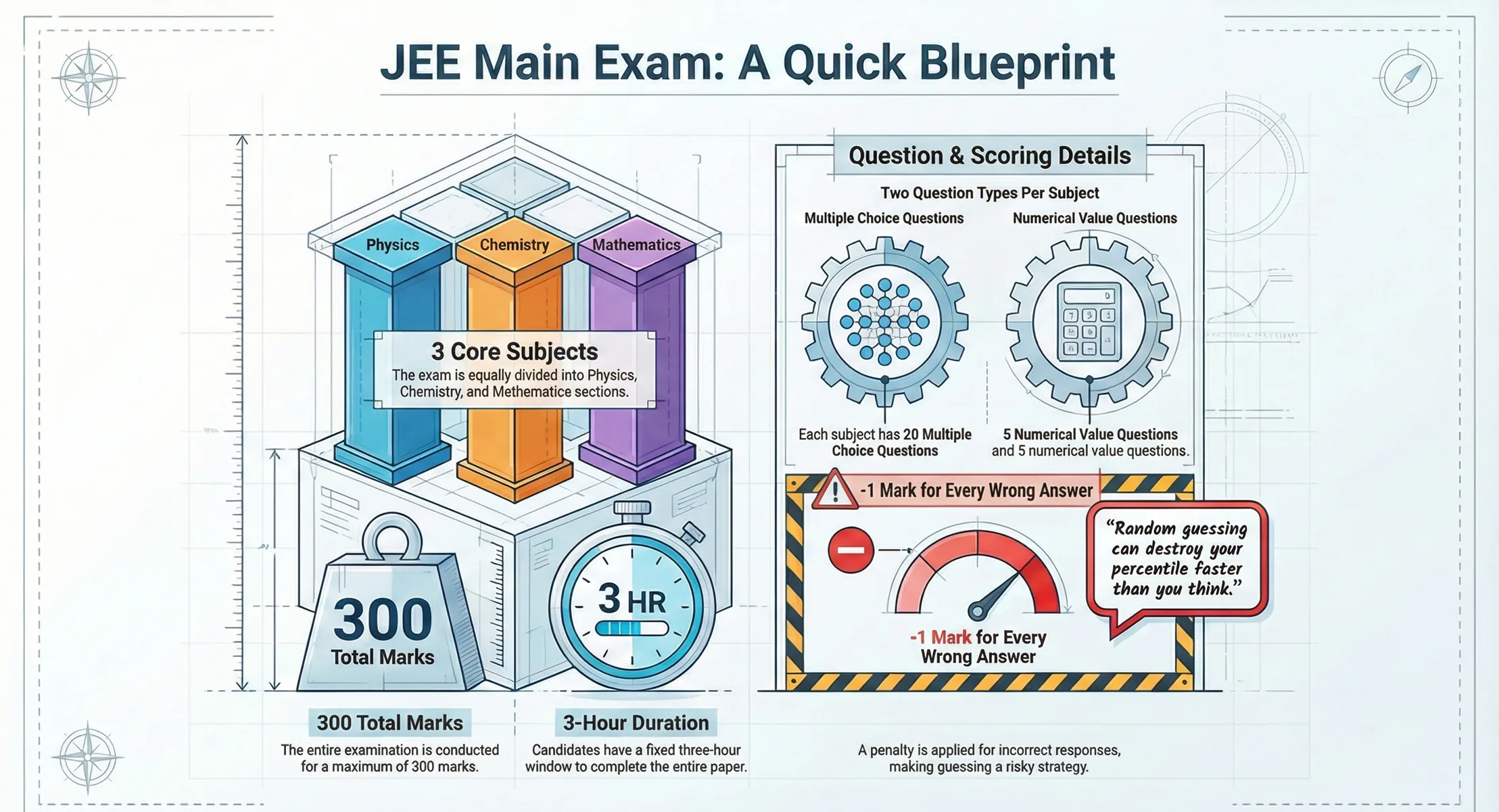
Here's the truth: The 3-hour JEE Main carries 300 marks and follows a rigid structure across Physics, Chemistry, and Mathematics. Each subject hits you with 20 multiple-choice questions in Section A plus 5 numerical value questions in Section B. Every wrong answer costs you -1 mark, which means random guessing can destroy your percentile faster than you think.
Most students make the mistake of treating JEE prep like school exams — reading theory, solving a few problems, hoping for the best. But JEE Main sample papers expose the reality: knowledge without an exam strategy equals average marks.
Students scoring 270+ marks consistently land in the 99+ percentile range, opening doors to top colleges across India. Whether you're targeting NIT Trichy CS or IIIT Hyderabad, these free JEE Main sample papers with detailed solutions will show you exactly where you stand and what you need to fix.
Your rank depends not on what you know, but on what you can execute under exam conditions.
👉 For deeper practice, also solve the JEE Main Previous Year Question Papers (Chapter-wise with Solutions) to understand recurring question patterns and high-weightage concepts.
Free JEE Main Sample Papers with Solutions [Download Now]
You need a structured attack plan for the JEE Exam sample papers. Random practice leads to random results. Smart practice? That's where rank jumps happen.
Here's your complete arsenal of free JEE Main sample papers designed to take you from confusion to confidence, step by step.
| JEE MAIN Practice Sample Papers with Important Questions |
| JEE MAIN Sample Paper 1 |
| JEE MAIN Sample Paper 2 |
| JEE MAIN Sample Paper 3 |
| JEE MAIN Sample Paper 4 |
| JEE MAIN Sample Paper 5 |
| JEE MAIN Sample Paper 6 |
These important questions are a starting point; students can find more practice from the same topics in the JEE Mains PYQ chapter wise collection.
JEE Main 2025 Question Papers with Complete Analysis
Target: Match current exam trends + Final preparation
Nothing beats solving from both the January and April sessions.
👉 You can also download all previous JEE Main Question Papers (PDFs) to compare difficulty levels across multiple years.
Why JEE Exam Sample Paper of 2025 is a game-changer:
· Current question trends: See exactly how difficulty has evolved
· Session-wise patterns: January vs April difficulty comparison
· Chapter-wise weightage: Discover which topics appeared most frequently
· Official solutions: NTA-approved answer approaches
· Shift analysis: Understand how paper difficulty varies across shifts
Each shift had slightly different difficulty levels — these papers teach you to adapt.
JEE Mains Practice Papers: Complete Syllabus Coverage
Target: Fill knowledge gaps + Final revision tool
JEE Mains Practice papers ensure you haven't missed any important topic. While sample papers test your exam skills, model papers test your syllabus completion.
Strategic advantages of model papers:
· Uniform topic coverage: Every chapter gets equal representation
· Self-assessment tool: Identify exactly what you still don't know
· Revision efficiency: Focus only on topics where you make mistakes
· Format mastery: Section A (20 MCQs) + Section B (5 numericals) per subject
· Marking practice: +4 for correct, -1 for wrong answers
Use these papers 2-3 weeks before your exam to ensure complete preparation.
Your Sample Paper Strategy:
Week 1-2: Papers 1-5 (one every alternate day)
Week 3-4: Papers 6-10 (focus on weak areas identified)
Week 5: 2024 actual papers (under strict time limits)
Week 6: Model papers (final gaps filling)
The goal isn't just solving papers. The goal is systematic improvement that translates into a higher percentile on exam day.
Each paper you solve correctly brings you closer to your target college. Each mistake you analyse prevents future rank loss.
Start with Paper 1 today. Your JEE Main rank depends on it.
After going through the important JEE Main questions, practise with previous years JEE Main question papers to see similar questions in their original exam context and understand how these concepts are tested across different years and sessions.
The JEE Main Battle Plan: Exam Pattern That Decides Your Rank
Most students think they know the JEE Main pattern. They're wrong.
👉 If you want a complete breakdown, check the latest JEE Main Exam Pattern to understand question distribution, section structure, and marking scheme.
Knowing the pattern and understanding how to exploit it strategically are two completely different things.
Here's what separates average performers from top rankers: they don't just memorize the exam structure — they use it as a weapon.
Paper Structure: Your 3-Hour Combat Zone
1 follows a rigid structure that hasn't changed in recent years. JEE Main PaperEvery subject throws the same challenge at you:
Section A: 20 Multiple Choice Questions
Section B: 5 Numerical Value Questions
That's 75 total questions across Physics, Chemistry, and Mathematics. No choices, no shortcuts. Every question is compulsory.
The exam runs in a computer-based mode, except for the B.Arch Drawing Test, which remains pen-and-paper. Students with disabilities get 4 hours instead of the standard 3.
But here's the critical insight: the pattern isn't your enemy — your time management within this pattern is.
The Marking Reality: +4 or -1
This is where strategy becomes everything:
Correct answer = +4 marks
Wrong answer = -1 mark
Blank = 0 marks
Simple math: One wrong answer cancels out 25% of a correct answer.
This identical scheme applies to both MCQs and numerical questions. Total paper value: 300 marks.
Most students focus on attempting more questions. Toppers focus on attempting the right questions. When you're solving sample papers, your goal isn't completion — it's optimisation.
Subject-Wise Breakdown: Where Your Rank Gets Made
Each subject carries exactly 100 marks with identical question distribution:
Physics: 25 questions (20 MCQs + 5 numerical)
Chemistry: 25 questions (20 MCQs + 5 numerical)
Mathematics: 25 questions (20 MCQs + 5 numerical)
But equal distribution doesn't mean equal difficulty. Each subject has its own personality:
Physics: Heavy on Mechanics, Electromagnetism, Modern Physics
👉 To prioritise your preparation, check the detailed JEE Main Physics Chapter-wise Weightage so you know exactly which topics matter the most.
Chemistry: Balanced across Organic, Inorganic, Physical
Mathematics: Dominated by Calculus, Algebra, and Coordinate Geometry
Here's the game-changer: While each subject gets equal marks, they don't demand equal time. Smart students identify which subject gives them the fastest mark accumulation and prioritise accordingly.
Sample papers reveal these patterns. Without this data, you're flying blind into the exam hall.
Why JEE Main Sample Papers Change Everything
Here's what separates average scorers from 99+ percentile students: the 99+ percentile students treat sample papers as their secret weapon, not just homework.
Most students solve sample papers randomly — attempt one, check answers, move on. But top rankers follow a systematic approach that turns every sample paper into a strategic advantage.
Your Brain Learns the Exam Language
Sample papers train your mind to think in "JEE mode." After solving 15-20 papers, your brain automatically recognises question patterns and starts predicting answer approaches. This isn't about memorising — it's about developing exam intuition that kicks in under pressure.
When you sit in the actual exam hall, everything feels familiar. The paper structure, question styles, even the way options are arranged — none of it surprises you anymore. Your mental energy stays focused on solving, not on understanding what's being asked.
Time Distribution Becomes Automatic
JEE Main gives you exactly 2.4 minutes per question. Sounds reasonable until you realise that some Physics problems take 5 minutes while some Chemistry questions need just 30 seconds.
Regular sample paper practice teaches you the 60-60-60 Rule:
· Physics: 60 minutes (some tough numericals need extra time)
· Chemistry: 60 minutes (fastest to solve with good memory)
· Maths: 60 minutes (accuracy is everything here)
Through repeated practice, you develop an internal clock that alerts you when you're spending too long on any single question. You learn to:
· Skip time-killers and return later
👉 For fast and effective concept recall, use the Physics Revision Series for Class 11 & 12, designed especially for JEE & NEET aspirants.
· Identify 30-second questions vs 4-minute problems
· Maintain speed without sacrificing accuracy
Mistake Patterns Become Visible
Every student has a unique "mistake fingerprint" — specific types of errors they repeat unconsciously. Sample papers expose these patterns before they destroy your actual exam score.
After 10-12 sample papers, you'll notice:
· Do you consistently mess up unit conversions in Physics?
· Are organic mechanism questions your weak spot?
· Do you make calculation errors in coordinate geometry?
This self-diagnosis is gold. Instead of studying everything randomly, you can target your actual problem areas.
Fear Transforms Into Confidence
The first time you sit for a 3-hour mock test, it feels impossible. Your back hurts, your concentration breaks, anxiety creeps in. But by the 20th sample paper, something magical happens — 3 hours feels normal.
Students who solve 25+ sample papers report a significant drop in exam anxiety. They've already "lived" the exam experience multiple times. This familiarity breeds confidence, and confidence directly translates to better performance under pressure.
Progress Becomes Measurable
Sample papers give you hard data about your preparation. Instead of wondering "Am I ready?", you get concrete answers:
· Paper 1: 180/300 marks
· Paper 10: 220/300 marks
· Paper 20: 260/300 marks
This progression tracking helps you stay motivated during tough preparation phases. You can literally see improvement happening, which keeps you pushing forward when motivation dips.
👉 Use the JEE Mains Percentile to Rank Calculator to estimate your real-time rank based on your mock test performance.
Bottom line: Sample papers aren't just practice — they're your dress rehearsal for the most important 3 hours of your academic life. Students who solve them strategically don't just improve their scores; they transform their entire approach to competitive exams.
When and How Often to Solve Sample Papers
"Sir, when should I start mock tests? How many papers should I solve?"
Most students get this timing completely wrong. They either start too late (panic mode in the last month) or too early (before covering sufficient syllabus). Both approaches waste precious preparation time.
Historical data show that students who increased their mock test frequency in the final two months before the exam had a higher likelihood of achieving top percentile scores. Here's the exact timeline that works:
Phase 1: Foundation Building (6–8 months before)
Start integrating JEE Main sample papers around 6-8 months before your exam date. But here's the key — you're not timing yourself strictly yet. You're learning the language of JEE.
What to do in this phase:
· One sample paper per week maximum
· Focus on understanding question patterns, not speed
· Spend 2-3 hours analysing each paper after solving
· Identify which chapters appear most frequently
👉 Before going deeper into sample papers, ensure you’ve covered the full JEE Main Syllabus (Latest) so you don’t miss any high-weightage chapters.
Surveys among top JEE rankers revealed that over 85% had completed their syllabus by December, allowing ample time for revision and practice. Don't rush into daily tests when your fundamentals are still shaky.
Phase 2: Acceleration Mode (3–5 months before)
This is where serious test practice begins. Shift toward more challenging papers to accurately gauge your progress. Start taking regular mock tests around 3-4 months before the exam.
Your new routine:
· 2-3 sample papers per week
· Chapter-wise tests for weak areas
· Full-length papers once per week minimum
Throughout this phase, divide topics into manageable sections for weekly review and attempt chapter-wise tests to identify knowledge gaps. After completing 70-80% of the syllabus, your focus should expand to include full-length papers that simulate actual exam conditions.
Critical rule: Every test must be followed by 60-90 minutes of analysis. No exceptions.
Phase 3: Exam Simulation (Last 1–2 months)
The last 1-2 months are absolutely critical for intensive practice with JEE Main sample paper PDFs. From the first week of December, aim for at least two full-length tests weekly.
Studies of past toppers show that those who solved over 10,000 problems during preparation had significantly higher success rates in both JEE Main and Advanced. Your goal: solve as many tests as possible in the final 15 days.
Final phase schedule:
· 4-5 full tests per week
· Daily chapter revision based on test mistakes
· Formula sheets for quick morning revision
· Zero new topics — only practice and polish
Your Weekly Test Strategy
Develop a consistent weekly rhythm for JEE model question paper practice. Begin with one paper weekly in early stages, gradually increasing to 2-3 papers per week midway through preparation.
Non-negotiable rules for every test:
· Simulate real exam conditions with proper timing and no distractions
· Analyze errors thoroughly after each attempt
· Revise weak areas identified through practice
· Maintain short notes for quick formula revision
Remember this: solving papers without analysis is like working out without tracking progress. The magic happens in understanding your mistakes. Regular practice builds problem-solving speed, accuracy, and proper time management skills, substantially improving your chances of success.
Bottom line: Tests are not just practice — they're your rank predictors. Treat them seriously.
The Smart Way to Solve JEE Main Sample Papers (And the Dumb Mistakes That Kill Ranks)
Most students solve sample papers like they're doing homework. They sit casually, check answers quickly, and move on to the next paper. Then they wonder why their mock test scores don't improve even after solving 50+ papers.
Here's what separates average students from top rankers: how you solve matters more than how many you solve.
Create Exam Hell at Home
Your sample paper session should feel exactly like the real JEE Main. That means:
· Sit for the full 3 hours without bathroom breaks
· Keep your phone in another room (not on silent, AWAY)
· Use only the calculator type allowed in the actual exam
· Set a timer that counts down, not up
This isn't just practice — it's mental conditioning. When you walk into the actual exam hall, your brain will think: "I've done this before."
The Post-Paper Analysis That Actually Works
Here's the biggest mistake: Students check their score, feel good or bad, then forget about it.
Here's what toppers do: They spend 90 minutes analysing every wrong answer.
For each mistake, ask:
· Did I know the concept, but make a calculation error?
· Was this a completely new type of question?
· Did I run out of time or rush through it?
· Would I make the same mistake again right now?
Golden Rule: For every mistake, solve 4-5 similar problems immediately. Don't just understand the solution — drill the pattern into your muscle memory.
Don't Become a Sample Paper Addict
Some students think solving 100 sample papers will magically boost their rank. They ignore their textbooks, skip theory revision, and just keep attempting more papers.
Reality check: Sample papers test what you already know. If your fundamentals are weak, no amount of practice papers will save you.
The right balance:
· 70% time on learning + revision
· 30% time on sample papers + analysis
The Chapter-wise Revision Trap
After solving each paper, most students think: "Let me revise the chapters where I made mistakes."
This sounds smart, but wastes massive time. Instead, target the specific concepts where you went wrong. If you messed up integration by parts, don't revise the entire calculus chapter — just drill 20 integration by parts problems.
Precision beats volume every single time.
Stop Attempting Subject-wise Mini Papers
Many students solve only Physics papers, or only Chemistry papers, thinking they're being "efficient."
This destroys your exam stamina.
JEE Main isn't three separate 1-hour exams — it's one brutal 3-hour marathon. Your brain needs to jump between Physics numerical and Chemistry organic reactions within the same sitting.
Always solve full 75-question papers. Your mental switching speed between subjects decides your rank more than your problem-solving ability in any single subject.
The difference between rank 1000 and rank 50,000 isn't talent. It's how seriously you treat practice.
Your JEE Main Journey Starts Now
You now have the complete toolkit.
JEE Main sample papers aren't just practice sheets you solve and forget. They're your training ground where average students become toppers, where confusion becomes clarity, and where exam fear transforms into exam confidence.
Every paper you solve is a step closer to your dream college. Every mistake you analyse saves you from repeating it on the actual exam day. Every hour you spend in exam-like conditions builds the mental stamina that separates 99+ percentile scorers from the rest.
Here's what separates winners from wishers in JEE Main:
Winners practice consistently. Wishers practice when they feel like it.
Winners analyse every mistake. Wishers move on quickly.
Winners simulate exam pressure. Wishers hope for the best.
The clock is ticking. Every day you delay starting serious sample paper practice is a day your competitors are getting stronger. But the beautiful thing about JEE Main is this: your past doesn't determine your future rank. Your next 90 days of focused action do.
Download these sample papers. Print them. Sit with them for 3 hours at a stretch. Make mistakes. Learn from them. Get frustrated. Push through. This is how engineering dreams become engineering realities.
Remember the question we started with: "How do I know if I'm actually ready for JEE Main?"
The answer is simple: You're ready when sample papers stop feeling scary and start feeling like opportunities to prove yourself.
All the best, beta. Your engineering seat is waiting. Now go grab it.
Frequently Asked Questions
Find answers to common questions.
What is the difference between JEE Main sample papers and previous year question papers?
Sample papers are designed to replicate JEE Main's difficulty and format using new questions. Previous year papers are actual questions asked by NTA in past exams. Both serve different purposes — sample papers build problem-solving stamina and breadth, while previous year papers reveal exactly how NTA frames questions and which specific concepts it tests most often.
Is it enough to solve only important questions, or should I cover the full syllabus?
Solving important questions first is a smart prioritisation strategy, not a replacement for full syllabus coverage. High-weightage chapters deserve 60–70% of your practice time, but leaving any chapter completely untouched is risky. Even a single question from a "low-weightage" chapter can be the difference between two colleges.
Are the important questions on this page aligned with the current NTA syllabus?
Yes. All sample papers on this page are built around the NTA-prescribed JEE Main syllabus, which covers Physics, Chemistry, and Mathematics from Class 11 and Class 12. NTA publishes the official syllabus on its website at nta.ac.in — always cross-check the current year's syllabus notification for any updates.
How many sample papers should I solve before JEE Main?
Solve at least 20–25 full-length sample papers before the exam. This includes 6–8 practice papers, 4–6 model papers, and all available actual JEE Main session papers from 2023–2025. Quality of analysis matters more than volume, but 20+ papers gives your brain enough exposure to recognise question patterns reliably
What is the best way to use solutions after solving a sample paper?
Do not look at solutions question-by-question after finishing. First, mark your own answers and score yourself. Then go through every wrong answer independently before reading the solution. This forces your brain to engage with the error rather than passively absorbing the right method. Faculty at eSaral — trained under IIT Bombay-level rigour — build solution explanations specifically to address the most common reasoning errors, not just show the final answer.
How should I handle negative marking during sample paper practice?
Treat negative marking the same way in practice as you will on exam day. If your confidence in an MCQ answer is below 50%, mark it for review and move forward rather than guessing. Use your returned time at the end to revisit. This discipline takes 10–12 papers to develop but it is what separates 95-percentile scorers from 99-percentile scorers.
Can Class 11 students start solving JEE Main sample papers?
Class 11 students should begin with chapter-wise practice before attempting full-length papers. Once you complete 60–70% of the Class 11 syllabus, start solving mixed papers that focus on Class 11 topics. Full-length 75-question papers become more useful in Class 12 when your syllabus coverage is broad enough to attempt all three subjects without leaving too many blanks.