JEE Main 2027 Registration: Dates, Eligibility & Process (Updated for session1)
Table of Contents
- JEE Main 2027 Session 1: Registration Dates & Exam Dates (Official)
- JEE Main 2027 Eligibility Criteria
- How to Complete JEE Main 2027 Registration: Step-by-Step Process
- JEE Main 2027 Registration Fee (Expected, Based on 2026 Structure)
- Documents Required for JEE Main 2027 Registration
- JEE Main 2027 Exam Pattern and Syllabus (Quick Overview)
- JEE Main and Advanced Syllabus 2027
- JEE Main 2027 Cutoff — Category-Wise
- JEE Main Application Form 2027
- JEE Main Session 1 Admit Card 2027
- JEE Main 2027 Preparation Strategy

eSaral › JEE › JEE Main 2027 Registration: Dates, Eligibility & Process (Updated for session1)

NTA has released the JEE Main 2027 Session 1 exam dates. Candidates can refer to the timeline below for registration, application deadline, fee payment, and the correction window for Session 1 (January attempt).
Always verify final dates on the official NTA portal, jeemain.nta.nic.in
JEE Main 2027 Session 1: Registration Dates & Exam Dates (Official)
JEE Main 2027 — Dates, Registration & Eligibility Timeline
| Event | Session 1 (Expected) | Session 2 (Expected) |
|---|---|---|
| Official notification release | September–October 2026 | Along with Session 1 or separately in December 2026 |
| JEE Main 2027 registration opens | Last week of October 2026 | Last week of January 2027 |
| Application Deadline | Fourth week of November 2026 | February 2027 |
| Application correction window | Early December 2026 | February 2027 |
| Admit card release | Third week of January 2027 | First week of April 2027 |
| Fee Payment Deadline | November 2026 | ---- |
| JEE Main 2027 Exam Dates (OUT) | January 22, 23, 24, 28, 29 and 30, 2027 | April 2027 |
| Result declaration | Within 2–3 weeks of the exam | Within 2–3 weeks of the exam |
(Exam dates for Session 1 are official as per NTA's notification. Admit card and Session 2 (April attempt) dates will be updated once released.)
The Relationship Between JEE Main and JEE Advanced
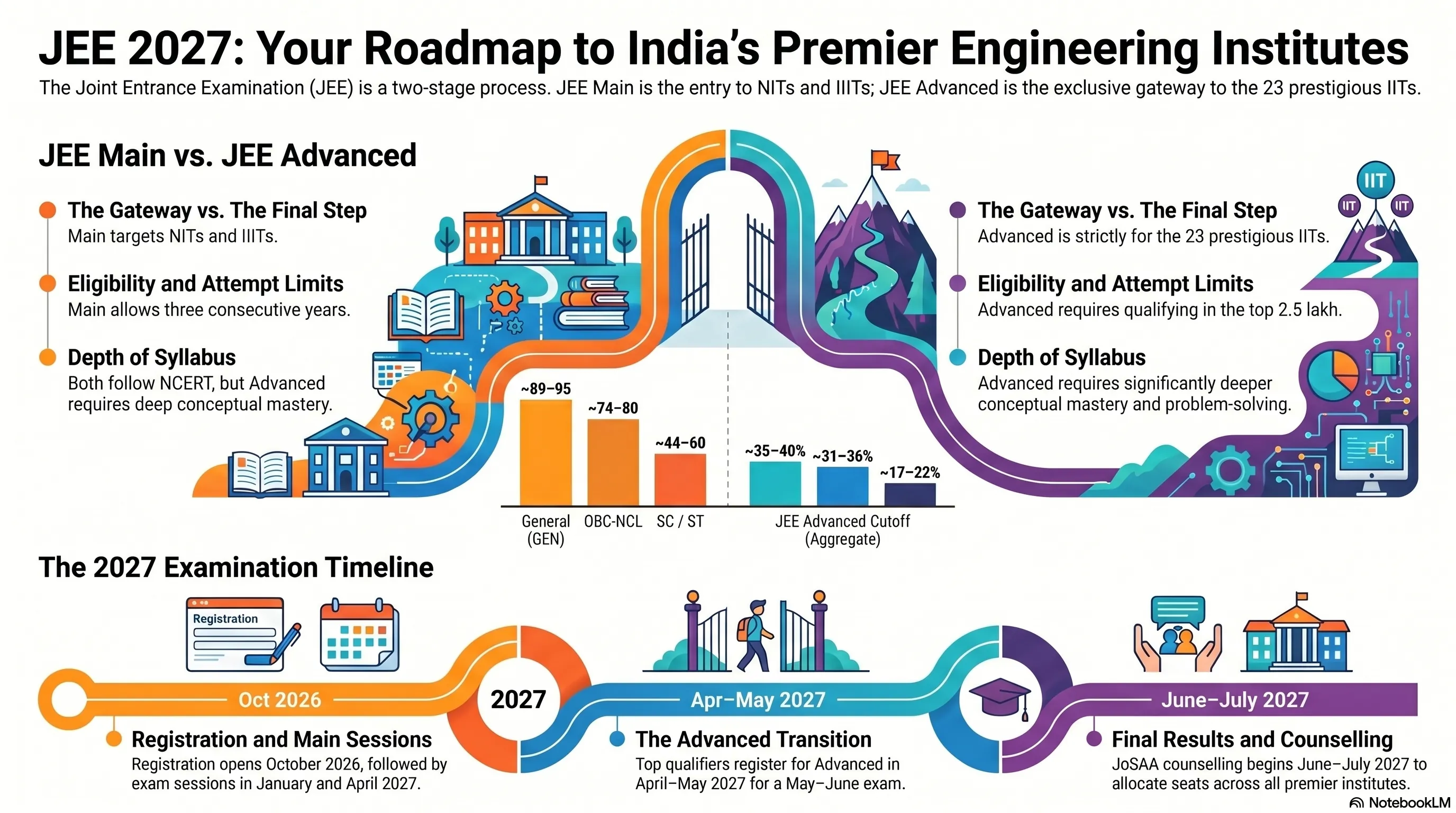
JEE Main is the gateway — qualifying it is mandatory to sit for JEE Advanced. Only the top 2.5 lakh candidates from JEE Main (across all categories) are eligible to register for JEE Advanced. JEE Main scores are used directly for admission to NITs, IIITs, and GFTIs; JEE Advanced scores determine IIT admissions.
For a deep dive into each exam, visit the dedicated JEE Main guide and JEE Advanced guide on eSaral
JEE Main 2027 Session 1 — Key Dates
| Event | Date |
|---|---|
| Notification Release | October 2026 |
| Registration Window | October–November 2026 |
| City Intimation Slip | January 2027 |
| Admit Card Release | 3–4 days before the exam |
| JEE Main 2027 Exam | January 22–24 & 28–30, 2027 |
| Result Declaration | February 2027 |
JEE Main 2027 Eligibility Criteria
Before starting JEE Main 2027 registration, candidates must confirm they meet the eligibility requirements, which are expected to remain largely unchanged from previous cycles:
- Qualifying exam: Candidates who passed Class 12 (or equivalent) in 2025 or 2026, or are appearing for Class 12 board exams in 2027, are eligible to apply.
- Subjects required: Candidates must have studied at least 5 subjects in Class 12, with Physics and Mathematics as compulsory subjects (Chemistry/Biology/Vocational subject as the fifth, depending on the intended course).
- Age limit: There is no upper age limit for JEE Main, in line with NTA's current policy.
- Number of attempts: Candidates can attempt JEE Main a maximum of 6 times across 3 consecutive years from their year of passing Class 12 (up to 2 attempts per year — Session 1 and Session 2).
- Diploma holders: Diploma holders are not eligible for admission through JEE Main to NITs/IIITs, though they may be eligible for other participating institutes.
| Criteria | Details |
|---|---|
| Age Limit | No upper age limit (check specific institute requirements) |
| Academic Qualification | 10+2 or equivalent with Physics, Chemistry, and Mathematics from a recognised board |
| Appearing Students | Class 12 students appearing in the 2027 board exam can apply |
| Attempts | Maximum 3 consecutive years from the year of Class 12 appearance |
| Prerequisite | None — direct application to NTA |
How to Complete JEE Main 2027 Registration: Step-by-Step Process
- Visit the official NTA JEE Main website (jeemain.nta.nic.in) once the JEE Main 2027 registration link is activated.
- Complete the registration step by entering basic personal details — name, date of birth, mobile number, and email ID — to generate your application number.
- Fill out the full application form with academic details (Class 10 and Class 12 information), category, state of eligibility, and choice of exam cities.
- Upload the required documents — photograph, signature, and category/PwD certificate (if applicable) — in the specified format and size.
- Pay the application fee online via net banking, debit/credit card, or UPI before the deadline.
- Download and save the confirmation page for your records; this will be needed for any future correspondence with NTA.
- Use the correction window (opened separately after registration closes) to fix any errors in personal, academic, or category details.
JEE Main 2027 Registration Fee (Expected, Based on 2026 Structure)
JEE Main 2027 Application Fee by Category (Tentative)
| Category | Fee (Centres in India) | Fee (Centres Outside India) |
|---|---|---|
| General / OBC-NCL / EWS (Male) | ₹1,000 (single paper) | ₹5,000 |
| General / OBC-NCL / EWS (Female) | ₹800 (single paper) | ₹5,000 |
| SC / ST / PwD / Transgender | ₹500 (single paper) | ₹5,000 |
| Both Paper 1 and Paper 2 | Fees are approximately double for most categories | Approximately double |
(All fee figures are based on the JEE Main 2026 fee structure and are expected to remain largely unchanged for JEE Main 2027; confirm exact figures once NTA's official notification is released.)
Documents Required for JEE Main 2027 Registration
Keep the following documents ready before starting the JEE Main 2027 registration process:
- Recent passport-size photograph (as per specified format)
- Scanned signature
- Class 10 certificate/marksheet (for date of birth proof)
- Class 12 marksheet or admit card (for appearing candidates)
- Valid photo ID proof (Aadhaar Card, PAN Card, or equivalent)
- Category certificate (SC/ST/OBC-NCL/EWS), if applicable
- PwD certificate, if applicable
JEE Main 2027 Exam Pattern and Syllabus (Quick Overview)
While the detailed JEE Main 2027 syllabus will be confirmed with the official notification, the exam pattern is expected to follow the established structure:
- Duration: 3 hours
- Total marks: 300
- Subjects: Physics, Chemistry, and Mathematics
- Question types: Multiple-choice questions plus numerical value-based questions
- Syllabus basis: Class 11 and Class 12 NCERT curriculum for Physics, Chemistry, and Mathematics
For the complete and official eligibility details, visit:
⚠️ Important: Eligibility criteria may be revised by NTA or JAB for 2027. Always refer to the official notification at jeemain.nta.nic.in and jeeadv.ac.in before applying.

JEE Main and Advanced Syllabus 2027
Both JEE Main and JEE Advanced draw from the Class 11 and Class 12 NCERT curriculum across Physics, Chemistry, and Mathematics. JEE Advanced goes significantly deeper — expect higher conceptual difficulty and more multi-step problem solving.
Physics
| JEE Main Topics | JEE Advanced Additional Depth |
|---|---|
| Mechanics (NLM, Work-Energy, Rotational) | Rigid body dynamics, advanced oscillations |
| Thermodynamics | Deeper thermodynamic cycles |
| Electromagnetism | Advanced EMI, LC circuits |
| Optics (Ray and Wave) | Interference, diffraction with calculations |
| Modern Physics | Nuclear physics, photoelectric effect |
| Waves and SHM | Superposition, beats, standing waves |
Chemistry
| JEE Main Topics | JEE Advanced Additional Depth |
|---|---|
| Physical Chemistry | Electrochemistry, Chemical Kinetics |
| Organic Chemistry | Reaction mechanisms, stereochemistry |
| Inorganic Chemistry | d-block, p-block, coordination compounds |
| Chemical Bonding | MO theory, advanced hybridisation |
| Equilibrium | Buffer, solubility product, advanced ionic equilibrium |
Mathematics
| JEE Main Topics | JEE Advanced Additional Depth |
|---|---|
| Calculus (Differential and Integral) | Definite integrals by complex methods, functional equations |
| Algebra (Quadratics, Complex Numbers, Matrices) | Advanced matrix properties, determinant applications |
| Coordinate Geometry (Conics) | Parametric locus problems, cross-ratio |
| Trigonometry | Advanced trigonometric equations |
| Statistics and Probability | Conditional probability, distributions |
| 3D Geometry | Skew lines, planes — advanced |
💡 Preparation Tip: NCERT is the non-negotiable foundation. Master every NCERT chapter completely before moving to advanced references. JEE Advanced questions are significantly harder — allocate at least 6 focused months after JEE Main for Advanced-level preparation.
JEE Main 2027 Cutoff — Category-Wise
What Is the Cutoff?
JEE Main cutoff is the minimum percentile a candidate must achieve to qualify for JEE Advanced and to be considered for NIT, IIIT, and GFTI admissions.
JEE Advanced cutoff is the minimum aggregate score required for IIT admission, set annually by the Joint Admission Board (JAB) and varying by category and programme.
Indicative Cutoff Figures (Based on Recent Trends)
| Category | JEE Main Cutoff (Indicative) | JEE Advanced Cutoff (Indicative) |
|---|---|---|
| General (GEN) | ~89–95 percentile | ~35–40% aggregate |
| OBC-NCL | ~74–80 percentile | ~31–36% |
| SC | ~54–60 percentile | ~17–22% |
| ST | ~44–50 percentile | ~17–20% |
| PwD | ~0.11 percentile | ~17% |
Indicative figures based on recent years. 2027 cutoffs will be officially declared by NTA and JAB after results. For a complete overview of top NIT options and their cutoffs, visit Top NIT Colleges.
JEE Main Application Form 2027
JEE Main 2027 Application
The JEE Main application form is released online by NTA at jeemain.nta.nic.in. Key steps:
- Register with a valid email ID and mobile number
- Fill in personal details, academic information, and exam centre preferences
- Upload scanned photograph and signature (within specified size/format limits)
- Pay the application fee online (debit card, credit card, net banking, or UPI)
- Download and save the confirmation page
JEE Advanced 2027 Application
Only candidates who have qualified for JEE Main 2027 and are within the top 2.5 lakh qualifiers can register for JEE Advanced. The form is available at jeeadv.ac.in and requires personal details, qualification information, centre preferences, document uploads, and fee payment.
📋 Application Checklist: Before starting, keep ready: scanned photograph (recent, passport size), scanned signature, Class 10 and Class 12 certificates, and category certificate (SC/ST/OBC/PwD if applicable). Errors in the application form can cause serious issues — verify every field before final submission.
JEE Main Session 1 Admit Card 2027
How to Download
- JEE Main Session 1 Admit Card: Released by NTA at jeemain.nta.nic.in, approximately 2 weeks before the exam. Download and print — it is not sent by post.
- JEE Advanced Admit Card: Released by the respective conducting IIT at jeeadv.ac.in before the Advanced exam.
What the Admit Card Contains
The admit card includes your name, roll number, exam centre address, date and time of exam, and reporting instructions. It serves as proof of eligibility for entry into the examination hall.
⚠️ Do Not Forget: You must carry both the admit card AND a valid government-issued photo ID (Aadhaar, Passport, Voter ID, Driving Licence) to the exam hall. Candidates without both documents will not be permitted entry under any circumstances. Download and check your admit card well in advance of the exam date.
JEE Main 2027 Preparation Strategy
Phase-Wise Preparation Plan for JEE 2027
Phase 1 — Foundation (Class 11 / Starting Point): Build Your Base
If you are in Class 11 or just starting, this phase is about building a strong foundation in all three subjects simultaneously.
Physics priorities: Mechanics (NLM, Work-Energy, Rotational), Waves, Thermodynamics — the chapters that feed into Class 12 and JEE Advanced heavily.
Chemistry priorities: Mole Concept, GOC (General Organic Chemistry), Chemical Bonding, Periodic Table — these unlock all subsequent chapters.
Mathematics priorities: Quadratics, Trigonometry, Coordinate Geometry basics — these are prerequisites for all of Class 12 Maths.
Study hours: Build to 6–8 hours per day. Consistency over intensity — 7 hours every day beats 14 hours on weekends.
Phase 2 — Full Syllabus Completion (April–December 2026)
Complete the entire JEE Main syllabus across Physics, Chemistry, and Mathematics. Begin chapter-wise tests immediately after finishing each chapter — do not wait until the "full syllabus is done" before testing.
Target: By December 2026 — full JEE Main syllabus covered at least once, with regular chapter-wise testing done.
Phase 3 — JEE Main Revision (December 2026 – January 2027)
This phase is intensive revision and mock testing. Minimum 2 full-length JEE Main mock tests per week. After each mock: analyse every error, categorise the error type (concept gap, calculation error, question misread, time pressure), and plug the specific gap.
Solve all previous-year JEE Main papers from 2019 to 2026. The question templates in JEE Main repeat — recognising them under pressure comes only from extensive timed practice.
Phase 4 — JEE Advanced Preparation (February – May 2027)
After JEE Main Session 1, shift to JEE Advanced level. This requires:
- Going deeper in every high-weightage chapter (especially Organic Chemistry mechanisms, Calculus, Electrostatics, and Optics)
- Solving all JEE Advanced previous year papers — year-wise and timed
- Using JEE Advanced marks vs. rank data to set realistic target scores and understand what rank your current performance level would produce
Subject-Wise Strategy
Physics: Concept-first, then numericals. Never solve a problem you do not understand conceptually. JEE Advanced Physics demands derivation-level understanding — not just formula application.
Chemistry: Three sub-subjects, three different approaches. Physical Chemistry: practice calculations daily. Organic Chemistry: mechanism and reaction logic, not memorisation. Inorganic Chemistry: NCERT thoroughly + visual mnemonics for d-block and p-block.
Mathematics: This is a skill. Skills require daily practice. Never skip a day of Maths practice — even 30 minutes of problem-solving maintains sharpness.
Explore eSaral's JEE 2027 Courses
For structured preparation with IIT Bombay faculty — online and offline options both available:
Also Explore:
- Get the complete subject-wise syllabus breakdown: JEE Main Syllabus – Physics, Chemistry & Maths →
- Compare JEE Main with the next stage exam: JEE Main vs JEE Advanced – Key Differences Explained →
- Practice with chapter-wise previous year questions: JEE Main Previous Year Question Paper – Chapter-wise with Solutions →
- Understand the exam basics if you're just starting out: What Is JEE Main Exam? Importance, Eligibility & Format →
Frequently Asked Questions
Find answers to common questions.
What are the important dates for JEE 2027?
The JEE Main 2027 Session 1 exam dates have been announced: January 22, 23, 24, 28, 29 and 30, 2027. Based on the expected notification cycle, registration is likely to open in October–November 2026, with the city intimation slip released in January 2027 and results expected in February 2027. Session 2 is expected in March–April 2027, with JEE Advanced following in May–June 2027. Candidates should confirm all details at jeemain.nta.nic.in and jeeadv.ac.in.
What are the eligibility criteria for JEE Main 2027?
Candidates must have passed or be appearing in Class 12 (10+2) with Physics, Chemistry, and Mathematics from a recognised board. There is no upper age limit for JEE Main (though individual institutes may have age requirements). Students can attempt JEE Main for up to 3 consecutive years. Detailed criteria at JEE Main Eligibility Criteria.
How many students qualify for JEE Advanced from JEE Main?
The top 2.5 lakh candidates who qualify JEE Main (across all categories combined) are eligible to register for JEE Advanced. This threshold is maintained annually — qualifying JEE Main with a high enough percentile to rank within this cutoff is the prerequisite for an IIT seat.
What is the difference between JEE Main and JEE Advanced?
JEE Main is conducted by NTA twice a year (January and April), leads to NITs, IIITs, and GFTIs, and is computer-based. JEE Advanced is conducted by the IITs once a year (May–June), leads exclusively to the 23 IITs, has two papers on the same day, and tests significantly higher conceptual difficulty. Clearing JEE Main is mandatory before appearing for JEE Advanced.
Is there an age limit for JEE Main 2027 registration?
No, there is currently no upper age limit for JEE Main, and this is expected to remain unchanged for JEE Main 2027.
When will JEE Main 2027 registration start?
NTA has not yet released the official JEE Main 2027 notification as of September 2026, but the Session 1 exam dates are already out: January 22–24 and 28–30, 2027. Registration for Session 1 is expected to open in the last week of October 2026.
Where can candidates check the official JEE Main 2027 notification?
Candidates should regularly check the official NTA JEE Main website, jeemain.nta.nic.in, for the confirmed JEE Main 2027 notification, registration dates, and syllabus.
What is the expected application fee for JEE Main 2027?
Based on the JEE Main 2026 fee structure, general category male candidates are expected to pay around ₹1,000 for a single paper, with lower fees for female and reserved-category candidates.
How many sessions will JEE Main 2027 have?
JEE Main 2027 will be conducted in two sessions — Session 1 on January 22, 23, 24, 28, 29 and 30, 2027, and Session 2 expected in April 2027 — following the established two-attempt format from previous years.
What documents are required for JEE Mains 2027 registration?
Candidates need a recent photograph, scanned signature, Class 10 and Class 12 certificates, a valid photo ID, and category or PwD certificates if applicable.