JEE Main Exam Pattern 2027: Total Marks, Number of Questions, Paper Pattern and Marking Scheme

Table of Contents
- JEE Main Exam Pattern 2027: Total Marks and Number of Questions
- JEE Main Paper Pattern 2027 for Paper 1 (B.E./B.Tech)
- JEE Main Marking Scheme 2027
- JEE Main Paper Pattern 2027 for Paper 2A (B.Arch)
- JEE Main Paper Pattern 2027 for Paper 2B (B.Planning)
- How the JEE Main Exam Pattern Has Changed (2021–2027)
- NTA Score, Percentile and Normalisation

eSaral › JEE › JEE Main › JEE Main Exam Pattern 2027: Total Marks, Number of Questions, Paper Pattern and Marking Scheme
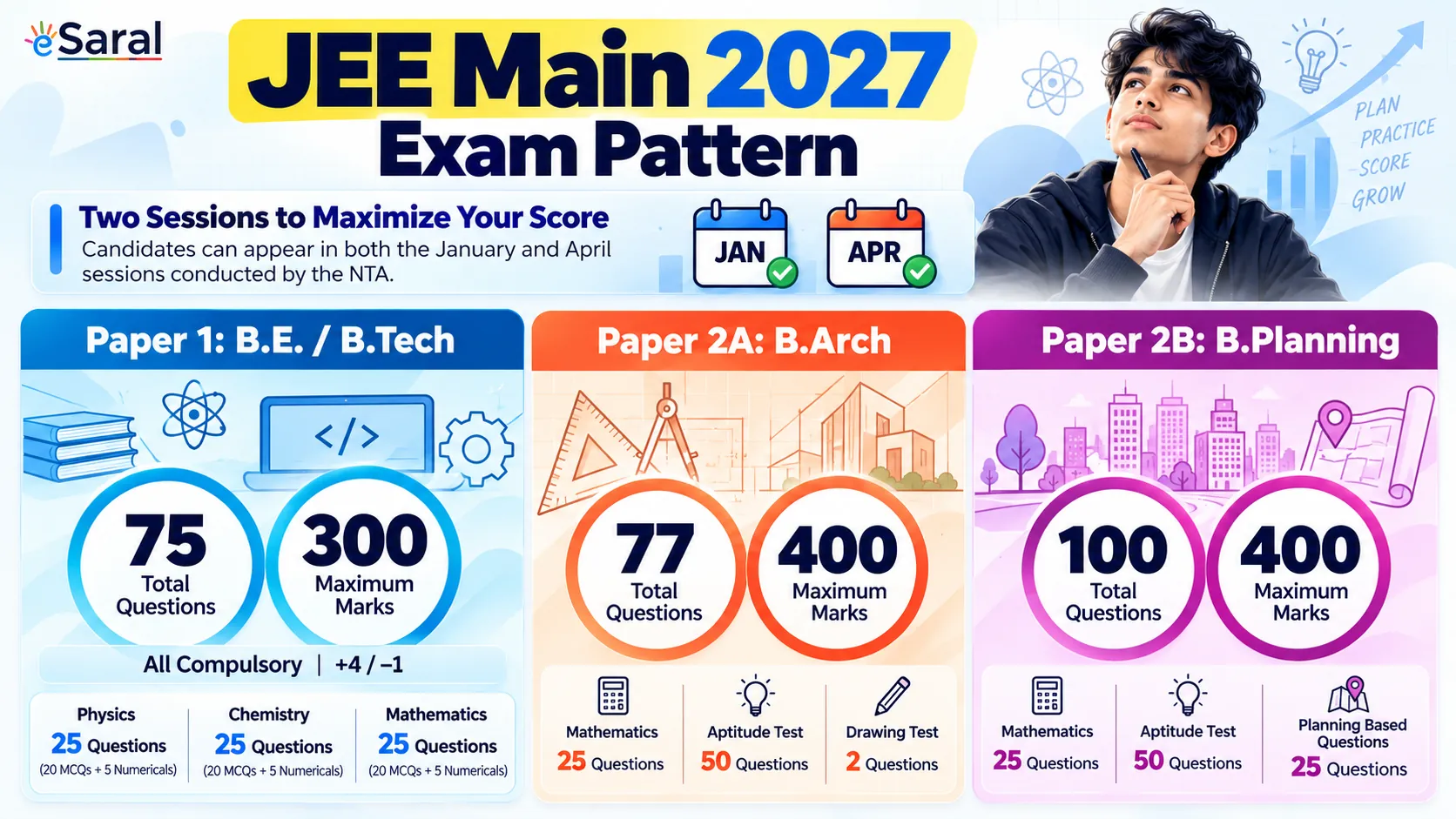
The JEE Main exam pattern 2027 is expected to stay the same as 2026: 75 questions, 300 total marks, and 3 hours for Paper 1, with +4/−1 marking. The National Testing Agency (NTA) has already scheduled Session 1 for 22–24 and 28–30 January 2027 in its exam calendar, and its information bulletin, due around late October 2026, will confirm the JEE Main exam pattern officially. Until then, everything below follows the 2026 bulletin, which is the rulebook NTA used for the most recent exam.JEE Main Exam Pattern 2027: Total Marks and Number of Questions
JEE Main total marks are 300 for Paper 1 (B.E./B.Tech) and 400 each for Paper 2A (B.Arch) and Paper 2B (B.Planning). As for how many questions in JEE Main, Paper 1 has 75, Paper 2A has 77, and Paper 2B has 100, and every question is compulsory.
|
Paper |
For |
Questions |
Total marks |
Duration |
|---|---|---|---|---|
|
Paper 1 |
B.E./B.Tech |
75 |
300 |
3 hours |
|
Paper 2A |
B.Arch |
77 |
400 |
3 hours |
|
Paper 2B |
B.Planning |
100 |
400 |
3 hours |
|
Paper 2A + 2B together |
B.Arch and B.Planning |
102 (Maths and Aptitude common, plus Drawing and Planning) |
400 each |
3 hours 30 minutes |
Candidates with benchmark disabilities (PwD) get 4 hours for any paper.
JEE Main Exam Pattern 2027 at a Glance
|
Feature |
JEE Main exam pattern 2027 |
|---|---|
|
Conducted by |
National Testing Agency (NTA) |
|
Sessions |
Two: January (22–24 and 28–30 Jan 2027) and April 2027 |
|
Mode |
Computer-based test; Paper 2A: drawing on paper |
|
Papers |
Paper 1 (B.E./B.Tech), Paper 2A (B.Arch), Paper 2B (B.Planning) |
|
Question types |
MCQs (4 options, one correct) |
|
Marking scheme |
+4 correct, −1 wrong, 0 unattempted |
|
Negative marking |
MCQs and numerical questions both |
|
Languages |
13: English, Hindi, Assamese, Bengali, Gujarati, Kannada, Malayalam, Marathi, Odia, Punjabi, Tamil, Telugu, Urdu |
|
Result |
NTA score (percentile); best of the two sessions counts |
JEE Main Paper Pattern 2027 for Paper 1 (B.E./B.Tech)
In the JEE Main paper pattern for Paper 1, each subject- Physics, Chemistry and Mathematics- has 25 questions worth 100 marks: 20 MCQs in Section A and 5 numerical value questions in Section B. All 75 questions are compulsory; the old "attempt any 5 of 10 numericals" choice was removed in 2025.
|
Subject |
Section A (MCQs) |
Section B (Numericals) |
Questions |
Marks |
|---|---|---|---|---|
|
Physics |
20 |
5 |
25 |
100 |
|
Chemistry |
20 |
5 |
25 |
100 |
|
Mathematics |
20 |
5 |
25 |
100 |
|
Total |
60 |
15 |
75 |
300 |
Section A vs Section B in the JEE Main exam pattern 2027
Section A has multiple-choice questions with four options and exactly one correct answer. Section B has numerical value questions: no options are given, and you type the answer with the on-screen virtual keypad. Because Section B has no options to eliminate, it rewards genuine problem-solving rather than smart guessing.
JEE Main exam pattern 2027 — exam duration and subject timing
Paper 1 lasts 3 hours (180 minutes), and there is no fixed time per subject; you can move between Physics, Chemistry and Maths freely. That works out to 2 minutes 24 seconds per question on average. A common plan is roughly 50 minutes for Chemistry, 60 for Physics and 70 for Maths, keeping the lengthier Maths section for when they are warmed up.
JEE Main Marking Scheme 2027
The JEE Main marking scheme awards +4 marks for every correct answer, deducts 1 mark for every wrong answer and gives 0 for a question left blank. The same rule applies to Section A and Section B, in every subject, in all three papers; only the Paper 2A drawing questions are marked differently.
|
Response |
MCQ (Section A) |
Numerical (Section B) |
Drawing (Paper 2A) |
|---|---|---|---|
|
Correct |
+4 |
+4 |
Up to 50 per question |
|
Wrong |
−1 |
−1 |
No negative marking |
|
Not attempted/marked for review only |
0 |
0 |
0 |
JEE Main Negative Marking: How Much Does a Wrong Answer Cost?
JEE Main negative marking takes away 1 mark for each wrong answer, in MCQs and numerical questions alike. So a wrong answer costs you 5 marks compared with a correct one: the 4 you missed plus the 1 deducted.
Worked example of the JEE Main marking scheme
Suppose you attempt 60 of the 75 questions: 48 correct and 12 wrong.
- Marks for correct answers: 48 × 4 = 192
- Deduction for wrong answers: 12 × 1 = 12
- Raw score: 192 − 12 = 180 out of 300
Had you skipped the 12 uncertain questions instead, your score would have been 192. That gap of 12 marks can move your percentile noticeably, which is why accuracy matters as much as speed under the JEE Main exam pattern 2027.
When should you guess in JEE Main?
Guess an MCQ only when you can eliminate at least two options. With two options left, a guess is worth +1.5 marks on average (½ × 4 − ½ × 1); with no options eliminated, it is worth only +0.25. In Section B, there are no options, so never guess a numerical answer blindly.
Marks for dropped or wrong questions
If a question is found to be wrong after the answer-key challenge, NTA drops it or accepts more than one answer. The final answer key decides the marks, so always check it before calculating your final JEE Main score.
JEE Main Paper Pattern 2027 for Paper 2A (B.Arch)
Paper 2A has 77 questions for 400 marks in 3 hours: Mathematics and Aptitude on computer, and a Drawing test on paper. The Maths section follows the same JEE Main paper pattern as Paper 1: 20 MCQs and 5 compulsory numericals.
|
Part |
Questions |
Marks |
Mode |
|---|---|---|---|
|
Mathematics |
25 (20 MCQ + 5 numerical) |
100 |
Computer |
|
Aptitude |
50 MCQ |
200 |
Computer |
|
Drawing |
2 |
100 (50 each) |
Pen and paper |
|
Total |
77 |
400 |
|
JEE Main Paper Pattern 2027 for Paper 2B (B.Planning)
Paper 2B has 100 questions for 400 marks in 3 hours, entirely on a computer. The Drawing test is replaced by 25 planning-based MCQs.
|
Part |
Questions |
Marks |
|---|---|---|
|
Mathematics |
25 (20 MCQ + 5 numerical) |
100 |
|
Aptitude |
50 MCQ |
200 |
|
Planning |
25 MCQ |
100 |
|
Total |
100 |
400 |
Candidates who apply for both B.Arch and B.Planning sit one combined sitting of 3 hours 30 minutes, answering the common Maths and Aptitude sections once. Each paper runs for 3 hours (3.5 hours if you attempt both B.Arch and B.Planning; 4 hours for PwD candidates), and is available in 13 languages — English, Hindi, and 11 regional languages. For the full breakdown of topics and weightage, check the JEE Main syllabus and the official JEE Main exam dates.
How the JEE Main Exam Pattern Has Changed (2021–2027)
The JEE Main exam pattern changed most in 2025: Paper 1 went from 90 questions (attempt 75) to 75 compulsory questions, and negative marking was extended to numericals. The JEE Main exam pattern 2027 is expected to carry these rules forward.
|
Feature |
2021–2024 |
2025–2026 |
2027 (expected) |
|---|---|---|---|
|
Paper 1 questions shown |
90 |
75 |
75 |
|
Questions to attempt |
75 (any 5 of 10 numericals per subject) |
75, all compulsory |
75, all compulsory |
|
Negative marking on numericals |
No |
Yes, −1 |
Yes, −1 |
|
JEE Main total marks (Paper 1) |
300 |
300 |
300 |
|
Tie-break by age/application number |
Used |
Removed |
Removed |
JEE Main 2027 Exam Dates and Sessions
NTA will hold JEE Main 2027 in two sessions. Session 1 is scheduled for 22, 23, 24, 28, 29, and 30 January 2027, with 31 January as a reserve day, according to the NTA exam calendar published on 16 September 2026 (NTA calls these dates tentative). Session 2 is planned for April 2027. You can take one or both, and your better NTA score is used for your rank. The exam pattern is the same in both sessions.
For more details, visit: JEE Main 2027 dates (out)
NTA Score, Percentile and Normalisation
Your JEE Main result is an NTA score, a percentile, not your raw marks out of 300. Because papers run in several shifts with different difficulty, NTA converts each candidate's raw marks into a percentile within their own shift, which makes scores comparable across shifts.
- Percentile in your shift = 100 × (candidates in your shift with raw marks equal to or below yours) ÷ (total candidates in your shift)
- A 95 percentile means you scored as well as or better than 95% of candidates in your shift.
- NTA calculates percentiles to seven decimal places to reduce ties.
JEE Main tie-breaking rules
When two candidates have the same NTA score in Paper 1, NTA breaks the tie in this order:
- Higher score in Mathematics
- Higher score in Physics
- Higher score in Chemistry
- Lower ratio of wrong to correct answers across all subjects
- Lower wrong-to-correct ratio in Mathematics, then Physics, then Chemistry
If the tie still remains, both candidates get the same rank. Steps 4 and 5 show again why JEE Main negative marking should shape how you attempt the paper.
How to Prepare According to the JEE Main Exam Pattern 2027
The JEE Main exam pattern 2027 rewards accuracy over volume, because every wrong answer costs 5 marks relative to a right one and also counts against you in tie-breaks.
- Practise numericals without options. Section B is 20% of the paper (60 of 300 marks) and all of it is compulsory.
- Take full mocks in the NTA interface. Practise with the virtual keypad and the "mark for review" button so nothing surprises you on exam day.
- Use a two-round attempt. Solve every sure-shot question first, then return to the doubtful ones with the time left.
- Track your accuracy, not just your score. Aim for 85%+ accuracy in mocks before pushing attempts higher.
- Revise from past papers. JEE Main previous year questions show which chapters NTA returns to most often.
💡 Expert Tip by Saransh Gupta, IIT Bombay AIR-41: Treat your January attempt as a real exam, not a trial run — but if it doesn't go your way, NTA merges your best score from both sessions for the final merit list, so April genuinely is your redemption round.
Each paper runs for 3 hours (3.5 hours if you attempt both B.Arch and B.Planning; 4 hours for PwD candidates), and is available in 13 languages — English, Hindi, and 11 regional languages. For the full breakdown of topics and weightage, check the JEE Main syllabus.
Frequently Asked Questions
Find answers to common questions.