CBSE Class 10 Exam Pattern 2027: Marking Scheme Explained
The CBSE Class 10 exam pattern 2027 allocates 100 marks per subject, split as 80 theory + 20 Internal Assessment for major subjects (Maths, Science, Social Science, English, Hindi), with skill-based subjects like AI and IT following a 50-50 theory-practical split. Question papers carry 20% MCQs, 50% competency-based questions, and 30% short/long answers, with no negative marking. CBSE will conduct two board exam phases for the 2026-27 session — Phase 1 in February 2027 as the primary exam, and an optional improvement Phase 2 in May 2027, with the better score retained. Students need a minimum of 33% aggregate marks to pass each subject.
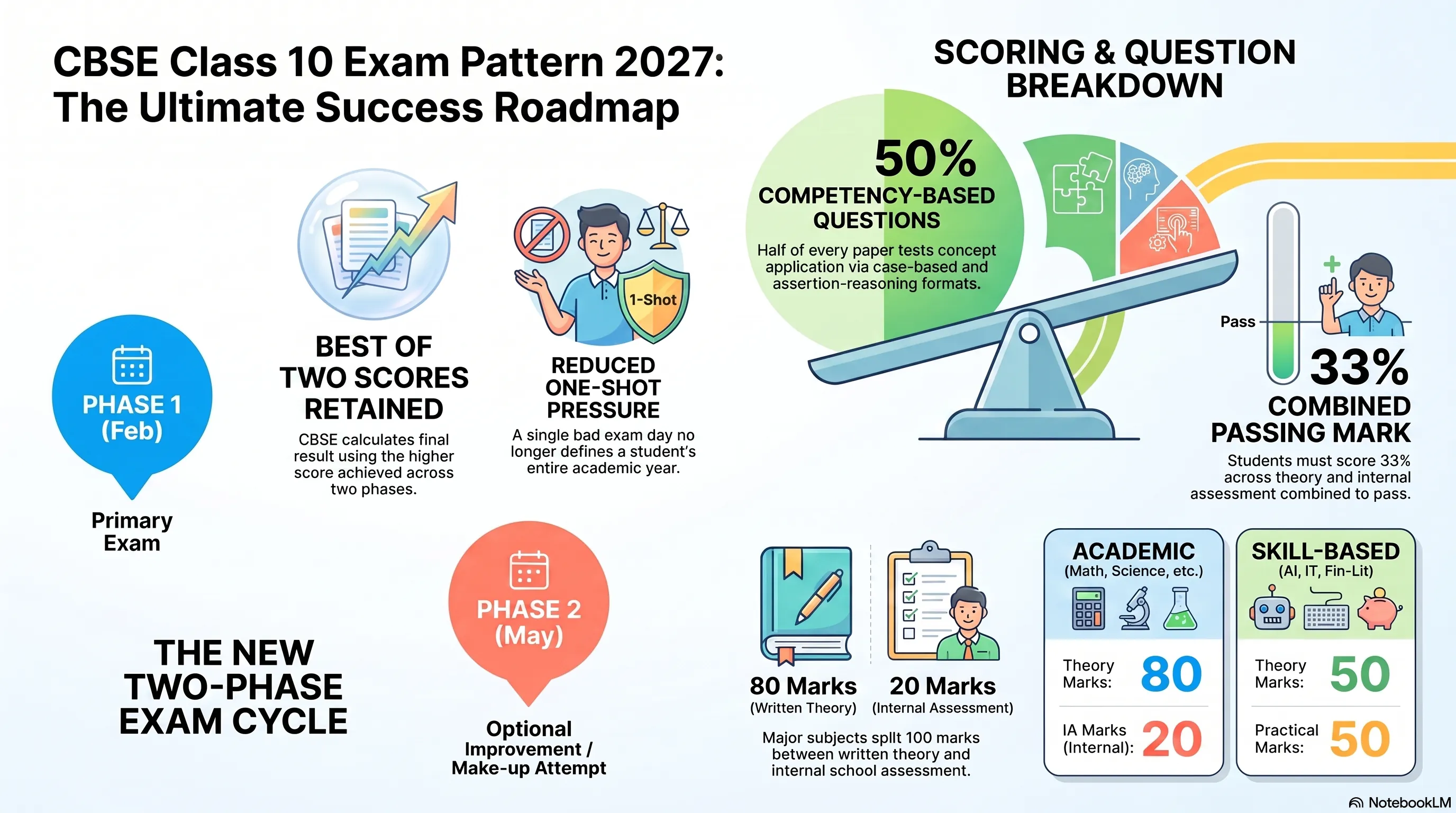
Table of Contents
- What Is the CBSE Class 10 Exam Pattern 2027?
- How Are Theory and Internal Assessment Marks Divided?
- What Types of Questions Will You Face in the 2027 Paper?
- How Do the Two Board Exam Phases Work in 2027?
- Subject-Wise Marking Scheme: Maths, Science, Social Science, English
- What Is the Passing Criteria for CBSE Class 10 2027?
- Building Your JEE/NEET Foundation Alongside Class 10 Boards

eSaral ›Foundation courses ›Class 10›CBSE Class 10 Exam Pattern 2027: Marking Scheme Explained

What Is the CBSE Class 10 Exam Pattern 2027?
CBSE conducts the Class 10 board exam for students enrolled in CBSE-affiliated schools nationwide, and it's typically the largest cohort CBSE tests — well over 20 lakh students appear each year across every state and several countries abroad.
Every major academic subject in the 2027 cycle carries 100 total marks, split between an externally conducted written theory paper and school-based internal assessment. Skill-based subjects such as Artificial Intelligence, Information Technology, and Financial Literacy follow a different 50-50 theory-practical structure instead, reflecting their more applied nature.
The single biggest structural change for the 2026-27 session is that Class 10 now runs on two board exam phases within the same academic year, giving students a second attempt to improve their score. This is covered in full detail further down this guide.
How is CBSE Class 10 different from CBSE Class 12?
Class 12 continues with a single annual board exam for the 2026-27 session, while Class 10 has moved to the new two-phase system. If you're comparing the two, this is the one structural difference worth remembering — everything else, including the 80/20 theory-IA logic, stays broadly similar across both classes.
How Are Theory and Internal Assessment Marks Divided?
This is the split students need to memorise before they build a study timetable, because it decides how much weight to give board-conducted papers versus year-round school work.
| Subject Type | Theory Marks | Internal Assessment / Practical | Total |
|---|---|---|---|
| Major academic subjects (Maths, Science, Social Science, English, Hindi) | 80 | 20 | 100 |
| Skill-based subjects (AI, IT, Financial Literacy, Cybersecurity) | 50 | 50 (Practical) | 100 |
The 20-mark Internal Assessment for major subjects is not a single number handed out casually — it's built from four components, each worth 5 marks: Periodic Tests, Multiple Assessments, Portfolio, and Subject Enrichment Activities. Schools calculate and submit these marks to CBSE directly, and they are not re-evaluated during board-level checking.
💡 Expert Tip by Saransh Gupta, IIT Bombay: Students consistently underestimate how much control they actually have over the 20 IA marks. Unlike the theory paper, this score is decided months in advance through periodic tests and portfolio work — start strong from term one instead of trying to recover lost ground closer to boards.
What Types of Questions Will You Face in the 2027 Paper?
CBSE's shift toward competency-based assessment, which began in 2023-24, continues unchanged for the 2027 papers.
- 20% — Objective / MCQ-type questions
- 50% — Competency-based questions, including case-based, source-based, and assertion-reasoning formats
- 30% — Constructed response questions, split between short-answer (2–3 marks) and long-answer (5 marks) formats
This means half of every Class 10 paper now tests whether a concept can be applied, not just recalled from memory. Internal choices are available in Sections B, C, D, and E of most papers — students attempt one option from a given pair — but Section A (MCQs) typically carries no choice.
Is there negative marking in CBSE Class 10?
No, CBSE does not apply negative marking anywhere in the Class 10 exam pattern. Wrong answers simply score zero, so leaving a question unattempted has no advantage over making an educated attempt.
How Do the Two Board Exam Phases Work in 2027?
This is the change that makes the 2026-27 session different from every CBSE Class 10 cycle before it.
- Phase 1 is expected to run from February 2027 and functions as the primary board examination for all students.
- Phase 2 is tentatively scheduled for May 2027, giving students who want to improve their score — or who missed Phase 1 for a valid reason — a second attempt.
- Students are not compelled to sit Phase 2. It exists purely as an improvement or make-up opportunity.
- CBSE retains the better of the two scores for each subject when compiling the final result.
For students juggling board prep with early JEE or NEET foundation work, this two-attempt structure genuinely reduces one-shot exam pressure — a single bad day in February no longer has to define the whole year.
💡 Expert Tip : Do NOT treat Phase 2 as a safety net you'll definitely use. Prepare for Phase 1 as if it's your only shot — students who mentally bank on a second attempt from day one usually under-prepare for both. Phase 2 ki taiyari tab shuru karo jab result आ जाए, na ki pehle se.
Subject-Wise Marking Scheme: Maths, Science, Social Science, English
Within the 80-mark theory paper, question sections follow a consistent design across the major subjects.
| Section | Question Type | Approx. Marks Share |
|---|---|---|
| Section A | MCQs (objective) | 20% |
| Section B & C | Short answer (2–3 marks each) | 30% |
| Section D & E | Long answer / case-based (4–5 marks each) | 50% |
A few subject-specific notes worth flagging:
- Mathematics uses step marking — every correct logical step earns credit, even if the final numerical answer is wrong. Calculators are not permitted.
- Science carries its 20 IA marks through lab practicals, experiments, and viva rather than the standard periodic-test-only format.
- Social Science includes compulsory map-work questions covering History and Geography, worth marks separately from the written theory sections.
- English (Course A or Course B) splits its 80 theory marks across Reading, Writing & Grammar, and Literature sections.
How many marks are needed to pass CBSE Class 10?
Students need a minimum of 33% aggregate marks in each subject, combining theory and internal assessment together, to pass CBSE Class 10. There is no separate minimum required within the theory or IA components individually for most subjects — the 33% threshold applies to the combined total.
What Is the Passing Criteria for CBSE Class 10 2027?
Beyond the numeric 33% threshold, CBSE grades every Class 10 result on a 9-point grading scale, ranging from A1 (highest) down to E1 and E2. Students falling into the E1 or E2 grade band are required to appear for the compartment examination to clear that subject.
Final results are compiled as a Cumulative Grade Point Average (CGPA) calculated from the best five subjects, similar to how a sixth optional subject works at the Class 12 level.
Building Your JEE/NEET Foundation Alongside Class 10 Boards
Class 10 is also the year many serious JEE and NEET aspirants start layering competitive-exam thinking on top of board preparation — and the two don't have to compete for the same hours.
Physics, Chemistry, and Mathematics concepts from Class 10 NCERT form the direct base for Class 11 topics that show up in both boards and entrance exams two years later. A student who builds genuine conceptual clarity now, rather than memorising for a 33% pass mark, walks into Class 11 with real momentum instead of starting from zero.
If you're mapping this transition, eSaral's Foundation courses are built around exactly this bridge — combining CBSE syllabus coverage with the conceptual depth JEE and NEET eventually demand, taught by the same IIT Bombay faculty who run eSaral's senior JEE and NEET batches.
Frequently Asked Questions
Find answers to common questions.
What is the CBSE Class 10 exam pattern for 2027?
Every major subject carries 100 total marks, split as 80 theory + 20 Internal Assessment. Papers combine MCQs, competency-based case questions, and short/long answers, with skill subjects following a separate 50-50 theory-practical structure.
How many board exams will CBSE Class 10 have in 2027?
CBSE will conduct two board exam phases for the 2026-27 session. Phase 1 is expected in February 2027 as the primary exam, and Phase 2 is tentatively scheduled for May 2027 as an optional improvement attempt.
What are the passing criteria for CBSE Class 10?
Students need a minimum of 33% aggregate marks in each subject, combining theory and Internal Assessment together, to pass. Results are graded on a 9-point scale from A1 down to E1/E2.
How is the 20-mark Internal Assessment calculated in Class 10?
Internal Assessment is built from four components worth 5 marks each: Periodic Tests, Multiple Assessments, Portfolio, and Subject Enrichment Activities. Schools calculate and submit these marks directly to CBSE.
Is there negative marking in CBSE Class 10 board exams?
No, CBSE does not deduct marks for incorrect answers anywhere in the Class 10 pattern. An unattempted question and a wrong answer both score zero, so attempting every question is always the safer strategy.
Can calculators be used in the CBSE Class 10 Maths exam?
No, calculators are not permitted in the CBSE Class 10 Mathematics board exam. Students are expected to perform all calculations manually, and Maths answers are evaluated using step marking for partial credit.