Essay in English for School Students
Learn the complete essay writing format for school students including structure, word count, writing tips, common mistakes, and 50+ important essay topics for Classes 3–12.
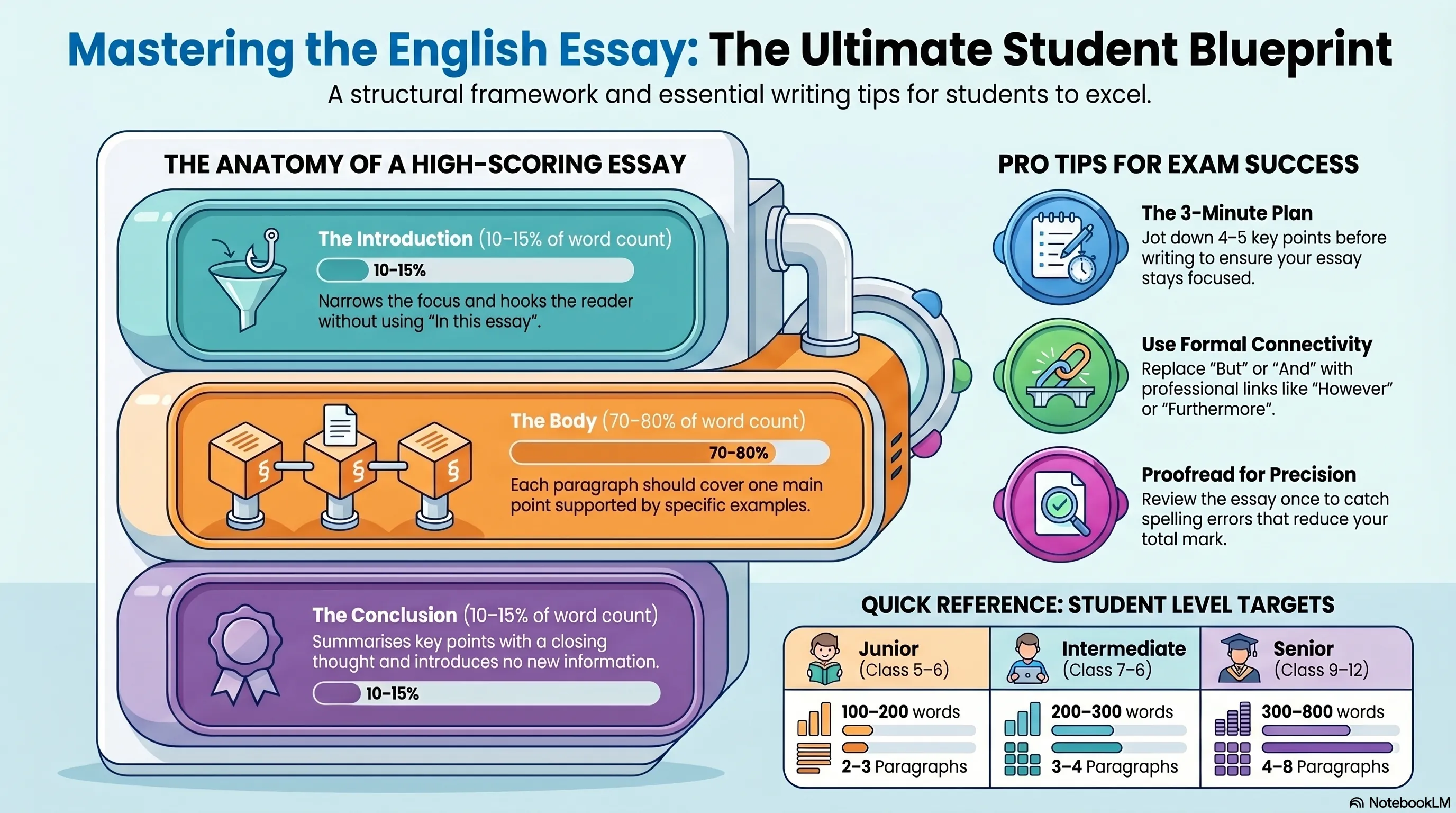
Table of Contents

eSaral ›Foundation courses ›Essay in English for School Students

How to Write a Good Essay in English — Structure & Format
Every well-written essay — regardless of topic or word count — follows the same three-part structure. Understanding this structure is more valuable than memorising any individual essay, because it allows you to write confidently on any topic in any exam.
The Three-Part Essay Structure
1. Introduction (10–15% of total word count)
The introduction does two things: it tells the reader what the essay is about, and it creates enough interest for them to continue reading. For a 200-word essay, your introduction should be 2–3 sentences. For a 500-word essay, 3–5 sentences.
A strong introduction:
- Opens with a general statement about the topic (not "In this essay, I will...")
- Narrows down to the specific focus of the essay
- Ends with a sentence that signals what the body will discuss
2. Body (70–80% of total word count)
The body is where you develop your ideas. Each paragraph in the body should cover one main point. For a 200-word essay, aim for 2–3 body paragraphs. For a 500-word essay, aim for 3–5.
Each body paragraph should:
- Start with a topic sentence stating the main point of that paragraph
- Support the point with facts, examples, or descriptions
- End with a connecting sentence that leads into the next paragraph
3. Conclusion (10–15% of total word count)
The conclusion summarises the essay's main points and ends with a closing thought. It should not introduce new information — only bring together what has already been said.
Word Count Guide by Class
| Class | Recommended Word Count | Paragraphs | Focus |
|---|---|---|---|
| Class 3–4 | 50–100 words | 1–2 | Simple sentences, familiar topics |
| Class 5–6 | 100–200 words | 2–3 | Basic structure, clear ideas |
| Class 7–8 | 200–300 words | 3–4 | Facts, examples, two sides |
| Class 9–10 | 300–500 words | 4–6 | Analysis, opinion, strong conclusion |
| Class 11–12 | 500–800 words | 5–8 | Arguments, data, critical thinking |
Essay Writing Tips for School Exams
Tip 1 — Read the topic carefully before writing. Many students lose marks not because they cannot write, but because they write about something slightly different from what was asked. Spend 30 seconds identifying exactly what the topic requires.
Tip 2 — Plan before you write. Spend 2–3 minutes jotting down 4–5 key points you want to cover. This prevents mid-essay confusion and ensures your writing stays focused.
Tip 3 — Use specific examples. An essay on Global Warming is stronger when it mentions specific effects — rising sea levels, melting glaciers, increased frequency of floods — rather than staying general. Real examples signal knowledge and improve your score.
Tip 4 — Vary your sentence length. Mix short, punchy sentences with longer, more descriptive ones. This makes the essay easier and more engaging to read.
Tip 5 — Never begin a sentence with "And" or "But" in formal essays. Use "Additionally", "However", "Furthermore", "Nevertheless" instead — these connectors also improve your score in language-marked exams.
Tip 6 — Proofread for spelling and grammar. In a 300-word essay, two or three spelling errors are noticeable and reduce your mark. Read through your essay once after writing, specifically looking for errors.
Tip 7 — Match your language to the audience. An essay on Diwali for Class 4 uses simple, cheerful language. An essay on Women Empowerment for Class 10 uses more formal, structured language. Always write for the expected reader.
Common Essay Writing Mistakes to Avoid
| Mistake | Why It Loses Marks | What to Do Instead |
|---|---|---|
| Starting with "In this essay..." | Weak, generic opening | Open with a fact or statement about the topic |
| Repeating the same point | Padding — adds words, not value | Each paragraph must make a new point |
| No conclusion | Feels incomplete | Always summarise and close |
| Very long paragraphs | Hard to read; looks unplanned | Max 4–5 sentences per paragraph |
| Informal language ("gonna", "kinda") | Wrong register for a formal essay | Use formal English throughout |
| Off-topic sentences | Reduces relevance score | Every sentence must relate to the topic |
All Essay Topics — Category-Wise Index
All 50+ essays are organised by category so you can find the right topic quickly. Click any link to read the full essay with short (100-word), medium (200–300word), and long (500-word) versions.
🎉 Festivals & Celebrations
- Essay on Diwali
- Essay on Holi Festival
- Essay on Christmas
- Essay on Dussehra
- Essay on Festivals of India
- Essay on Gandhi Jayanti
🌿 Environment & Nature
- Essay on Pollution
- Essay on Global Warming
- Essay on Save Water Save Life
- Essay on Water Pollution
- Essay on Environmental Pollution
- Essay on Air Pollution
- Essay on Save Environment for Future Generations
- Essay on Nature
- Essay on Tree Plantation
- Essay on Rainy Season
🇮🇳 India & National Topics
- India Independence Day Essay
- Essay on Republic Day
- Essay on India of My Dreams
- Essay on Digital India
- Essay on Indian Culture and Tradition
- Essay on Indian Heritage
- Essay on Democracy
🧑🏫 Personalities & Historical Figures
- Essay on Mahatma Gandhi
- Essay on My Favourite Teacher
- Essay on My Mother
- Essay on Dr. B. R. Ambedkar
- Essay on Pandit Jawaharlal Nehru
- Essay on Chhatrapati Shivaji Maharaj
🌍 Social Issues
- Essay on Women Empowerment
- Essay on Save Girl Child
- Essay on Child Labour
- Essay on Dowry System
- Essay on Terrorism
- Essay on Unity Is Strength
📚 Education & Personal Development
- Essay on Importance of Education
- Essay on My Aim in Life
- Essay on Value of Time
- Essay on Health Is Wealth
- Essay on Importance of Sports
💻 Technology & Modern World
🏡 My Life & Personal Essays
- Essay on My Village
- Essay on My School Life
- Essay on My Childhood Memories
- Essay on Summer Vacation
- Essay on College Life
🦁 Animals & Birds
🏏 Sports & Recreation
Most Important Essay Topics for Class 10 & 12 Exams
These topics appear most frequently in CBSE board exams, state board exams, and school-level competitions. If you are preparing for any of these, start here.
Top 10 Most Asked Essay Topics in School Exams
| Rank | Topic | Why It's Important |
|---|---|---|
| 1 | Pollution / Environmental Pollution | Appears in almost every Class 9–12 English exam |
| 2 | Global Warming | High-frequency topic linked to environment curriculum |
| 3 | Mahatma Gandhi | Asked in patriotic/personality category across all classes |
| 4 | Women Empowerment | Core social issues topic for Class 10–12 |
| 5 | Importance of Education | Linked to personal development essays |
| 6 | Diwali | Most common festival essay across all classes |
| 7 | Digital India / Technology | Modern India topic — rising frequency post-2020 |
| 8 | Child Labour | Social awareness topic in CBSE and state boards |
| 9 | Save Water Save Life | Environment category, asked repeatedly in Class 6–9 |
| 10 | My Aim in Life | Personal essay — asked in Class 7–10 consistently |
How to Choose the Right Essay for Your Exam
Different exams ask for different types of essays. Match your preparation to the type:
Descriptive essays — Describe a person, place, season, or object. Topics: My Village, Rainy Season, My Mother, Parrot.
Narrative essays — Tell a story or describe a personal experience. Topics: My Childhood Memories, Summer Vacation, My School Life.
Argumentative essays — Present a case for or against something. Topics: Women Empowerment, Child Labour, Dowry System, Importance of Education.
Expository essays — Explain a concept or phenomenon objectively. Topics: Global Warming, Pollution, Digital India, Artificial Intelligence.
💡 Exam Tip: In board exams, the essay question almost always says either "Write an essay on..." or "Describe..." or "Discuss...". The verb tells you the type: "Describe" = descriptive, "Discuss" = argumentative or expository. Match your structure to the instruction.
Frequently Asked Questions
Find answers to common questions.
Which topics are most important for essay writing in school exams?
The most frequently asked essay topics in school exams are Pollution, Global Warming, Mahatma Gandhi, Women Empowerment, Importance of Education, Diwali, Digital India, Child Labour, Save Water Save Life, and My Aim in Life. These appear across CBSE, ICSE, and state board exams from Class 6 to Class 12 and should be prepared first.
How do you write a good essay in English for students?
A good essay follows three parts: an introduction that presents the topic (2–3 sentences), a body that develops 3–5 key points in separate paragraphs, and a conclusion that summarises and closes. Use specific examples, vary sentence length, avoid informal language, and proofread for spelling errors. Spending 2–3 minutes planning before writing significantly improves structure and score.
What is the format of an essay for Class 10?
For Class 10, an essay should be 300–500 words with 4–6 paragraphs. The introduction states the topic and its importance. The body paragraphs each discuss one main point with supporting facts or examples. The conclusion summarises the essay and offers a final thought or call to action. Use formal English and connectors like "Furthermore", "However", and "In conclusion".
How long should an essay be for Class 5 and Class 6 students?
For Class 5 and 6, essays should be 100–200 words with 2–3 paragraphs. Focus on simple, clear sentences and basic structure — one introductory paragraph, one or two body paragraphs describing the main points, and a short conclusion. At this level, language clarity and correct spelling matter more than complex arguments.
What are the different types of essays asked in school exams?
School exams ask four main types: descriptive essays (describing a person, place, or season — e.g., My Village, Rainy Season), narrative essays (personal experiences — e.g., My Childhood Memories, Summer Vacation), argumentative essays (presenting a case — e.g., Women Empowerment, Child Labour), and expository essays (explaining a concept — e.g., Global Warming, Digital India). Identifying the type from the question helps you choose the right structure.