CBSE Class 8 Syllabus 2026-27: PDF Download
The CBSE Class 8 Syllabus 2026-27 covers Mathematics, Science, Social Science, English, and Hindi, based on new NCERT textbooks — Ganita Prakash, Curiosity, Exploring Society: India and Beyond, Poorvi, and Malhar. Class 8 has no CBSE board exam; schools conduct and evaluate the annual exam internally.
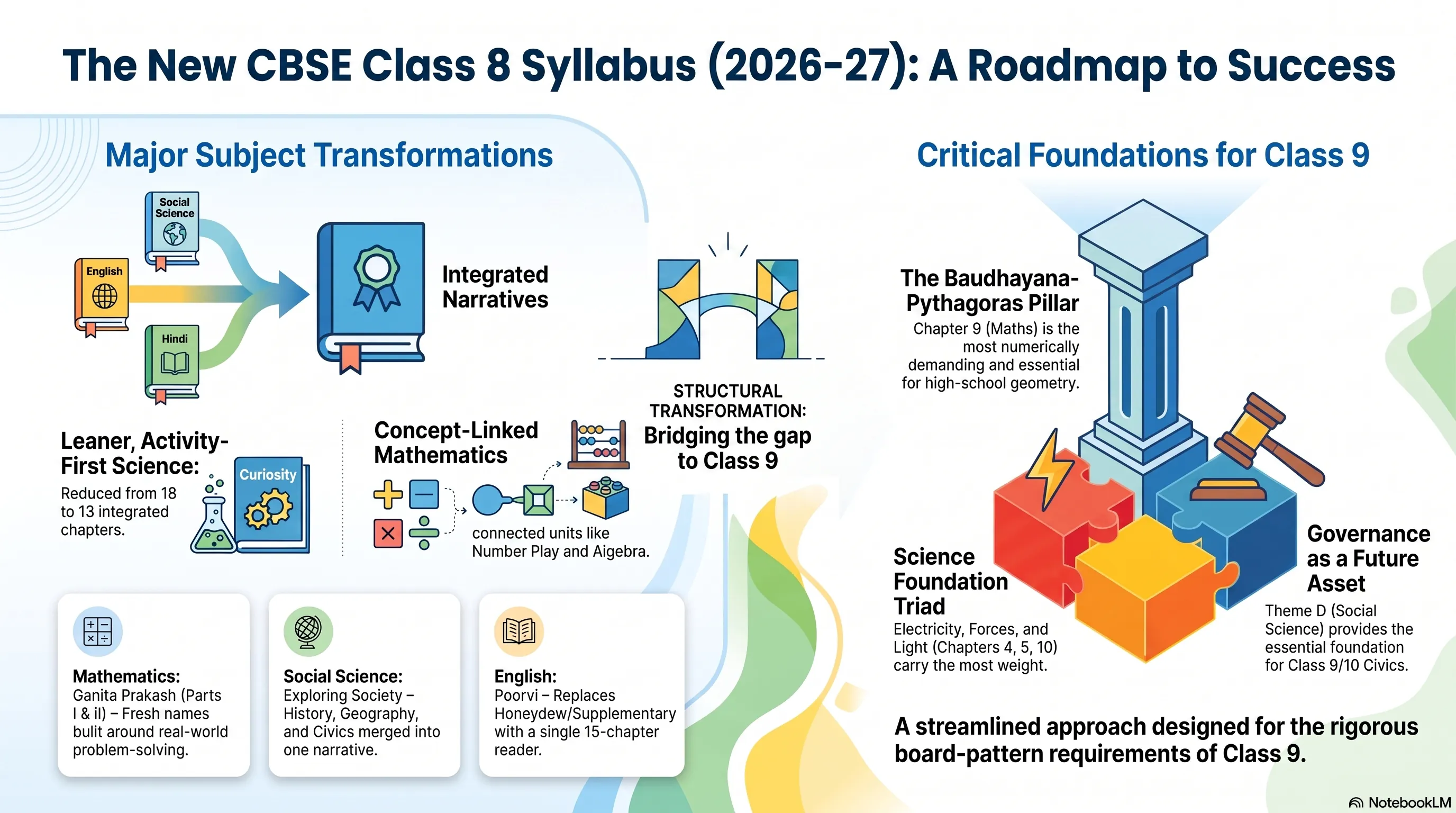
Table of Contents
- CBSE Class 8 Syllabus 2026-27 PDF
- CBSE Class 8 Syllabus Subject-Wise
- CBSE Syllabus for Class 8 Mathematics
- CBSE Syllabus for Class 8 Science
- CBSE Syllabus for Class 8 Social Science
- CBSE Syllabus for Class 8 English
- CBSE Syllabus for Class 8 Hindi
- Why Class 8 Is a Turning Point Before Class 9
- Benefits of Completing the CBSE Class 8 Syllabus Early

eSaral ›Foundation courses ›CBSE Class 8 Syllabus 2026-27: PDF Download

CBSE Class 8 Syllabus 2026-27 PDF
| Subject | PDF Download |
|---|---|
| CBSE Syllabus for Class 8 Mathematics (Ganita Prakash) | PDF Download |
| CBSE Syllabus for Class 8 Science (Curiosity) | PDF Download |
| CBSE Syllabus for Class 8 Social Science (Exploring Society) | PDF Download |
| CBSE Syllabus for Class 8 English (Poorvi) | PDF Download |
| CBSE Syllabus for Class 8 Hindi (Malhar) | PDF Download |
💡 Expert Tip by eSaral Academic Team: Confirm with your school which edition each subject teacher is using this year. Several schools are still finishing the transition, so a few sections may run the older textbook (Honeydew, Vasant, or the old History-Geography-Civics set) alongside the new one for 2026-27.
CBSE Class 8 Syllabus Subject-Wise
The biggest change in the CBSE Class 8 Syllabus 2026-27 is structural. Instead of separate books for History, Geography, and Civics, Social Science is now a single integrated textbook. Science moves from 18 chapters to a leaner, activity-first 13-chapter book. English replaces Honeydew and It So Happened with a single 15-chapter reader, and Hindi consolidates four older books into one 10-chapter textbook. Maths keeps the same depth but is now split into two parts — Ganita Prakash I and II — with fresh chapter names built around real-world problem-solving rather than only drill exercises.
Since there's no CBSE board exam at Class 8, each school sets its own weightage across periodic tests, half-yearly, and annual exams — but nearly all schools follow the NCERT chapter sequence closely, since CBSE affiliation requires it.
CBSE Syllabus for Class 8 Mathematics
The new Maths textbook, Ganita Prakash ("light of mathematics"), is split into two parts covering 14 chapters in total.
Ganita Prakash — Part 1
| Chapter | Title |
|---|---|
| 1 | A Square and A Cube |
| 2 | Power Play |
| 3 | A Story of Numbers |
| 4 | Quadrilaterals |
| 5 | Number Play |
| 6 | We Distribute, Yet Things Multiply |
| 7 | Proportional Reasoning – 1 |
Ganita Prakash — Part 2
| Chapter | Title |
|---|---|
| 8 | Fractions in Disguise |
| 9 | The Baudhayana–Pythagoras Theorem |
| 10 | Proportional Reasoning – 2 |
| 11 | Exploring Some Geometric Themes |
| 12 | Tales by Dots and Lines |
| 13 | Algebra Play |
| 14 | Area |
What's New in the Class 8 Maths Syllabus 2026-27?
Ganita Prakash replaces topic-isolated chapters like Rational Numbers and Factorisation with concept-linked units — Number Play builds directly into Algebra Play, and Quadrilaterals leads into Exploring Some Geometric Themes — so the syllabus now teaches ideas as a connected sequence rather than standalone chapters.
Chapter 9: The Baudhayana–Pythagoras Theorem deserves special attention — it's typically the most numerically demanding chapter and forms the base for coordinate geometry in Classes 9 and 10.
💡 Expert Tip by eSaral Academic Team,: Don't skip "Tales by Dots and Lines" thinking it's just a data-handling chapter. Line graphs and the arithmetic mean introduced here return in a much harder form in Class 9 Statistics.
CBSE Syllabus for Class 8 Science
The new Science textbook, Curiosity, has 13 chapters, down from the earlier book's 18, and blends Physics, Chemistry, and Biology into a single connected narrative instead of teaching them as separate sections.
| Chapter | Title |
|---|---|
| 1 | Exploring the Investigative World of Science |
| 2 | The Invisible Living World: Beyond Our Naked Eye |
| 3 | Health: The Ultimate Treasure |
| 4 | Electricity: Magnetic and Heating Effects |
| 5 | Exploring Forces |
| 6 | Pressure, Winds, Storms, and Cyclones |
| 7 | Particulate Nature of Matter |
| 8 | Nature of Matter: Elements, Compounds, and Mixtures |
| 9 | The Amazing World of Solutes, Solvents, and Solutions |
| 10 | Light: Mirrors and Lenses |
| 11 | Keeping Time with the Skies |
| 12 | How Nature Works in Harmony |
| 13 | Our Home: Earth, A Unique Life-Sustaining Planet |
Which Chapters in Class 8 Science Carry the Most Weight?
Chapters 4, 5, and 10 — Electricity, Exploring Forces, and Light — cover the Physics foundation most heavily tested through numericals and diagrams, while Chapters 7, 8, and 9 build the Chemistry base needed for Class 9's Matter chapters.
Chapter 2: The Invisible Living World introduces microorganisms and cell structure — material that directly precedes Class 9 Biology's cell chapter, so building a clear picture here saves real time later.
Science practicals in Class 8 are school-conducted rather than board-assessed, but most schools still grade lab notebooks and simple experiments as part of internal assessment.
CBSE Syllabus for Class 8 Social Science
The new Social Science textbook, Exploring Society: India and Beyond, merges History, Geography, and Civics into one book organised around five themes instead of separate subject sections.
| Theme | Chapters |
|---|---|
| A: India and the World — Land and the People | 1. Geographical Diversity of India · 2. Understanding the Weather · 3. Climates of India |
| B: Tapestry of the Past | 4. New Beginnings: Cities and States · 5. The Rise of Empires · 6. The Age of Reorganisation · 7. The Gupta Era: An Age of Tireless Creativity |
| C: Our Cultural Heritage and Knowledge Traditions | 8. How the Land Becomes Sacred |
| D: Governance and Democracy | 9. From the Rulers to the Ruled: Types of Governments · 10. The Constitution of India — An Introduction |
| E: Economic Life Around Us | Chapters on resources, production, and economic activity that close out the book |
How Is the New Social Science Syllabus Different From the Old One?
The earlier syllabus taught History, Geography, and Civics as three separate books with unrelated chapter sequences; the new Exploring Society: India and Beyond threads them into one narrative, so a geography chapter on India's climate is followed directly by history chapters on how ancient cities and empires responded to that same geography.
Theme D: Governance and Democracy — covering types of government and an introduction to the Indian Constitution — is foundational for Class 9 and 10 Civics, where the Constitution and democratic institutions are studied in far greater depth.
💡 Expert Tip by eSaral Academic Team,: Draw a simple timeline while studying Theme B (Tapestry of the Past). Students consistently lose marks not from not knowing facts but from mixing up the order of empires and reorganisation periods.
CBSE Syllabus for Class 8 English
The new English textbook, Poorvi, replaces both Honeydew and the supplementary reader It So Happened with a single 15-chapter book organised into 5 thematic units. Each unit pairs a story, a poem, and a non-fiction piece.
| Unit | Theme |
|---|---|
| 1 | Wit and Wisdom |
| 2 | Values and Dispositions |
| 3 | Mystery and Magic |
| 4 | Environment |
| 5 | Science and Curiosity |
Is Honeydew Still Part of the Class 8 English Syllabus?
No — for the 2026-27 session, NCERT has replaced Honeydew and It So Happened with the single new textbook Poorvi, though some schools may run a transition year using the older books alongside it, so it's worth confirming with your school.
Poorvi leans heavily on real biographical accounts — including Unit 5's chapter on physicist Bibha Chowdhuri — alongside grammar and structured writing practice (notices, letters, and reports), similar in format to what students will meet in Class 9 and 10 English.
CBSE Syllabus for Class 8 Hindi
The new Hindi textbook, Malhar (मल्हार), consolidates four older books — Vasant, Durva, and Bharat Ki Khoj — into one 10-chapter reader mixing poetry, stories, letters, and a one-act play.
| Chapter | Title |
|---|---|
| 1 | स्वदेश (कविता) |
| 2 | दो गौरैया (कहानी) |
| 3 | एक आशीर्वाद (कविता) |
| 4 | हरिद्वार (पत्र) |
| 5 | कबीर के दोहे |
| 6 | एक टोकरी भर मिट्टी (कहानी) |
| 7 | मत बाँधो (कविता) |
| 8 | नए मेहमान (एकांकी) |
| 9 | आदमी का अनुपात (कविता) |
| 10 | तरुण के स्वप्न (उद्बोधन) |
Malhar keeps a strong grammar (व्याकरण) component running alongside the literature chapters, which schools typically test separately from the prose and poetry sections.
Why Class 8 Is a Turning Point Before Class 9
Class 8 is the last year before CBSE's board-pattern assessment structure begins in Class 9. Concepts introduced loosely here — the Pythagoras theorem in Maths, cell structure in Science, the Constitution in Social Science — return in Class 9 with far more rigour and marks weightage. Students who treat Class 8 as "just pass-level" often spend their first Class 9 term re-learning material that should already be familiar, which is exactly the gap eSaral's Foundation courses for Classes 8-10 are built to close early.
Benefits of Completing the CBSE Class 8 Syllabus Early
- Match your subject list to the new textbook names first. Before making a timetable, confirm your school is using Ganita Prakash, Curiosity, Exploring Society, Poorvi, and Malhar — not the older editions — so you don't study the wrong chapters.
- Start with the subjects you find hardest, not the easiest. With more study time available early in the year, tackling Maths and Science first leaves comfortable subjects like English and Hindi for revision-heavy months closer to exams.
- Build simple chapter summaries as you go. A one-page summary per chapter, written right after finishing it, makes revision before school tests dramatically faster than re-reading the whole textbook.
- Practice every NCERT in-text and exercise question. School exam papers at this level are drawn almost entirely from NCERT content, so completing every exercise is the single highest-value activity.
- Treat Class 8 as preparation for Class 9, not just this year's exam. Chapters like the Pythagoras theorem, cell structure, and the Constitution of India return with far more depth next year — understanding them well now saves real time later.
- Get structured support where a concept isn't clicking. If a topic isn't clear after two attempts at self-study on your own, a mentor can save weeks of confusion — this is where eSaral's structured Foundation courses for Classes 8-10 help students the most.
If you want structured Class 8 preparation that also builds early habits for JEE and NEET foundation years, eSaral's Foundation Course for Class 8 is worth exploring alongside your school syllabus. Bookmark this page and check back before every unit test — it's updated whenever CBSE or NCERT revises the curriculum.
Frequently Asked Questions
Find answers to common questions.
What is the CBSE Class 8 syllabus for 2026-27?
The CBSE Class 8 Syllabus 2026-27 covers Mathematics, Science, Social Science, English, and Hindi, based on five new NCERT textbooks — Ganita Prakash, Curiosity, Exploring Society: India and Beyond, Poorvi, and Malhar — introduced under the NCF 2023 framework.
What are the new NCERT textbooks for Class 8?
The new textbooks are Ganita Prakash (Maths, in two parts), Curiosity (Science, 13 chapters), Exploring Society: India and Beyond (Social Science, single integrated book), Poorvi (English, 15 chapters), and Malhar (Hindi, 10 chapters).
Where can I download the CBSE Class 8 syllabus PDF for free?
You can download the subject-wise CBSE Class 8 Syllabus 2026-27 PDF directly from this page, or from the official NCERT website at ncert.nic.in under the Textbook section for Class 8.
Does Class 8 have a CBSE board exam?
No. Class 8 exams are conducted and evaluated entirely by individual schools, not by CBSE. However, all CBSE-affiliated schools are required to follow the official NCERT syllabus and chapter sequence.
How many chapters are there in the new Class 8 Science and Maths syllabus?
The new Curiosity Science textbook has 13 chapters, while the new Ganita Prakash Maths textbook has 14 chapters split across two parts.
Why does the Class 8 syllabus matter for competitive exam preparation?
Chapters like the Pythagoras theorem, forces and pressure, and cell structure in Class 8 form the direct foundation for Class 9 and 10 concepts that later feed into JEE and NEET preparation, making early conceptual clarity valuable beyond just the school exam.