NEET Revision Videos & Mind Maps: Fast-Track Your Physics, Chemistry & Biology Revision
NEET revision videos and mind maps are free, chapter-wise resources that summarise Physics, Chemistry, and Biology formulae, reactions, and NCERT concepts in a 20–30 minute video paired with a one-page visual mind map, helping students recall an entire chapter quickly before NEET UG.
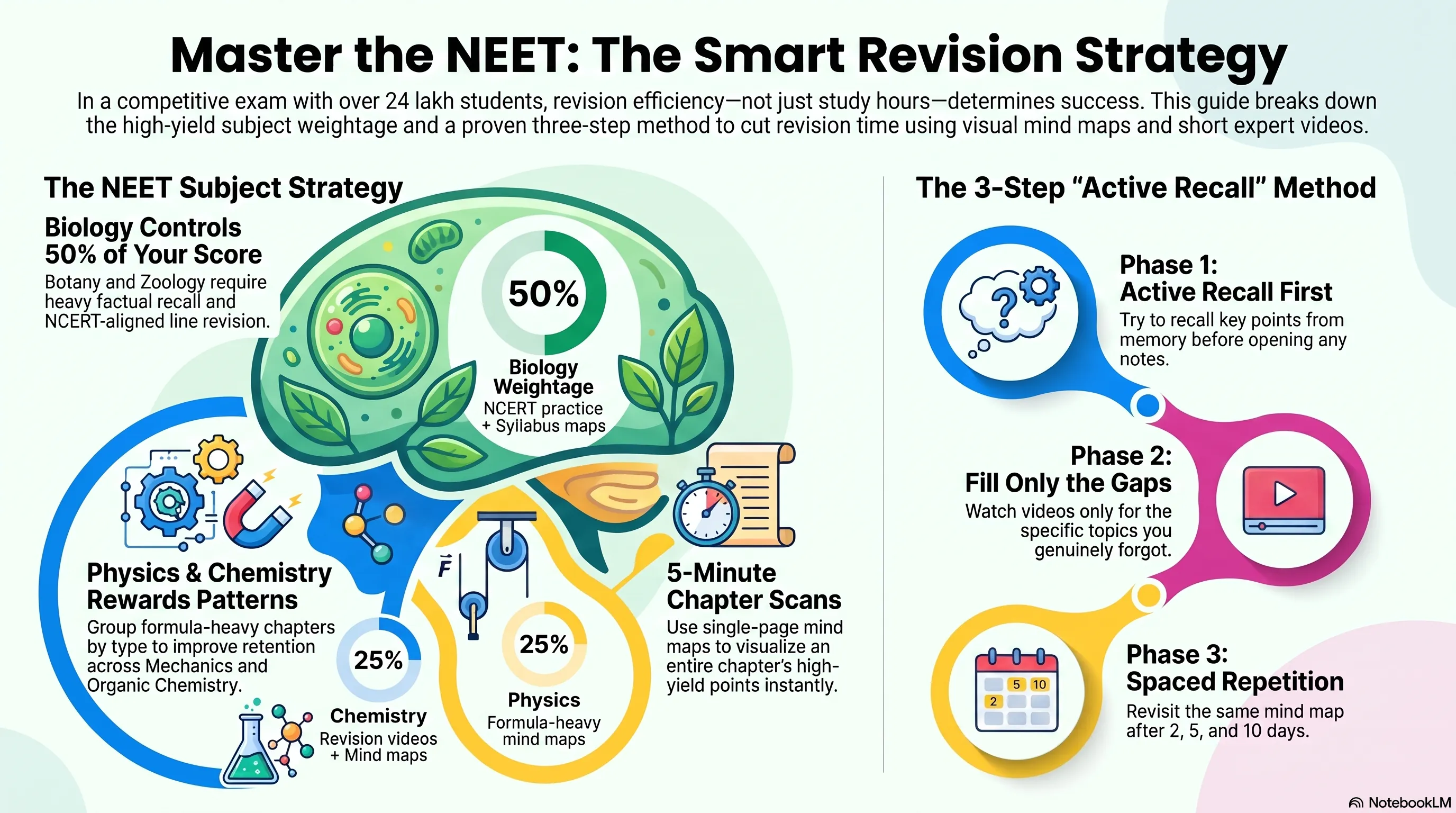
Table of Contents
- Why NEET Revision Is Different From Regular Study
- What Are eSaral's NEET Revision Videos & Mind Maps?
- Subject-Wise Breakdown for NEET
- How to Use Mind Maps for NEET Biology, Physics & Chemistry
- 30-Day NEET Revision Schedule
- How Is NEET Revision Different From JEE Revision?
- eSaral Revision Series vs Random YouTube Revision Videos

eSaral › NEET ›NEET Revision Videos & Mind Maps: Fast-Track Your Physics, Chemistry & Biology Revision

Why NEET Revision Is Different From Regular Study
Over 24 lakh students appeared for NEET UG in recent years, competing for a limited number of MBBS and BDS seats. In a syllabus this large, the difference between a 550 scorer and a 650 scorer usually isn't who studied more — it's who revised smarter.
NEET has one trait that makes revision non-negotiable: Biology alone contributes 50% of the paper, spread across Botany and Zoology chapters packed with facts, diagrams, and NCERT lines. Re-reading the textbook a third time in the last month wastes hours you don't have. What actually moves your score is fast, structured recall — checking what you already know and spending your remaining time only on what you don't.
This is exactly where revision videos and mind maps outperform plain notes. A 20–30 minute video can walk you through an entire chapter's high-yield points, and a single-page mind map lets you scan the same chapter again in under five minutes. Used together in the final weeks before NEET, they cut revision time dramatically without cutting coverage.
What Are eSaral's NEET Revision Videos & Mind Maps?
eSaral's revision series is a free, chapter-wise collection of revision videos and mind maps built for students preparing for NEET UG, JEE, and CBSE Boards across Class 11 and 12. For Physics and Chemistry, the series is prepared by IIT Bombay faculty and covers the full syllabus overlap between NEET and JEE — so a NEET aspirant gets the same depth of Physics and Chemistry revision as a JEE aspirant, minus the topics NEET doesn't test.
What Every Revision Video Covers
- Important formulae, reactions, and NCERT-aligned concepts
- Shortcuts and elimination techniques for MCQ-based recall
- Solved examples based on previous year NEET and JEE questions
- A matching chapter mind map for repeat revision
- High-yield points that are frequently tested in NEET UG
💡 Expert Tip by Saransh Gupta,: In NEET Physics, don't revise chapter by chapter in isolation. Group chapters by formula type — for instance, revise all rotational motion and SHM formulae together. Your brain retains formulae better when it sees the pattern connecting them, not just the chapter label.
A note on Biology coverage: eSaral's structured revision-video-plus-mind-map format is currently strongest for Physics and Chemistry, where it's been built out chapter by chapter. Dedicated Biology revision videos in the same format are being expanded, so if you're revising Botany or Zoology right now, pair this page with eSaral's NEET syllabus breakdown and NCERT-based practice until the full Biology video set is live — we'll update this page the moment it is.
Subject-Wise Breakdown for NEET
| Subject | Weightage in NEET | Format Available | Best Used For |
|---|---|---|---|
| Biology | ~50% | NCERT-based practice + syllabus map | Botany & Zoology recall, diagram-heavy chapters |
| Chemistry | ~25% | Revision videos + mind maps | Physical, Organic & Inorganic Chemistry recall |
| Physics | ~25% | Revision videos + mind maps | Formula-heavy numerical chapters |
Physics Revision for NEET
| Chapter | Download |
|---|---|
| Units and Dimensions | Download PDF |
| Errors and Measurement | Download PDF |
| Vectors | Download PDF |
| Kinematics 1D | Download PDF |
| Kinematics 2D | Download PDF |
| Newton's Laws of Motion (NLM) | Download PDF |
| Friction | Download PDF |
| Circular Motion | Download PDF |
| Work, Power and Energy (WPE) | Download PDF |
| Centre of Mass (COM) | Download PDF |
| Rotational Motion | Download PDF |
| Gravitation | Download PDF |
| Elasticity | Download PDF |
| Fluid Mechanics – Viscosity and Surface Tension | Download PDF |
| Thermal Expansion | Download PDF |
| Calorimetry | Download PDF |
| Kinetic Theory of Gases (KTG) | Download PDF |
| Thermodynamics | Download PDF |
| Heat Transfer | Download PDF |
| Simple Harmonic Motion (SHM) | Download PDF |
| Wave on String | Download PDF |
| Sound Wave (Full Chapter Revision) | Download PDF |
| Electrostatics | Download PDF |
| Capacitor | Download PDF |
| Current Electricity (CE) | Download PDF |
| Magnetic Effects of Current (MEC) | Download PDF |
| Magnetism and Matter | Download PDF |
| Electromagnetic Induction (EMI) | Download PDF |
| Alternating Current (AC) | Download PDF |
| Electromagnetic Waves (EMW) | Download PDF |
| Ray Optics | Download PDF |
| Wave Optics | Download PDF |
| Atomic Structure | Download PDF |
| Dual Nature of Radiation and Matter | Download PDF |
| Radioactivity | Download PDF |
| Semiconductor Devices | Download PDF |
| Nuclear Physics | Download PDF |
| X-Rays | Download PDF |
Chemistry Revision for NEET
Chemistry is where NEET students often gain the fastest marks, because it rewards memory more than problem-solving speed. The revision series breaks Chemistry into:
- Physical Chemistry: Mole Concept, Thermodynamics, Electrochemistry, Chemical Kinetics
- Organic Chemistry: Reaction Mechanisms, Named Reactions, Isomerism, Biomolecules
- Inorganic Chemistry: p-Block, d-Block, Coordination Compounds
Mind maps here are particularly effective for organic reaction pathways and periodic trends, which are otherwise hard to hold in memory without a visual structure.
| Chapter | Download |
|---|---|
| Mole Concept | ⬇ Download PDF |
| Atomic Structure | Download PDF |
| Chemical Bonding | ⬇ Download PDF |
| States of Matter | ⬇ Download PDF |
| Liquid Solution | ⬇ Download PDF |
| Solid State | ⬇ Download PDF |
| Thermodynamics | ⬇ Download PDF |
| Thermochemistry | ⬇ Download PDF |
| Chemical Equilibrium | ⬇ Download PDF |
| Ionic Equilibrium | ⬇ Download PDF |
| Redox Reactions | ⬇ Download PDF |
| Electrochemistry (Part 1) | ⬇ Download PDF |
| Electrochemistry (Revision) | ⬇ Download PDF |
| Chemical Kinetics (CK) | ⬇ Download PDF |
| Surface Chemistry | ⬇ Download PDF |
| Periodic Table | ⬇ Download PDF |
| s-Block Elements | ⬇ Download PDF |
| P-Block Elements (Group 13–14) | ⬇ Download PDF |
| P-Block Elements (Group 15–18) | ⬇ Download PDF |
| Hydrogen | ⬇ Download PDF |
| D-Block Elements | ⬇ Download PDF |
| Coordination Compounds | ⬇ Download PDF |
| Metallurgy | ⬇ Download PDF |
| Salt Analysis | ⬇ Download PDF |
| IUPAC Nomenclature | ⬇ Download PDF |
| General Organic Chemistry (GOC) | ⬇ Download PDF |
| Isomerism | ⬇ Download PDF |
| Optical Isomerism | ⬇ Download PDF |
| Purification of Organic Compounds | ⬇ Download PDF |
| Hydrocarbons | ⬇ Download PDF |
| Haloalkanes and Haloarenes | ⬇ Download PDF |
| Alcohol, Phenol and Ether | ⬇ Download PDF |
| Carbonyl Compounds | ⬇ Download PDF |
| Carboxylic Acid | ⬇ Download PDF |
| Environmental Chemistry | ⬇ Download PDF |
| Oxidation | Download PDF |
| Biomolecules (BM) | Download PDF |
Biology Revision for NEET
Biology needs the most attention in the final month because it accounts for half of your NEET score. Until eSaral's dedicated Biology revision videos are fully live, the most effective substitute is chapter-wise NCERT re-reading paired with your own quick-recall sheets for Human Physiology, Genetics, Ecology, and Plant Physiology — the highest-weightage chapters historically. Cross-check your syllabus coverage against the official NEET syllabus page so nothing gets missed in the rush.
How to Use Mind Maps for NEET Biology, Physics & Chemistry
Why Mind Maps Beat Re-Reading Notes
A mind map fits an entire chapter onto one page by grouping related facts, formulae, and diagrams visually instead of linearly. For a fact-heavy subject like Biology, this matters even more than in Physics — your brain recalls a spatial layout faster than a paragraph of text.
Three-Step Revision Method
- Active Recall First — Before opening any mind map, try to recall the chapter's key points from memory. Note what you genuinely forgot.
- Fill Only the Gaps — Watch or read only the portion covering what you missed. Don't re-revise what you already know cold.
- Spaced Review — Revisit the same mind map after 2 days, then 5 days, then 10 days. Spaced repetition is what actually moves facts into long-term memory before exam day.
💡 Expert Tip by Prateek Gupta: For Organic Chemistry mind maps, don't just memorise the reaction — trace the mechanism with your finger on the page each time you revise. Motor memory sticks longer than visual memory alone for reaction sequences.
30-Day NEET Revision Schedule
| Week | Physics | Chemistry | Biology |
|---|---|---|---|
| Week 1 | Mechanics, Waves | Mole Concept, Thermodynamics | Human Physiology (Digestion, Circulation) |
| Week 2 | Electrostatics, Current Electricity | Organic Chemistry | Genetics & Evolution |
| Week 3 | Optics, Modern Physics | Inorganic Chemistry | Ecology, Plant Physiology |
| Week 4 | Mock Tests & Mind Map Revision | Mock Tests & Mind Map Revision | Mock Tests & Full NCERT Line-Revision |
- Give Biology roughly 3–4 hours daily given its 50% weightage; split Physics and Chemistry evenly with the remaining time.
- Watch the revision video before its matching mind map, then run the same mind map again 2 days later.
- Reserve the last week for full-length mock tests and previous year papers, not new content. You can practice with NEET previous year papers, chapter-wise to convert revision into exam-ready recall.
- Do not start a fresh topic in the final 7 days before NEET.
How Many Hours Should You Revise Daily Before NEET?
Most toppers reserve 8–10 hours daily in the final month, split roughly 4 hours for Biology, 3 hours for Chemistry, and 3 hours for Physics — with at least one full mock test every 2–3 days to keep exam-day stamina and speed sharp.
How Is NEET Revision Different From JEE Revision?
NEET revision leans heavily on memory-based recall — especially Biology — while JEE revision leans on applying formulae to solve harder numericals. A NEET student benefits more from mind maps and spaced repetition of facts; a JEE student benefits more from repeated problem-solving using the same mind maps as a formula reference. Chemistry and Physics mind maps overlap almost completely between the two exams, so NEET aspirants can safely use the same JEE-shared revision videos for those two subjects.
eSaral Revision Series vs Random YouTube Revision Videos
| Feature | eSaral Revision Series | Random YouTube Videos |
|---|---|---|
| Faculty | IIT Bombay experts | Varies, often unverified |
| Syllabus Alignment | Full NEET/NCERT syllabus mapped | Inconsistent |
| Format | Video + matching mind map | Video only, no visual summary |
| Previous Year Question Tie-in | Included | Rarely included |
| Average Chapter Revision Time | 20–30 minutes | Varies widely, often longer |
| Doubt Support | 5-layer doubt-solving system | Not available |
| Cost | Free | Free |
Random revision videos aren't necessarily bad, but they aren't built specifically around what NEET actually tests. A revision resource that's mapped to the exact NEET syllabus, paired with a mind map, and backed by faculty who can resolve your doubts if a concept still doesn't click saves you the guesswork of figuring out what's high-yield on your own — which matters most exactly when you have the least time left.
If you want structured NEET preparation with IIT Bombay faculty rather than piecing together revision resources on your own, eSaral's NEET courses are worth exploring closer to your final revision phase.
Frequently Asked Questions
Find answers to common questions.
Are eSaral's NEET revision videos and mind maps free?
Yes, they are completely free to access on the eSaral website and app, with no subscription required. Physics and Chemistry are covered in full chapter-wise detail, and Biology coverage is being expanded in the same video-plus-mind-map format.
How many days before NEET should I start focused revision?
Most students start dedicated revision 30–45 days before NEET UG, after completing the syllabus at least once. This window is enough to cover all chapters through revision videos and mind maps, plus 2–3 rounds of spaced repetition before the exam.
Which subject should I revise first for NEET — Biology, Physics, or Chemistry?
Start with Biology since it carries roughly 50% weightage and involves the most factual recall. Follow up with Chemistry, which rewards memory-based revision quickly, then Physics, which typically needs the most active problem-practice alongside revision.
Do NEET and JEE share the same Physics and Chemistry revision content?
Yes, largely. NEET and JEE Physics and Chemistry syllabuses overlap significantly at the NCERT level, so the same eSaral revision videos and mind maps work for both exams, minus a few JEE-only numerical-heavy topics NEET doesn't test.
How is NEET Biology weighted compared to Physics and Chemistry?
Biology (Botany and Zoology combined) makes up about 50% of the NEET paper, with Physics and Chemistry contributing roughly 25% each. This is why most toppers allocate nearly half their daily revision time to Biology alone.