Choosing MNNIT Allahabad Over IIT: Jeet’s eSaral JEE Success Story
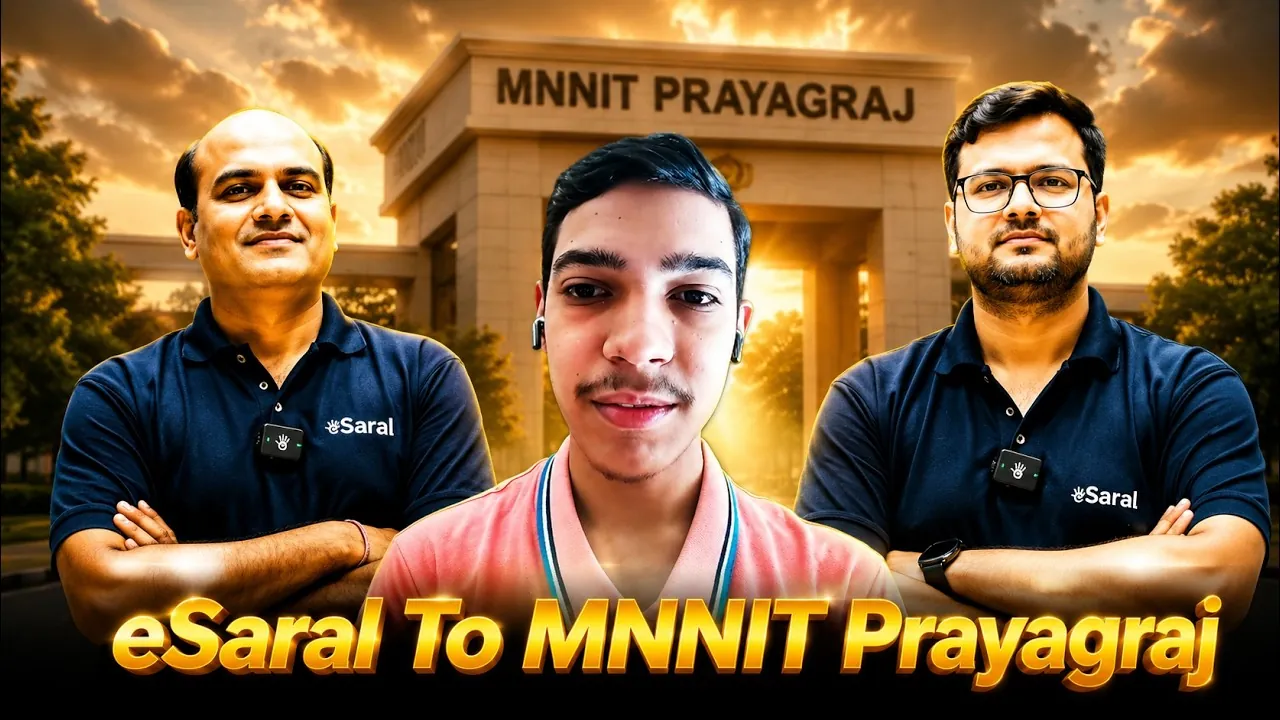
Table of Contents
- Should Students Choose a Better Branch at an NIT Over a Lower-Preference IIT Branch?
- Can Online JEE Coaching Create Enough Competition and Motivation?
- Why Is Consistency More Important Than Being a Childhood Topper?
- Why Should JEE Students Attend Live Classes Regularly?
- How Much JEE Study Material Is Actually Enough for Selection?
- How Often Should JEE Aspirants Revise Completed Chapters?
- Why Can Mock-Test Strategy Decide the Final JEE Result?
- Is Regular Revision More Useful Than Constantly Changing Books?
- How Can Students Reduce Distractions During Online JEE Preparation?
- What Can Parents Learn From a Successful Online JEE Journey?
- What Are the Non-Negotiable Habits for JEE Main and Advanced Preparation?

eSaral › Success stories › Choosing MNNIT Allahabad Over IIT: Jeet’s eSaral JEE Success Story

Getting an IIT seat is often treated as the only acceptable ending to a JEE journey.
Jeet made a different choice.
The Ayodhya student had IIT options in branches such as Mechanical, Civil, Chemical and Biotechnology, but those were not the engineering areas he wanted to prioritise.
His preference was towards Electrical, Electronics or Computer Science-related options.
So instead of selecting an IIT only for the IIT tag, he chose MNNIT Allahabad in Prayagraj.
That decision itself makes his story useful for JEE aspirants and parents.
Jeet’s preparation was also fully online. He attended eSaral classes live, followed the material given by teachers, attempted tests and avoided adding unnecessary books.
His success was not built on being an exceptional topper in childhood.
When asked whether a student needs to be brilliant from school days to reach a top engineering college, his answer was clear: No.
For him, what mattered much more were the two years of work that followed.
▶ Watch the complete student interview: Hear Jeet explain why he preferred MNNIT over available IIT branches, how he prepared through live online classes and which JEE habits he considers non-negotiable.
Should Students Choose a Better Branch at an NIT Over a Lower-Preference IIT Branch?
This is one of the hardest questions students face during JoSAA counselling.
Jeet had IIT options available.
According to the interview, he could have considered branches including Mechanical, Civil, Chemical and Biotechnology at IITs.
But his academic preference was different.
He wanted to move towards Electrical, Electronics or Computer Science.
So he chose MNNIT rather than selecting an IIT branch he did not want simply because of the institute label.
This does not mean that every student should choose an NIT over an IIT.
The right decision depends on branch interest, college options, future goals and the student’s own priorities.
The lesson is that counselling decisions should not be made only around the word “IIT”.
Students approaching counselling can compare previous institute and branch trends through eSaral’s JoSAA Opening and Closing Rank resource before building their preference list.
Can Online JEE Coaching Create Enough Competition and Motivation?
A common concern among students is that online preparation may feel isolated.
Jeet was asked the same question.
His answer was that the live classes themselves helped maintain the preparation environment.
He specifically mentioned teachers including KD Sir, Satyam Sir and RR Sir.
Teachers regularly motivated students during live sessions, interacted with them through the microphone and even discussed test performance after examinations.
When Jeet performed well, teachers encouraged him to aim even higher.
This interaction made online preparation more than simply watching videos.
Jeet specifically said he attended live classes, rather than depending mainly on recorded lectures.
Students evaluating online preparation can explore eSaral’s current JEE Main + Advanced online and offline courses, which include live preparation options.
Why Is Consistency More Important Than Being a Childhood Topper?
When Jeet was asked what mattered most during his journey, his answer started with one word:
Consistency.
Later, he was asked whether someone needs to have been an exceptional topper from childhood to crack a strong IIT or NIT.
Again, his answer was no.
He did not describe himself as an exceptional childhood topper.
Instead, he emphasised working as hard as possible during the actual JEE preparation years.
This matters because many students enter Class 11 already carrying labels.
“Average student.”
“School topper.”
“Not good enough for IIT.”
“Only good at one subject.”
JEE eventually tests what a student can do with Physics, Chemistry and Mathematics under examination conditions.
Past academic identity matters much less than the preparation built during Classes 11 and 12.
Why Should JEE Students Attend Live Classes Regularly?
Live classes were one of Jeet’s strongest recommendations for juniors.
He felt that students should attend them consistently rather than treating classes casually and assuming recordings can always be completed later.
A live class creates a fixed academic commitment.
The teacher is teaching at that moment.
Questions are being discussed.
Other students are participating.
There is less room to keep postponing the work.
For an online student, this routine can provide some of the structure normally associated with physical classrooms.
Jeet combined this regular class attendance with homework, modules and testing instead of treating lectures as standalone content.
How Much JEE Study Material Is Actually Enough for Selection?
Jeet’s answer here was particularly useful.
He did not use multiple extra books.
When asked whether additional books beyond the coaching material were necessary, he said no.
His suggested sequence was essentially:
Attend the live class
Understand what the teacher is explaining rather than only collecting lecture recordings.
Complete the homework
Use the assigned questions to strengthen the same topic.
Complete the module
Finish the core study material rather than moving to another book midway.
Solve PYQs for Main and Advanced
Use actual previous-year questions to understand how those concepts appear in JEE.
That, according to Jeet, was enough material for a serious selection-focused preparation.
Students can use eSaral’s JEE Main chapter-wise PYQs after completing their modules. The resource currently organises previous questions chapter-wise for Physics, Chemistry and Mathematics.
For higher-level preparation, JEE Advanced chapter-wise PYQs can then be added without turning the preparation into a collection of random books.
▶ Watch Jeet explain his resource strategy: In the complete interview, he clearly answers whether extra books are required beyond classes, homework, eSaral modules and PYQs.
How Often Should JEE Aspirants Revise Completed Chapters?
Jeet did not only recommend completing material.
He emphasised revisiting it at fixed intervals.
His advice was to create a time interval for revision and return to previously completed material regularly.
This is important because finishing a module once does not guarantee that the same questions will remain solvable three months later.
A workable preparation cycle is:
Learn → Practise → Test → Revise → Retest
Students can also use JEE Main previous-year papers during later revision phases to check whether concepts are still accessible in mixed-paper conditions. eSaral’s archive currently includes recent JEE Main papers through 2026.
The objective of revision is not simply to reread everything.
It is to prevent previously mastered chapters from slowly becoming weak chapters again.
Why Can Mock-Test Strategy Decide the Final JEE Result?
When Jeet was asked what he could have done better, he identified test strategy.
His issue was not that he had avoided tests.
He felt he could have handled test situations better because he sometimes became panicked during papers.
That is an important distinction.
Knowledge and exam performance are not exactly the same skill.
A student may know a chapter well and still lose marks because of panic, poor question selection or time-management problems.
Repeated testing gives students opportunities to work on those issues before the actual examination.
eSaral’s current JEE Main + Advanced Test Series includes exam-pattern testing designed around Main and Advanced preparation.
After every test, students should therefore ask more than “How many marks did I score?”
They should also ask:
Where did panic begin?
Which question consumed unnecessary time?
Did I change correct answers?
Which section should I have attempted first?
Which mistakes keep repeating?
That is how test-taking itself becomes a trainable skill.
Is Regular Revision More Useful Than Constantly Changing Books?
Jeet followed his eSaral material properly and kept revising it.
He did not continuously move between new books.
This reduced one of the biggest hidden problems in JEE preparation: unfinished resources.
Students often interpret difficulty as a sign that they need another teacher or book.
Sometimes they simply need another revision of the same concept.
The goal should therefore be mastery, not resource count.
A student who completes one structured module, revises it and solves PYQs may be in a much stronger position than someone who owns six books but has completed none.
How Can Students Reduce Distractions During Online JEE Preparation?
Jeet said he was not active on social media.
He did use YouTube, and he acknowledged that some time could be wasted there.
This is especially relevant for online students because the same device may contain both the classroom and the distraction.
Completely avoiding technology is unrealistic when preparation itself is digital.
A better approach is to separate purposeful use from uncontrolled consumption.
Joining the scheduled live class is purposeful.
Opening YouTube for one academic doubt can be purposeful.
Continuing through unrelated recommendations for another hour is where the preparation begins leaking time.
Jeet’s recommendation was straightforward: reduce that unnecessary waste.
What Can Parents Learn From a Successful Online JEE Journey?
Jeet’s parents were extremely happy with the result.
He also said he was the first in his family when asked whether there was already an IITian or engineer at home.
That made the result especially meaningful for the family.
Parents sometimes worry that online coaching cannot provide enough academic atmosphere.
Jeet’s experience gives another perspective.
With interactive teachers, live classes, regular tests and consistent student participation, online preparation can still create structure.
The student, however, has to participate in that structure.
Simply purchasing an online course cannot replace attending classes, completing homework and taking tests.
What Are the Non-Negotiable Habits for JEE Main and Advanced Preparation?
Jeet’s recommendations can be reduced to a very practical sequence.
Attend classes live.
Complete the homework.
Finish the module.
Solve Main and Advanced PYQs.
Revise the same material at regular intervals.
Take every important test.
Analyse panic and test-strategy mistakes.
Do not keep searching for extra books when the existing material is still incomplete.
These habits may sound basic.
But Jeet’s journey from online JEE preparation to MNNIT shows why execution matters more than continuously looking for a new strategy.
His story also leaves students with another valuable counselling lesson:
A successful JEE result is not only about getting the most famous college name. It is also about selecting an institute and academic direction that make sense for you.
For Jeet, that meant choosing MNNIT Allahabad in Prayagraj over IIT branch options that did not match his own preferences.
▶ Watch the complete eSaral success story: Hear Jeet discuss online preparation, teacher interaction, test panic, resource selection, revision and why he made his IIT-vs-MNNIT counselling decision.
| Timestamp | Earlier Situation / Decision | Verified Preparation |
|---|---|---|
| 0:00–0:45 | Jeet had IIT options in Mechanical, Civil, Chemical and Biotechnology but preferred Electrical, Electronics or Computer Science-oriented branches. | He chose MNNIT Allahabad/Prayagraj instead of selecting an IIT only for the institute tag. |
| 1:30–2:23 | Online students can struggle with motivation and lack of physical competition around them. | Jeet attended live eSaral classes where teachers interacted with students, discussed tests and regularly motivated them. |
| 3:27–4:17 | Students often believe only childhood toppers can reach strong IITs/NITs. | Jeet said being an exceptional topper was not necessary; he emphasised hard work, live classes, modules and periodic revision. |
| 4:17–4:55 | Aspirants often keep adding extra books and resources. | Jeet said he did not use extra books and recommended live classes, homework, modules and Main + Advanced PYQs. |
Frequently Asked Questions
Find answers to common questions.
Do students need multiple books to crack JEE Main and Advanced?
Not necessarily. A well-completed coaching module, class homework and PYQs can provide substantial preparation. Adding books makes sense only after the core resources are genuinely complete.
Can online coaching be enough for a strong JEE Main result?
Online preparation can work when students actively attend live classes, complete assignments, revise and take regular tests. eSaral’s live JEE courses combine teaching with structured practice and testing rather than relying only on recorded videos.
Is a top NIT with a preferred branch better than an IIT with a less-preferred branch?
There is no universal answer. Students should compare branch interest, institute opportunities and long-term preferences instead of choosing only by college tag. Previous JoSAA cut-offs can help with research, but the decision should remain individual.
Are live classes better than recorded lectures for online JEE students?
Recorded lectures offer flexibility, but live classes can provide routine, immediate interaction and accountability. Students who struggle with procrastination may particularly benefit from attending scheduled classes live.
How can students stop panicking during JEE mock tests?
Take regular full tests, identify the point where panic starts and analyse question-selection decisions afterward. Exam temperament improves through repeated exposure, just like problem-solving skill.
What should parents check before selecting online JEE coaching?
Look beyond the number of recorded lectures. Consider whether the programme provides live teaching, structured material, regular tests, revision planning and student-teacher interaction that the aspirant will actually use.
Should students solve both JEE Main and Advanced PYQs?
Yes, when preparing for both exams. Main PYQs help with speed, patterns and syllabus coverage, while Advanced PYQs build familiarity with deeper and multi-concept problems.