Class 10 SST Important MCQs: History, Civics, Economics & Geography
Class 10 SST important MCQs for the PT and half-yearly exams cover the first chapter of each subject: Nationalism in Europe, Power Sharing, Development, and Resource and Development. This guide covers the Congress of Vienna, HDI and per capita income, Sri Lanka's and Belgium's power-sharing arrangements, and India's soil types, with answer explanations and memory tricks for each topic.
Table of Contents

eSaral ›Foundation courses ›Class 10 SST Important MCQs: History, Civics, Economics & Geography

Nationalism in Europe: Important MCQs
Congress of Vienna and the Treaty of Vienna
The Congress of Vienna in 1815 was hosted by Duke Metternich, the Austrian Chancellor — not Otto von Bismarck or Victor Emmanuel, who belong to the German and Italian unification story instead. The main aim of the Treaty of Vienna was to restore the monarchy overthrown by Napoleon, undo the changes introduced under the Napoleonic Code and reset the boundaries around France.
Greece was recognised as an independent nation under the Treaty of Constantinople, which followed the July Revolution.
💡 Exam Tip: The blue information box in the NCERT chapter, covering Metternich, is a favourite source for board-level questions — read it as carefully as the main text.
The Napoleonic Code and Giuseppe Mazzini
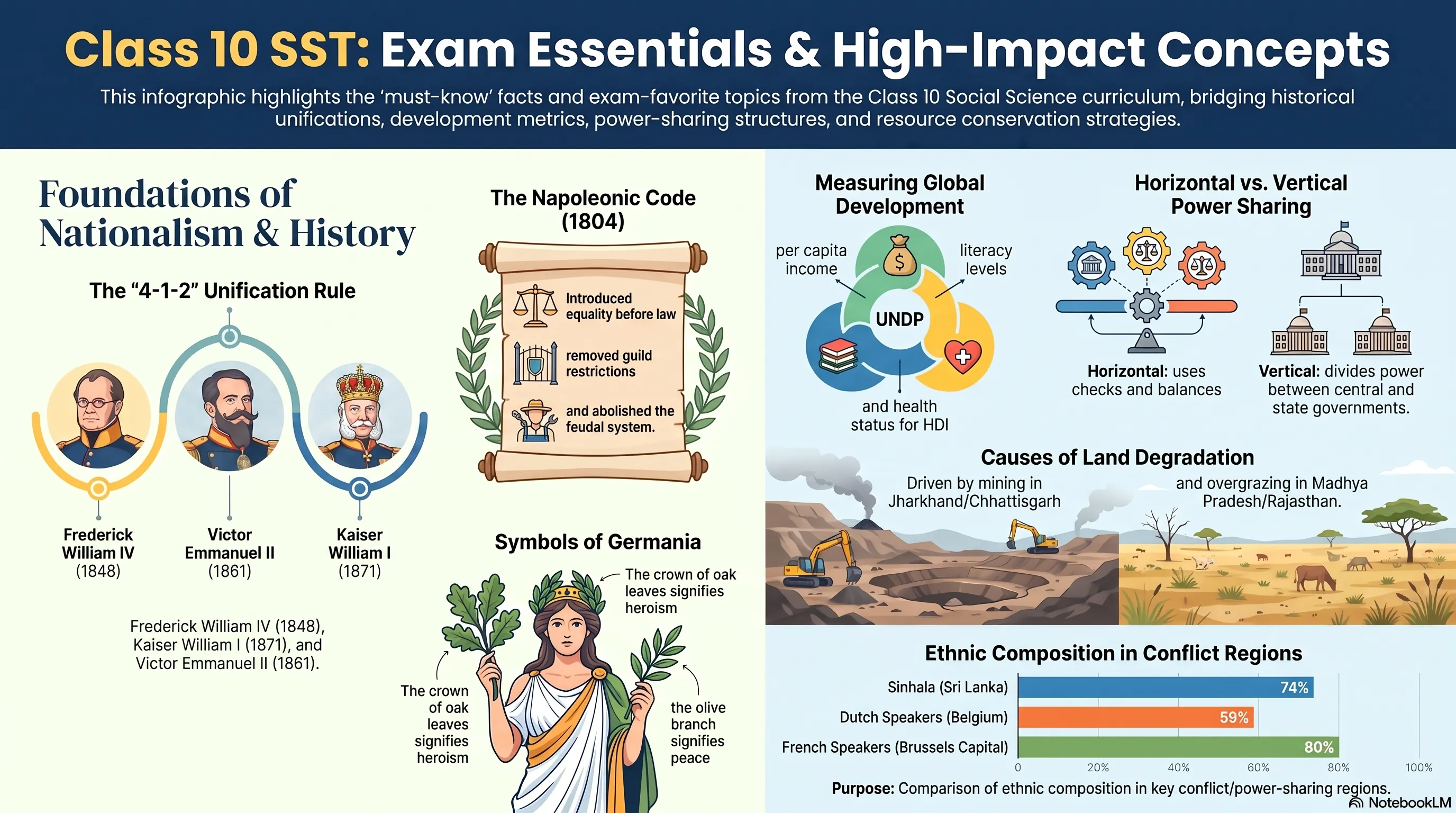
The Civil Code of 1804 is commonly known as the Napoleonic Code. Its key features include equality before law, removal of guild restrictions, improved transport and communication, and the abolition of the feudal system — a favourite three-mark question in boards.
Duke Metternich described Giuseppe Mazzini as "the most dangerous enemy of our social order." Mazzini was born in Genoa and founded two secret societies, Young Europe and Young Italy — a detail that has repeatedly shown up as an MCQ.
The Zollverein and the Germania Allegory
A customs union formed at the initiative of Prussia in 1834 was called the Zollverein. Under it, the number of currencies in the region was reduced from over 30 to just two, and transport restrictions along with guild restrictions were removed.
The crown of oak leaves worn by Germania in the well-known allegorical image symbolises heroism, while the olive branch wrapped around the sword symbolises the willingness to make peace. This image opens the chapter and is a recurring source for board questions.
Liberalism and the Balkans
The word "liberalism" comes from the Latin word liber, meaning free. Political, economic, and middle-class interpretations of liberalism are all built on this idea, so it's worth understanding all three angles, not just the MCQ-level meaning.
The most serious source of nationalist tension in Europe after 1871 was the Balkans, since a large part of the Balkan region was under the control of the declining Ottoman Empire. This exact assertion-reason pair has appeared in board exams, with both statements true and the reason correctly explaining the assertion.
Unification of Germany and Italy
Frederick William IV, Kaiser William I, and Victor Emmanuel II are frequently mixed up. Here's how they connect:
| Ruler | Event | Year |
|---|---|---|
| Frederick William IV | Refused the crown offered by the Frankfurt Parliament, rejecting a constitutional monarchy | 1848 |
| Kaiser William I | Proclaimed German Emperor after German unification | 1871 |
| Victor Emmanuel II | Became king after Italian unification | 1861 |
💡 Memory Trick from the Faculty: Remember it as "4-1-2" — Frederick William IV refused the crown, then Kaiser William I unified Germany, and finally Victor Emmanuel II unified Italy.
Cavour led the movement to unite the northern regions of Italy, while Giuseppe Garibaldi led the movement in the south. Venetia became part of unified Italy in 1866, a fact drawn directly from the "before and after" unification map in the NCERT chapter and one that has already appeared in a board paper.
Britain and the Prussian Junkers
The Act of Union of 1707 joined England and Scotland, an event covered under "The Strange Case of Britain" and also referred to as the Bloodless Revolution.
The Prussian Junkers were large landowners who supported the king during Germany's unification — not artists, university professors, or factory workers.
The Habsburg Empire granted more autonomy to the Hungarians in 1867, another date-based MCQ that examiners like to test alongside the Vienna Congress year of 1815.
Development: Important MCQs
Measuring Development
The most common indicator used to measure the economic development of a country is per capita income, calculated as total income divided by total population. More broadly, a country's development can be judged by per capita income, average literacy level, and health status — all of the above together, not any single measure in isolation.
Per capita income is also known as average income.
HDI, UNDP, and India's Rank
The Human Development Report (HDR) is published by the UNDP (United Nations Development Programme) — not the World Bank, IMF, or WHO.
Among neighbouring countries compared on HDI in the NCERT data, Sri Lanka performs better than India. India's current HDI rank stands at 130.
Literacy Rate, IMR, and Net Attendance Ratio
Literacy rate is the proportion of the literate population aged 7 and above who can read and write.
Kerala has the lowest Infant Mortality Rate (IMR) among the states compared in the NCERT table — Bihar, Uttar Pradesh, and Punjab all rank behind it — because Kerala provides better basic health and education facilities.
Net attendance ratio is defined as the total number of children of a given age group attending school, expressed as a percentage of the total number of children in that age group. As per the latest NCERT edition, this age group is 15 to 17 years; older editions state 14–15 years, so match the answer to the edition you're studying from.
World Bank Criteria and Per Capita Income Data
The World Bank's main criterion for classifying countries is per capita income, measured in dollar terms, and used to define rich and poor countries as well as India's own position.
Per the NCERT data box comparing states, Haryana has the highest per capita income among Haryana, Bihar, Odisha, and Kerala.
Public Facilities and BMI
Money alone cannot buy everything needed to live well — public facilities such as a pollution-free environment, protection from infection, and unadulterated medicines are examples of what income cannot substitute for.
BMI (Body Mass Index) is used to measure the level. It is calculated by dividing a person's weight in kilograms by the square of their height in metres. A BMI below 18.5 indicates the person is undernourished.
Renewable vs Non-Renewable Resources and Sustainable Development
Groundwater is an example of a renewable resource, since it is replenished every year through rainfall. Crude oil, by contrast, is a non-renewable resource.
Sustainable development means development that meets the needs of the present without compromising the ability of future generations to meet their own needs. Among the books discussed, "Small is Beautiful" — associated with Gandhian philosophy — is credited with first introducing this concept.
Power Sharing: Important MCQs
Ethnic Composition of Sri Lanka and Belgium
Power sharing in Sri Lanka and Belgium is best understood through their population data:
| Country/Region | Group | Share |
|---|---|---|
| Sri Lanka | Sinhala (majority) | 74% |
| Sri Lanka | Sri Lankan Tamils | 13% |
| Sri Lanka | Indian Tamils | 5% |
| Belgium (Flemish region) | Dutch speakers | 59% |
| Belgium (Wallonia region) | French speakers | 40% |
| Belgium (Brussels, capital) | French speakers | 80% |
| Belgium (Brussels, capital) | Dutch speakers | 20% |
💡 Memory Trick from the Faculty: To recall that Sinhalas make up 74% of Sri Lanka, reverse India's independence year — 1947 becomes 74.
Sri Lanka's Official Language and Civil War
The Act of 1956 was passed in Sri Lanka to recognise Sinhala as the sole official language — not to grant autonomy to Tamils, establish a federal system, or distribute power. Sri Lanka became independent in 1948.
The civil war in Sri Lanka was caused by the policy of majoritarianism, not by a demand for a separate Dutch state, tension between the French and Germans, or UN intervention. Majoritarianism, as defined in the NCERT glossary, is when a majority community rules in a way that dominates other groups.
Horizontal and Vertical Power Sharing
Power sharing between higher and lower levels of government — central, state, and local — is called vertical division of power.
Power shared among the legislature, executive, and judiciary, including the system of checks and balances, is called horizontal distribution of power.
Belgium's Constitutional Accommodation
Belgium amended its constitution for the fourth time between 1970 and 1993 to work out an arrangement that would let different communities live together. This led to the creation of community governments, elected by people belonging to one language community, with powers over culture, education, and language.
💡 Memory Trick from the Faculty: Remember the subjects covered by a community government using "CEL" — Culture, Education, Language.
Why Power Sharing Matters
Power sharing is desirable mainly because it reduces the possibility of conflict between social groups — not because it increases conflict or ensures the dominance of the majority. A key prudential reason for power sharing is that it ensures the stability of the political order.
In a democracy, power is shared among different political parties representing different ideologies and social groups. When power is shared by two or more political parties forming a government together, it is called a coalition government. The tyranny of the majority — unchecked, one-sided rule — is destructive for both the majority and the minority.
Resource and Development: Important MCQs
Cropped Area and Land Degradation
Land that is sown more than once in an agricultural year is classified as gross cropped area.
Land degradation across India has different causes depending on the state:
- Overgrazing — mainly in Madhya Pradesh and Rajasthan
- Mining — mainly in Jharkhand, along with Odisha and Chhattisgarh
💡 Memory Trick from the Faculty: Recall the mining-affected states using "36 ghante mauj" — the "36" stands for Chhattisgarh, Madhya Pradesh, Odisha, and Jharkhand.
Types of Soil in India
Alluvial soil is the most widely spread and important soil type in India. It is classified into Bangar (older soil) and Khadar (newer, fresher soil) based on age.
Regur soil, also called black soil, is best suited for growing cotton and is found mainly in Gujarat and Maharashtra.
Laterite soil gets its name from the Latin word later, meaning brick, and is actually used to make bricks.
Erosion and Soil Conservation
Gully erosion, which creates badlands, is most common in the Chambal basin — the Chambal ravines referenced directly in the NCERT chapter's image.
Growing strips of grass between crops to break the force of the wind is called strip cropping.
Land left uncultivated for more than five years is categorised as culturable wasteland, distinct from current fallow and fallow-other-than-current categories.
Frequently Asked Questions
Find answers to common questions.
Who hosted the Congress of Vienna in 1815?
The Congress of Vienna was hosted by Duke Metternich, the Austrian Chancellor. Its main aim was to restore the monarchy that had been overthrown by Napoleon and to reset the boundaries around France to their pre-Napoleonic state.
What was the most serious source of nationalist tension in Europe after 1871?
The Balkans were the most serious source of nationalist tension in Europe after 1871. A large part of the Balkan region was under the control of the declining Ottoman Empire, which fuelled competing nationalist movements in the region.
Which organisation publishes the Human Development Report?
The UNDP (United Nations Development Programme) publishes the Human Development Report. It is used to compare countries on indicators such as per capita income, literacy, and health status rather than income alone.
Why does Kerala have a low Infant Mortality Rate?
Kerala has a low IMR because it provides better basic health and education facilities compared to other Indian states. Among the states compared in the NCERT table, Kerala consistently outperforms Bihar, Uttar Pradesh, and Punjab on this indicator.
What led to the civil war in Sri Lanka?
The civil war in Sri Lanka was caused by the policy of majoritarianism, where the Sinhala majority government dominated the Tamil minority. This included the Act of 1956, which made Sinhala the sole official language of the country.
Which soil is most widely spread in India, and how is it classified?
Alluvial soil is the most widely spread soil type in India. It is classified into Bangar (older) and Khadar (newer) based on age, colour, moisture content, and chemical composition.