Differentiation Formulas
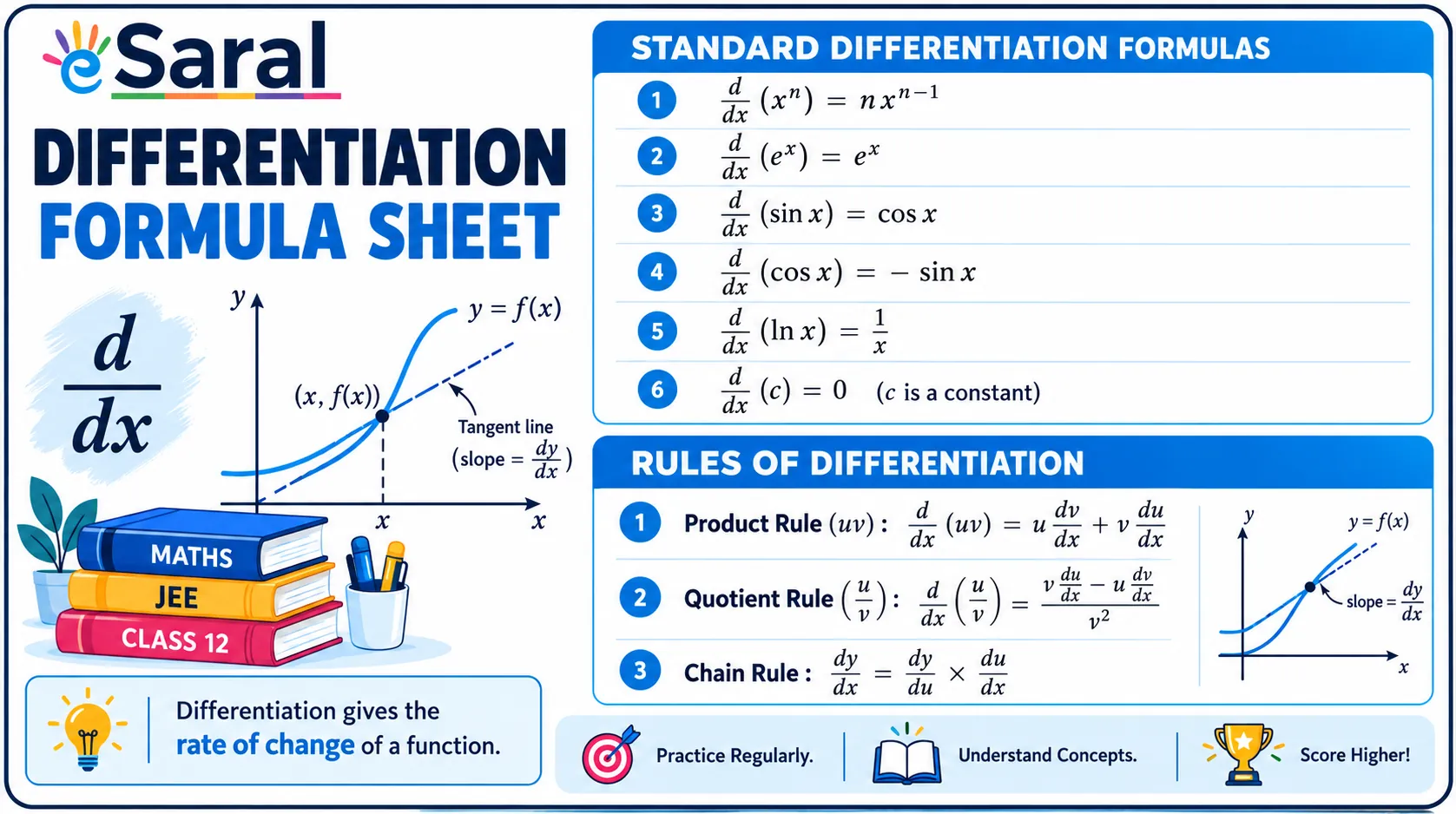
Table of Contents
- Differentiation Formula List – Standard Derivative Formulas
- Basic Algebraic Differentiation Formulas
- What Is the Differentiation Formula of UV?
- Exponential and Logarithmic Differentiation Formulas
- What Is the Differentiation Formula List for Trigonometric Functions?
- What Are the Inverse Trigonometric Differentiation Formulas?
- Differentiation Formulas: Class 11 vs Class 12 — What's the Difference?
- What Are the Main Rules of Differentiation?
- What Is Logarithmic and Implicit Differentiation?
- Solved Examples Using the Differentiation Formula
- Download the Differentiation Formulas Sheet (Free PDF)

eSaral › Class 12 Maths › Differentiation Formulas

Differentiability / Derivatives chapter covers the complete differentiation formula list — algebraic, trigonometric, inverse trigonometric, exponential, and logarithmic — along with the key rules of differentiation and solved examples.
Differentiation Formula List – Standard Derivative Formulas
Every differentiation formula in this list represents the rate of change of a function with respect to its variable. This differentiation formula list is the foundation of every topic that follows — Application of Derivatives, Integrals, and Differential Equations all depend on fluency here.
Basic Algebraic Differentiation Formulas
| Function | Differentiation Formula |
|---|---|
| $x^n$ | $\frac{d}{dx}(x^n)=nx^{n-1}$ |
| $x$ | $\frac{d}{dx}(x)=1$ |
| $c$ (constant) | $\frac{d}{dx}(c)=0$ |
| $cx$ (constant multiple) | $\frac{d}{dx}(cf(x))=c\frac{d}{dx}f(x)$ |
| $\sqrt{x}$ | $\frac{d}{dx}(\sqrt{x})=\frac{1}{2\sqrt{x}}$ |
| $\frac{1}{x}$ | $\frac{d}{dx}\left(\frac{1}{x}\right)=-\frac{1}{x^2}$ |
What Is the Differentiation Formula of UV?
When a function is written as the product of two functions, u and v, the **differentiation formula of uv** — also called the product rule — is:
d/dx(uv) = u(dv/dx) + v(du/dx)
This is one of the most commonly searched differentiation formulas because it applies any time two functions are multiplied together, such as x²·sin(x) or eˣ·ln(x). It cannot be differentiated term-by-term like a sum — the uv formula must be applied directly.
Exponential and Logarithmic Differentiation Formulas
| Function | Differentiation Formula |
| $e^x$ | $\frac{d}{dx}(e^x)=e^x$ |
| $a^x$ | $\frac{d}{dx}(a^x)=a^x\ln a$ |
| $\ln x$ | $\frac{d}{dx}(\ln x)=\frac{1}{x}$ |
| $\log_a x$ | $\frac{d}{dx}(\log_a x)=\frac{1}{x\ln a}$ |
What Is the Differentiation Formula List for Trigonometric Functions?
The differentiation formula for trigonometric functions is one of the most frequently tested parts of this differentiation formula list, since these results recur across almost every JEE calculus question.
Trigonometric Differentiation Formulas
| Function | Differentiation Formula |
| $\sin x$ | $\frac{d}{dx}(\sin x)=\cos x$ |
| $\cos x$ | $\frac{d}{dx}(\cos x)=-\sin x$ |
| $\tan x$ | $\frac{d}{dx}(\tan x)=\sec^2 x$ |
| $\cot x$ | $\frac{d}{dx}(\cot x)=-\csc^2 x$ |
| $\sec x$ | $\frac{d}{dx}(\sec x)=\sec x\tan x$ |
| $\csc x$ | $\frac{d}{dx}(\csc x)=-\csc x\cot x$ |
Test your recall speed with JEE Main Chapterwise PYQ, where trigonometric differentiation appears in nearly every paper.
What Are the Inverse Trigonometric Differentiation Formulas?
Inverse trigonometric derivative formulas complete this differentiate formula list and appear regularly in composite-function and implicit differentiation problems.
Inverse Trigonometric Differentiation Formulas
| Function | Differentiation Formula |
| $\sin^{-1}x$ | $\frac{d}{dx}(\sin^{-1}x)=\frac{1}{\sqrt{1-x^2}}$ |
| $\cos^{-1}x$ | $\frac{d}{dx}(\cos^{-1}x)=-\frac{1}{\sqrt{1-x^2}}$ |
| $\tan^{-1}x$ | $\frac{d}{dx}(\tan^{-1}x)=\frac{1}{1+x^2}$ |
| $\cot^{-1}x$ | $\frac{d}{dx}(\cot^{-1}x)=-\frac{1}{1+x^2}$ |
| $\sec^{-1}x$ | $\frac{d}{dx}(\sec^{-1}x)=\frac{1}{x\sqrt{x^2-1}}$ |
| $\csc^{-1}x$ | $\frac{d}{dx}(\csc^{-1}x)=-\frac{1}{x\sqrt{x^2-1}}$ |
Practice these directly with JEE Advanced Chapterwise PYQ, where inverse trig derivatives often show up inside harder composite functions.
Differentiation Formulas: Class 11 vs Class 12 — What's the Difference?
Class 11 differentiation (NCERT, Limits and Derivatives chapter) covers first-principles differentiation and basic formulas only:
- Derivative using limits: lim(h→0) [f(x+h)−f(x)]/h
- Power rule, and derivatives of polynomial, sine, cosine, and log functions
- No inverse trigonometric, logarithmic, or implicit differentiation
Class 12 differentiation (Continuity and Differentiability chapter) builds on this with the full differentiation formulas list:
- Exponential and logarithmic derivatives -
- Inverse trigonometric derivatives -
- Product rule, quotient rule, and chain rule -
- Logarithmic differentiation and implicit differentiation
If you're preparing for JEE, focus on the Class 12 list above — it is the version tested in Class 12 boards, JEE Main, and JEE Advanced.
What Are the Main Rules of Differentiation?
Beyond the standard differentiation formula for individual functions, three core rules of differentiation are used to differentiate combinations of functions:
Product, Quotient, and Chain Rule
| Rule | Formula for Differentiation |
| Product Rule | $\frac{d}{dx}(uv)=u\frac{dv}{dx}+v\frac{du}{dx}$ |
| Quotient Rule | $\frac{d}{dx}\left(\frac{u}{v}\right)=\frac{v\frac{du}{dx}-u\frac{dv}{dx}}{v^2}$ |
| Chain Rule | $\frac{dy}{dx}=\frac{dy}{du}\times\frac{du}{dx}$ |
These three rules — especially the Chain Rule — form the backbone of nearly every calculus question in JEE Main PYQ, so fluency here directly impacts speed on the rest of the paper.
What Is Logarithmic and Implicit Differentiation?
Some functions cannot be differentiated directly using the standard differentiation formula list, and require an additional step first:
Logarithmic differentiation:
Implicit differentiation:
Used when $y$ is not directly expressed as a function of $x$, such as in $x^2+y^2=r^2$. Differentiate both sides with respect to $x$, treating $y$ as a function of $x$ and applying the chain rule wherever $y$ appears.
Once comfortable with both methods, test your application under timed conditions using eSaral's JEE Test Series, which includes dedicated Calculus mock sections.
Solved Examples Using the Differentiation Formula
Applying the differentiation formula, once the pattern is recognised, follows direct substitution into the matching standard result:
Example 1: Differentiate $f(x)=x^5$
$\frac{d}{dx}(x^5)=5x^4$
Example 2: Differentiate $f(x)=x^2\sin x$ using the product rule
$\frac{d}{dx}(x^2\sin x)=x^2\cos x+2x\sin x$
Example 3: Differentiate $f(x)=\sin(3x^2)$ using the chain rule
Let $u=3x^2$, so $\frac{du}{dx}=6x$.
$\frac{d}{dx}(\sin(3x^2))=\cos(3x^2)\times6x=6x\cos(3x^2)$
Example 4: Differentiate $f(x)=\frac{x}{\sin x}$ using the quotient rule
$\frac{d}{dx}\left(\frac{x}{\sin x}\right)=\frac{\sin x-x\cos x}{\sin^2 x}$
Download the Differentiation Formulas Sheet (Free PDF)
Keep this complete differentiation formulas sheet handy for quick revision
before exams. It includes every formula covered on this page — algebraic,
exponential, logarithmic, trigonometric, inverse trigonometric, and the
product, quotient, and chain rules — laid out on a single printable page.
[Download Differentiation Formulas PDF →]
Explore More on eSaral (Related Continuity, Differentiability & Class 12 Mathematics Resources)
Master the complete chapter this topic belongs to: Continuity and Differentiation Notes for Class 12 & IIT JEE →
Apply these formulas to real problems: Application of Derivatives Class 12 Notes →
See where derivatives are used next: Differential Equations Class 12 Notes →
Quick revision before your exam: Mind Maps for Methods of Differentiation →
Frequently Asked Questions
Find answers to common questions.
What are the formulas differentiation for trigonometric functions?
What is the differential formula for $e^x$?
What is the formula for differentiation of $x^n$?
What is the differentiation formula?
How many differentiation formulas should I memorise for Class 12 boards?
When is logarithmic differentiation used instead of the standard differentiation formula?
What is the chain rule differentiation formula?
What is the product rule in the differentiation formula list?
What is the differentiation formula of uv?
The differentiation formula of $uv$, also called the product rule, is $\frac{d}{dx}(uv)=u\frac{dv}{dx}+v\frac{du}{dx}$, used whenever two functions $u$ and $v$ are multiplied together.