Three vertices of a rectangle ABCD are A(3, 1), B(–3, 1) and C(–3, 3). Plot these points on a graph paper and find the coordinates of the fourth vertex D.
This solution determines the fourth vertex of the rectangle as (3, 3) using coordinate properties and calculates its area as 12 square units by finding the rectangle's length and breadth.
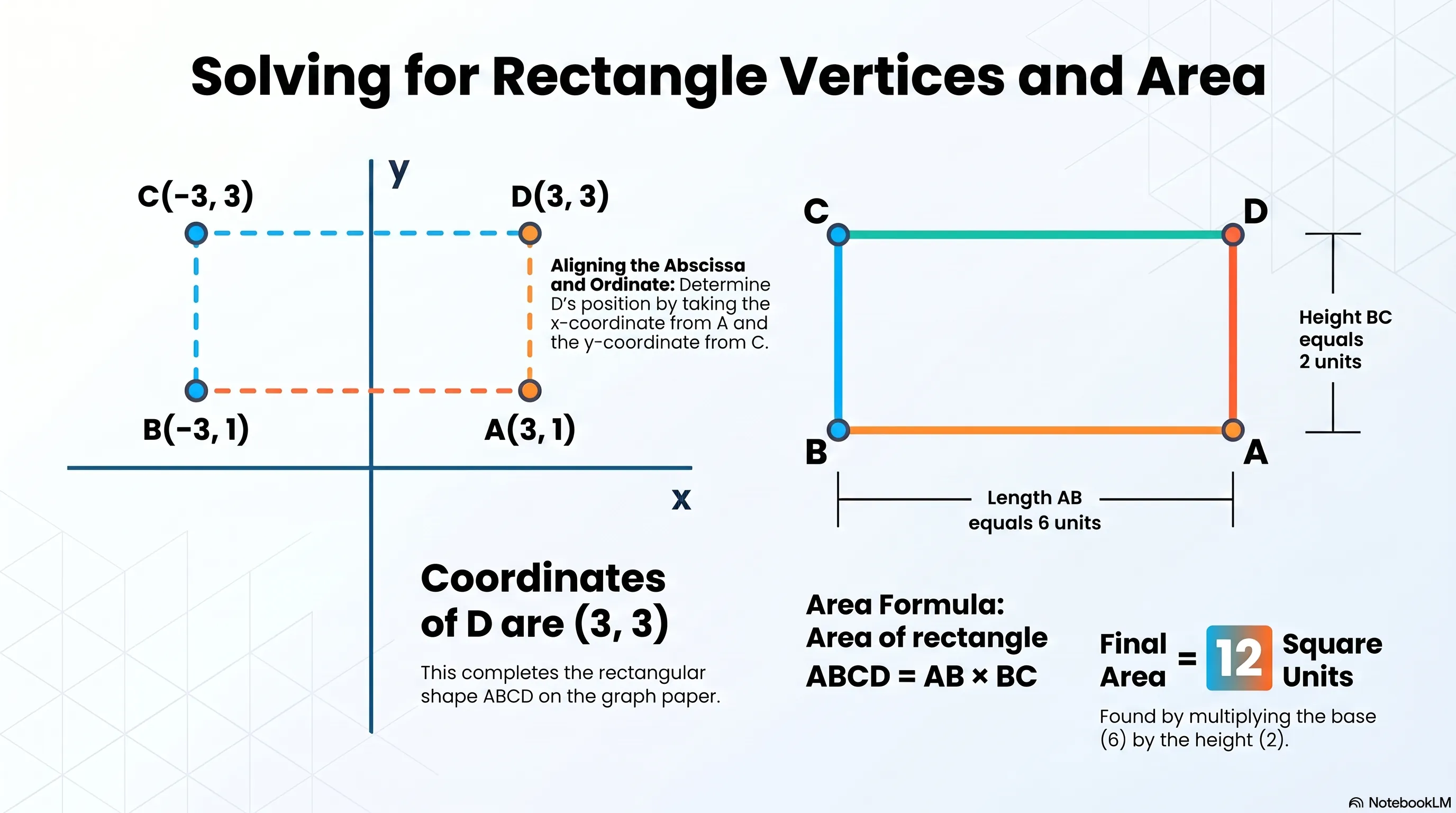


Three vertices of a rectangle ABCD are A(3, 1), B(–3, 1) and C(–3, 3). Plot these points on a graph paper and find the coordinates of the fourth vertex D. Also, find the area of the rectangle ABCD.
Let A(3, 1), B(–3, 1) and C(–3, 3) be three vertices of a rectangle ABCD.
Let A(3, 1), B(–3, 1) and C(–3, 3) be three vertices of a rectangle ABCD.
Abscissa of D = Abscissa of A = 3.
Ordinate of D = Ordinate of C = 3.
∴ The coordinates of D are (3, 3).
AB = (BP + PA) = (3 + 3) units = 6 units.
BC = (OQ – OP) = (3 – 1) units = 2 units.
Ar(rectangle ABCD) = (AB × BC)
= (6 × 2) sq. units
= 12 sq. units
Hence, the area of rectangle ABCD is 12 square units.
Frequently Asked Questions
Find answers to common questions.
What are the coordinates of the fourth vertex D of rectangle ABCD where A(3,1), B(–3,1), C(–3,3)?
D = (3, 3). Since ABCD is a rectangle with sides parallel to the axes, D must have the same x-coordinate as A (x = 3) and the same y-coordinate as C (y = 3). This follows directly from the property that opposite sides of a rectangle are parallel and equal in length.
How do you find a missing vertex of a rectangle in coordinate geometry?
Identify which sides are horizontal and which are vertical. The missing vertex shares its x-coordinate with the vertex on the same vertical side and its y-coordinate with the vertex on the same horizontal side. You can verify your answer by checking that both diagonals share the same midpoint, since diagonals of a rectangle bisect each other.
What is the area of rectangle ABCD with vertices A(3,1), B(–3,1), C(–3,3), D(3,3)?
The area is 12 square units. Length AB = |3–(–3)| = 6 units. Breadth BC = |3–1| = 2 units. Area = 6 × 2 = 12 sq. units. A common error is calculating BC as 3 units (confusing the y-coordinate of C with the length of BC), but BC is the difference of ordinates, not the ordinate itself.
Why does D share its x-coordinate with A and its y-coordinate with C?
In rectangle ABCD, the side DA connects D to A and must be vertical (parallel to the y-axis), so both D and A have the same x-coordinate. The side DC connects D to C and must be horizontal (parallel to the x-axis), so both D and C have the same y-coordinate. This is a direct consequence of the rectangle's right angles.
How do you verify that D(3,3) is the correct fourth vertex?
Use the diagonal midpoint property. In any rectangle, the diagonals bisect each other. Midpoint of AC = ((3+(–3))/2, (1+3)/2) = (0, 2). Midpoint of BD = ((–3+3)/2, (1+3)/2) = (0, 2). Both midpoints are identical, confirming D(3, 3) is correct.