What are the different ways of increasing production on the same piece of land?
Production on the same piece of land can be increased through multiple cropping and modern farming methods, including high-yielding seeds, irrigation, fertilizers, and pesticides to maximize crop yield.

eSaral ›Foundation courses ›What are the different ways of increasing production on the same piece of land?

What are the different ways of increasing production on the same piece of land? Use examples to explain
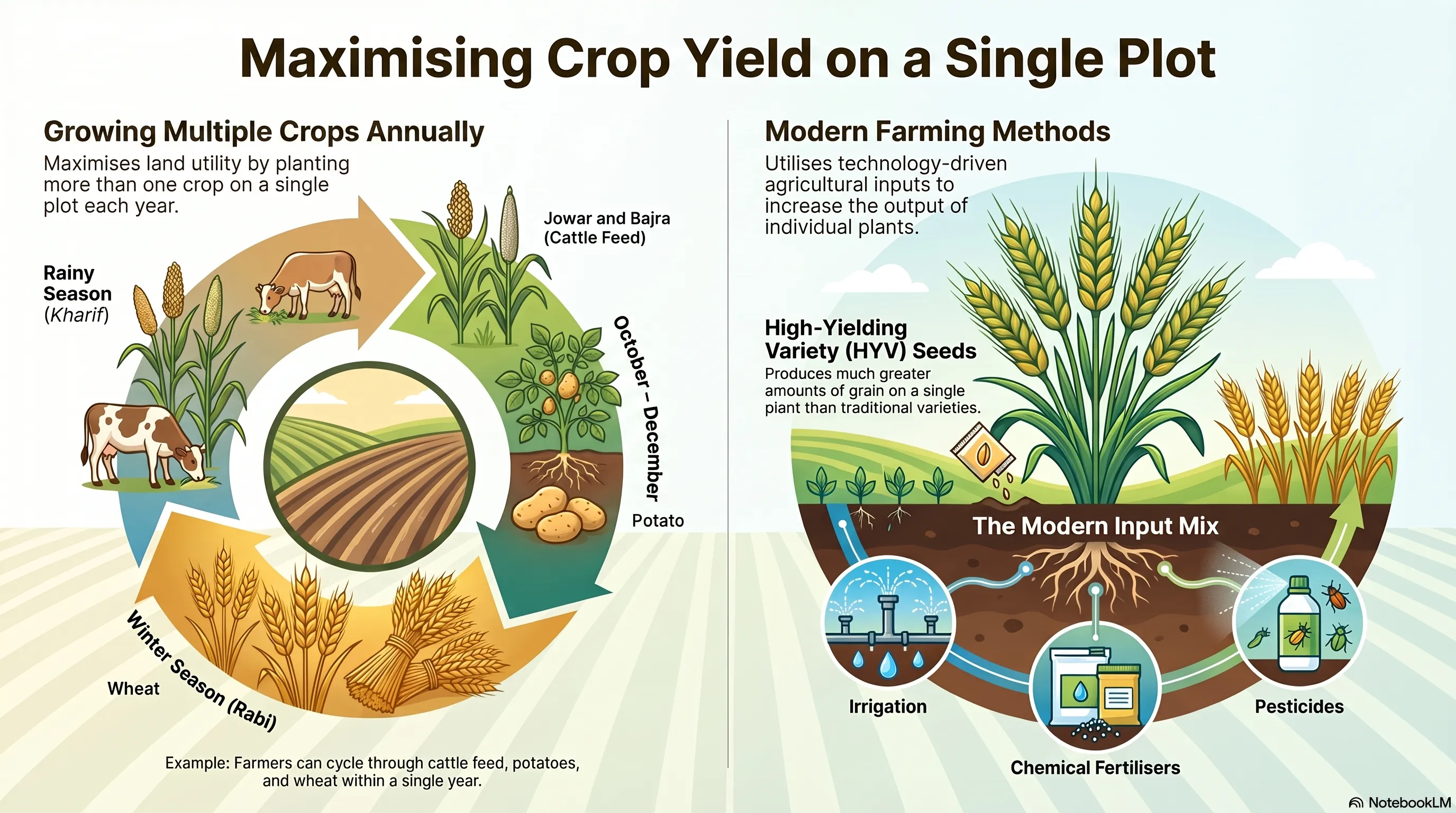
Multiple cropping and the use of modern farming methods are the two common ways of increasing production on the same piece of land. Multiple cropping involves growing more than one crop on a piece of land during the year. For example, farmers in the western parts of Uttar Pradesh practise multiple cropping. During the rainy season (kharif), they grow jowar and bajra. These plants are used as cattle feed. It is followed by the cultivation of potato between October and December. In the winter season (rabi), fields are sown with wheat.
The other way of increasing yield is by adopting modern farming methods. Modern farming methods involve the use of high-yielding variety seeds, irrigation, and chemical fertilisers and pesticides to produce maximum output from the same piece of land. The high-yielding varieties of seeds produce much greater amounts of grain on a single plant than the traditional varieties. As a result, far larger quantities of food grains can be produced from the same piece of land.
Frequently Asked Questions
Find answers to common questions.
What are the two main ways of increasing production on the same piece of land?
The two main methods are multiple cropping and modern farming methods. Multiple cropping means growing more than one crop on the same land during the year. Modern farming methods involve using HYV seeds, chemical fertilisers, pesticides, and irrigation to increase the output from each hectare of farmland without requiring additional land.
What is multiple cropping? Give an example.
Multiple cropping is the practice of growing more than one crop on the same piece of land within a single year. A clear example from the NCERT textbook is the village of Palampur in Uttar Pradesh, where farmers grow jowar and bajra in the rainy season, potato from October to December, and wheat in the winter (rabi) season — three crops from the same land annually.
How do HYV seeds help increase agricultural production?
High-Yielding Variety (HYV) seeds are scientifically developed to produce much greater quantities of grain per plant compared to traditional seeds. When combined with proper irrigation and chemical fertilisers, HYV seeds can multiply food grain output from the same piece of land dramatically. They were central to India's Green Revolution and remain a key tool for improving agricultural productivity.
What is the difference between multiple cropping and crop rotation?
Multiple cropping broadly means growing more than one crop on the same land per year — this includes sequential cropping, intercropping, and crop rotation. Crop rotation is a specific type of multiple cropping where different types of crops are grown in succession (e.g., cereals followed by legumes) to maintain soil fertility and break pest cycles naturally.
What are the disadvantages of modern farming methods?
While modern farming methods increase yields significantly, they carry risks. Excessive use of chemical fertilisers can reduce long-term soil fertility and cause water pollution. Over-irrigation depletes groundwater levels. Dependence on chemical pesticides can harm beneficial insects and biodiversity. Sustainable practices like organic farming and crop rotation are increasingly recommended to balance productivity with environmental health.