Why did political leaders differ sharply over the question of separate electorates?
Explore why Gandhi and Ambedkar sharply disagreed over separate electorates, the debate between political representation and social integration, and how the Poona Pact shaped India’s reservation system and democratic framework.

eSaral ›Foundation courses ›Why did political leaders differ sharply over the question of separate electorates?

What Are Separate Electorates? Definition & Meaning
Simple Definition
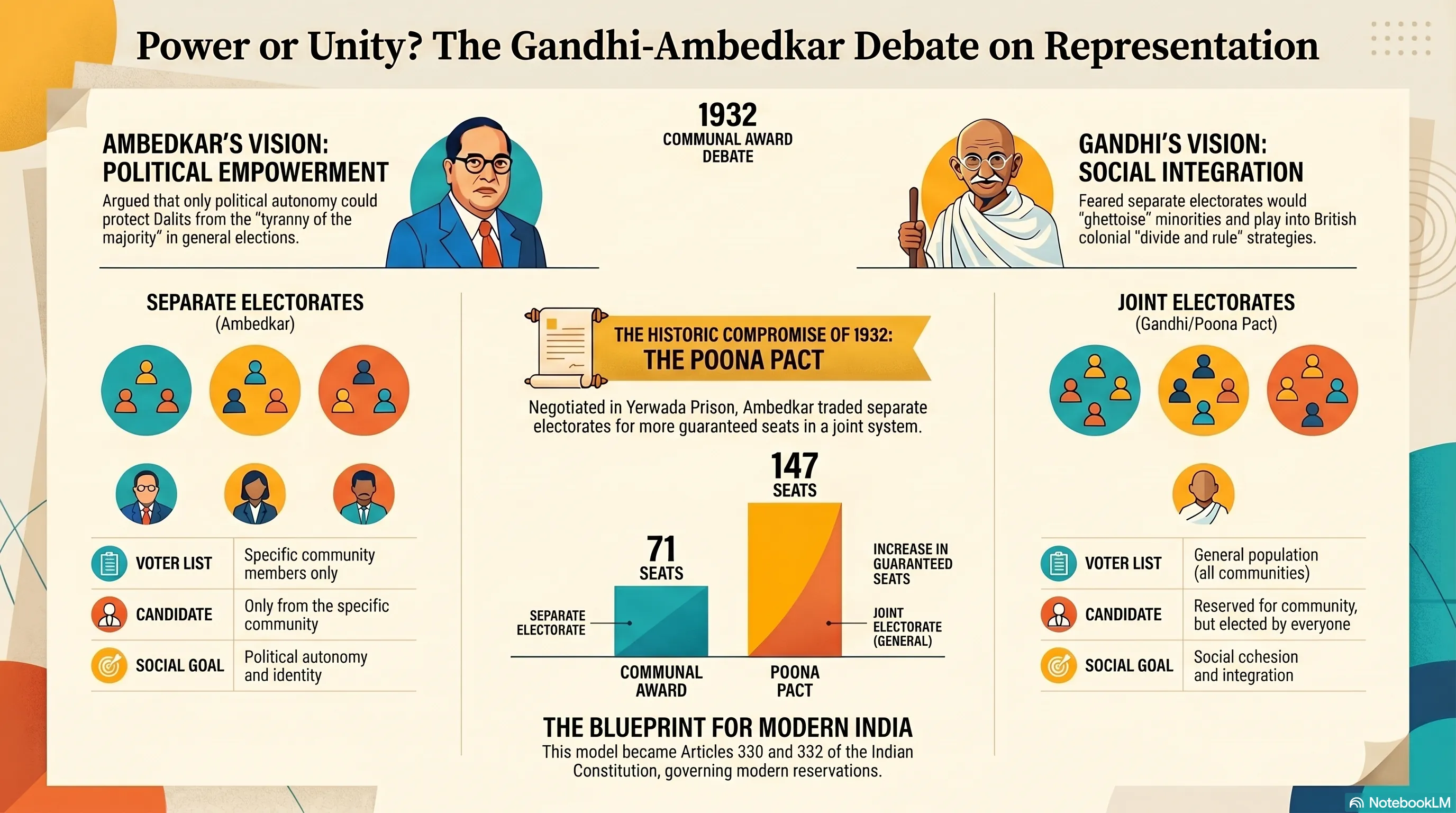
Separate electorates mean that members of a particular community or group (like Scheduled Castes, minorities, or women) have their own voting constituencies completely separate from the general population. Only members of that community can vote in their constituency, and they elect representatives exclusively for their group.
How It Works: A Visual Example
General Electorate System (What India adopted):
- One constituency: 500,000 voters (all communities mixed)
- Voters elect 1 representative
- Anyone can vote; anyone can contest
Separate Electorates System (What was proposed):
- Constituency A: 500,000 Hindu voters → elect 1 Hindu representative
- Constituency B: 50,000 Dalit voters (separate) → elect 1 Dalit representative
- Constituency C: 30,000 Muslim voters (separate) → elect 1 Muslim representative
Key Difference: In separate electorates, a Hindu voter cannot vote in the Dalit constituency, and vice versa. Communities are completely isolated electorally.
Real-World Example: Historical Application
The Communal Award (1932) by British PM Ramsay MacDonald granted separate electorates to:
- Scheduled Castes (Dalits): Separate constituencies within each province
- Muslims: Separate constituencies (already granted in 1909)
- Sikhs, Christians, Anglo-Indians: Separate constituencies
This is what sparked the Gandhi-Ambedkar controversy.
Historical Context: Why Were Separate Electorates Proposed?
The British Strategy
The British colonial government used separate electorates as a "divide and rule" strategy. By granting different communities separate representation, they believed:
- Communities would compete rather than unite against British rule
- Regional governance would be easier with fragmented political structures
- They could control each group separately
The Minority Protection Argument
Historically, separate electorates were introduced for:
| Community | Year Introduced | Reason |
|---|---|---|
| Muslims | 1909 | "Minority protection" from Hindu majority |
| Sikhs | 1909 | Religious minority representation |
| Christians | 1909 | Religious minority representation |
| Scheduled Castes | 1932 | Social empowerment through Communal Award |
| Anglo-Indians | 1932 | Community representation |
The logic: If minorities can't win in joint elections, give them separate constituencies where they're the majority.
But Who Decides This Protection?
Here's the irony: The British decided who needed "protection," not the Indian communities themselves. This arbitrary division became the source of major political controversy.
The Great Debate: Gandhi vs. Ambedkar
Dr. B.R. Ambedkar's Position (Supporting Separate Electorates)
Who was he?
- Untouchable (Dalit) by birth; faced extreme discrimination
- Educated at Columbia University and London School of Economics
- Later became the architect of the Indian Constitution
- Believed in securing political rights for the most marginalized
His Arguments:
| Argument | Explanation |
|---|---|
| Political Empowerment Only | Dalits have been socially oppressed for centuries. Only political representation can give them power to claim their rights. |
| Majority Will Ignore Them | In a joint electorate, upper-caste voters (majority) will never vote for Dalit candidates. Separate electorates guarantee Dalit representation. |
| Voluntary Integration is False | Asking Dalits to integrate "voluntarily" is naive. Without political power, they remain oppressed. |
| Minority of a Minority | Dalits are a minority within a minority (minority of Hindus). They need their own voice. |
His Fear: If Dalits didn't secure political seats now, upper-caste-dominated assemblies would never grant them meaningful rights post-independence.
Mahatma Gandhi's Position (Opposing Separate Electorates)
His Arguments:
| Argument | Explanation |
|---|---|
| Division of Nation | Separate electorates fragment the nation into antagonistic communities. This weakens national unity. |
| Perpetuates Backwardness | Segregation maintains social divisions. Integration through joint representation is the only long-term solution. |
| Artificial Ghettoization | Separate electorates create permanent "ghettoes" for minorities, reinforcing the idea that they're separate from the mainstream. |
| Slow Social Integration | Dalits mixing with upper-caste voters in joint elections forces interaction and social change over time. Separate electorates prevent this. |
| British Divide-and-Rule Tactic | The system plays directly into colonial strategy of dividing Indians. Accepting it is surrendering to British manipulation. |
His Fear: Once separate electorates are established, they become permanent—future generations of Dalits will remain segregated, not integrated.
💡 Key Insight: This wasn't a debate about who cares more for Dalits. Both leaders wanted Dalit empowerment. They disagreed profoundly on the method—political separation vs. social integration.
Arguments Supporting Separate Electorates
1. Guaranteed Representation
The Problem: In joint elections, minorities get drowned out. If Hindus are 80% and Dalits are 15%, Dalit candidates can almost never win a general election.
The Solution: Separate electorates guarantee Dalit candidates will win in Dalit constituencies because only Dalit voters decide.
Real Data: In the pre-1932 period, very few Dalit representatives were elected in joint elections. The Communal Award promised 71 Dalit seats out of 1,585 total—a realistic number.
2. Immediate Political Power
The Argument: Dalits are too weak now to fight for rights without representation. Give them seats first, and they'll use political power to claim social equality.
Example: Once Dalits have legislative seats, they can:
- Introduce bills for land rights
- Push for educational access
- Demand economic opportunities
- Hold upper-caste governments accountable
3. Protection Against Majoritarian Democracy
In a pure majority-rule system, 80% of voters can forever marginalize 15%. Separate electorates are a constitutional safeguard against tyranny of the majority.
4. Community Solidarity
Separate electorates force each community to organize internally. Dalit communities would develop leadership, political consciousness, and collective identity—strengthening them long-term.
Arguments Against Separate Electorates
1. Permanent Division of Society
The Fear: Separate electorates become institutionalized. After independence, it becomes harder to remove them. Generations of Dalits grow up thinking they're fundamentally "separate" from the rest of India.
Example: Pakistan introduced separate electorates for various groups after independence—it hardened communal divisions and led to greater conflicts.
2. Slow Integration
The Argument: Social change happens through interaction and familiarity. When upper-caste and Dalit voters participate together in joint elections, they interact, debate, and eventually accept each other. Separate electorates prevent this.
Psychological Effect: Separateness reinforces otherness. Over time, Dalits may internalize the idea that they're fundamentally different.
3. Plays Into Colonial Strategy
The Shrewd Observation: The British want separate electorates because it divides Indians. By accepting it, independence movements strengthen the enemy and weaken national unity.
4. Creates a Parallel Hierarchy
The Risk: Instead of eliminating the caste hierarchy, separate electorates create a political parallel to it. Dalits get "Dalit representatives," Muslims get "Muslim representatives"—reinforcing community-based identity instead of individual citizenship.
5. Weakens Broader Movements
The Strategic Point: Separate representation forces Dalits to negotiate only with the government, not with other communities. They lose the ability to build broader coalitions for social change.
The Poona Pact: A Turning Point in Indian History
What Happened: The Context
On August 17, 1932, British PM Ramsay MacDonald announced the Communal Award, which granted separate electorates to Scheduled Castes (Dalits).
Ambedkar's reaction: He saw this as partial victory—Dalits now had guaranteed representation.
Gandhi's reaction: He went on an indefinite hunger strike to oppose the Communal Award and separate electorates for Dalits.
Why Did Gandhi Fast?
Gandhi believed:
- Separate electorates would divide the Indian nationalist movement
- Dalit segregation would continue even after independence
- The issue should be resolved by Indian leaders together, not imposed by British decree
He wrote: "I would die a thousand deaths rather than see the Hindu-Dalit unity broken."
The Negotiation: September 1932
Ambedkar and Gandhi met in Yerwada Prison (where Gandhi was imprisoned) for negotiations. The stakes were high: If they didn't reach an agreement, Gandhi would die.
The Historic Compromise (Poona Pact, September 24, 1932):
| Original Communal Award | Poona Pact (Compromise) |
|---|---|
| Separate electorates for Dalits | Joint electorate with reserved seats |
| Dalits vote only for Dalit constituencies | Dalits vote in general constituencies (like everyone else) |
| 71 Dalit seats guaranteed | 147 Dalit seats (more than before!) |
| Permanent segregation | Seats reserved, not electorates—seats can be changed by Parliament later |
The Key Difference
Separate Electorates → Separate constituencies, separate voter lists (Permanent)
Reserved Seats in Joint Electorate → Same constituencies, same voter lists, but guaranteed seats for Scheduled Castes (Can be reformed)
Why This Compromise Worked
- Ambedkar got more seats: 147 instead of 71
- Gandhi prevented division: Joint electorate meant Dalits participated in mainstream democracy
- Both took political risks: Ambedkar faced criticism from Dalit activists; Gandhi ended his fast but faced criticism from Hindu nationalists
Impact on India's Constitutional Development
1. Became the Model for India's Constitution
The Poona Pact principle—reserved seats in joint electorate—became the foundation of the Indian Constitution.
Articles implementing this principle:
- Article 330: Reserved seats for Scheduled Castes in Lok Sabha (lower house)
- Article 331: Nominated Anglo-Indian representatives
- Article 332: Reserved seats for Scheduled Castes in State Assemblies
- Article 334: Original provision for 10 years (renewed multiple times)
2. Prevented Community Fragmentation
If India had adopted separate electorates for all minorities, the country would have been divided into dozens of separate constituencies:
- Separate electorates for Scheduled Castes
- Separate electorates for Scheduled Tribes
- Separate electorates for Muslims (in princely states)
- Separate electorates for religious minorities
- Separate electorates for linguistic minorities
Result: India chose unity in diversity, not separate representation.
3. Created the "Reserved Seats" Concept
This concept has been extended beyond Dalits:
| Group | Constitutional Provision |
|---|---|
| Scheduled Castes | Articles 330, 332 |
| Scheduled Tribes | Articles 330, 332 |
| Women | 33% reservation in local bodies (73rd Amendment) |
| OBC (Other Backward Classes) | Articles 330, 332 (added in 1990) |
4. Ongoing Debate: Reserved Seats vs. Representation
Even today, this debate continues:
Pro-Reservation Argument: Like the Poona Pact, reserved seats guarantee marginalized groups have a voice in government.
Anti-Reservation Argument: As Gandhi feared, reservation based on caste/community identity may perpetuate group identity instead of individual merit.
Frequently Asked Questions
Find answers to common questions.
What is the difference between separate electorates and reserved seats?
Separate electorates create completely separate voter lists and constituencies—a Dalit cannot vote for a general seat, and a Hindu cannot vote for a Dalit seat. Reserved seats are within a joint electorate—all voters vote together, but some seats are guaranteed for specific groups. The Poona Pact replaced the first with the second, ensuring Dalits remained part of mainstream electoral democracy.
Did Dr. Ambedkar accept the Poona Pact willingly?
Ambedkar's acceptance was pragmatic, not enthusiastic. He later wrote that he accepted the Pact to save Gandhi's life and because 147 reserved seats were more than 71. However, he remained skeptical about whether reserved seats would truly empower Dalits. He later became more critical of the compromise, but by then, the Pact had become constitutional law.
Why didn't other minorities like Muslims get reserved seats instead of separate electorates?
.
The Poona Pact applied only to Scheduled Castes. For Muslims and other religious minorities, the separate electorate system continued in British India and was abolished after independence. India chose joint electorate for all religious communities, not reserved seats for them (unlike Scheduled Castes). This became a controversial decision in partition politics
Are reserved seats in modern India the same as Poona Pact's reserved seats?
The principle is the same (reserved seats in joint electorate), but the implementation has expanded. The original Poona Pact reserved seats for only Scheduled Castes. Modern India has extended reservations to Scheduled Tribes (1950), OBCs (1990), and gender (33% in local bodies, 2023 Lok Sabha). The debate remains the same: Do reservations empower marginalized groups or perpetuate group-based identity?
How did the Poona Pact affect independence movements?
The Pact unified Hindu and Dalit nationalist movements. If separate electorates had been imposed, Dalit movements might have remained separate from the broader nationalist movement. The Pact ensured that Dalits participated in mainstream independence politics, strengthening the movement's reach and legitimacy. It also influenced how post-independent India designed its democratic system.