Vasudev’s eSaral Mission IIT Success Story : From 99.3 Percentile to IIT Kanpur
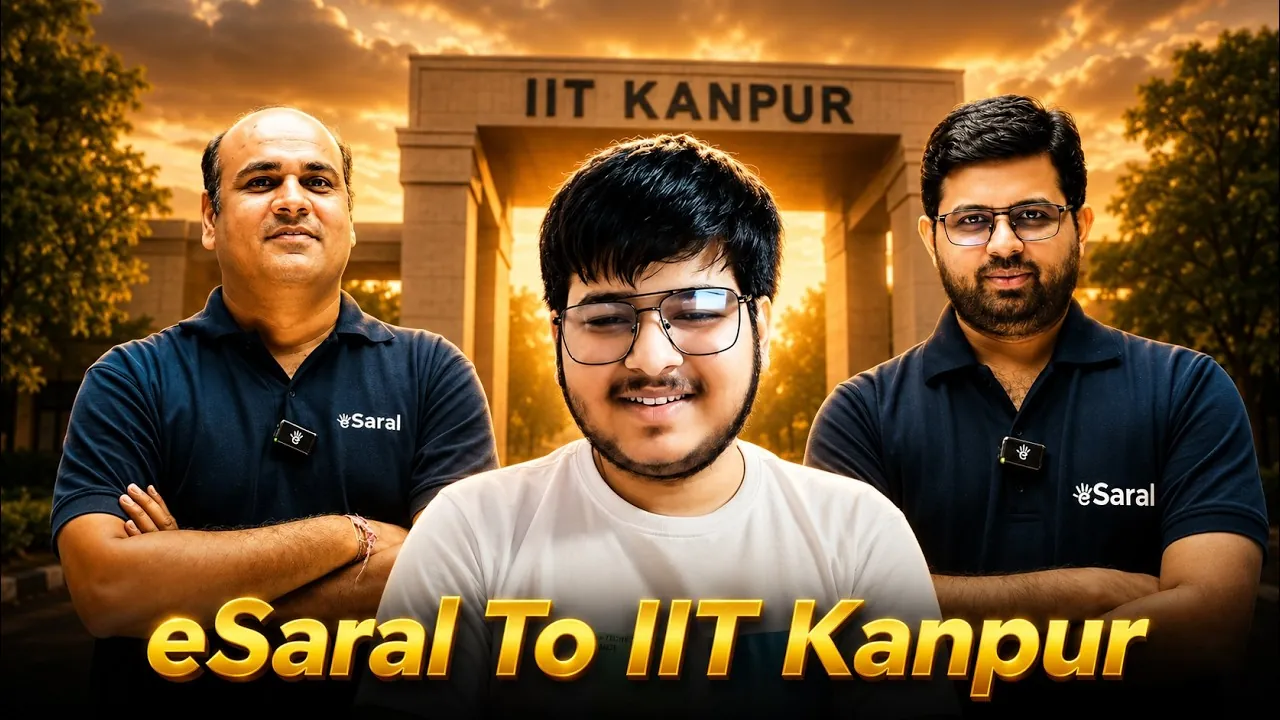
Table of Contents
- What Should Students Do Immediately After Scoring Well in JEE Main?
- How Should JEE Main Preparation Be Upgraded for JEE Advanced?
- Is Daily Revision Necessary for JEE Main and Advanced?
- Why Should JEE Aspirants Avoid Missing Mock Tests?
- Should Students Ever Skip Regular Classes to Focus on Self-Study?
- How Much Social Media Is Too Much During JEE Preparation?
- What Is a Practical Daily Routine for JEE Aspirants?
- How Can Students Make the Two Months Before JEE Advanced More Productive?
- Can Strong Physics and Mathematics Make Up for Other Weak Areas in JEE?
- What Should Students Do After Receiving an IIT Seat in Round 1?
- What Habits Consistently Help Students Reach the IIT Level?

eSaral › Success stories › Vasudev’s eSaral Mission IIT Success Story: From 99.3 Percentile to IIT Kanpur

A 99+ percentile in JEE Main is a major milestone, but for an IIT aspirant, the preparation does not end there.
That was the situation for Vasudev.
He had already scored 99.3 percentile in JEE Main 2026. Instead of allowing that result to make him comfortable, he shifted attention towards the next challenge—JEE Advanced.
After JEE Main, Vasudev joined eSaral Mission IIT and used the short gap before Advanced to revise his notes properly and solve stronger problems.
The result of his overall JEE journey was a Round 1 allotment of Civil Engineering at IIT Kanpur.
His interview does not mention his exact JEE Advanced marks or rank, so those numbers should not be added without scorecard verification.
What makes his journey useful for future aspirants is not an extraordinary timetable or a secret book. His advice revolves around basic preparation habits that students often underestimate: revision, quality problem-solving, regular classes, every test and controlling unnecessary distractions.
▶ Watch the complete student interview: Hear directly how a 99.3-percentiler used the Main-to-Advanced phase, what he would improve in his revision strategy and which preparation habits he considers compulsory for future IIT aspirants.
What Should Students Do Immediately After Scoring Well in JEE Main?
A strong JEE Main result can create an unusual problem.
The student feels relieved.
The family celebrates.
College options become safer.
And suddenly the intensity that helped produce the result can start falling exactly when JEE Advanced requires another level of preparation.
Vasudev did not stop after 99.3 percentile.
He joined eSaral’s Mission IIT programme after JEE Main and began preparing specifically for the Advanced phase. The Mission IIT page remains available on eSaral for Advanced-focused preparation.
His first priority was revision.
He went through his notes properly before moving heavily into problem-solving.
For students entering the same phase, this sequence is important because Advanced preparation should not begin with random difficult questions while basic formulas and concepts remain partially forgotten.
How Should JEE Main Preparation Be Upgraded for JEE Advanced?
JEE Main and JEE Advanced share the same core subjects, but doing well in Main does not automatically mean a student is fully prepared for Advanced-level problems.
Vasudev highlighted two things from his post-Main preparation:
Revise the Notes Properly
His first step was to revise his notes thoroughly.
This helps reactivate concepts that may not have appeared recently in mocks or Main-focused revision.
Solve Better Problems
After revision, he focused on good-quality problems.
Advanced questions often require students to connect multiple ideas instead of identifying one direct formula.
Students preparing for this transition can use JEE Advanced chapter-wise previous-year questions to expose themselves to actual Advanced-level applications across Physics, Chemistry and Mathematics. eSaral currently hosts these chapter-wise PYQs with solutions.
The purpose is not simply to solve more questions.
It is to solve questions that force deeper thinking.
Is Daily Revision Necessary for JEE Main and Advanced?
Vasudev identified one weakness in his own preparation very clearly.
He revised throughout the two-year journey, but not necessarily every day.
Instead, he sometimes created a separate block after two or three days and revised accumulated material together.
Looking back, he felt that daily revision could have made his preparation better.
This is useful because successful students do not need to pretend that every part of their strategy was perfect.
A practical revision model can include:
Daily Revision
Spend a short period revisiting formulas, class notes and mistakes from the day.
Weekly Consolidation
Revisit topics studied across the week and solve mixed questions.
Test-Based Revision
Use test mistakes to identify concepts that require another round of study.
Students can combine revision with JEE Main chapter-wise PYQs instead of measuring revision only by how many pages they reread. eSaral currently maintains chapter-wise Main PYQs with solutions.
Why Should JEE Aspirants Avoid Missing Mock Tests?
Vasudev’s advice to future aspirants was straightforward:
Give every test.
He felt students should not casually skip mocks during their preparation.
A test provides information that normal study cannot.
It shows whether concepts remain accessible under time pressure.
It reveals which chapters consume too much time.
It exposes careless errors.
Most importantly, repeated tests teach students to perform even when the paper does not feel comfortable.
Students who need a structured testing system can use the eSaral JEE Main + Advanced Test Series, which currently includes separate Main and Advanced testing formats along with performance analysis.
▶ Want to understand Vasudev’s preparation habits? Watch the full interview where he explains why regular classes and attempting every test were among his strongest recommendations for juniors.
Should Students Ever Skip Regular Classes to Focus on Self-Study?
Another point Vasudev emphasised was regular class attendance.
For him, attending classes and attempting tests were non-negotiable parts of preparation.
Students sometimes make the mistake of assuming that more self-study automatically means better preparation.
They start skipping lectures because they want extra revision time.
But if a class introduces a concept, Advanced application or problem-solving method that the student later has to cover independently, the apparent time saved may create more work.
The better approach is to keep classes, self-study, revision and testing connected rather than treating them as competing activities.
How Much Social Media Is Too Much During JEE Preparation?
Vasudev said he was not active on social media during his preparation.
He did use YouTube, and he acknowledged that some time could be wasted there.
His advice was to reduce unnecessary time loss.
This distinction matters.
Digital resources themselves are not automatically harmful.
The problem begins when an academic break turns into uncontrolled consumption.
Students should therefore know why they are opening an app.
Watching a specific lecture is different from opening YouTube without a purpose and returning two hours later.
Reducing these small daily leaks can create a significant difference across a two-year JEE preparation cycle.
What Is a Practical Daily Routine for JEE Aspirants?
Vasudev did not describe an extreme schedule involving studying until 3:00 a.m.
He generally woke around 7:00 a.m.
After getting fresh, he began self-study.
His day then included classes and additional preparation.
He usually went to sleep around midnight.
The interview does not provide an exact verified number of daily study hours, so assigning a specific 12-hour or 14-hour routine to him would be misleading.
The useful takeaway is the stability of the routine.
A JEE timetable should allow a student to remain alert in classes, revise independently and continue the same pattern over months.
Sleeping extremely late and then struggling to stay awake during lectures usually defeats the purpose of extra study hours.
How Can Students Make the Two Months Before JEE Advanced More Productive?
The gap between JEE Main and Advanced can feel short.
Vasudev’s approach suggests a simple framework.
Phase 1: Rebuild Recall
Revise notes properly so formulas and fundamental methods become immediately accessible.
Phase 2: Increase Problem Quality
Move from familiar Main-level patterns towards stronger multi-concept problems.
Phase 3: Solve Previous Advanced Papers
Once chapter-level preparation stabilises, use complete JEE Advanced previous-year papers to practise full-paper decision-making. eSaral currently provides both Advanced papers with solutions across multiple years.
Phase 4: Analyse, Don’t Just Count Tests
A difficult mock is useful only if the mistakes influence the next revision session.
This is where the Main-to-Advanced transition becomes more strategic than simply increasing study hours.
Can Strong Physics and Mathematics Make Up for Other Weak Areas in JEE?
Vasudev described Mathematics and Physics as subjects he had generally been comfortable with.
However, that does not mean aspirants should build a strategy around ignoring another subject.
JEE Advanced performance ultimately depends on handling all three subjects well enough for the examination requirements.
Natural strengths are useful.
But preparation should identify the subject that still has the greatest potential to improve the overall score.
Strong students often gain more marks by improving their comparatively weaker area than by repeatedly polishing a subject they already handle comfortably.
What Should Students Do After Receiving an IIT Seat in Round 1?
Vasudev received Civil Engineering at IIT Kanpur in Round 1.
That is the counselling status explicitly mentioned in the interview.
The conversation also refers to the possibility of improvement in later counselling, so it would be inaccurate to claim that Civil was necessarily his permanently locked final branch based only on this transcript.
Students in a similar situation should compare their current allotment with realistic upgrade possibilities instead of reacting only to the branch name.
eSaral’s JoSAA Opening and Closing Rank Tool can help students research previous IIT and branch trends, while the official JoSAA portal remains the final authority for actual 2026 allotments.
College counselling is another phase where patience matters.
An excellent current seat and a possible upgrade can both be evaluated without losing perspective on what has already been achieved.
What Habits Consistently Help Students Reach the IIT Level?
Vasudev’s interview repeatedly comes back to preparation fundamentals.
Attend classes regularly.
Attempt every test.
Keep revising older chapters.
Solve strong problems after revision.
Reduce unnecessary distractions.
And do not wait until the last few weeks to realise that older chapters are becoming difficult to recall.
None of these habits sounds revolutionary.
That is precisely the point.
Competitive-exam success is often built by executing obvious things more consistently than everyone else.
After scoring 99.3 percentile in JEE Main, Vasudev did not treat Main as the finish line.
He used the remaining phase for Advanced-focused preparation through eSaral Mission IIT and finally reached IIT Kanpur with a Civil Engineering Round 1 allotment.
▶ Watch the complete JEE 2026 success story: Hear Vasudev explain his post-Main revision, problem-solving strategy, test discipline, daily routine and what he would recommend to students targeting IIT next year.
| Timestamp | Earlier Situation | Verified Preparation |
|---|---|---|
| 0:07–0:34 | Vasudev had completed JEE Main and then joined eSaral Mission IIT. | He reported 99.3 percentile in JEE Main and received IIT Kanpur Civil in JoSAA Round 1. |
| 0:37–1:36 | Only the short Main-to-Advanced preparation window remained. | He first revised his notes properly and then focused on good-quality problem solving. |
| 2:16–2:56 | Long preparation can become inconsistent or distracted. | He advised juniors to attend classes regularly, attempt every test and reduce unnecessary time waste. |
| 3:31–4:12 | His revision was not always daily during the two-year journey. |
Looking back, he recommended daily revision because he felt it could have made his preparation even better.
|
Frequently Asked Questions
Find answers to common questions.
Is solving difficult questions enough to prepare for JEE Advanced?
No. Difficult questions are useful only when the underlying concepts are already accessible. eSaral Mission IIT combines Advanced-focused learning and problem practice, while PYQs help students check whether that preparation matches actual examination demands.
How early should complete JEE Advanced note revision begin after JEE Main?
Students should start as soon as the Main attempt is over rather than waiting for the final weeks. A quick but thorough first revision leaves more time for Advanced-level problems, mock tests and correction of weak chapters.
What should a 99-percentiler do differently for JEE Advanced?
A strong Main score means the fundamentals are already working, but Advanced requires deeper problem solving. Students should revise notes, solve Advanced PYQs, attempt full papers and analyse mistakes instead of continuing only with Main-style speed practice.
Are JEE Advanced previous-year papers useful after scoring 99 percentile in Main?
Yes. Main percentile does not directly test all the skills required in Advanced. Previous papers expose students to multi-concept questions, paper structure and actual Advanced-level decision-making.
Why should students give every JEE mock test?
Tests reveal speed, accuracy, forgotten concepts and question-selection problems that ordinary studying may hide. eSaral’s JEE Test Series allows aspirants to practise Main and Advanced formats and use performance analysis for further revision.
What should students do if their revision is irregular throughout Class 11 and 12?
Introduce short daily revision blocks instead of waiting for large accumulated revision sessions. Old chapters should repeatedly return through notes, PYQs and tests so that complete-syllabus revision does not become overwhelming.
How should students balance self-study with coaching classes?
Students should avoid treating the two as competing activities. Classes should provide concepts and methods, while self-study should reinforce them through revision, homework and PYQs.