CBSE Class 11 Syllabus 2026-27: PDF Download
The CBSE Class 11 Syllabus 2026-27 covers Physics, Chemistry, Maths (or Biology), and English, based on the NCERT curriculum. Physics, Chemistry, and Biology each carry 70 theory marks plus 30 practical marks, while Maths carries 80 theory marks plus 20 internal assessment marks, spread across five to ten units per subject.
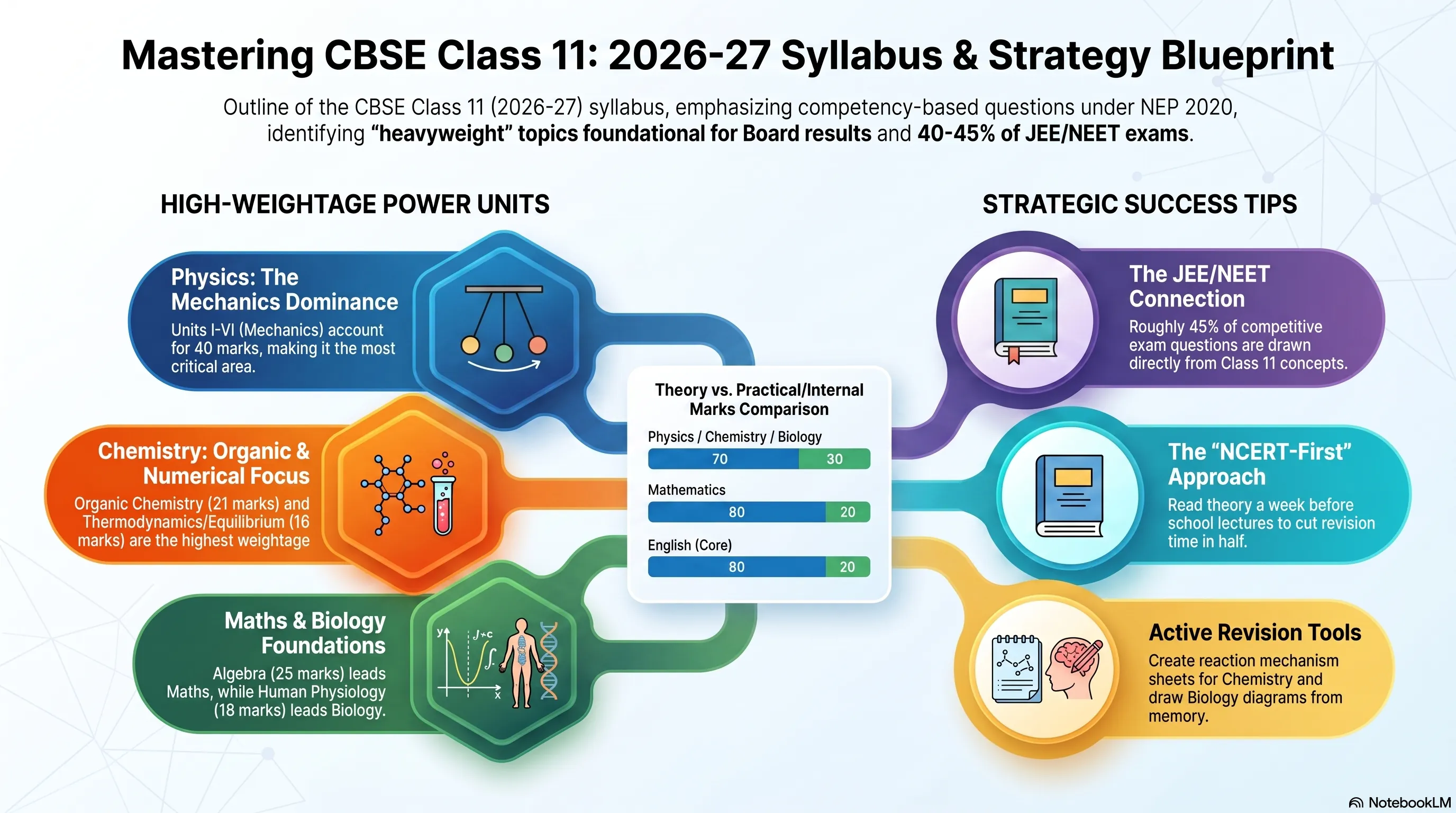
Table of Contents
- CBSE Class 11 Syllabus 2026-27 PDF
- CBSE Class 11 Syllabus Subject-Wise
- CBSE Syllabus for Class 11 Physics
- CBSE Syllabus for Class 11 Chemistry
- CBSE Syllabus for Class 11 Maths
- CBSE Syllabus for Class 11 Biology
- CBSE Syllabus for Class 11 English
- How Is the Class 11 Syllabus Different From Class 12?
- Benefits of Completing the CBSE Class 11 Syllabus Early

eSaral › NEET › JEE› CBSE Class 11 Syllabus 2026-27: PDF Download

CBSE Class 11 Syllabus 2026-27 PDF
| Subject | PDF Download |
|---|---|
| CBSE Syllabus for Class 11 Maths | PDF Download |
| CBSE Syllabus for Class 11 Physics | PDF Download |
| CBSE Syllabus for Class 11 Chemistry | PDF Download |
| CBSE Syllabus for Class 11 Biology | PDF Download |
| CBSE Syllabus for Class 11 English | PDF Download |
💡 Expert Tip by Saransh Gupta, IIT Bombay : Don't wait for the school to finish a chapter before starting numericals. Read the NCERT theory a week ahead and solve in-text questions on your own — it cuts your revision time in half before the unit test.
CBSE Class 11 Syllabus Subject-Wise
The CBSE Class 11 Syllabus 2026-27 has been notified by the Central Board of Secondary Education on its official curriculum portal. Each Science-stream subject splits into a theory paper and a practical/internal assessment component, while Maths carries 80 theory marks plus 20 internal assessment marks instead of a lab practical.
CBSE has continued rationalising the syllabus in recent sessions, so several chapters and sub-topics that appeared in older editions of the NCERT textbooks — such as Mathematical Reasoning in Maths or Mineral Nutrition in Biology — are no longer part of the 2026-27 assessment. Always cross-check deleted topics against the official PDF before you start a chapter, so you're not spending evenings on content that won't be tested.
The maximum score for each Science subject is 100: Physics, Chemistry, and Biology split this into 70 theory marks and 30 practical marks, while English follows a reading-writing-literature structure similar to Class 12. In line with the NEP 2020 framework, expect a mix of competency-based questions, MCQs, and descriptive answers rather than pure rote-recall questions.
CBSE Syllabus for Class 11 Physics
| Unit | Chapters | Marks |
|---|---|---|
| I | Physical World and Measurement — Units and Measurements | 23 |
| II | Kinematics — Motion in a Straight Line, Motion in a Plane | 23 |
| III | Laws of Motion | 23 |
| IV | Work, Energy and Power | 17 |
| V | Motion of System of Particles and Rigid Body | 17 |
| VI | Gravitation | 17 |
| VII | Properties of Bulk Matter — Mechanical Properties of Solids, Fluids, Thermal Properties of Matter | 20 |
| VIII | Thermodynamics | 20 |
| IX | Behaviour of Perfect Gases and Kinetic Theory | 20 |
| X | Oscillations and Waves | 10 |
| Total | 70 | |
| Practical / Internal Assessment | 30 |
Note: Units I–III together (23 marks), Units IV–VI together (17 marks), and Units VII–IX together (20 marks) as per the official CBSE weightage grouping.
Unit I: Physical World and Measurement
Units and Measurements covers the need for measurement, SI units, significant figures, dimensional analysis and its applications — the foundation every later chapter builds on.
Unit II: Kinematics
Motion in a Straight Line and Motion in a Plane introduce vectors, projectile motion, and uniform circular motion — heavily tested in both boards and JEE/NEET.
How Much Weightage Does Mechanics Carry in Class 11 Physics?
Mechanics — Kinematics, Laws of Motion, Work-Energy-Power, Rotational Motion, and Gravitation combined — accounts for the largest share of the 70 theory marks, making it the single most important area to master early.
Unit VII: Properties of Bulk Matter
Mechanical Properties of Solids and Fluids, plus Thermal Properties of Matter, bring in Hooke's law, Bernoulli's theorem, surface tension, and calorimetry.
Unit VIII–IX: Thermodynamics and Kinetic Theory
Covers the zeroth, first, and second laws of thermodynamics, along with the kinetic theory of gases and specific heat capacities — a frequent source of JEE Main numericals.
Unit X: Oscillations and Waves
Simple harmonic motion, energy in SHM, wave motion, and standing waves close out the syllabus, carrying 10 marks but a disproportionate share of conceptual JEE questions.
Physics practicals (30 marks) are split into two sections of experiments and activities on mechanics and heat, evaluated through a viva, practical record, and an investigatory project.
CBSE Syllabus for Class 11 Chemistry
| Unit | Topic | Marks |
|---|---|---|
| 1 | Some Basic Concepts of Chemistry | 7 |
| 2 | Structure of Atom | 9 |
| 3 | Classification of Elements and Periodicity in Properties | 6 |
| 4 | Chemical Bonding and Molecular Structure | 7 |
| 5 | Chemical Thermodynamics | 9 |
| 6 | Equilibrium | 7 |
| 7 | Redox Reactions | 4 |
| 8 | Organic Chemistry: Some Basic Principles and Techniques | 11 |
| 9 | Hydrocarbons | 10 |
| Total | 70 | |
| Practical / Internal Assessment | 30 |
Unit 1: Some Basic Concepts of Chemistry
Mole concept, stoichiometry, and percentage composition — the calculation toolkit used across the entire syllabus, so this chapter deserves extra numerical practice.
Unit 2: Structure of Atom
Discovery of subatomic particles, atomic models, quantum numbers, and electronic configuration — a NEET and JEE favourite.
Which Class 11 Chemistry Chapters Carry the Highest Weightage?
Organic Chemistry: Basic Principles and Techniques (11 marks) and Hydrocarbons (10 marks) together account for 21 of the 70 theory marks, making organic chemistry the single highest-weightage area in Class 11 Chemistry.
Units 5–6: Chemical Thermodynamics and Equilibrium
Thermodynamics (9 marks) covers enthalpy, entropy, and Gibbs energy, while Equilibrium (7 marks) introduces ionic and chemical equilibrium, pH, and buffer solutions — both are numerical-heavy and NEET-relevant.
💡 Expert Tip by Saransh Gupta, IIT Bombay : Build one formula sheet each for Physical Chemistry (mole concept, thermodynamics, equilibrium) and Organic Chemistry (reaction mechanisms). Revisiting these weekly beats re-reading the whole NCERT chapter before every test.
Chemistry practicals (30 marks) include volumetric analysis, qualitative salt analysis, and a content-based experiment, along with a project and viva.
CBSE Syllabus for Class 11 Maths
| Unit | Title | Marks |
|---|---|---|
| I | Sets and Functions | 23 |
| II | Algebra | 25 |
| III | Coordinate Geometry | 12 |
| IV | Calculus | 8 |
| V | Statistics and Probability | 12 |
| Total (Theory) | 80 | |
| Internal Assessment | 20 |
Unit I: Sets and Functions
Sets, relations and functions, trigonometric functions — the base for every algebraic and calculus chapter that follows in Class 11 and 12.
Unit II: Algebra
Complex numbers, linear inequalities, permutations and combinations, the binomial theorem, and sequences and series. At 25 marks, Algebra is the single highest-weightage unit in Class 11 Maths.
Is Calculus Introduced in Class 11 Maths?
Yes, Class 11 introduces calculus through Limits and Derivatives, covering the intuitive idea of a limit and basic differentiation of polynomial and trigonometric functions, worth 8 marks and forming the base for Class 12 calculus.
Units III–V: Coordinate Geometry, Calculus, Statistics and Probability
Coordinate Geometry covers straight lines and conic sections; Statistics and Probability introduces measures of dispersion and axiomatic probability — both are common sources of JEE Main questions.
Internal assessment (20 marks) is split between periodic tests (10 marks) and maths lab activities or projects (10 marks), so consistent classwork matters as much as the final paper.
CBSE Syllabus for Class 11 Biology
| Unit | Title | Marks |
|---|---|---|
| I | Diversity of Living Organisms | 15 |
| II | Structural Organisation in Plants and Animals | 10 |
| III | Cell: Structure and Function | 15 |
| IV | Plant Physiology | 12 |
| V | Human Physiology | 18 |
| Total | 70 | |
| Practical / Internal Assessment | 30 |
Unit I: Diversity of Living Organisms
Classification, the five-kingdom system, and plant and animal group characteristics — largely descriptive and diagram-heavy.
Unit III: Cell: Structure and Function
Cell theory, cell organelles, biomolecules, and enzymes — the base for Class 12's Genetics and Molecular Biology units.
Which Unit Carries the Highest Weightage in Class 11 Biology?
Human Physiology carries the highest weightage at 18 marks, covering breathing and gas exchange, body fluids and circulation, excretion, and chemical coordination — all frequently tested in NEET.
Unit IV–V: Plant and Human Physiology
Plant Physiology (transport, photosynthesis, respiration, plant growth) and Human Physiology (digestion, breathing, circulation, excretion, neural and chemical coordination) together carry 30 of the 70 marks and form the core of NEET Biology preparation from Class 11.
💡 Expert Tip by eSaral Academic Team: Draw and label every diagram — cell organelles, the human heart, the nephron — from memory at least three times before your exam. Diagram-based questions are scored strictly on labelling accuracy.
Biology practicals (30 marks) include slide preparation, spotting, one major and one minor experiment, and a project with viva.
CBSE Syllabus for Class 11 English
Class 11 English (Core) is built around two prescribed NCERT readers — Hornbill (prose and poetry) and Snapshots (supplementary reader) — alongside a Reading, Writing, and Grammar section.
- Reading Comprehension — unseen passages assessing comprehension, interpretation, and vocabulary
- Writing Skills — notice writing, formal/informal letters, and article/report writing based on verbal or visual input
- Literature — prose and poetry extracts from Hornbill, with short and long answer questions requiring textual analysis
- Supplementary Reading — chapters from Snapshots, tested through short and long answer questions
Internal assessment covers listening and speaking skills, along with project work, mirroring the structure used in Class 12 English.
How Is the Class 11 Syllabus Different From Class 12?
The Class 11 syllabus lays the conceptual groundwork — Mechanics in Physics, Organic Basics in Chemistry, Algebra and Calculus in Maths, and Human Physiology in Biology — while Class 12 builds directly on top of it with Electrostatics, Electrochemistry, advanced Calculus, and Genetics. Roughly 40-45% of JEE and NEET questions each year are drawn from Class 11 topics, which is why treating this syllabus as "just board prep" is a common and costly mistake.
Benefits of Completing the CBSE Class 11 Syllabus Early
- Make a subject-wise study plan. List every unit from the tables above, mark your weak and strong areas, and timetable accordingly rather than studying whichever chapter feels comfortable that day.
- Start with high-weightage units first. Mechanics in Physics, Organic Chemistry basics, Algebra in Maths, and Human Physiology in Biology give the best return on study time.
- Write short notes after every chapter. Summarising a chapter in your own words right after finishing it makes revision before unit tests dramatically faster.
- Solve NCERT in-text and exercise questions fully. Board papers and most competitive-exam basics are drawn directly from NCERT line items, not external references.
- Revisit deleted topics only if you're preparing for JEE/NEET. Some chapters removed from the board syllabus, like parts of Mineral Nutrition or Mathematical Reasoning, may still appear in competitive exams — check separately.
- Take structured guidance where needed. If a concept isn't clicking after two attempts at self-study, a mentor who has cleared JEE or NEET themselves can save you weeks of confusion — this is where eSaral's IIT Bombay faculty and 5-layer doubt-solving system help students the most.
Students starting Unit II can use this Motion in a Plane concept guide to understand vectors, projectile motion and uniform circular motion before beginning question practice.
Frequently Asked Questions
Find answers to common questions.
What is the CBSE Class 11 syllabus for 2026-27?
The CBSE Class 11 Syllabus 2026-27 covers Physics, Chemistry, Maths (or Biology), and English, based on NCERT textbooks. Physics, Chemistry, and Biology each carry 70 theory marks plus 30 practical marks, while Maths carries 80 theory marks plus 20 internal assessment marks.
Where can I download the CBSE Class 11 syllabus PDF for free?
You can download the subject-wise CBSE Class 11 Syllabus 2026-27 PDF directly from this page, or from the official CBSE academic website at cbseacademic.nic.in under the Curriculum section for Senior Secondary classes.
Which topics are removed from the Class 11 syllabus this year?
CBSE has continued rationalising content across subjects — for example, Mathematical Reasoning is removed from Maths, and portions of Mineral Nutrition and Digestion and Absorption are removed from Biology. Always check the official deleted-topics list before skipping a chapter.
Is the Class 11 syllabus important for JEE and NEET preparation?
Yes. Nearly 40-45% of JEE Main and NEET questions each year are based directly on Class 11 concepts, especially Mechanics in Physics, Organic Chemistry basics, Algebra and Calculus in Maths, and Human Physiology in Biology.
How many units are there in Class 11 Physics and Chemistry?
Class 11 Physics has 10 units across 14 chapters, while Class 11 Chemistry has 9 units, both carrying 70 theory marks and 30 practical marks.
Does Class 11 have board exams like Class 12?
No, Class 11 exams are conducted internally by individual schools, not by CBSE directly. However, the syllabus, marking scheme, and question paper design follow the same CBSE-notified structure as Class 12.