Centre of Mass Class 11 - IIT JEE | NEET
Centre of Mass is the point in a body or system where its entire mass can be considered concentrated for analyzing motion, helping Class 11 students understand the balance, position, and movement of objects in mechanics.
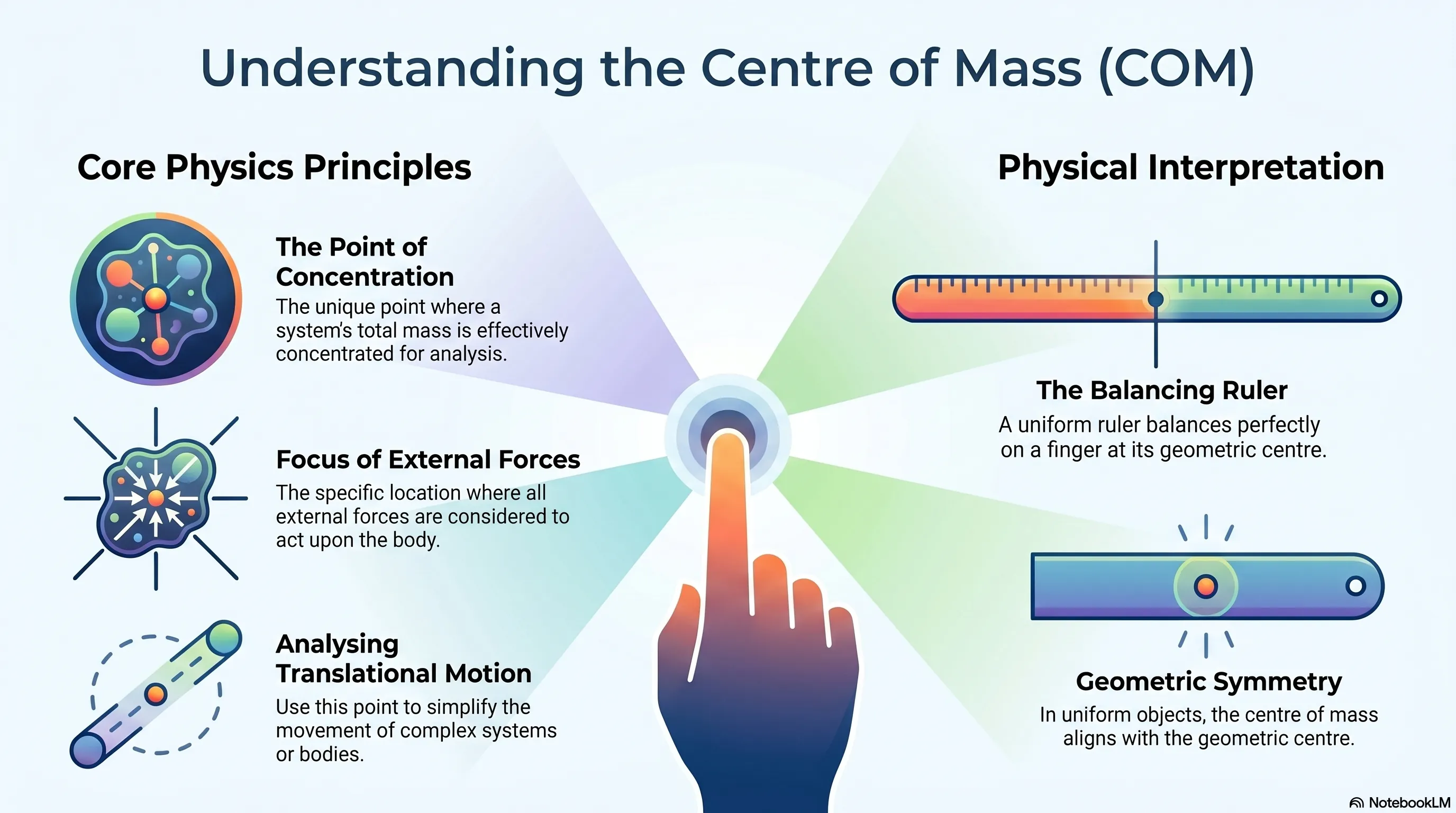
Table of Contents

eSaral › Class 11› Centre of Mass Class 11

🚀 Checkout eSaral Courses
What is the centre of Mass?
The centre of mass (COM) of a body or system of bodies is the unique point at which the total external force can be considered to act, and at which the distributed mass of the system is effectively concentrated for the purpose of analysing translational motion.
A simple physical interpretation: if you balance a uniform ruler on your finger, the point where it balances is its centre of mass — exactly at the geometric centre.
Centre of Mass Class 11 Notes
India's Best Exam Preparation for Class 11th - Download Now
India's Best Exam Preparation for Class 11th - Download Now
Frequently Asked Questions
Find answers to common questions.
What is the centre of mass in simple terms?
The centre of mass is the single point in a body or system of bodies that moves as if all the mass were concentrated there and all external forces were applied at that point. For a uniform object, it lies at the geometric centre. For a non-uniform object, it shifts toward the heavier side.
What is the formula for the centre of mass of a two-particle system?
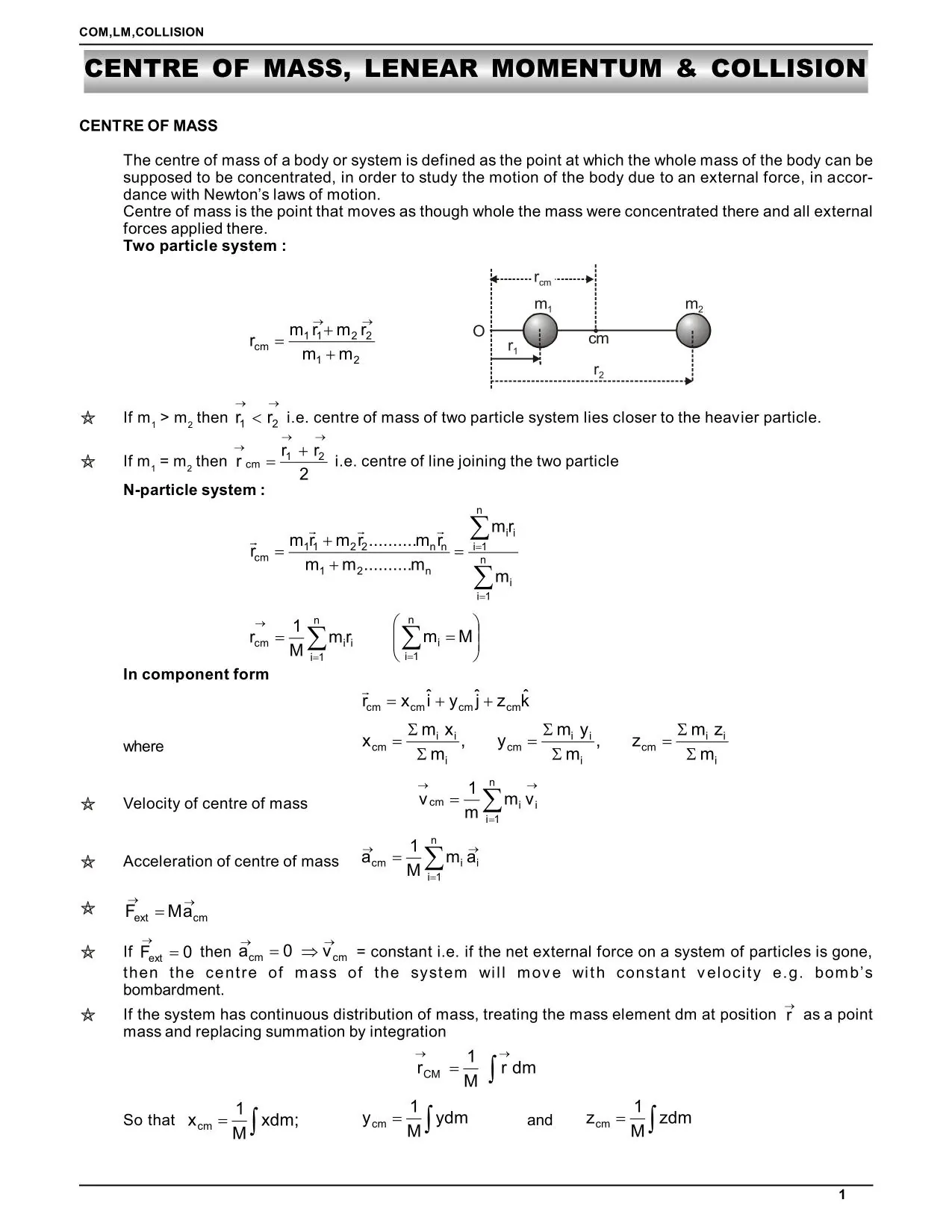
For two particles of mass m₁ and m₂ at positions x₁ and x₂ on the x-axis, the centre of mass is at x_cm = (m₁x₁ + m₂x₂) / (m₁ + m₂). The point always lies between the two masses and is closer to the heavier mass.
Does the centre of mass always lie inside the body?
No. The centre of mass can lie outside the physical boundary of the body. A classic example is a uniform ring — its centre of mass is at the geometric centre, which is in empty space at the middle of the ring. Similarly, for a horseshoe-shaped object, the COM lies in the air between the two arms.
Is centre of mass important for NEET 2025?
Yes. Centre of mass and linear momentum conservation appear in almost every NEET paper, contributing 1–2 questions. The sub-topics most tested in NEET are the COM formula for discrete systems, momentum conservation during collisions, and perfectly inelastic collision results. These are straightforward once the formulas are clearly understood.
How is centre of mass related to linear momentum?
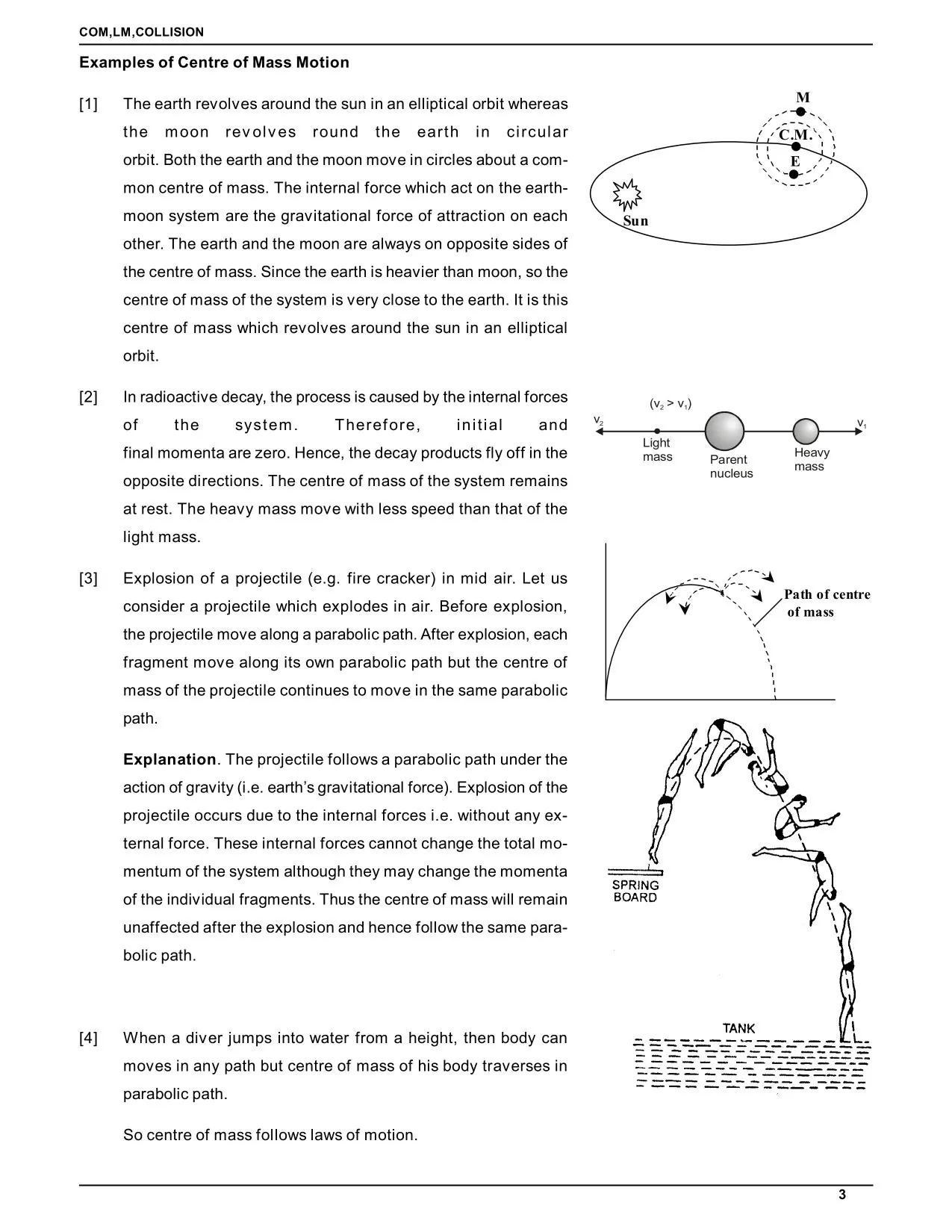
The total linear momentum of a system equals the total mass multiplied by the velocity of the centre of mass: P = Mv_cm. When no net external force acts, v_cm is constant — meaning the centre of mass moves in a straight line at constant speed, even if individual particles are colliding or exploding internally.