Class 10 Board Exam Second Attempt: 15-Day Preparation Strategy by Chapter (2025)
To prepare for the Class 10 board exam second attempt, focus on high-weightage chapters like Real Numbers, Polynomials, Quadratic Equations, Statistics, and Probability. In the 15 days remaining, solve one sample paper daily, revise all key formulas, and avoid the mistakes you made last time — less practice, poor focus, and skipping sample papers. CBSE rarely makes the second attempt paper difficult.
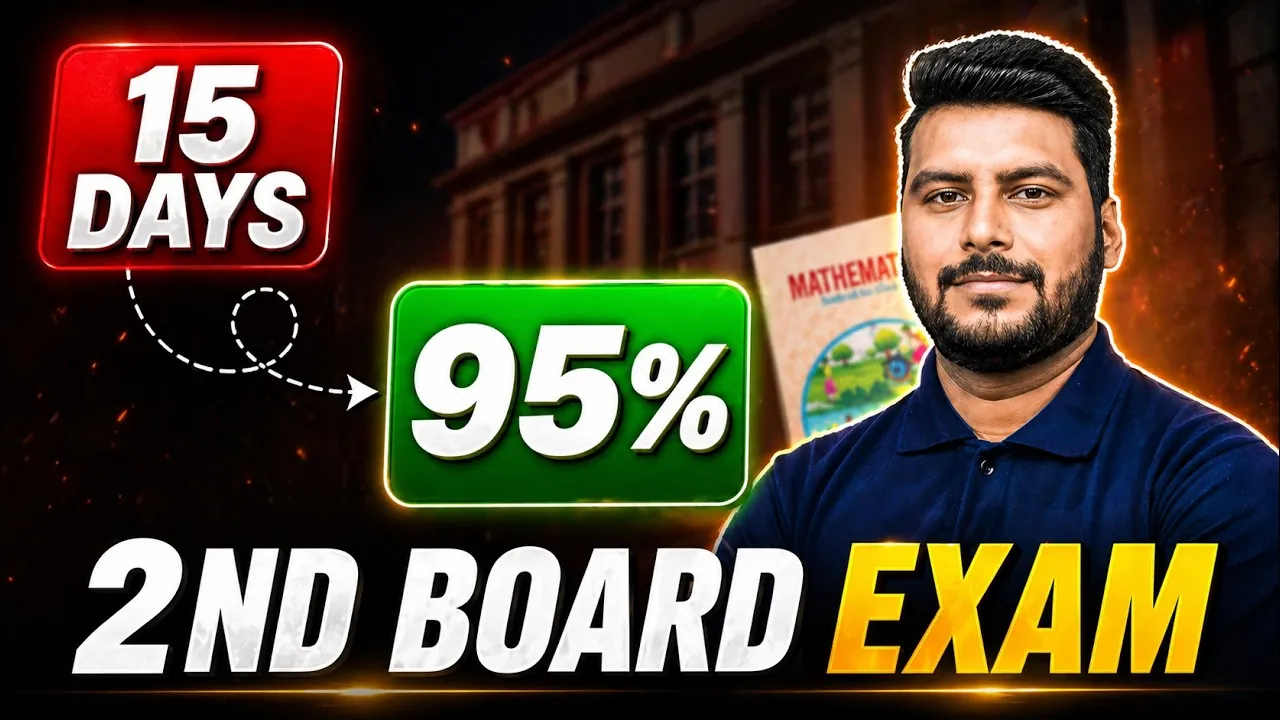
Table of Contents

eSaral ›Foundation courses ›Class 10›Class 10 Board Exam Second Attempt

Why Your Second Attempt Is a Powerful Opportunity
Getting a second chance at the Class 10 board exam is not a setback — it is an advantage. You already know the paper pattern, the type of questions asked, and exactly which areas let you down. Most students who appear for the second attempt come out with significantly better marks because they walk in better prepared and less anxious.
The goal right now is simple: show everyone your Version 2.0. You know what went wrong. Now fix it.
Write it down somewhere visible: "I will not repeat my first attempt mistakes." That one commitment, if followed seriously over the next 15 days, is enough to turn the result around completely.
Mistakes You Made in the First Attempt — And How to Fix Them
Before jumping into chapters, be honest about what held you back. These are the four most common reasons students underperform in their first board attempt:
| Mistake | Why It Hurts | Fix in 15 Days |
|---|---|---|
| Less practice overall | You forget the steps under exam pressure | Solve 1 full sample paper daily |
| Poor focus during study | Topics feel half-done | Study in 45-min focused blocks with no phone |
| Skipping sample papers | You don't know the exam format | Use the eSaral app — sample papers + chapter-wise questions available |
| Weak presentation | Marks are lost even when the answer is right | Write neatly; show all steps; box your final answer |
💡 Expert Tip by eSaral Academic Team: Download the eSaral app today. It has hundreds of chapter-wise practice questions and previous year sample papers for Class 10 Maths and Science. Even 30 minutes of daily practice on the app builds the writing habit that boards reward.
The single most impactful change you can make right now is sitting down with one full sample paper every single day. Do not read passively — write answers with pen and paper, exactly as you will in the exam hall.
Also, pay close attention to presentation: neat handwriting, proper steps, and a clearly boxed final answer can add 5–8 marks to your score without you knowing any extra content.
.webp)
High-Scoring Chapters to Focus On (With Weightage)
Not all chapters deserve equal time. Here are the chapters that give you the best return on every hour you put in:
| Chapter | Approx. Marks Weightage | Difficulty | Priority |
|---|---|---|---|
| Real Numbers | 6–7 marks | Easy–Medium | ⭐⭐⭐ High |
| Polynomials | 4–5 marks | Easy | ⭐⭐⭐ High |
| Coordinate Geometry | 5–6 marks | Easy–Medium | ⭐⭐⭐ High |
| Introduction to Trigonometry | 7 marks | Medium | ⭐⭐⭐ High |
| Statistics | 5–7 marks | Medium | ⭐⭐⭐ High |
| Probability | 3–4 marks | Easy | ⭐⭐⭐ High |
| Applications of Trigonometry | 5 marks | Medium | ⭐⭐ Medium |
| Quadratic Equations | 5–6 marks | Medium | ⭐⭐ Medium |
| Triangles | 6–7 marks | Medium–Hard | ⭐⭐ Medium |
| Surface Area & Volume | 5 marks | Medium | ⭐⭐ Medium |
These chapters alone can get you 30–35 marks if covered well. Focus here first, then pick up the remaining chapters if time allows.
Chapter-by-Chapter Breakdown: What Exactly to Study
Chapter 1 — Real Numbers
Real Numbers is one of the most scoring chapters in the paper. Three topics you must cover:
- Irrational number proofs — Practice proving that √2, √3, and (√2 − √3) are irrational. These appear almost every year.
- Fundamental Theorem of Arithmetic — Understand it conceptually and be able to apply it.
- LCM × HCF formula — The relationship LCM(a,b) × HCF(a,b) = a × b is frequently tested. Also, solve 2–3 composite number problems so you know the writing format.
Chapter 2 — Polynomials
This chapter is genuinely easy. There is very little to memorise. Just nail these two formulas for a quadratic polynomial with roots α and β:
- α + β = −b/a
- α × β = c/a
Solve 3–4 problems from R.D. Sharma based on these relationships. That is enough.
Chapter 3 — Linear Equations in Two Variables
This is a slightly harder chapter and deserves dedicated time. Here is what you must do:
- Solve a minimum of 20–25 word problems. Word problems are the highest-priority part of this chapter.
- Learn to draw graphs correctly for linear equations.
- Memorise the three conditions — parallel lines (no solution), intersecting lines (one solution), and coincident lines (infinite solutions) — using the ratio test: a₁/a₂, b₁/b₂, c₁/c₂.
Chapter 4 — Quadratic Equations
Two non-negotiable topics:
- The Quadratic Formula — You simply must know this by heart. There is no shortcut.
- Nature of Roots (Discriminant) — Know what D = b² − 4ac tells you: D > 0 (two real roots), D = 0 (equal roots), D < 0 (no real roots).
Word problems and case-based questions are likely here. Practise at least 5 word problems.
Chapter 5 — Arithmetic Progression
AP is an easy chapter with a high reward. Two formulas to master:
- aₙ = a + (n−1)d — nth term
- Sₙ = n/2 × [2a + (n−1)d] — sum of n terms
Case-based questions and word problems can appear from this chapter. Completing both formulas with 4–5 practice problems is sufficient.
💡 Expert Tip by eSaral Academic Team: For Chapters 5, 7, and 8, NCERT exercises are your best friend. If you cannot solve a question in NCERT on your own — without looking at the solution — you are not ready for the exam. Sit with NCERT and solve every question yourself.
Chapter 6 — Triangles
Triangles is a moderately hard chapter, but the exam pattern is predictable:
- BPT (Basic Proportionality Theorem) — 3-mark proof almost certain to appear.
- Application of BPT — 2-mark problem on the BPT application.
- A few similarity proofs to glance through.
Do not overthink this chapter. BPT proof + 1 application problem = well-covered.
Chapter 7 — Coordinate Geometry
Formulas to memorise well:
- Distance Formula: d = √[(x₂ − x₁)² + (y₂ − y₁)²]
- Section Formula: P = [(m·x₂ + n·x₁)/(m+n), (m·y₂ + n·y₁)/(m+n)]
Paste a formula sheet on your wall if needed. Check out NCERT Solutions for Class 10 Maths to practice full coordinate geometry questions with step-by-step solutions.
Chapter 8 — Introduction to Trigonometry
This chapter carries roughly 7 marks — significant. Expect:
- One identity proof (e.g., prove sin²θ + cos²θ = 1 type questions)
- NCERT exercises must be solved independently — do not skip them
- If you have not covered all the NCERT questions, your confidence will be low in the exam
Chapter 9 — Applications of Trigonometry (Heights and Distances)
Around 5 marks of weightage. A case-based 4-mark question is likely. Make sure you:
- Know the difference between the angle of elevation and the angle of depression
- Can draw a clear diagram before solving any height/distance problem
Chapter 12 — Areas Related to Circles
Formulas for sector area and segment area are essential. Questions often combine both in the same problem. Do at least 2–3 previous year questions from this chapter before the exam.
Chapter 13 — Surface Area and Volume
Combination problems are a must — these ask you to find the surface area or volume of a shape made by combining a cone, cylinder, hemisphere, etc. All formulas must be memorised. A 2-day formula revision session is enough if you are starting from scratch.
These two chapters together carry roughly 10 marks.
Chapter 14 — Statistics
Statistics carries 5–7 marks and is very reliable. You will almost certainly get:
- A Mean question
- A Median question — specifically, the type with missing values x and y in the frequency table. This question appeared in many first-attempt papers and will likely appear again.
- A Mode question
If Mean doesn't have the missing-value type question, Mode will. If not Mode, then Median. It will appear somewhere — prepare it.
Chapter 15 — Probability
You likely find Probability easy — and it is. But 3–4 marks depend on it, so do spend 30 minutes revising basic concepts and solving a few problems to stay sharp.
How to Use Your 15 Days Most Effectively
Here is a realistic 15-day structure:
| Days | Focus |
|---|---|
| Day 1–2 | Formula revision: paste all key formulas on a wall sheet |
| Day 3–5 | Real Numbers, Polynomials, Coordinate Geometry |
| Day 6–8 | Trigonometry (Chapter 8 + 9) + Statistics |
| Day 9–11 | Linear Equations, Quadratic Equations, AP |
| Day 12–13 | Triangles, Circles, Surface Area & Volume |
| Day 14 | Full sample paper — timed, written on paper |
| Day 15 | Quick revision of formulas + rest |
Solve one full sample paper daily from Day 4 onwards. The eSaral app has chapter-wise questions and mock tests that you can use to fill gaps between chapters.
For additional NCERT questions and previous year papers, refer to Class 10 NCERT Solutions and the Class 10 Maths Question Paper 2023 to understand what a real board paper looks like.
Is the Second Attempt Paper Harder?
This is a very common worry — and the answer is almost certainly no.
CBSE does not design the second attempt to fail students. The board's own policy discourages mass failure. Based on historical patterns, second-attempt papers tend to be slightly easier or at a similar level to the first attempt. CBSE's goal is to give students a fair opportunity to pass and progress.
So do not let fear of a tougher paper hold you back. Put in the preparation, walk in confidently, and trust the process. Your marks will reflect your effort.
Frequently Asked Questions
Find answers to common questions.
How should I prepare for the Class 10 board second attempt in 15 days?
Focus on high-weightage chapters first: Real Numbers, Polynomials, Trigonometry, Statistics, and Probability. Solve one full sample paper every day in writing. Revise all formulas in the first two days and paste them somewhere visible. Do not skip NCERT questions — they build the confidence needed to write clearly in the exam.
Which chapters are most important for Class 10 Maths board exam?
The most important chapters for Class 10 Maths board exam are Real Numbers, Polynomials, Coordinate Geometry, Introduction to Trigonometry, Statistics, and Probability. These chapters together can fetch you 30–35 marks and are comparatively easier to prepare thoroughly in a short time.
Is the Class 10 CBSE second attempt paper difficult?
No. Historically, CBSE keeps the second attempt paper at a similar or slightly easier level than the first attempt. CBSE's policy does not favour mass failure, so students who prepare even moderately can expect a manageable paper. Focus on preparation rather than worrying about paper difficulty.
What are the most common mistakes in Class 10 board exams?
The most common mistakes include insufficient practice, skipping sample papers, weak presentation, and not revising formulas before the exam. Students who write neatly, show all steps clearly, and box final answers consistently score higher even when their subject knowledge is the same as peers who skip these habits.
What is the weightage of Statistics and Probability in Class 10 Maths?
Statistics carries approximately 5–7 marks in Class 10 Maths board exams, while Probability typically accounts for 3–4 marks. Together they contribute around 8–10 marks. Statistics usually includes a missing-value type question in Mean, Median, or Mode — this question appears almost every year and must be practised thoroughly.
How many sample papers should I solve before Class 10 boards?
Solve at least one full sample paper per day in the last 10–12 days before the exam. Writing papers on actual paper — not reading solutions — builds the muscle memory for writing under time pressure. The eSaral app and platform have multiple sample papers and chapter-wise question banks for Class 10 Maths and Science.