CBSE Class 12 Chapter-Wise PYQs: Free Practice Guide 2027
CBSE Class 12 chapter-wise PYQs are previous year board exam questions organised unit by unit, so students can see exactly which chapters carry the most marks in Physics, Chemistry, Maths, Biology, and English. Physics and Chemistry theory papers carry 70 marks each with Optics and Organic Chemistry as the highest-weightage units respectively; Maths carries 80 marks with Calculus accounting for nearly half; Biology carries 70 marks led by Genetics and Evolution; and English Core carries 80 marks split across Reading, Writing & Grammar, and Literature. Every paper follows a 20% MCQ, 30% competency-based, 50% short/long answer split, and the same NCERT chapters tested here form the direct syllabus base for JEE Main and JEE Advanced.
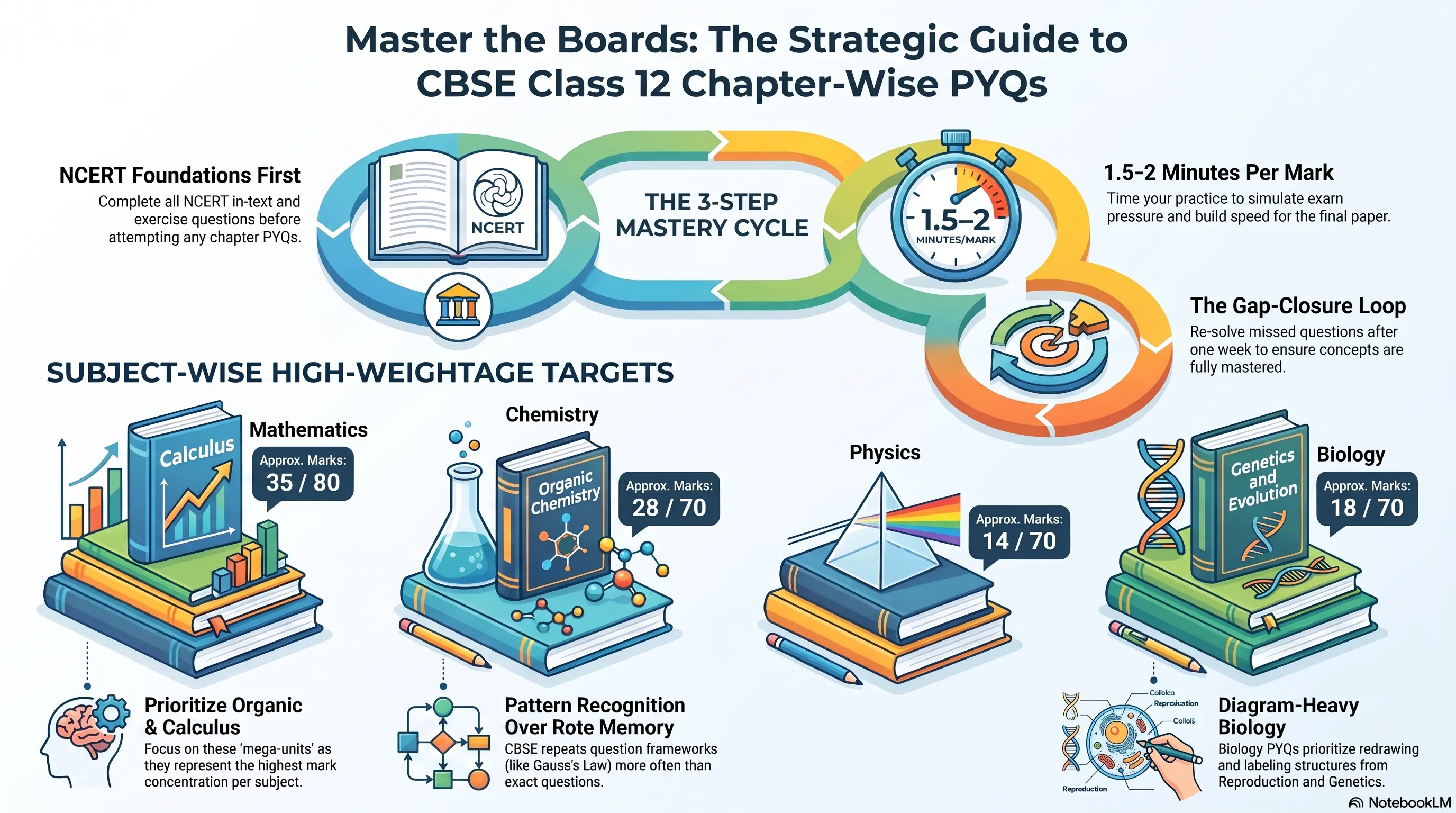
Table of Contents
- What Are CBSE Class 12 Chapter-Wise PYQs and Why Do They Matter?
- How to Use Chapter-Wise PYQs Effectively
- CBSE Class 12 Physics: Chapter-Wise Weightage and Key PYQ Chapters
- CBSE Class 12 Chemistry: Chapter-Wise Weightage and Key PYQ Chapters
- CBSE Class 12 Mathematics: Chapter-Wise Weightage and Key PYQ Chapters
- CBSE Class 12 Biology: Chapter-Wise Weightage and Key PYQ Chapters
- CBSE Class 12 English: What PYQs Reveal About the Paper
- How These Same PYQs Build Your JEE Main and JEE Advanced Preparation

eSaral › NEET › JEE› CBSE Class 12 Chapter-Wise PYQs: Free Practice Guide 2027

What Are CBSE Class 12 Chapter-Wise PYQs and Why Do They Matter?
A standard previous year paper gives you one full 70- or 80-mark exam from a single year. Chapter-wise PYQs instead pull every question CBSE has asked on a specific chapter — say, Electrostatics or Coordination Compounds — across multiple years, grouped together in one place.
This matters because CBSE repeats question patterns far more than it repeats exact questions. A student who solves five years of Electrostatics questions together starts recognising the two or three ways CBSE typically frames a Gauss's Law numerical, which is a very different kind of preparation than solving one full random paper and moving on.
How is this different from solving full previous year papers?
Full previous year papers test your overall exam temperament and time management under real conditions. Chapter-wise PYQs test depth on a single topic, revealing exactly which sub-concepts within that chapter get asked repeatedly. Both are useful, but they solve different problems — use full papers close to the exam and chapter-wise PYQs during regular revision.
How to Use Chapter-Wise PYQs Effectively
Chapter-wise PYQs only work if they're used in the right sequence relative to your regular study.
- Finish the NCERT chapter first, including every in-text and end-of-chapter question, before touching any PYQ.
- Solve the chapter-wise PYQ set without checking answers, timing yourself against the marks allotted (roughly 1.5–2 minutes per mark).
- Mark every question you got wrong or skipped, and go back to the exact NCERT section that covers it.
- Repeat the same chapter's PYQs after a week to confirm the gap is actually closed, not just temporarily patched.
- Move to the next high-weightage chapter, prioritising by marks first and comfort level second.
💡 Expert Tip by Saransh Gupta, IIT Bombay AIR-41: Don't solve chapter-wise PYQs in the order chapters appear in NCERT. Start with the highest-weightage chapters in each subject first — Optics in Physics, Organic Chemistry in Chemistry, Calculus in Maths — since that's where the marks concentrate, and revising them twice is far more valuable than revising a 2-mark chapter twice.
CBSE Class 12 Physics: Chapter-Wise Weightage and Key PYQ Chapters
Physics carries 70 theory marks, with weightage spread across ten NCERT units rather than concentrated in one or two chapters.
| Unit | Chapters | Approx. Marks |
|---|---|---|
| Electrostatics | Electric Charges and Fields, Electrostatic Potential and Capacitance | 8 |
| Current Electricity | Current Electricity | 7 |
| Magnetic Effects of Current & Magnetism | Moving Charges and Magnetism, Magnetism and Matter | 8 |
| Electromagnetic Induction & AC | EMI, Alternating Current | 8 |
| Electromagnetic Waves | Electromagnetic Waves | 3 |
| Optics | Ray Optics, Wave Optics | 14 |
| Dual Nature of Radiation and Matter | Dual Nature of Radiation and Matter | 4 |
| Atoms and Nuclei | Atoms, Nuclei | 6 |
| Electronic Devices | Semiconductor Electronics | 7 |
| Communication Systems | Communication Systems | 5 |
Optics is consistently the single highest-weightage unit, so PYQs on ray optics numericals (lens and mirror formula, refraction through prisms) and wave optics (interference, diffraction) deserve first priority. Electrostatics and Current Electricity together form the next major block, with Kirchhoff's Law and Gauss's Law numericals appearing almost every year in some form.
Where can you find full Physics PYQ papers to practice?
The CBSE Class 12 Physics Question Paper 2023 is a good starting point for solving a complete previous year paper after finishing chapter-wise practice, since it shows exactly how these high-weightage chapters get combined into one exam.
CBSE Class 12 Chemistry: Chapter-Wise Weightage and Key PYQ Chapters
Chemistry also carries 70 theory marks, split across Physical, Inorganic, and Organic Chemistry in roughly this proportion:
| Chemistry Branch | Key Chapters | Approx. Marks |
|---|---|---|
| Physical Chemistry | Solutions, Electrochemistry, Chemical Kinetics | 23 |
| Inorganic Chemistry | p-Block Elements, d- and f-Block Elements, Coordination Compounds | 19 |
| Organic Chemistry | Haloalkanes & Haloarenes, Alcohols/Phenols/Ethers, Aldehydes/Ketones/Carboxylic Acids, Amines, Biomolecules | 28 |
Organic Chemistry carries the single largest share of marks, so chapter-wise PYQs on named reactions, mechanism-based questions, and conversion problems from this block deserve the most repeated practice. Within Physical Chemistry, Electrochemistry and Chemical Kinetics repeatedly show up as numerical-heavy questions, while Coordination Compounds dominate the Inorganic section in terms of question frequency.
💡 Expert Tip : Organic Chemistry PYQs mein sirf answer yaad mat karo — reaction ka mechanism samajhna zaroori hai. Students who memorise final products without understanding the mechanism struggle the moment CBSE changes the substrate or reagent slightly, which happens in nearly every year's paper.
For a complete previous year paper once chapter practice is done, the CBSE Class 12 Chemistry Question Paper 2023 and the NCERT Solutions for Class 12 Chemistry work well together for review.
CBSE Class 12 Mathematics: Chapter-Wise Weightage and Key PYQ Chapters
Mathematics carries 80 theory marks, and unlike Physics or Chemistry, its weightage is heavily concentrated in one area.
| Unit | Key Chapters | Approx. Marks |
|---|---|---|
| Relations and Functions | Relations and Functions, Inverse Trigonometric Functions | 8 |
| Algebra | Matrices, Determinants | 10 |
| Calculus | Continuity & Differentiability, Applications of Derivatives, Integrals, Applications of Integrals, Differential Equations | 35 |
| Vectors and 3D Geometry | Vector Algebra, Three-Dimensional Geometry | 14 |
| Linear Programming | Linear Programming | 5 |
| Probability | Probability | 8 |
Calculus alone accounts for nearly half the theory paper, making it the single most important unit to build chapter-wise PYQ fluency in — particularly Integrals and Applications of Derivatives, which appear in both objective and long-answer sections almost every year. Vectors and 3D Geometry is the second-largest block, and questions here reward clean, step-by-step working since CBSE's step-marking rewards correct method even with a wrong final answer.
Why does Calculus deserve the most PYQ practice time?
Calculus carries roughly 35 of the 80 theory marks, close to double any other unit in the Class 12 Maths paper. Spending disproportionate PYQ practice time here — especially on Integrals and Differential Equations — gives the highest return per hour of any single decision a student can make in their Maths revision.
The CBSE Class 12 Maths Question Paper 2023 and NCERT Solutions for Class 12 Maths are useful next steps once chapter-wise practice on Calculus and Vectors feels solid.
CBSE Class 12 Biology: Chapter-Wise Weightage and Key PYQ Chapters
Biology also carries 70 theory marks, distributed across five broad units.
| Unit | Key Chapters | Approx. Marks |
|---|---|---|
| Reproduction | Sexual Reproduction in Flowering Plants, Human Reproduction, Reproductive Health | 16 |
| Genetics and Evolution | Principles of Inheritance and Variation, Molecular Basis of Inheritance, Evolution | 18 |
| Biology and Human Welfare | Human Health and Disease, Microbes in Human Welfare | 14 |
| Biotechnology | Biotechnology: Principles and Processes, Biotechnology and its Applications | 10 |
| Ecology | Organisms and Populations, Ecosystem, Biodiversity and Conservation | 12 |
Genetics and Evolution carries the single highest weightage, and PYQs here consistently test Mendelian genetics numericals, molecular biology diagrams (DNA replication, transcription), and evolution-based case questions. Biology PYQs are also unusually diagram-dependent — questions repeatedly ask students to draw and label structures from Reproduction and Genetics chapters, so chapter-wise practice should always include diagram redrawing, not just written answers.
CBSE Class 12 English: What PYQs Reveal About the Paper
English Core carries 80 marks, split across Reading (16), Writing & Grammar (24), and Literature (40) — and unlike the Science subjects, "chapter-wise" here means practising by section type rather than by topic weightage.
Literature PYQs repeatedly draw from the same recurring themes across the Flamingo and Vistas textbooks — character analysis, central idea questions, and extract-based comprehension from prose and poetry. Writing & Grammar PYQs are the most formulaic section to practice, since letter formats, notice writing, and grammar transformation exercises follow near-identical structures year after year, making them the highest-return, lowest-effort marks in the entire paper.
How These Same PYQs Build Your JEE Main and JEE Advanced Preparation
Here's what makes chapter-wise PYQ practice worth even more for Science stream students: the exact NCERT chapters tested in CBSE Class 12 form the direct syllabus base for JEE Main and JEE Advanced as well.
A CBSE PYQ on Electrostatics or Organic Chemistry mechanisms builds the same conceptual base that JEE later tests with tighter time limits and trickier applications. Students who treat board PYQs and JEE PYQs as two separate preparation tracks end up re-learning the same chapters twice — those who study once and switch practice formats save real revision time in the final months before both exams.
If you want to see how the same chapters get tested at the entrance-exam level, the JEE Main question paper and JEE Advanced question paper archives are worth comparing directly against your board PYQ practice. Students who want structured guidance running both tracks together can also look at eSaral's JEE Early Brahmos and JEE Early Warrior batches, built specifically for Class 12 students preparing for boards and JEE Main or Advanced in the same academic year.
Frequently Asked Questions
Find answers to common questions.
Which chapters have the highest weightage in CBSE Class 12 Physics?
Optics carries the highest weightage at around 14 of the 70 theory marks, followed by Electrostatics, Current Electricity, and Electromagnetic Induction & AC, each contributing 7–8 marks. Together these four areas account for well over half the Physics theory paper.
How should you use chapter-wise PYQs for CBSE Class 12 board prep?
Finish the NCERT chapter fully first, then solve that chapter's PYQ set under timed conditions before checking answers. Review every mistake against the exact NCERT section it came from, and revisit the same chapter's PYQs a week later to confirm the gap is closed.
Are CBSE Class 12 PYQs useful for JEE and NEET preparation too?
Yes, since the NCERT chapters tested in CBSE Class 12 form the direct syllabus base for both JEE Main and NEET. Board-level PYQ practice builds the conceptual foundation that entrance exams later test with tighter time limits and trickier applications.
Which chapter has the highest weightage in CBSE Class 12 Chemistry?
Organic Chemistry carries the largest share of marks overall, at roughly 28 of the 70 theory marks across Haloalkanes, Alcohols, Aldehydes and Ketones, Amines, and Biomolecules. Within Physical Chemistry, Electrochemistry and Chemical Kinetics are the most frequently tested numerical-based chapters.
Why does Calculus matter so much in CBSE Class 12 Maths PYQs?
Calculus accounts for around 35 of the 80 theory marks in CBSE Class 12 Mathematics, nearly double any other unit. Prioritising chapter-wise PYQ practice on Integrals, Applications of Derivatives, and Differential Equations gives the highest return on revision time.
Which Biology chapters should get the most PYQ practice?
Genetics and Evolution carries the highest weightage in CBSE Class 12 Biology at around 18 of the 70 theory marks. Reproduction follows closely at 16 marks, and both units are heavily diagram-dependent in previous year questions.