CBSE Class 12 Exam Pattern 2027: Marking Scheme Explained
The CBSE Class 12 exam pattern 2027 allocates 100 marks per subject, split as 70 theory + 30 practical for Science subjects (Physics, Chemistry, Biology) and 80 theory + 20 Internal Assessment for Mathematics, Commerce, and Humanities. Question papers carry 20% MCQs, 30% competency-based questions, and 50% short/long answers, with a minimum of 33% required to pass each subject and in aggregate. Each theory paper runs 3 hours, and the 2027 board exams are expected between mid-February and early April 2027.
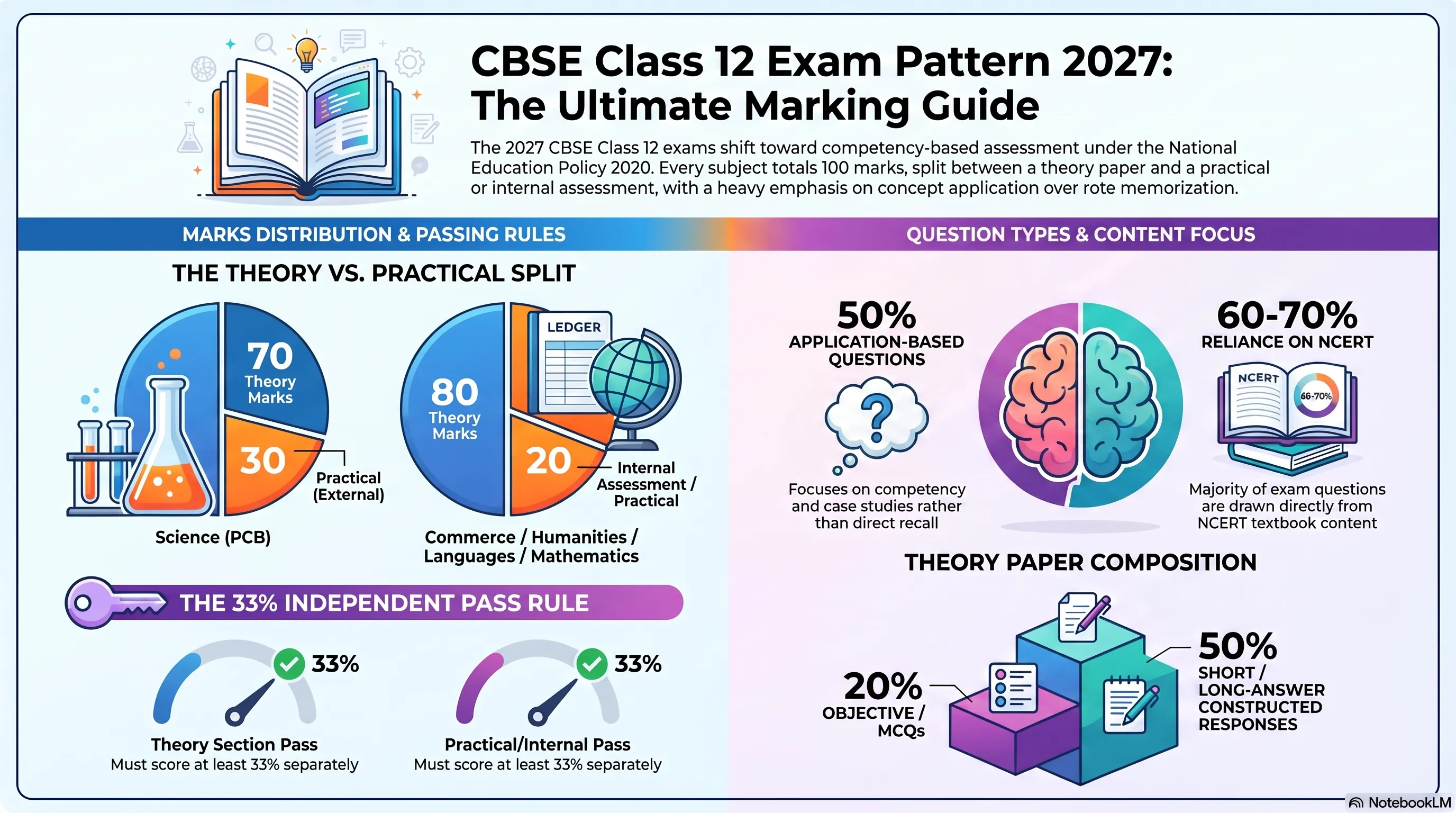
Table of Contents
- What Is the CBSE Class 12 Exam Pattern 2027?
- How Are Theory and Practical Marks Divided?
- What Types of Questions Will You Face in the 2027 Paper?
- Subject-Wise Marking Scheme: Physics, Chemistry, Maths, Biology
- What Is the Passing Criteria for CBSE Class 12 2027?
- CBSE Class 12 2027 Exam Dates and Duration
- Balancing Board Prep with JEE and NEET Preparation

eSaral › NEET › JEE› CBSE Class 12 Exam Pattern 2027: Marking Scheme Explained

What Is the CBSE Class 12 Exam Pattern 2027?
CBSE conducts the Class 12 board exam once a year for students enrolled in CBSE-affiliated schools across the Science, Commerce, and Humanities streams. Roughly 17 lakh students appear for it annually, sitting papers in more than 100 subjects.
Every subject paper for the 2027 cycle carries 100 marks total, combining a written theory paper with either a practical exam or an internal assessment component. The exact split varies by subject group, as covered in detail in the next section.
CBSE has continued to push its papers toward competency-based assessment under the framework of the National Education Policy 2020. That means less rote recall and more real-life application — case studies, source-based questions, and MCQs that test whether a concept is actually understood, not just memorised.
How is CBSE Class 12 different from CBSE Class 10?
Class 10 in the 2026-27 session offers CBSE students two board exam attempts, with the better score counted toward the final result. Class 12 has not adopted this dual-exam system — as of this writing, CBSE conducts a single annual board exam for Class 12, and students appear only once per academic session.
How Are Theory and Practical Marks Divided?
This is the number students get wrong most often, because the split isn't the same across every subject.
| Subject Group | Theory Marks | Practical / Internal Assessment | Total |
|---|---|---|---|
| Science (Physics, Chemistry, Biology) | 70 | 30 | 100 |
| Mathematics | 80 | 20 (Internal Assessment) | 100 |
| Commerce (Accountancy, Business Studies, Economics) | 80 | 20 (Internal Assessment) | 100 |
| Humanities / Languages | 80 | 20 (Internal Assessment) | 100 |
For Physics, Chemistry, and Biology, the 30 practical marks come from a hands-on lab exam conducted by your school with an external examiner present — this is separate from the written theory paper and is graded independently. Subjects without a physical lab component instead carry 20 marks of Internal Assessment, built from periodic tests, notebook submission, and subject enrichment activities through the year.
💡 Expert Tip: Students often ignore the practical/IA component because it "feels smaller." Don't. A weak practical score can pull down an otherwise strong Physics or Chemistry result by 4–5 percentile points in your overall aggregate — treat those 30 marks with the same seriousness as the theory paper.
What Types of Questions Will You Face in the 2027 Paper?
CBSE's competency-based push means the 2027 question paper is built around a fixed proportion of question types rather than a free mix.
- 20% — Objective / MCQ-type (select-response) questions
- 30% — Competency-based questions such as case-based, source-based, and application-driven MCQs
- 50% — Constructed response questions, meaning short-answer and long-answer type questions that require written explanation
Put together, that means 50% of every paper now tests concept application rather than direct recall — a meaningful shift from the older, more memorisation-heavy pattern. CBSE has also confirmed that around 60–70% of questions will draw directly from NCERT textbook content, so ignoring NCERT in favour of only reference books is a mistake.
Are marks deducted for exceeding the word limit?
No. CBSE does not penalise students for writing beyond the suggested word limit in board answers. Marks can, however, be deducted for factual errors, and in language papers, for spelling and grammar mistakes — so precision still matters more than length.
Subject-Wise Marking Scheme: Physics, Chemistry, Maths, Biology
Within the 70-mark (or 80-mark) theory paper, questions are further broken down by mark value. Here's how a typical Physics theory paper is structured for 2027, based on the current CBSE format:
| Question Type | Number of Questions | Marks Each | Total Marks |
|---|---|---|---|
| 1-mark questions | 16 | 1 | 16 |
| 2-mark questions | 5 | 2 | 10 |
| 3-mark questions | 7 | 3 | 21 |
| 4-mark questions | 2 | 4 | 8 |
| 5-mark questions | 3 | 5 | 15 |
| Total | 33 | — | 70 |
Chemistry and Biology follow a similar 70-mark distribution logic, adjusted for their own unit weightages. Mathematics, being an 80-mark theory paper, spreads its questions across a comparable spectrum of MCQs, very-short-answer, short-answer, and long-answer sections, with calculus carrying the single highest weightage among all units.
Which chapters carry the highest weightage?
Weightage varies by subject, but the general rule holds across Science papers: units with the most NCERT chapters and highest conceptual depth (Calculus in Maths, Electrochemistry and Organic Chemistry in Chemistry, Electromagnetic Induction and Optics in Physics) consistently draw the most marks. Building strength in these units first gives the best return on study time.
What Is the Passing Criteria for CBSE Class 12 2027?
A student needs a minimum of 33% marks in each subject and in aggregate to pass CBSE Class 12. For subjects with a separate theory and practical component, this 33% rule applies to both parts independently — scoring 33% overall while failing the practical section in isolation will still result in a fail for that subject.
Students typically register for five compulsory subjects, with a sixth optional subject allowed. When a sixth subject is taken, CBSE calculates the final percentage using the best five of the six results.
💡 Expert Tip: Board pass percentage aur competitive rank ke liye required score alag-alag hoते हैं. Clearing the 33% bar keeps your certificate valid, but if JEE or NEET is the actual goal, benchmark yourself against 85%+ aggregate — that's the zone most serious droppers and Class 12 toppers operate in.
CBSE Class 12 2027 Exam Dates and Duration
Every theory paper runs for 3 hours, regardless of subject or stream — this has stayed consistent across recent CBSE cycles and is expected to continue for 2027.
Based on CBSE's academic calendar for the 2026-27 session, here's the expected timeline for the Class 12 board exams:
- Practical exams: November–December 2026 for winter-bound schools; January–February 2027 for the rest
- Datesheet release: Typically published in December 2026 or January 2027
- Theory exams: Expected to run from mid-February through early April 2027
- Admit card release: February 2027 for regular students
CBSE has not officially confirmed a twice-a-year board exam system for Class 12 (unlike Class 10, which already runs two attempts). Until an official notification changes this, Class 12 students should prepare for a single annual attempt.
Balancing Board Prep with JEE and NEET Preparation
Here's the part most Class 12 students underestimate: roughly 70% of the CBSE syllabus overlaps directly with the JEE Main and NEET syllabus for Physics, Chemistry, Mathematics, and Biology. Studying a chapter thoroughly for boards is not time lost from competitive exam prep — it's the same foundation, tested two different ways.
The difference lies in application. CBSE rewards clear derivations, complete steps, and NCERT-aligned explanations. JEE and NEET reward speed, elimination technique, and the ability to apply the same concept to an unfamiliar problem. Students who treat both as separate subjects end up over-studying; those who study once and switch practice formats save real time.
If you're mapping this overlap against your entrance exam target, it helps to also study the JEE Main exam pattern, the JEE Advanced exam pattern, and the NEET exam pattern side by side with this CBSE breakdown — the shared chapters become obvious quickly, and so does where the marking schemes genuinely diverge.
Frequently Asked Questions
Find answers to common questions.
What is the CBSE Class 12 exam pattern for 2027?
Every subject carries 100 total marks, split as 70 theory + 30 practical for Science subjects or 80 theory + 20 Internal Assessment for Commerce, Humanities, and Mathematics. Papers combine MCQs, case-based questions, and short/long answers, each 3 hours long.
How many marks are theory and practical in CBSE Class 12?
Physics, Chemistry, and Biology carry 70 marks for theory and 30 for the practical exam. Mathematics, Commerce, and Humanities subjects carry 80 marks for theory and 20 for Internal Assessment instead of a practical.
What is the passing criteria for CBSE Class 12 2027?
Students need a minimum of 33% marks in each subject and in the overall aggregate to pass. For subjects with separate theory and practical components, the 33% requirement applies to each part individually.
How many MCQs are there in the CBSE Class 12 exam?
Objective, select-response MCQs make up 20% of any CBSE Class 12 paper. Another 30% comes from competency-based questions, which are often also MCQ or case-based in format, taking the total objective-style share higher.
Are CBSE Class 12 board exams held twice a year in 2027?
No. Class 10 has moved to a two-attempt system, but CBSE has not implemented this for Class 12. As of now, Class 12 students appear for a single annual board examination.
Does CBSE deduct marks for exceeding the word limit?
No, CBSE does not penalise answers for length. Marks are deducted only for factual inaccuracies, and in language subjects, for spelling or grammatical errors.
How much of the CBSE Class 12 syllabus overlaps with JEE and NEET?
Around 70% of the Physics, Chemistry, Mathematics, and Biology syllabus overlaps between CBSE boards and JEE/NEET. The core concepts are shared; only the question format and difficulty level differ.