Halogen Derivatives Notes for Class 12, IIT JEE & NEET
Halogen Derivatives Notes: Master haloalkanes and haloarenes with concise notes covering SN1/SN2 mechanisms, Grignard reagents, preparation methods, reactions, and important concepts for JEE, NEET, and Class 12 boards.
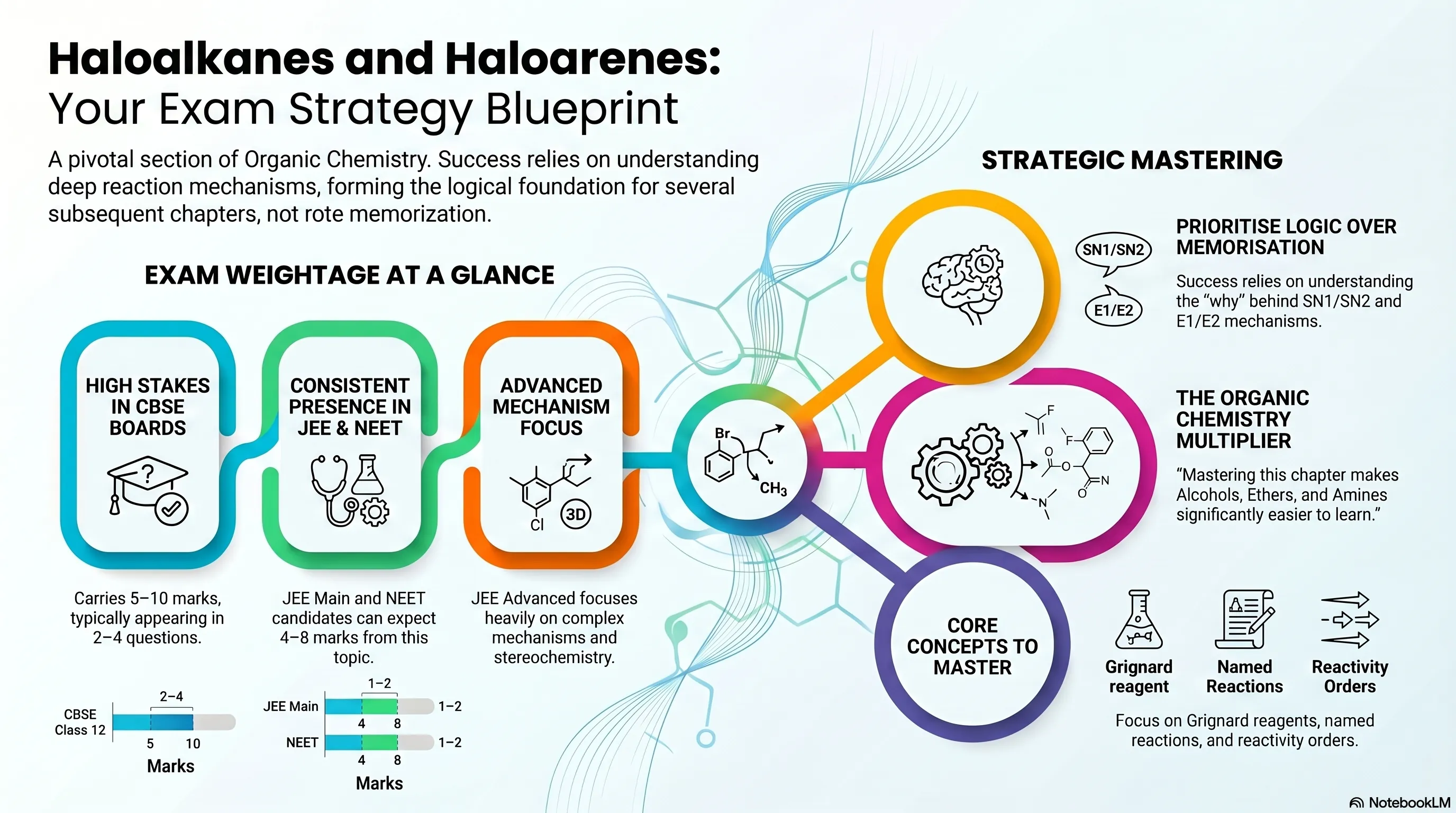
Table of Contents

eSaral › Class 12›Halogen Derivatives Notes for Class 12, IIT JEE & NEET

🚀 Checkout eSaral Courses
Chapter Overview & Weightage
Haloalkanes and Haloarenes is Chapter 10 in NCERT Class 12 Chemistry. It is one of the most concept-rich chapters in Organic Chemistry, and unlike chapters that rely on memorisation, this chapter rewards students who understand why reactions happen — particularly the SN1/SN2 and E1/E2 mechanistic reasoning.
Exam Weightage at a Glance
| Exam | Questions Per Year (approx.) | Marks | Key Topics Tested |
|---|---|---|---|
| JEE Main | 1–2 | 4–8 | SN1 vs SN2, mechanism, Grignard |
| JEE Advanced | 0–1 | 0–4 | Mechanism, stereochemistry |
| NEET | 1–2 | 4–8 | Named reactions, reactivity order |
| CBSE Class 12 Board | 2–4 | 5–10 | Preparation, reactions, definitions |
💡 Expert Tip by Prateek Gupta, IIT Bombay: "This chapter is deceptively important for JEE. The SN1/SN2 concept appears directly in questions and also underpins other chapters — Alcohols, Ethers, and Amines all use nucleophilic substitution logic. Master this chapter and three chapters become easier simultaneously."
Halogen Derivatives Notes
India's Best Exam Preparation for Class 12th - Download Now
India's Best Exam Preparation for Class 12th - Download Now
India's Best Exam Preparation for Class 12th - Download Now
India's Best Exam Preparation for Class 12th - Download Now
India's Best Exam Preparation for Class 12th - Download Now
India's Best Exam Preparation for Class 12th - Download Now
Frequently Asked Questions
Find answers to common questions.
What is the difference between haloalkanes and haloarenes?
Haloalkanes have halogen atoms attached to sp³ carbon atoms in an aliphatic (non-aromatic) chain, such as CH₃Cl or C₂H₅Br. Haloarenes have halogen atoms attached to sp² carbon atoms in an aromatic ring, such as chlorobenzene (C₆H₅Cl). The C–X bond in haloarenes is shorter and stronger due to partial double bond character from resonance, making haloarenes far less reactive towards nucleophilic substitution than haloalkanes.
What are the most important reactions of halogen derivatives for JEE?
The highest-priority reactions for JEE are: SN1 and SN2 nucleophilic substitution (including stereochemistry and solvent effects), elimination vs substitution competition, Grignard reagent preparation and reactions with aldehydes/ketones/CO₂, the Finkelstein and Sandmeyer reactions, and Wurtz reaction for alkane synthesis. The SN1/SN2 mechanistic distinction — including carbocation stability, Walden inversion, and solvent polarity effects — is the single most tested concept.
What is the reactivity order of alkyl halides in SN reactions?
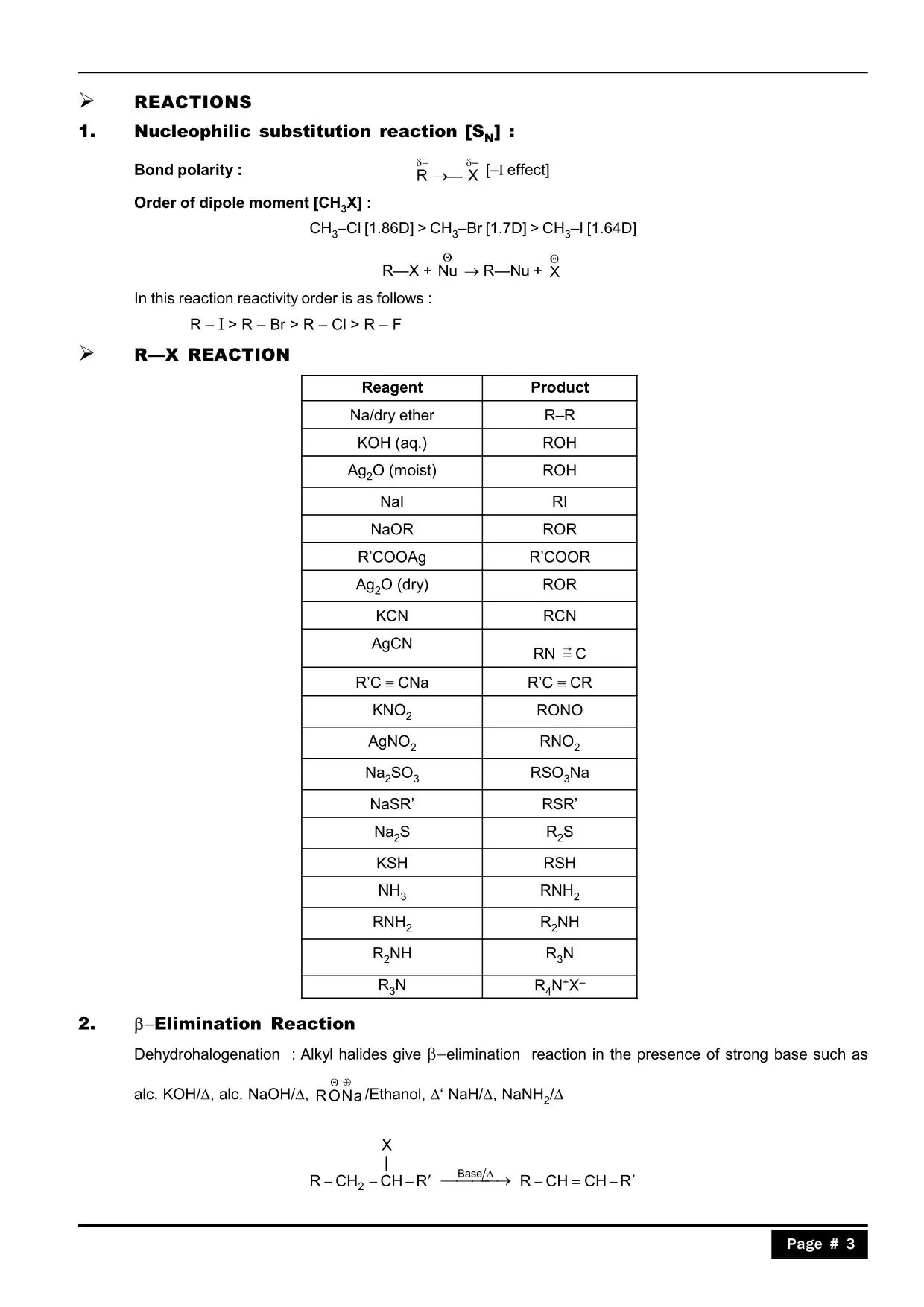
In nucleophilic substitution reactions, the reactivity order is RI > RBr > RCl > RF. This is because the leaving group ability follows the same order — iodide (I⁻) is the best leaving group as it forms the weakest C–I bond (despite being the largest halide). Fluoride (F⁻) is the worst leaving group because the C–F bond is the strongest.
When does SN1 occur and when does SN2 occur?
SN1 occurs with tertiary alkyl halides, weak nucleophiles, polar protic solvents (water, alcohols), and at higher temperatures. It proceeds via a carbocation intermediate, giving a racemic mixture. SN2 occurs with primary alkyl halides (or methyl halides), strong nucleophiles (OH⁻, CN⁻, I⁻), polar aprotic solvents (DMSO, acetone), and at lower temperatures. It is a concerted one-step reaction with Walden inversion of configuration.
What is the Wurtz reaction and what are its limitations?
The Wurtz reaction involves treating an alkyl halide with sodium metal in dry ether to produce a higher alkane: 2R–X + 2Na → R–R + 2NaX. Its limitation is that it only works efficiently with two identical alkyl halides. When two different alkyl halides are used, a mixture of three products forms (R–R, R'–R', and R–R'), making it unsuitable for synthesising unsymmetrical alkanes.