JEE Advanced 2026 Answer Key: Download PDF (Paper 1 & 2), Score Calculator & Objection Guide
The JEE Advanced 2026 answer key will be released by IIT Roorkee at jeeadv.ac.in in two stages: provisional answer key on May 25, 2026 and final answer key with results on June 1, 2026. eSaral's unofficial answer key for Paper 1 and Paper 2 is available within hours of the May 17 exam. Use the marking scheme — Single correct (+3/−1), Multi-correct (+4 partial/−2), Numerical (+4/no negative) — to calculate your score out of 360.
Table of Contents
- JEE Advanced 2026 Answer Key — Download PDF (Paper 1 & 2)
- Answer Key Release Dates — Official Timeline
- How to Download the Official JEE Advanced 2026 Answer Key from IIT Roorkee
- How to Calculate Your JEE Advanced 2026 Score Step by Step
- How to Challenge the JEE Advanced 2026 Answer Key — Full Objection Process
- Subject-wise Answer Key — Physics, Chemistry & Mathematics
- Previous Year JEE Advanced Answer Key Trends — What to Expect in 2026

eSaral ›JEE ›JEE Advanced ›JEE Advanced 2026 Answer Key

JEE Advanced 2026 Answer Key — Download PDF (Paper 1 & 2)
JEE Advanced 2026 was conducted by IIT Roorkee on May 17, 2026 in CBT (Computer-Based Test) mode. Unlike NEET, candidates do not receive a physical copy of the paper — the official question papers are released at jeeadv.ac.in. eSaral's faculty team prepares unofficial answer keys and detailed solutions for both papers as soon as memory-based questions become available.
eSaral Unofficial Answer Key (Available May 17, 2026)
IIT Roorkee Official Answer Key
| Answer Key Type | Expected Release | Download Link |
|---|---|---|
| Candidate Response Sheet | May 21, 2026 (5 PM) | jeeadv.ac.in (Active post-release) |
| Provisional Answer Key | May 25, 2026 (10 AM) | jeeadv.ac.in |
| Challenge Window | May 25–26, 2026 | jeeadv.ac.in (₹200/question) |
| Final Answer Key + Result | June 1, 2026 (10 AM) | jeeadv.ac.in |
Expert Tip by Saransh Gupta, IIT Bombay AIR-41: Bookmark this page and check it after the exam on May 17. eSaral's answer key is typically ready within 2–3 hours of the exam ending. For JEE Advanced, always verify your answers against your response sheet (released May 21) — not just memory — since question ordering can vary per candidate in CBT mode.
Answer Key Release Dates — Official Timeline
Understanding the full answer key timeline helps you plan score estimation, college research, and the objection window without missing any deadlines.
| Event | Date | Status |
|---|---|---|
| Exam Date | May 17, 2026 | Completed |
| Response Sheet | May 21, 2026 (5 PM) | Upcoming |
| Provisional Answer Key | May 25, 2026 (10 AM) | Upcoming |
| Challenge Window | May 25–26, 2026 (till 5 PM) | Upcoming |
| Final Answer Key + Result | June 1, 2026 (10 AM) | Upcoming |
| JoSAA Counselling Registration | June 2, 2026 | Upcoming |
Historical pattern for reference:
| Year | Exam Date | Provisional Key | Final Key + Result | Conducting IIT |
|---|---|---|---|---|
| JEE Advanced 2026 | May 17, 2026 | May 25, 2026 | June 1, 2026 | IIT Roorkee |
| JEE Advanced 2025 | May 18, 2025 | May 22, 2025 | June 2, 2025 | IIT Kanpur |
| JEE Advanced 2024 | May 26, 2024 | June 2, 2024 | June 9, 2024 | IIT Madras |
| JEE Advanced 2023 | June 4, 2023 | June 9, 2023 | June 18, 2023 | IIT Guwahati |
How to Download the Official JEE Advanced 2026 Answer Key from IIT Roorkee
Once IIT Roorkee releases the provisional answer key on May 25, follow these steps to download it from the official candidate portal:
Step 1: Visit the official JEE Advanced website at jeeadv.ac.in and look for the "JEE Advanced 2026 Answer Key" notification on the homepage.
Step 2: Click the link and log in using your JEE Advanced 2026 Registration Number and Date of Birth / Password.
Step 3: Your candidate portal will show links to both Paper 1 Answer Key and Paper 2 Answer Key. Download both as PDF.
Step 4: Also download your Response Sheet from the same portal (available May 21). You need this to match your actual responses against the key using Question IDs.
Step 5: Compare responses using Question ID and Option ID — not question numbers, which may differ in CBT mode across candidates.
Step 6: Apply the marking scheme (see below) to each question type to arrive at your Paper 1 and Paper 2 scores, then add them for your total out of 360.
Expert Tip by eSaral IIT Faculty: In JEE Advanced CBT mode, the same question can appear in a different position for different candidates. Never compare your "Question 5" with a friend's — always match using the unique Question ID printed on your response sheet. This is the most common score calculation error students make.
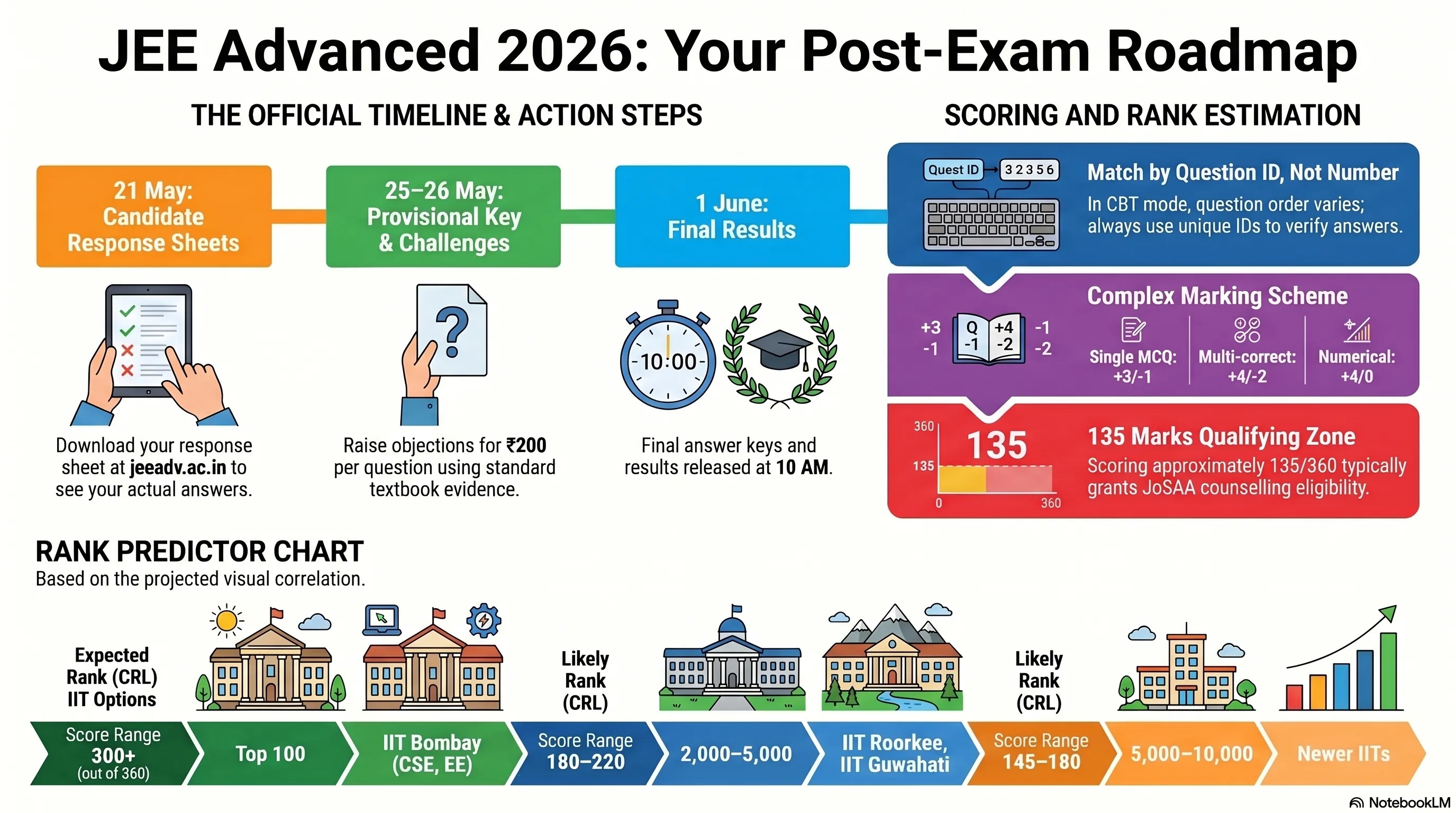
NOTE: Use a rank predictor. Once you have your estimated score, a JEE Advanced rank predictor (based on 2024–2025 data) gives you a fair estimate of your probable AIR and IIT options.
How to Calculate Your JEE Advanced 2026 Score Step by Step
JEE Advanced uses four types of questions across Paper 1 and Paper 2, each with a different marking scheme. Calculating your score correctly requires knowing the question type, not just whether your answer was right or wrong.
JEE Advanced 2026 Marking Scheme
| Question Type | Correct | Partial | Incorrect | Unattempted |
|---|---|---|---|---|
| Single Correct MCQ | +3 | 0 | −1 | 0 |
| Multi Correct MCQ (all correct options) | +4 | +1 to +3 | −2 | 0 |
| Numerical Value Type | +4 | 0 | 0 (no negative) | 0 |
| Matrix Match (per row) | +3 | 0 | −1 | 0 |
Total Score = Σ (Correct response marks) − Σ (Negative marks for incorrect responses)
Step-by-step score calculation
Step 1: Download your response sheet (May 21) and provisional answer key (May 25) from jeeadv.ac.in.
Step 2: For each question, identify its type — Single MCQ, Multi MCQ, Numerical, or Matrix Match — from the paper.
Step 3: Mark each response as Correct, Incorrect, or Unattempted by comparing Question IDs.
Step 4: Apply the correct marking rule for each question type. For multi-correct: check if any wrong option was selected — if yes, −2 applies regardless of correct options also chosen.
Step 5: Total Paper 1 marks + Paper 2 marks = your JEE Advanced 2026 aggregate score (out of 360).
Score to expected rank (estimated, General CRL)
| Score Range (out of 360) | Expected CRL Rank | Likely IIT Options |
|---|---|---|
| 300+ | Top 100 | IIT Bombay CSE, EE |
| 260–300 | 100–500 | IIT Delhi, IIT Bombay |
| 220–260 | 500–2,000 | IIT Madras, IIT Kharagpur |
| 180–220 | 2,000–5,000 | IIT Roorkee, IIT Guwahati |
| 145–180 | 5,000–10,000 | Newer IITs |
| ~135 | ~10,000 (qualifying zone) | JoSAA counselling eligible |
Estimates based on JEE Advanced 2024–2025 data. Actual ranks depend on the number of qualified candidates and paper difficulty. Official cutoff releases with results on June 1.
How to Challenge the JEE Advanced 2026 Answer Key — Full Objection Process
When should you challenge the JEE Advanced 2026 answer key?
Challenge an answer if you have strong evidence — from standard textbooks, official NCERT material, or well-established scientific literature — that the key is incorrect. Do not challenge on guesswork. Each challenge costs ₹200 and is non-refundable if rejected. If accepted, IIT Roorkee revises the answer for all candidates and refunds your fee.
Step-by-step objection process
Step 1: Visit jeeadv.ac.in during the challenge window: May 25 (10 AM) to May 26 (5 PM).
Step 2: Log in using your JEE Advanced 2026 Registration Number and Date of Birth.
Step 3: Click on "Answer Key Challenge" or "Raise Objection" on your candidate dashboard.
Step 4: Select the paper (Paper 1 or Paper 2) and the specific Question ID you wish to challenge.
Step 5: Indicate the answer you believe is correct and upload supporting evidence — scan of the relevant textbook page, standard reference, or published source.
Step 6: Pay ₹200 per challenged question via the online payment gateway. Note your challenge reference number after submission.
Step 7: IIT Roorkee's expert committee reviews all objections. If accepted, the revised answer applies to all candidates and your fee is refunded. The final key (June 1) cannot be challenged.
Important: In JEE Advanced 2025, at least one question was revised after candidate challenges. A single mark at the 150–200 score range can shift your rank by 500–1,000 positions and change your IIT branch options. If you have solid evidence, challenging is worth the ₹200.
Subject-wise Answer Key — Physics, Chemistry & Mathematics
JEE Advanced 2026 tested Physics, Chemistry, and Mathematics across Paper 1 and Paper 2, with 18 questions per subject per paper (54 total per paper). Here is the subject-wise breakdown of what to expect in each section's answer key.
Physics Answer Key (Paper 1: Q1–18 | Paper 2: Q1–18)
Physics was rated the toughest section in Paper 2 and second toughest in Paper 1. Questions were heavily numerical and multi-step. Students who excelled in Mechanics and Electrodynamics generally performed better.
| Chapter Group | Expected Questions | Marks (combined) |
|---|---|---|
| Mechanics (Rotation, SHM, Gravitation) | 7–9 | 21–36 |
| Electrostatics & Current Electricity | 6–8 | 18–32 |
| Optics (Ray & Wave) | 4–5 | 12–20 |
| Modern Physics & Nuclear | 4–5 | 12–20 |
| Thermodynamics & Waves | 3–4 | 9–16 |
Chemistry Answer Key (Paper 1: Q19–36 | Paper 2: Q19–36)
Chemistry was the most scoring section for well-prepared students. Organic mechanisms and Coordination Compounds were prominent. Strong conceptual clarity in Physical Chemistry — especially Thermodynamics and Equilibrium — was rewarded.
| Chapter Group | Expected Questions | Marks (combined) |
|---|---|---|
| Organic Chemistry (Reactions & Mechanisms) | 9–11 | 27–44 |
| Coordination Compounds & d-Block | 5–6 | 15–24 |
| Physical Chemistry (Thermodynamics, Equilibrium) | 6–8 | 18–32 |
| p-Block Elements | 3–5 | 9–20 |
| Electrochemistry & Chemical Kinetics | 3–4 | 9–16 |
Mathematics Answer Key (Paper 1: Q37–54 | Paper 2: Q37–54)
Mathematics was the most challenging section in Paper 1 and second hardest in Paper 2. Calculus and Coordinate Geometry carried the highest weightage. Students found this section highly time-consuming due to lengthy multi-step problems.
| Chapter Group | Expected Questions | Marks (combined) |
|---|---|---|
| Integral & Differential Calculus | 8–10 | 24–40 |
| Coordinate Geometry (Conics, Circles) | 6–7 | 18–28 |
| Algebra (Matrices, Complex Numbers, Sequences) | 5–7 | 15–28 |
| Probability & Statistics | 3–4 | 9–16 |
| Vectors & 3D Geometry | 3–4 | 9–16 |
Previous Year JEE Advanced Answer Key Trends — What to Expect in 2026
Understanding how IIT Roorkee and previous conducting IITs have handled answer key revisions helps you decide whether to file a challenge and what to expect from the final result.
Key observations from JEE Advanced 2023–2025 answer keys:
- 1–3 questions per year have been revised after candidate challenges in recent JEE Advanced exams.
- Mathematics and Physics have the highest objection rates — multi-correct questions with ambiguous options are the most common targets.
- Numerical value type questions have never been successfully challenged in recent years — IIT committees typically uphold these.
- In JEE Advanced 2025, a Chemistry question was revised after candidates presented evidence from IUPAC guidelines — changing marks for thousands of students.
- A single revised question near the qualifying cutoff (around 135 marks) can affect JoSAA counselling eligibility for hundreds of candidates.
| Year | Questions Revised | Subjects Affected | Impact |
|---|---|---|---|
| JEE Advanced 2025 | 1 question | Chemistry | Marks awarded to all candidates |
| JEE Advanced 2024 | 2 questions | Physics, Maths | Rank changes near the cutoff boundary |
| JEE Advanced 2023 | 1 question | Mathematics | Minor score adjustments across candidates |
Expert Tip by eSaral IIT Faculty: For multi-correct questions where you selected two options and the key shows three correct options — even partial credit can matter. If you selected only correct options (no wrong one), you get partial marks. Review your response sheet carefully for these cases before concluding your final score.
JEE Advanced 2026 score below target? Start 2027 the right way. eSaral's JEE Dropper Course is built by IIT Bombay faculty who've been inside the exam. Kota-quality teaching, online and offline — structured from day one.
Frequently Asked Questions
Find answers to common questions.
Is the unofficial JEE Advanced 2026 answer key from eSaral reliable?
Yes. eSaral's JEE Advanced answer key is prepared by IIT-trained subject experts with deep experience in Physics, Chemistry, and Mathematics at the JEE Advanced level. Unofficial keys are typically 97–99% accurate and are useful for quick score estimation immediately after the exam. For official score calculation and any challenge filing, always refer to the IIT Roorkee provisional answer key released at jeeadv.ac.in on May 25.
How do I calculate my JEE Advanced 2026 score using the answer key?
Download your response sheet (May 21) and the provisional key (May 25) from jeeadv.ac.in. Match answers using Question IDs. The marking scheme varies by question type: Single correct (+3/−1), Multi-correct (+4 to +1 partial / −2 if any wrong option chosen), Numerical (+4 / no negative marking), Matrix Match (+3 per correct row / −1 per wrong row). Add Paper 1 and Paper 2 for your total out of 360.
How do I challenge the JEE Advanced 2026 answer key if I think an answer is wrong?
Log in to jeeadv.ac.in during the official challenge window (May 25, 10 AM to May 26, 5 PM). Select the paper and Question ID you wish to challenge, indicate your answer, upload supporting evidence from a standard textbook or official source, and pay ₹200 per question. If IIT Roorkee's expert committee accepts your challenge, the answer is revised for all candidates and your fee is refunded. If rejected, the fee is forfeited.
What is the difference between the provisional and final JEE Advanced answer key?
The provisional answer key is IIT Roorkee's initial release on May 25 — it is open to challenge by candidates for 2 days. After reviewing all objections, IIT Roorkee publishes the final answer key on June 1, simultaneously with the result. The final key incorporates any accepted revisions and cannot be challenged. Results and ranks are calculated exclusively using the final answer key.
When will JEE Advanced 2026 results be declared?
JEE Advanced 2026 results will be declared by IIT Roorkee on June 1, 2026 at 10 AM at jeeadv.ac.in. The result will show each candidate's subject-wise marks, total aggregate, AIR (All India Rank), category rank, and qualifying status. JoSAA 2026 counselling registration opens the following day, June 2, 2026.