JEE Main Physics Chapter wise Weightage - PDF Download
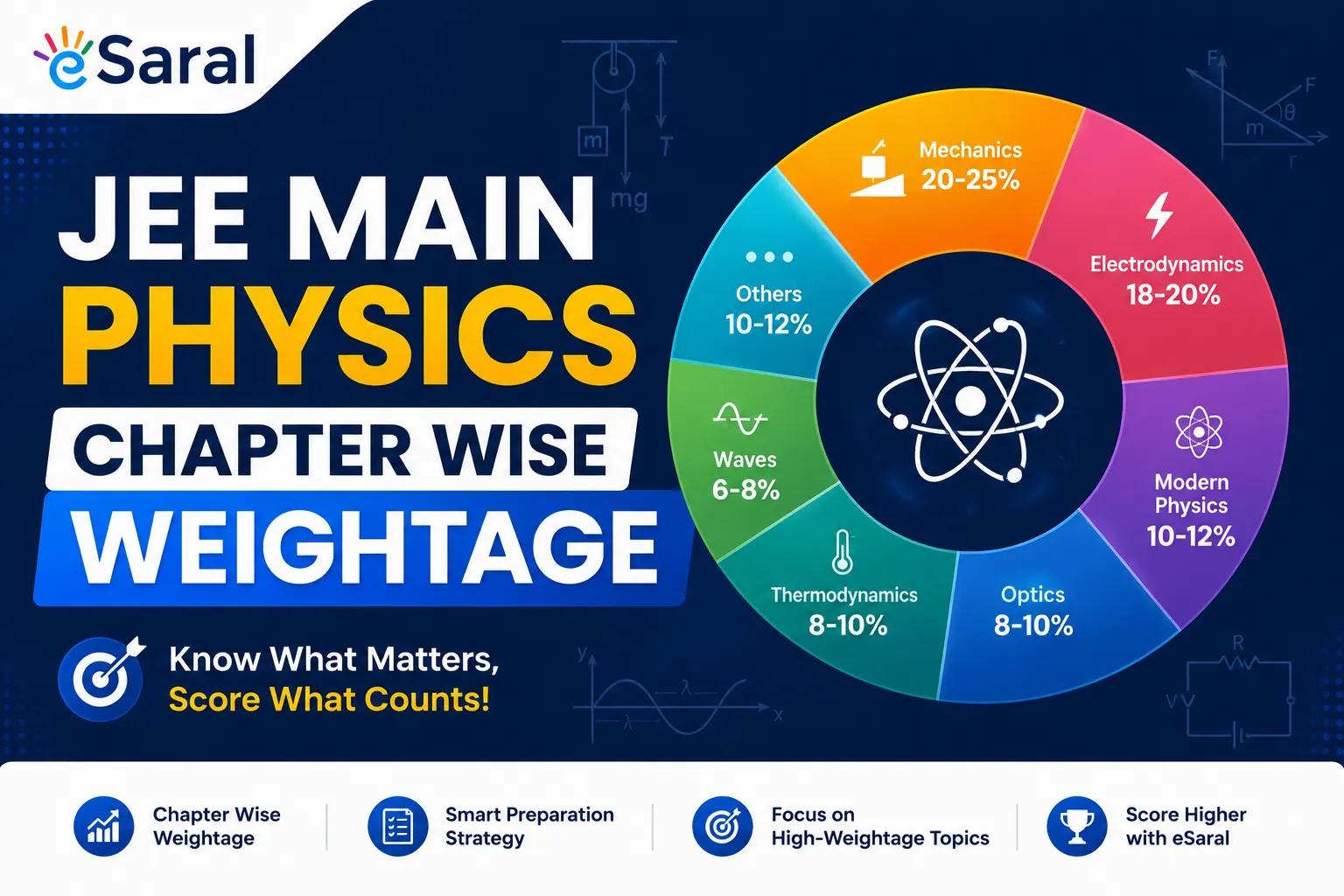
Table of Contents
- Physics Weightage in JEE Main Exam
- JEE Main Physics Chapter-Wise Weightage
- Most Weightage Chapters for JEE Main Physics
- List of Important Topics and Chapters for JEE Main Physics
- Why is it Important to Cover the Physics Syllabus?
- What are the Benefits of Completing Your Physics Syllabus Before Time?

eSaral > JEE Main > JEE Main Physics Weightage

Physics Weightage in JEE Main Exam
Physics (22.5%):
-
High weightage: Electrostatics, Current Electricity, Optics, Mechanics.
-
Moderate weightage: Modern Physics, Magnetism, Thermodynamics, Waves.
-
Relatively lower weightage: Units and Dimensions, Experimental Physics, Kinematics
JEE Main Physics Chapter-Wise Weightage
|
Chapters |
Total Questions |
Weightage |
|
Electrostatics |
1 |
3.3% |
|
Capacitors |
1 |
3.3% |
|
Simple Harmonic Motion |
1 |
3.3% |
|
Sound Waves |
1 |
3.3% |
|
Elasticity |
1 |
3.3% |
|
Error in Measurement |
1 |
3.3% |
|
Circular Motion |
1 |
3.3% |
|
Electromagnetic Waves |
1 |
3.3% |
|
Semiconductors |
1 |
3.3% |
|
Magnetic Effect of Current and Magnetism |
2 |
6.6% |
|
Alternating Current |
2 |
6.6% |
|
Kinetic Theory of Gases & Thermodynamics |
2 |
6.6% |
|
Kinematics |
2 |
6.6% |
|
Work, Energy, and Power |
2 |
6.6% |
|
Laws of Motion |
2 |
6.6% |
|
Centre Of Mass |
2 |
6.6% |
|
Rotational Dynamics |
2 |
6.6% |
|
Modern Physics |
2 |
6.6% |
|
Wave Optics |
2 |
6.6% |
|
Current Electricity |
3 |
9.9% |
Verify the chapter-wise weightage by checking the JEE Main previous year question paper and comparing the actual questions.
Most Weightage Chapters for JEE Main Physics
The chapters with the most weight in Physics are Current Electricity, Gravity, Electrostatics, the Magnetic Effect of Currents, Ray Optics, and Thermodynamics. These are the chapters that help you score well in exams. To maximize scoring from these high-weightage chapters, students should regularly practice JEE Main Important Questions that are frequently asked from Physics in the actual exam.
List of Important Topics and Chapters for JEE Main Physics
|
High Weightage |
Low Weightage |
|
3 Dimensional Geometry |
Differential Equation |
|
Vectors |
Differentiation |
|
Determinant & Matrices |
Trigonometric Equation |
|
Sequence & Series |
Statistics |
|
Straight Line |
Mathematical Logic |
|
Circle |
Set & Relation |
|
Probability Distribution (Binomial Mean & Variance) |
Height & Distance |
|
Definite Integral & Area Under the Curve |
Trigonometric Ratio & Functions |
|
Limits, Continuity & Differentiability |
Properties of Triangle |
|
Functions |
Permutation & Combination |
|
Application of Derivatives |
Indefinite Integral |
|
Conic Sections |
|
|
Complex Number |
|
|
Quadratic Equation |
|
|
Binomial Theorem & M. I. |
|
Weightage numbers land better with proof — link to the JEE Main previous year question paper page so students can verify the chapter-wise counts themselves.
Why is it Important to Cover the Physics Syllabus?
Covering the physics syllabus is important for several reasons, especially for students preparing for exams like IIT-JEE or NEET. Physics is a fundamental subject that helps us understand how the world around us works. From the motion of planets to the working of electronic devices, everything is governed by the laws of physics. By studying the entire syllabus, students gain a complete understanding of these concepts, which is essential for both academic success and everyday life.
Firstly, the physics syllabus is designed to cover various topics systematically, building upon previous knowledge. If students skip certain parts of the syllabus, they may miss key concepts that are crucial for understanding more complex topics later on. For example, understanding basic mechanics is necessary before moving on to topics like electromagnetism or thermodynamics. A thorough grasp of the syllabus ensures that students have a strong foundation.
Secondly, exams like IIT-JEE and NEET are based on the entire physics syllabus. These competitive exams often test students on their in-depth understanding and application of physics principles. If students have not covered the syllabus properly, they may find it difficult to answer such questions, affecting their performance and overall score.
Moreover, covering the syllabus helps students develop problem-solving skills. Physics is not just about learning facts; it’s about applying principles to solve real-world problems. Solving important questions for JEE Main Physics after completing the syllabus improves application skills and helps students handle exam-level numerical and conceptual questions confidently.Regular practice with different topics builds confidence and enhances analytical thinking. This skill is useful not only in exams but also in various professions, especially in engineering, medicine, and technology.
In conclusion, covering the physics syllabus thoroughly is essential for academic success, skill development, and a deeper understanding of the world. It prepares students for exams, future studies, and even professional life by providing them with the tools needed to solve practical problems.
What are the Benefits of Completing Your Physics Syllabus Before Time?
1. More Time for Revision
One of the biggest advantages of completing the physics syllabus early is the extra time you get for revision. Physics concepts often require repeated practice to fully grasp and remember. When you finish the syllabus ahead of schedule, you have the opportunity to go back and review each topic, which helps reinforce your understanding. You can also revisit complex topics, clear any doubts, and strengthen your knowledge. This will help you feel more confident during exams.
2. Opportunity for Practice Tests and Mock Exams
Another major benefit is the time available for taking practice tests and mock exams. Physics exams, especially for competitive ones like IIT-JEE or NEET, often contain tricky and application-based questions. With an early completion, you can attempt multiple practice papers to familiarize yourself with the exam pattern and the types of questions that might appear. This practice improves your speed, accuracy, and problem-solving skills. Mock exams also help identify your weak areas, allowing you to focus on improving them.
3. Better Time Management
Completing your syllabus early also teaches you time management skills. You can divide your time efficiently between other subjects and activities without feeling overwhelmed. When the pressure of finishing the syllabus is lifted, you can create a balanced study schedule that accommodates all subjects, ensuring you prepare well for each one. This organized approach reduces stress and increases your productivity.
4. Enhanced Conceptual Clarity
Physics is a subject that often builds on earlier concepts. For example, understanding mechanics is essential before moving on to rotational motion or electromagnetism. Completing the syllabus early allows you to grasp these foundational concepts at a comfortable pace. You can spend more time on difficult topics like optics, thermodynamics, or electrostatics, ensuring you understand them thoroughly. This strong conceptual clarity is crucial for solving high-level problems, especially in competitive exams.
5. Flexibility to Explore Extra Resources and Advanced Topics
When you have already completed the syllabus, you can explore additional learning materials, such as reference books, online courses, or videos, that may offer different perspectives or in-depth explanations. This extra time also allows you to learn about advanced topics not covered in your regular syllabus but which might be useful in competitive exams. Exploring beyond the textbook makes your knowledge more comprehensive and may give you an advantage in exams where extra knowledge is often tested.
6. Time for Relaxation and Other Activities
Studying continuously without any breaks can lead to burnout. When you complete your syllabus early, you have more free time to relax, pursue hobbies, or engage in extracurricular activities. Balancing studies and relaxation is important for maintaining your mental and physical well-being, which ultimately helps you perform better academically. A relaxed mind is better at retaining information and solving problems, which is crucial in subjects like physics.
7. Boosts Confidence and Reduces Exam Anxiety
Knowing that you have completed the syllabus early can significantly boost your confidence. You feel well-prepared, and this reduces the anxiety that often comes with last-minute cramming. Being calm and composed before an exam allows you to focus better, recall information accurately, and apply concepts effectively. This positive mindset enhances your chances of scoring higher marks.
8. Room for Group Studies and Discussions
Finishing your syllabus early provides you the chance to engage in group studies or discussions with peers. Group studies can be helpful as they allow you to exchange knowledge, solve complex problems together, and understand different methods of solving a question. You can also help others by explaining concepts, which reinforces your understanding further. Moreover, group discussions can reveal new insights or shortcuts that you might not have considered before.
Frequently Asked Questions
Find answers to common questions.
Is Class 11 Physics or Class 12 Physics more important for JEE Main?
Both are equally important. Class 11 covers Mechanics (Kinematics, Laws of Motion, Rotational Dynamics, Thermodynamics), which contributes roughly 40–45% of Physics questions. Class 12 covers Electrostatics, Current Electricity, Optics, and Modern Physics, which contribute the remaining 55–60%. Skipping either year's content significantly limits your score potential.
Which chapter has the highest weightage in JEE Main Physics?
Current Electricity has the highest single-chapter weightage in JEE Main Physics, contributing approximately 3 questions (9.9%) per session on average. Modern Physics, Rotational Dynamics, Wave Optics, and Thermodynamics each contribute around 2 questions (6.6%) and are equally critical for scoring well.
What is the weightage of Physics in JEE Main?
Physics carries 100 marks out of a total of 300 marks in JEE Main, which is approximately 33% of the paper. The section has 30 questions (20 MCQs + 10 numerical), of which 25 must be attempted. Each correct answer gives +4 marks, and each wrong MCQ carries a -1 penalty.
How should I use previous year questions for JEE Main Physics preparation?
Solve previous year JEE Main questions chapter by chapter after completing each chapter, not all at once at the end. This approach reveals your weak subtopics while you still have time to fix them. Aim to solve at least 5 years of questions per chapter. For Class 12 chapters, use the NCERT Solutions for Class 12 Physics as your conceptual anchor before attempting JEE-level problems.
Can I score 70+ in JEE Main Physics without covering Tier 3 chapters?
It is very difficult. Tier 3 chapters (Semiconductors, Sound Waves, Elasticity, Circular Motion, EMW, Error in Measurement) together contribute 6 questions — worth 24 marks. Missing all of them puts a hard ceiling of around 96 marks on your Physics score in the best case, but in practice you will also drop marks in overlapping areas. A minimum-level revision of Tier 3 in 2–3 weeks is strongly recommended.
How many questions come from Mechanics in JEE Main Physics?
Mechanics — including Kinematics, Laws of Motion, Work-Energy-Power, Rotational Dynamics, and Centre of Mass — typically contributes 5–6 questions per JEE Main session. This makes it the largest thematic block in Physics, even though no single Mechanics chapter individually has the highest weightage.