NCERT Class 11 Hindi Book Aroh PDF Download – Chapter-wise | कक्षा 11 हिंदी आरोह
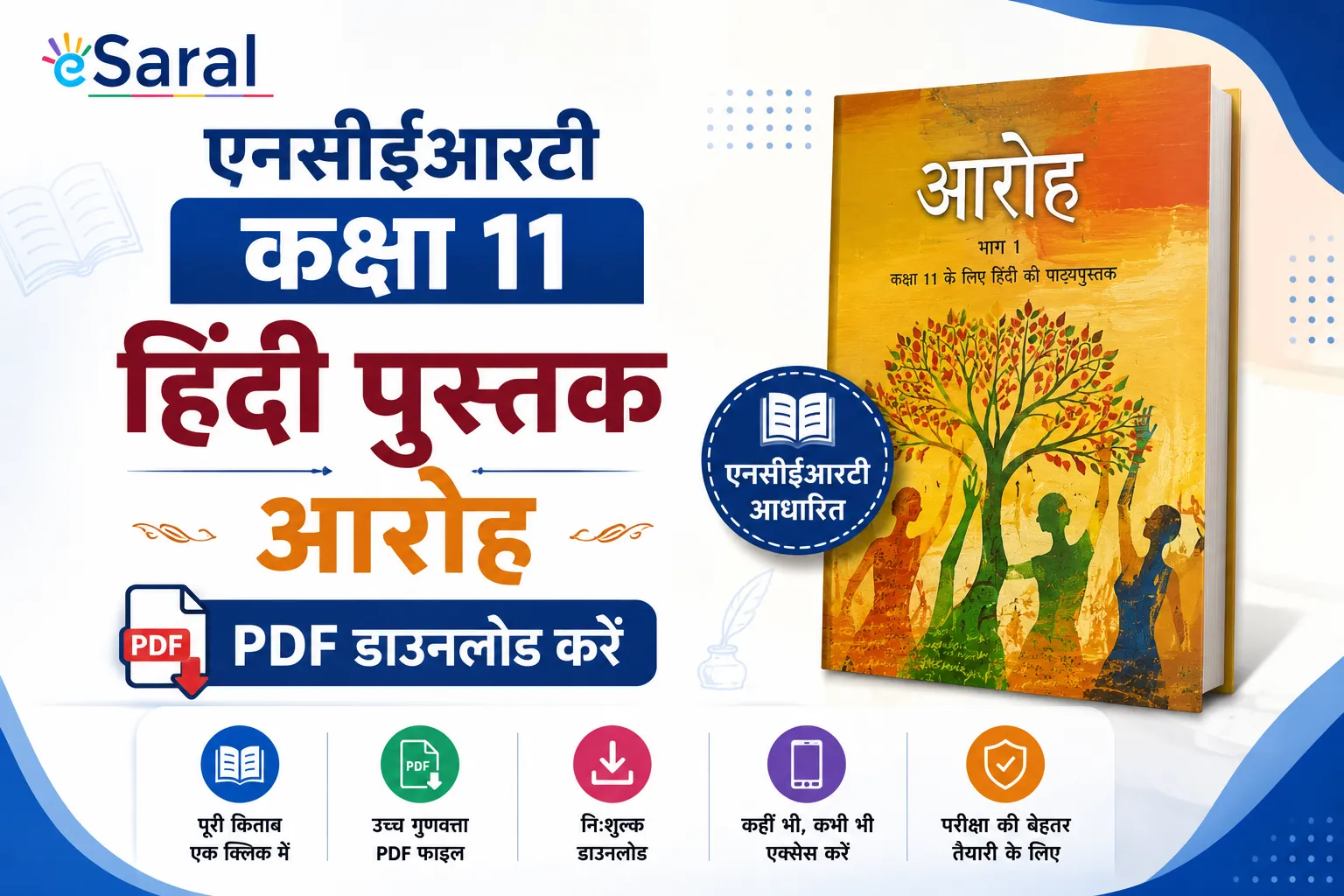
Table of Contents

Home » Class 11 NCERT Books » NCERT Class 11 Hindi Book Aroh

NCERT Class 11 Hindi Book Aroh (आरोह – भाग 1)
NCERT Class 11 Hindi Book Aroh (आरोह – भाग 1) is the primary Hindi textbook prescribed for Class 11 students studying under the CBSE curriculum. The book is divided into two major sections—गद्य भाग (Prose) and काव्य भाग (Poetry)—with each section containing ten chapters.
Aroh is designed to strengthen students' reading comprehension, literary appreciation, vocabulary, and writing skills. The prose section features stories, essays, travelogues, and biographical writings by renowned Hindi authors, while the poetry section introduces students to the works of both medieval saint-poets and modern Hindi poets.
Published by NCERT, Aroh forms a core component of the CBSE Class 11 Hindi Core syllabus. Every chapter is important from the examination perspective, making the textbook essential for school assessments as well as annual board preparation.
Students should carefully read the author introductions and footnotes provided before every chapter. These sections often help in answering short-answer questions related to authors and literary background in school examinations.
Which Four Books Are Included in the Class 11 Hindi Syllabus?
The CBSE Class 11 Hindi syllabus is divided into four separate textbooks, depending on whether a student is studying Hindi Core or Hindi Elective.
| Book Name | Hindi Name | Focus Area |
|---|---|---|
| Aroh – Part 1 | आरोह – भाग 1 | Core Prose and Poetry |
| Vitan – Part 1 | वितान – भाग 1 | Supplementary Reader |
| Antra – Part 1 | अंतरा – भाग 1 | Elective Hindi Prose and Poetry |
| Antral – Part 1 | अंतराल – भाग 1 | Elective Supplementary Reader |
Aroh and Vitan are prescribed for students studying Hindi Core, while Antra and Antral are meant for Hindi Elective students. Since most CBSE schools follow the Hindi Core curriculum, Aroh is the textbook students use most frequently.
NCERT Class 11 Hindi Aroh Chapter-wise PDF Download
The Aroh textbook is divided into two sections—Prose (गद्य भाग) and Poetry (काव्य भाग). Students can download or study each chapter individually according to their preparation needs.
गद्य भाग (Prose Chapters)
| Chapter No. | Chapter Name | Author |
|---|---|---|
| 1 | नमक का दारोगा | मुंशी प्रेमचंद |
| 2 | मियाँ नसीरुद्दीन | कृष्णा सोबती |
| 3 | अपू के साथ ढाई साल | सत्यजित राय |
| 4 | विदाई-संभाषण | बालमुकुंद गुप्त |
| 5 | गलता लोहा | शेखर जोशी |
| 6 | स्पीति में बारिश | कृष्णनाथ |
| 7 | रजनी | मन्नू भंडारी |
| 8 | जामुन का पेड़ | कृशन चंदर |
| 9 | भारत माता | जवाहरलाल नेहरू |
| 10 | आत्मा का ताप | सैयद हैदर रज़ा |
- Chapter 1 - नमक का दारोगा
- Chapter 2 - मियाँ नसीरुद्दीन
- Chapter 3 - अपू के साथ ढाई साल
- Chapter 4 - विदाई-संभाषण
- Chapter 5 - गलता लोहा
- Chapter 6 - स्पीति में बारिश
- Chapter 7 - रजनी
- Chapter 8 - जामुन का पेड़
- Chapter 9 - भारत माता
- Chapter 10 - आत्मा का ताप
काव्य भाग (Poetry Chapters)
| Chapter No. | Poem | Poet |
|---|---|---|
| 1 | हम तौ एक एक करि जांनां / संतों देखत जग बौराना | कबीर |
| 2 | मेरे तो गिरधर गोपाल दूसरो न कोई / पग घुँघरू बाधि मीरां नाची | मीराबाई |
| 3 | पथिक | रामनरेश त्रिपाठी |
| 4 | वे आँखें | सुमित्रानंदन पंत |
| 5 | घर की याद | भवानीप्रसाद मिश्र |
| 6 | चंपा काले-काले अच्छर नहीं चीन्हती | त्रिलोचन |
| 7 | ग़ज़ल | दुष्यंत कुमार |
| 8 | हे भूख! मत मचल / हे मेरे जूही के फूल जैसे ईश्वर | अक्कमहादेवी |
| 9 | सबसे खतरनाक | पाश |
| 10 | आओ, मिलकर बचाएँ | निर्मला पुतुल |
- Chapter 1 - हम तौ एक एक करि जांनां, संतों देखत जग बौराना
- Chapter 2 - मेरे तो गिरधर गोपाल दूसरो न कोई, पग घुँघरू बाधि मीरां नाची
- Chapter 3 - पथिक
- Chapter 4 - वे आँखें
- Chapter 5 - घर की याद
- Chapter 6 - चंपा काले-काले अच्छर नहीं चीन्हती
- Chapter 7 - गजल
- Chapter 8 - हे भूख! मत मचल, हे मेरे जूही के फूल जैसे ईश्वर
- Chapter 9 - सबसे खतरनाक
- Chapter 10 - आओ, मिलकर बचाएँ
What Do Students Learn from the Aroh Book?
Literary Diversity and Language Development
Aroh introduces students to a wide range of literary genres, including short stories, essays, travel writing, satire, biographies, lyric poetry, devotional poetry, and ghazals. This variety helps students understand different writing styles while improving reading comprehension, vocabulary, and writing skills.
For example, नमक का दारोगा by Munshi Premchand explores moral values and honesty through narrative fiction, whereas स्पीति में बारिश presents descriptive travel writing that develops observation and expressive language.
Understanding Classical and Modern Hindi Poetry
The poetry section provides balanced exposure to both classical and contemporary Hindi literature. Students study devotional poetry by Kabir and Mirabai alongside modern poets such as Dushyant Kumar, Paash, and Nirmala Putul.
This combination helps students prepare for literature-based questions, appreciation writing, unseen passages, and long-answer questions commonly asked in CBSE Hindi examinations.
How to Study NCERT Class 11 Hindi Aroh Effectively
Step-by-Step Study Strategy
- Read the author's introduction before starting each chapter.
- Read the complete lesson once to understand the central idea.
- Write down difficult Hindi words and learn their meanings.
- Solve all NCERT exercise questions in your own words.
- Prepare short chapter summaries highlighting the main themes and important literary points.
High-Priority Chapters for School Exams
Although every chapter in Aroh is important, the following lessons frequently receive greater attention in school examinations:
- नमक का दारोगा – Important for comprehension and long-answer questions.
- घर की याद – Frequently selected in poetry-based questions.
- सबसे खतरनाक – Popular for theme-based and appreciation questions.
- विदाई-संभाषण – Commonly used for language and satire-related questions.
Students should revise important themes, literary devices, character sketches, and chapter summaries regularly instead of relying on last-minute preparation.
For comprehensive preparation, students can also refer to the NCERT Solutions for Class 11 across all subjects. Those studying Mathematics and Physics can strengthen their concepts further using detailed NCERT Solutions for Class 11 Maths and NCERT Solutions for Class 11 Physics available on eSaral.
India's Best Exam Preparation for Class 11th - Download Now
To watch Free Learning Videos for class 11 by Kota’s top Faculties, install the eSaral App
Frequently Asked Questions
Find answers to common questions.
Can I download NCERT Class 11 Hindi Aroh PDF for free?
Yes. NCERT makes all its textbooks freely available as PDF downloads on its official website (ncert.nic.in). The chapter-wise PDF links on this eSaral page also allow you to download individual chapters directly, so you do not need to download the entire book if you only need specific chapters.
NCERT Aroh used for Hindi Core or Hindi Elective?
Aroh Part 1 is prescribed for Hindi Core students under CBSE. Students who have opted for Hindi Elective use Antra and Antral instead. Check your school's subject registration or your CBSE admit card to confirm which course you are enrolled in before downloading the book
How many chapters are in NCERT Class 11 Hindi Aroh?
NCERT Class 11 Hindi Aroh contains 20 chapters in total — 10 chapters in the Prose section (गद्य भाग) and 10 chapters in the Poetry section (काव्य भाग). Each section is examined separately in CBSE Class 11 board and school exams, so students must prepare both parts thoroughly
Does NCERT Aroh follow the latest CBSE syllabus?
Yes. The NCERT Class 11 Hindi Aroh textbook listed on this page matches the CBSE 2025–26 prescribed syllabus. NCERT books are updated periodically by the National Council of Educational Research and Training. Always verify the latest chapter inclusions on the official NCERT website (ncert.nic.in) or CBSE's academic calendar before your exams.
Who are the authors in NCERT Class 11 Hindi Aroh?
The prose section includes authors like Munshi Premchand, Krishna Sobti, Satyajit Ray, Balkrishna Gupt, and Jawaharlal Nehru. The poetry section features poets like Kabir, Mirabai, Sumitranandan Pant, Dushyant Kumar, and Paash. This mix of classical and modern writers reflects the full range of Hindi literary tradition.
Which is the most important chapter in Class 11 Hindi Aroh for exams?
All chapters carry marks, but नमक का दारोगा (Prose, Chapter 1) by Premchand and घर की याद (Poetry, Chapter 5) by Bhawaniprasad Mishra are among the most frequently tested. सबसे खतरनाक by Paash is also a high-frequency poetry chapter for appreciation-type questions in CBSE exams.