NEET 2026 Last 7 Days Preparation Strategy: What Toppers Do Differently (2026)
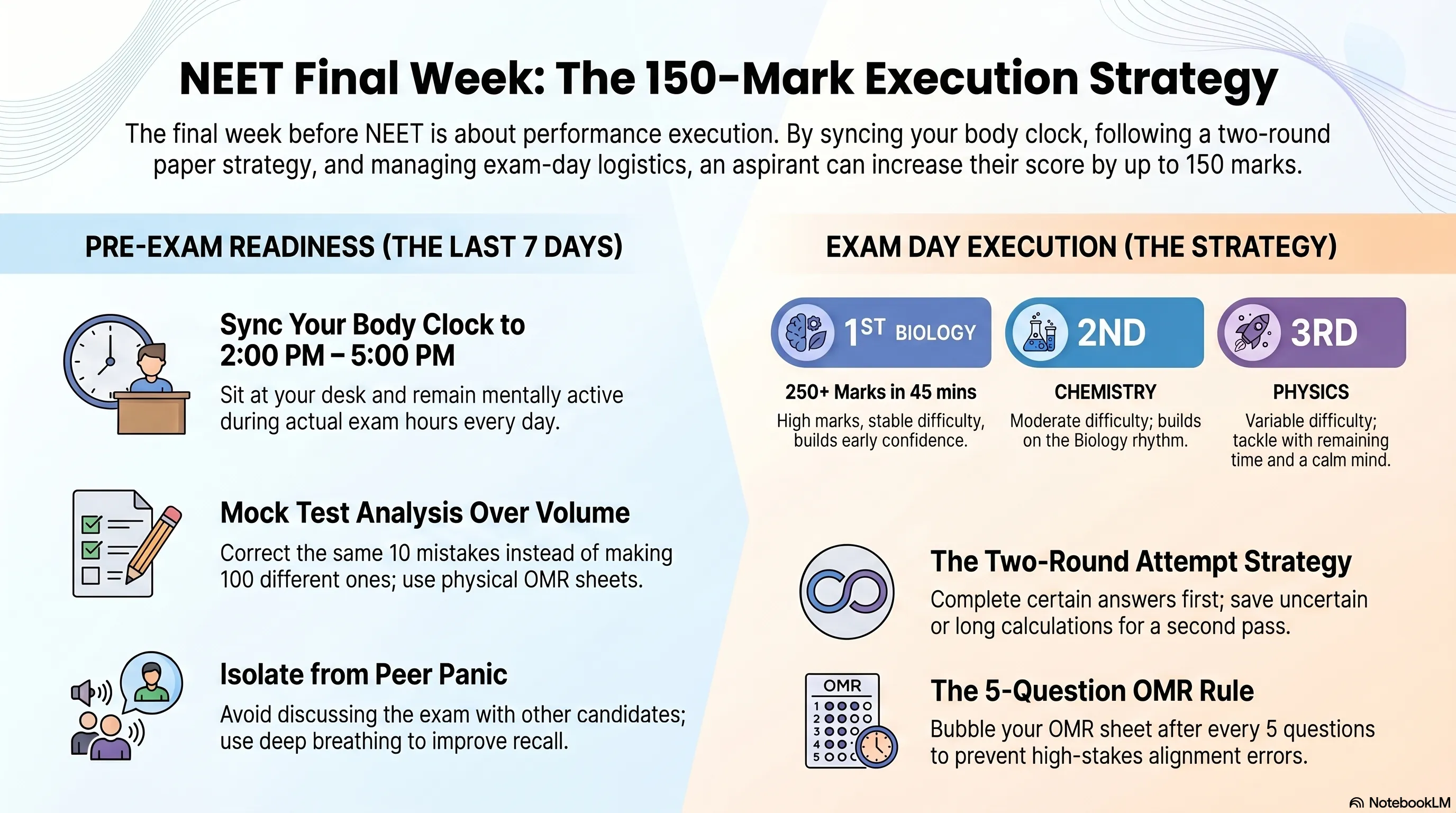
In the last 7 days before NEET, toppers focus on five key areas: syncing their body clock to exam time (2–5 PM), giving 1–2 mock tests daily, using a two-round paper strategy starting with Biology, filling OMR after every 5 questions, and isolating themselves from exam-related anxiety and panic.


Table of Contents
- Why the Last 7 Days Can Change Your Score by 150 Marks
- Step 1: How to Fix Your Body Clock for NEET Exam Day
- Step 2: How Many Mock Tests Should You Give in the Last Week?
- Step 3: The Two-Round Paper Attempt Strategy That Toppers Use
- Step 4: OMR Sheet Strategy — The Rule Nobody Talks About
- Step 5: Focus on Strengths, Not New Topics
- Step 6: Isolate Yourself from Exam Panic — The Most Underrated Tip

eSaral › NEET ›NEET TEST SERIES >NEET Last 7 Days Preparation Strategy

Why the Last 7 Days Can Change Your Score by 150 Marks
Most NEET aspirants spend 1–2 years in preparation. Yet the final week determines whether they perform at 80% or 100% of their potential. The difference is not knowledge — it's execution.
Last year, students whose preparation level was around 600 marks ended up scoring 490–510 simply because of poor mental readiness, wrong paper strategy, or OMR errors. Conversely, aspirants who followed a structured final-week plan got every mark their preparation deserved.
A tough paper can move your score down by 100 marks if you panic. An easy paper can bring you 150 extra marks if your mind is fresh, your body clock is synced, and your strategy is locked. The variable is entirely within your control.
💡 Expert Tip by Prateek Gupta, IIT Bombay: "I have seen students with 600-mark preparation get 490 in NEET because they were mentally unprepared. The last 7 days are not about studying more — they're about being ready to perform."
Step 1: How to Fix Your Body Clock for NEET Exam Day
Why Does Body Clock Matter for NEET?
NEET 2026 is conducted between 2:00 PM and 5:00 PM. If your brain is used to being half-asleep or distracted during this window — because you study at night and sleep in the afternoon — you will underperform on exam day regardless of how much you know.
Your body clock must be synced to the exam window at least 7 days in advance.
Three Body Clock Rules to Follow Right Now
| Rule | What to Do | Why It Matters |
|---|---|---|
| 2–5 PM: Active Study or Mock Test | Sit at your desk every day from 2 to 5 PM, no exceptions | Trains your brain to be sharp during exam hours |
| Eat Before 12:30 PM | Have your lunch fully before 12:30 PM on exam days | No food is allowed inside; avoid hunger distraction |
| Sleep 7–8 Hours Minimum | Go to bed at a consistent time; do not cut sleep in panic | Sleep deprivation erases previously learned content |
One of eSaral's students from the 2024 NEET batch was scoring 580–590 in mock tests but got 494 in the actual exam. The reason: he slept from 3–6 PM every day during preparation, but never bothered to change this before exam day. He dozed off mentally during the 2–5 PM exam window.
If you currently go to bed late and wake up late, do not attempt a sudden schedule change in the last two days. Shift gradually. But if you sleep at 6 AM and wake at 1 PM, change now — because you need to reach the exam centre well before 1:00 PM.
Step 2: How Many Mock Tests Should You Give in the Last Week?
The Right Mock Test Frequency
- If your mock test score is above 400, give 2 full mock tests per day. One must fall in the 2–5 PM window.
- If your mock test score is below 400: Give at least 1 mock test per day, mandatorily between 2–5 PM.
Do not give more than two tests a day. The goal is not exhaustion — it's targeted improvement.
What to Do After Every Mock Test
Giving a test without analysis is a wasted test. After each mock:
- Identify every sub-topic where you made an error
- Go back to your notes and revise only those specific areas
- For Biology — if a concept is appearing wrong repeatedly, memorise it directly
- For Physics and Chemistry — trace why you got it wrong: formula confusion, calculation error, or concept gap
💡 Expert Tip by Prateek Gupta, IIT Bombay: "Analysis is worth more than the test itself. Students who score 700+ are not those who gave 100 tests — they are those who corrected the same 10 mistakes, not 100 different ones."
Always print a physical OMR sheet and fill it during your mock test. Your practice conditions must exactly replicate the NEET UG exam conditions.
Step 3: The Two-Round Paper Attempt Strategy That Toppers Use
What Is the Two-Round Strategy?
Every eSaral topper from the 2024 batch — including students who got ranks 189, 440, 733, and 1300 — attempted the paper in two rounds. Students who cracked JEE Mains with ranks in the 40s and 70s use the same approach.
Round 1 (approximately 2 to 2.5 hours): Attempt only the questions where you:
- Understood the question in the first read
- Know which formula or concept applies
- Are you confident that the calculation is not excessively long
- Can see the answer path clearly
Skip every question where you feel uncertain. Mark it and move on.
Round 2 (remaining time): Return to the skipped questions. Now attempt the partially solvable ones. Leave the ones you genuinely cannot solve — do not guess unless penalty rules allow it (check NTA's latest guidelines).
Why Start with Biology, Not Physics?
Start with Biology first. Always. Here is why:
In NEET 2024, Physics was extremely tough. Students who started with Physics spent the first 60 minutes solving 5–6 questions and saw only 30–40 marks accumulate. With 2 hours left and 600+ marks still to score, panic set in — and their Biology and Chemistry suffered.
Students who started with Biology secured 250–260 marks in the first 30–45 minutes. They felt confident, calm, and ready for Chemistry and Physics.
| Subject Order | Recommended | Reason |
|---|---|---|
| Biology (90 questions) | ✅ Start here | High marks, high confidence, stable difficulty |
| Chemistry (45 questions) | ✅ Attempt second | Moderate difficulty, formula-based, builds on Biology rhythm |
| Physics (45 questions) | ✅ Attempt last | Variable difficulty; tackle with remaining time and a calm mind |
The only exception: if your Biology score in mock tests is consistently below 200, reconsider. But if Biology is even your weakest subject among the three, it is still the safest starting point for most NEET aspirants.
Step 4: OMR Sheet Strategy — The Rule Nobody Talks About
The 5-Question OMR Rule
Never let more than 5 unentered answers accumulate on your rough sheet before filling the OMR.
Many students save OMR filling for the end of the exam. This is one of the most common NEET mistakes. When the invigilator is about to collect the sheet, and you still have 30 answers to bubble, you will make errors in a panic — wrong row, skipped bubble, misaligned entries.
The rule: after every 5 Physics or Chemistry questions, stop and fill in the OMR. For Biology, you can stretch this to 10 questions maximum.
Benefits of the 5-Question Rule
- Mental breaks: Filling the OMR gives your brain a 30-second reset between question blocks
- Error prevention: A sequence error of 5 questions costs you a maximum of 5 questions, not 45
- Reduced end-of-exam panic: You never face a pile-up of unanswered bubbles when the clock hits 5:00 PM
Practice this rule in every single mock test before exam day. It must become automatic.
Step 5: Focus on Strengths, Not New Topics
What NOT to Study in the Last 7 Days
Do not open any chapter you are weak in for the first time. The last 7 days are not for learning — they are for consolidation.
Chapters to let go of if they are your weak areas:
- Physics: Rotational Motion, Fluid Mechanics, if these have never clicked
- Chemistry: Thermodynamics, Ionic Equilibrium, Electrochemistry — only if you have zero base
- Biology: No chapter should be abandoned in Biology — revise everything, even briefly
What to Focus On
Revise only what you already know and can recall. Your preparation over 1–2 years has built a strong knowledge base. Trust it.
If a chapter is moderately familiar — not your strongest but not completely unknown — spend 20–30 minutes reinforcing the key formulas or reactions. That is enough.
Your score on exam day will come from your strengths performing reliably, not from weak topics surprising you. Believe in what you have built.
Step 6: Isolate Yourself from Exam Panic — The Most Underrated Tip
Why "Gyanachand Raychand" Can Cost You Marks
In the final week, every well-meaning friend, relative, or fellow aspirant around you becomes a potential source of panic transfer. Someone else's anxiety about the paper being tough, NTA's latest tweet, or a rumour about the difficulty level will enter your mind and disturb your calm.
The rule: Do not discuss the exam with anyone who is also appearing for NEET. Not your closest friend. Not your sibling preparing for NEET. Nobody.
Instead, speak to friends or family members who have no connection to the exam. Talk about anything else. Watch something light. Laugh. Your mental state on exam day is worth 50–100 marks.
Three Isolation Rules
- No NTA social media tracking — If something important changes, eSaral faculty will inform you directly through the channel
- Tell your family — Ask them, calmly but clearly, to avoid any exam-related conversation for the next 7–10 days
- 30 minutes of Pranayama daily — Deep breathing, done consistently every morning, measurably improves recall and reduces anxiety. If you do not know formal Pranayama, simply sit quietly and take 10 slow, deep breaths. Do this three times during the actual exam,m too — once per subject transition
Remember: When the paper arrives, it will be equally tough or equally easy for all 2.6 million aspirants. The only variable is how prepared and calm you are.
Bookmark this article and explore the NEET syllabus
Frequently Asked Questions
Find answers to common questions.
What should I do in the last 7 days before NEET 2025?
In the last 7 days before NEET, focus on five things: sync your body clock to the 2–5 PM exam window, give 1–2 mock tests daily with OMR practice, attempt the paper in two rounds starting with Biology, fill the OMR after every 5 questions, and stay isolated from exam anxiety. Do not start new topics.
How many hours should I sleep before NEET exam?
Sleep 7–8 hours every night in the week before NEET. Sleep deprivation erases previously learned content from memory. Even on the night before the exam, if sleep does not come, lie down without your phone. Rest without screens is still effective recovery.
Should I start the NEET paper with Physics or Biology?
Always start with Biology. It has 90 questions, is the most predictable section, and helps you accumulate 250–260 marks in confidence early. Starting with Physics — especially if it is tough — creates panic that spills into your Biology and Chemistry performance.
How do I fill the OMR sheet correctly in NEET?
Fill the OMR sheet after every 5 questions in Physics and Chemistry, and after every 10 questions in Biology. Never save OMR filling for the end. A misaligned sequence can cost you 5 questions at most, not 45. Practice this rule in every mock test before exam day.
Can the last 7 days increase my NEET score?
Yes. Depending on the paper's difficulty, the last 7 days can shift your score by 100–150 marks — positively or negatively. A student with 600-mark preparation who panics and mismanages time may score 490. The same student who stays calm, follows a strategy, and sleeps well can score 600+.
Should I study new topics in NEET last 7 days?
No. Do not open any new chapter or weak topic in the last 7 days of NEET preparation. Focus entirely on revising what you already know. Your strengths — not weak topic surprises — will determine your rank. New topics in the final week create confusion, not confidence.