Rajasthan Board (RBSE) Syllabus for Class 12 Chemistry- PDF Download
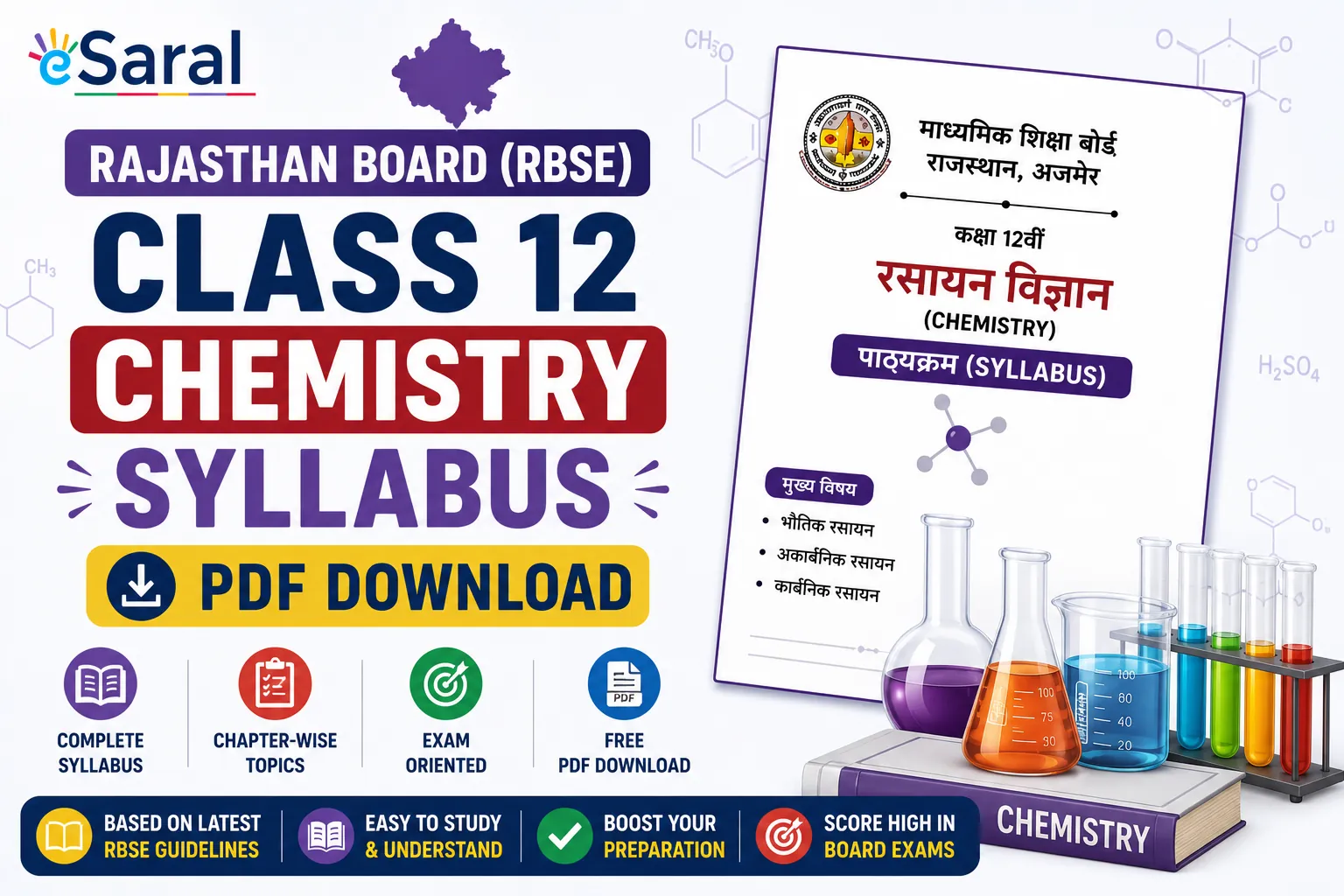
Table of Contents
- What Is the RBSE Class 12 Chemistry Syllabus?
- RBSE Class 12 Chemistry Course Structure
- Unit-wise RBSE Class 12 Chemistry Syllabus
- Unit-wise Difficulty and Weightage
- RBSE 12th Admit Card 2026 – Overview & Important Dates
- How to Download the RBSE 12th Admit Card?
- RBSE 12th Chemistry Preparation Tips
- Final Preparation Strategy

Home » Rajasthan Board » RBSE Class 12 Chemistry Syllabus

What Is the RBSE Class 12 Chemistry Syllabus?
The RBSE Class 12 Chemistry Syllabus is the official curriculum prescribed by the Board of Secondary Education, Rajasthan (BSER) for students appearing in the Class 12 board examination. It outlines every unit, topic, and the distribution of marks that students are expected to study. The theory syllabus has been rationalised compared to earlier editions, allowing students to focus on the most important concepts.
Understanding the syllabus before beginning your preparation helps you:
- Identify high-weightage units and prioritise your study schedule.
- Avoid spending time on topics that are no longer part of the syllabus.
- Align your NCERT textbook preparation with the RBSE examination pattern.
- Please create an efficient revision plan before the board examinations.
The RBSE Class 12 Chemistry syllabus closely follows the NCERT Class 12 Chemistry curriculum. This makes board preparation useful for students simultaneously preparing for competitive examinations such as JEE Main and NEET.
You can strengthen your preparation further using NCERT Solutions for Class 12 Chemistry available on eSaral, where every chapter is explained step by step according to the latest syllabus.
Since the Biomolecules unit overlaps closely with CBSE, add a link to the chemical formula of glucose page next to that entry here too.
RBSE Class 12 Chemistry Course Structure
The Chemistry theory examination carries 56 marks, while the remaining marks are allocated to practical examinations and internal assessment.
| Unit No. | Topic | Marks |
|---|---|---|
| 1 | Solutions | 6 |
| 2 | Electrochemistry | 6 |
| 3 | Chemical Kinetics | 6 |
| 4 | d and f Block Elements | 5 |
| 5 | Coordination Compounds | 5 |
| 6 | Haloalkanes and Haloarenes | 6 |
| 7 | Alcohols, Phenols and Ethers | 6 |
| 8 | Aldehydes, Ketones and Carboxylic Acids | 7 |
| 9 | Amines | 5 |
| 10 | Biomolecules | 4 |
| Total | 56 |
Unit-wise RBSE Class 12 Chemistry Syllabus
Unit 1: Solutions
This unit introduces different types of solutions and concentration terms used in chemistry.
- Types of solutions
- Methods of expressing concentration (molarity, molality, mole fraction, percentage)
- Solubility of solids and gases in liquids
- Henry's Law
- Vapour pressure of liquid solutions
- Raoult's Law
- Ideal and non-ideal solutions
- Colligative properties
- Relative lowering of vapour pressure
- Elevation of boiling point
- Depression of freezing point
- Osmotic pressure
- Determination of molar mass
- Abnormal molar masses and van't Hoff factor
Unit 2: Electrochemistry
This unit focuses on electrochemical cells and their practical applications.
- Electrochemical and galvanic cells
- Nernst equation and applications
- Conductance of electrolytic solutions
- Specific, molar and equivalent conductance
- Kohlrausch's Law
- Electrolytic cells and electrolysis
- Faraday's laws of electrolysis
- Primary and secondary batteries
- Fuel cells
- Corrosion and methods of prevention
Unit 3: Chemical Kinetics
This unit explains the factors affecting the speed of chemical reactions.
- Rate of chemical reactions
- Average and instantaneous reaction rates
- Factors affecting reaction rate
- Order and molecularity of reactions
- Integrated rate equations for zero and first-order reactions
- Half-life of reactions
- Temperature dependence of reaction rate
- Arrhenius equation
- Collision theory of chemical reactions
Unit 4: d and f Block Elements
This unit covers transition elements, lanthanoids and actinoids.
- Position in the periodic table
- Electronic configuration
- General properties of transition elements
- Variable oxidation states
- Catalytic and magnetic properties
- Interstitial compounds and alloy formation
- Important compounds such as KMnO₄ and K₂Cr₂O₇
- Lanthanoids and lanthanoid contraction
- Actinoids
- Applications of d-block and f-block elements
Unit 5: Coordination Compounds
This unit introduces the structure, bonding and applications of coordination compounds.
- Werner's theory
- Ligands, coordination number and coordination sphere
- Oxidation number
- IUPAC nomenclature
- Structural and stereoisomerism
- Valence Bond Theory (VBT)
- Crystal Field Theory (CFT)
- Bonding in metal carbonyls
- Applications of coordination compounds in medicine, metallurgy and analytical chemistry
Unit 6: Haloalkanes and Haloarenes
This unit introduces halo compounds, their preparation, properties and important chemical reactions.
- Classification and nomenclature of haloalkanes and haloarenes
- Nature of the carbon-halogen (C–X) bond
- Preparation of haloalkanes from alcohols and hydrocarbons
- Preparation of haloarenes
- Physical properties of halo compounds
- Nucleophilic substitution reactions (SN1 and SN2)
- Elimination reactions
- Reactions with metals
- Polyhalogen compounds such as DDT and Freons
- Environmental concerns associated with polyhalogen compounds
Unit 7: Alcohols, Phenols and Ethers
This unit focuses on the preparation, properties and reactions of oxygen-containing organic compounds.
- Classification and nomenclature
- Structure of alcohols, phenols and ethers
- Preparation of alcohols from alkenes and carbonyl compounds
- Preparation of phenols from haloarenes and cumene
- Physical properties
- Chemical reactions of alcohols and phenols
- Esterification and oxidation reactions
- Reaction with PCl5
- Commercial importance of methanol and ethanol
- Preparation and reactions of ethers
Unit 8: Aldehydes, Ketones and Carboxylic Acids
This is one of the highest-weightage units in the RBSE Chemistry syllabus.
- Nomenclature and structure of the carbonyl group
- Preparation of aldehydes and ketones
- Preparation from alcohols, acid chlorides and ozonolysis
- Physical and chemical properties
- Nucleophilic addition reactions
- Reduction and oxidation reactions
- Tollens' test
- Fehling's test
- Cannizzaro reaction
- Uses of aldehydes and ketones
- Nomenclature and structure of carboxylic acids
- Preparation from primary alcohols, alkylbenzenes and nitriles
- Physical and chemical properties of carboxylic acids
- Applications and uses of carboxylic acids
Unit 9: Amines
This unit explains the chemistry of nitrogen-containing organic compounds.
- Structure and classification of amines
- Primary, secondary and tertiary amines
- Nomenclature of amines
- Preparation from nitro compounds, nitriles and amides
- Physical properties
- Chemical properties
- Basic character of amines
- Acylation reactions
- Effect of aromaticity
- Preparation of diazonium salts
- Reactions of diazonium salts
- Applications of diazonium salts in organic synthesis
Unit 10: Biomolecules
The final unit introduces biologically important molecules commonly asked in board examinations.
- Carbohydrates
- Classification of carbohydrates
- Structure of glucose and fructose
- Monosaccharides, disaccharides and polysaccharides
- Proteins and amino acids
- Peptide bond and protein structure
- Denaturation of proteins
- Enzymes
- Vitamins and deficiency diseases
- Nucleic acids (DNA and RNA)
- Functions of DNA and RNA
- Introduction to hormones
Unit-wise Difficulty and Weightage
| Unit | Marks | Difficulty Level | Recommended Study Time |
|---|---|---|---|
| Solutions | 6 | Medium | 8–10 hours |
| Electrochemistry | 6 | High | 10–12 hours |
| Chemical Kinetics | 6 | Medium | 8–10 hours |
| d and f Block Elements | 5 | Medium | 6–8 hours |
| Coordination Compounds | 5 | High | 10–12 hours |
| Haloalkanes and Haloarenes | 6 | Medium | 7–9 hours |
| Alcohols, Phenols and Ethers | 6 | Medium | 7–9 hours |
| Aldehydes, Ketones and Carboxylic Acids | 7 | High | 12–14 hours |
| Amines | 5 | Medium | 6–8 hours |
| Biomolecules | 4 | Low | 4–5 hours |
RBSE 12th Admit Card 2026 – Overview & Important Dates
The RBSE Class 12 admit card is a mandatory document for every student appearing in the Rajasthan Board examination. Without a valid admit card, students will not be allowed to enter the examination hall. Make sure to download and print it well before the examination begins.
Admit Card Overview
| Particulars | Details |
|---|---|
| Exam Name | Rajasthan Board Senior Secondary Examination (Class 12) |
| Conducting Body | Board of Secondary Education, Rajasthan (BSER) |
| Admit Card Release | February 2026 (Tentative) |
| Official Website | rajeduboard.rajasthan.gov.in |
Important Dates (Tentative)
| Event | Tentative Date |
|---|---|
| RBSE 12th Admit Card Release | February 2025 |
| RBSE Class 12 Board Exams | February–April 2025 |
| RBSE Class 12 Result | May 2025 |
How to Download the RBSE 12th Admit Card?
The RBSE Class 12 admit card is released on the official Rajasthan Board website. Follow these steps to download it.
Step-by-Step Process
- Visit the official RBSE website.
- Click on the RBSE Admit Card 12th (Year) link.
- Regular students should log in using their school credentials.
- Private candidates should enter the required details such as name, father's name, or roll number.
- Verify all information displayed on the admit card.
- Download the admit card and print at least two copies for future use.
Details to Verify on the Admit Card
- Student's full name
- Father's name
- Roll number
- Photograph and signature
- Subject-wise examination schedule
- Examination centre name and address
- Reporting time
- Exam-day instructions
Exam Day Instructions
- Reach the examination centre at least 30 minutes before reporting time.
- Carry the original RBSE Class 12 admit card.
- Electronic devices such as mobile phones and calculators are not permitted unless specifically allowed.
- Read the question paper carefully during the allotted reading time before starting the examination.
- Follow all instructions issued by the invigilator throughout the examination.
RBSE 12th Chemistry Preparation Tips
1. Start with the Syllabus Before the Textbook
Before beginning any chapter, carefully review the complete RBSE Class 12 Chemistry syllabus. Identify high-weightage units and prepare a study plan accordingly. Since most board examination questions are based on NCERT concepts, study each chapter alongside the NCERT textbook for better conceptual understanding.
2. Prepare a Realistic Study Timetable
Divide your preparation into three phases to ensure complete syllabus coverage and sufficient revision.
- Phase 1: Complete all ten units systematically.
- Phase 2: Solve previous year RBSE question papers and sample papers.
- Phase 3: Revise every unit using short notes, reaction charts and formula sheets.
3. Practise Numericals Regularly
Units such as Solutions, Electrochemistry, and Chemical Kinetics contain several numerical problems. Reading theory alone is not sufficient.
- Solve at least 20–30 numerical questions from each unit.
- Revise important formulas regularly.
- Practise calculations without referring to solutions.
4. Strengthen Concepts Using NCERT Exercises
Many RBSE board questions are directly based on NCERT textbook exercises. Complete every exercise carefully and revise important examples multiple times. Focus on understanding concepts instead of memorising answers.
5. Revise Organic Chemistry Every Day
Organic Chemistry covers four major units and contributes a significant portion of the theory paper.
- Prepare reaction charts.
- Memorise important named reactions.
- Revise reaction mechanisms regularly.
- Create flashcards for important reagents and conversions.
6. Attempt Full-Length Mock Tests
Begin solving complete mock papers at least one month before the examination.
- Solve papers within the official time limit.
- Avoid using books or notes during practice.
- Evaluate your answers honestly.
- Maintain an error notebook for revision.
Final Preparation Strategy
- Study according to the latest RBSE syllabus.
- Prioritise high-weightage units first.
- Complete every NCERT exercise.
- Practise previous year question papers regularly.
- Revise formulas, reactions and important concepts every week.
- Focus equally on theory and numerical questions.
- Solve full-length mock tests before the examination.
- Maintain short notes for quick revision during the final week.
Consistent preparation, regular revision, and continuous practice are the keys to scoring well in the RBSE Class 12 Chemistry examination. By following the latest syllabus, solving previous year papers and strengthening concepts through NCERT-based study, students can improve both their confidence and overall performance in the board examination.
Frequently Asked Questions
Find answers to common questions.
Is the RBSE Class 12 Chemistry syllabus the same as NCERT?
The RBSE Class 12 Chemistry syllabus is largely based on the NCERT Class 12 Chemistry textbook. The units, chapter sequence, and major topics are aligned. This means students can use NCERT textbooks and NCERT Solutions for Class 12 Chemistry as their primary study material for RBSE board exam preparation.
Which unit carries the most marks in RBSE Class 12 Chemistry?
Unit 8 — Aldehydes, Ketones and Carboxylic Acids — carries the highest marks at 7 out of 56. Units 1 (Solutions), 2 (Electrochemistry), 3 (Chemical Kinetics), 6 (Haloalkanes and Haloarenes), and 7 (Alcohols, Phenols and Ethers) each carry 6 marks. Prioritising these six units gives you access to 38 of the 56 theory marks.
How many units are there in the RBSE Class 12 Chemistry syllabus 2024-25?
The RBSE Class 12 Chemistry syllabus 2024-25 has 10 units. These cover Physical Chemistry (Units 1–3), Inorganic Chemistry (Units 4–5), and Organic Chemistry (Units 6–10). The theory paper carries a total of 56 marks. The remaining marks are for practicals and internal assessment.
Has the RBSE Class 12 Chemistry syllabus been reduced?
Yes. The RBSE Board had rationalised the Class 12 Chemistry syllabus, reducing theory content by approximately 30–40% compared to pre-2021 editions. The current syllabus reflects this rationalised version, with 10 units covering the most important conceptual and application-based topics from the original curriculum.
When will the RBSE Class 12 admit card 2027 be released?
The RBSE Class 12 admit card 2027 is expected to be released in February 2027 on the official website rajeduboard.rajasthan.gov.in. Regular students can download it using their school login credentials. Private candidates need to enter their name, father's name, or roll number to access the hall ticket.
How should I prepare for RBSE Class 12 Chemistry in 3 months?
Start by covering all 10 units in the first 6–7 weeks, spending more time on high-weightage and high-difficulty units (Electrochemistry, Coordination Compounds, Aldehydes and Ketones). In weeks 7–10, solve previous year RBSE papers and NCERT exercises. In the final 2 weeks, focus on revision, named reactions, and formula sheets. Attempt at least 4 full mock tests in timed conditions