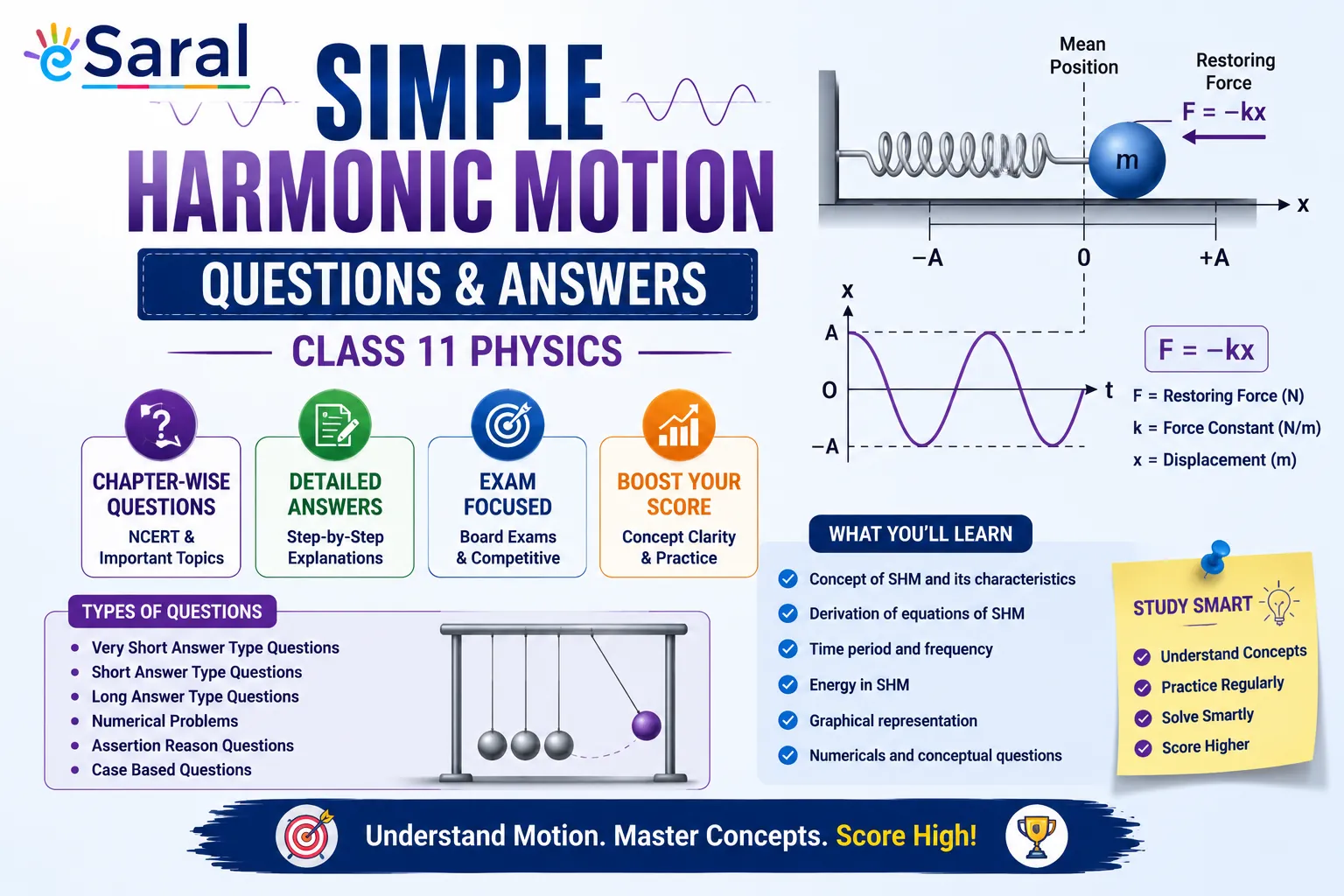
Simple Harmonic Motion Questions and Answers Class 11 Physics

eSaral > Class 11 Physics Questions and Answers > Simple Harmonic Motion

Get (SHM) simple harmonic motion questions and answers for physics class 11 exams. View 11th Physics important questions for exam point of view. These important questions will play a significant role in clearing the concepts of Physics chapters. This question bank is designed by expert faculties keeping the NCERT in mind and the questions are updated with respect to upcoming Board exams. You will get all the important questions for the Class 11 Physics chapter-wise CBSE. Click Here for Detailed Notes of SHM along with other chapters of Physics and other subjects. 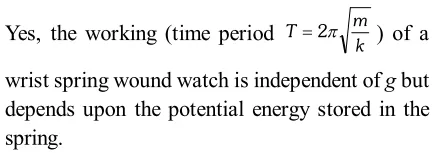



Frequently Asked Questions
Find answers to common questions.
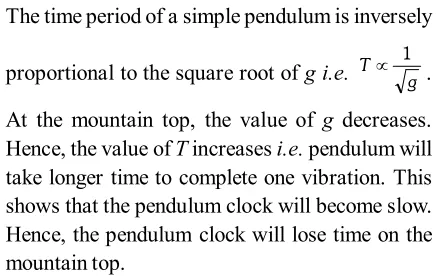
Why does a pendulum clock lose time at higher altitudes?
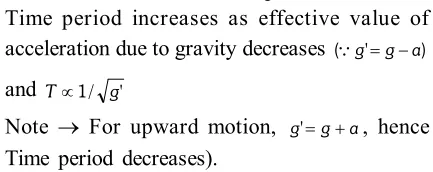
At higher altitudes, gravitational acceleration (g) decreases because the distance from Earth's centre increases. Since the time period of a pendulum is T = 2π√(l/g), a smaller value of g makes T larger. Each oscillation takes fractionally longer, causing the clock to complete fewer oscillations per hour and therefore show a time that progressively falls behind — it loses time.
What is the difference between periodic motion and SHM?
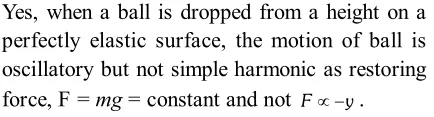
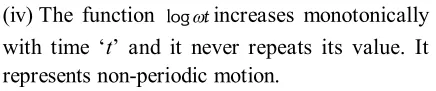
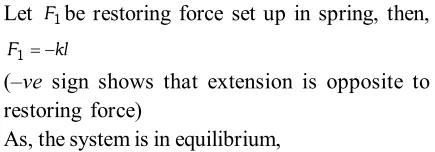
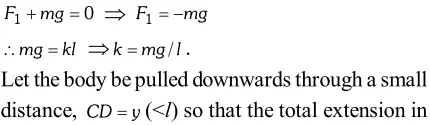
All SHM is periodic, but not all periodic motion is SHM. Periodic motion simply repeats after a fixed time interval. SHM is a special case where the restoring force obeys F = –kx. A rotating wheel is periodic but not SHM. A swinging pendulum (small angles) is both periodic and approximately SHM. The key distinguishing test is whether the force-displacement relationship is linear.
What is Simple Harmonic Motion in simple terms?
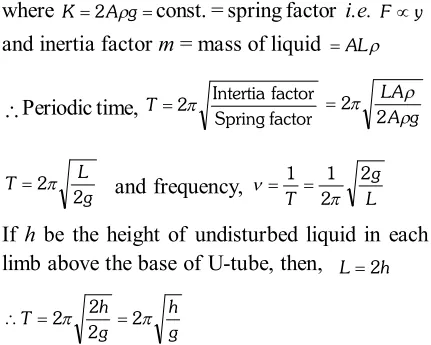
Simple Harmonic Motion is a type of periodic motion where a particle oscillates about a fixed mean position, with its acceleration always directed toward the mean position and proportional to its displacement from it. Mathematically, this means a = –ω²x. The motion is sinusoidal in nature — displacement, velocity, and acceleration all vary as sine or cosine functions of time
What is resonance and why is it dangerous in structures?
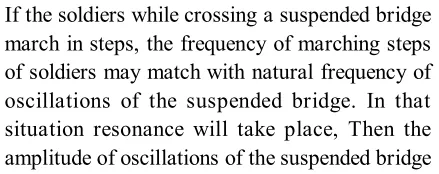
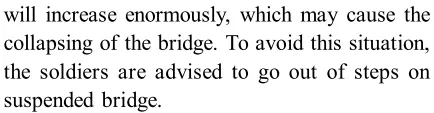
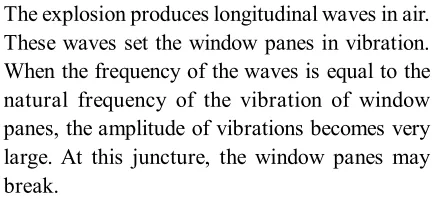
Resonance occurs when an external periodic force is applied to a system at exactly its natural frequency. At resonance, energy transfer to the system is maximally efficient, causing the amplitude of oscillation to grow very large — theoretically without limit in the absence of damping. In structures like bridges or buildings, resonance can produce vibrations large enough to cause mechanical failure, which is why soldiers break step on suspension bridges and engineers design buildings with resonance-avoiding natural frequencies.
What happens to the time period of a spring if it is cut in half?
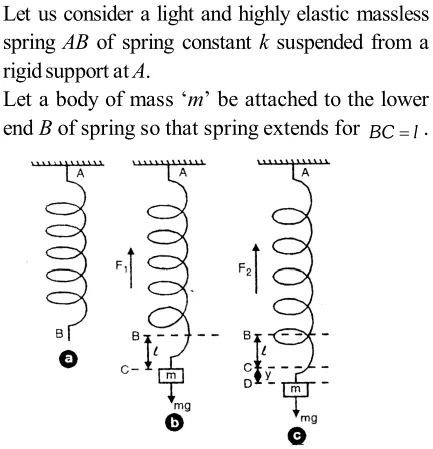
When a spring of spring constant k is cut in half, each half has a spring constant of 2k (shorter springs are stiffer). The time period of a mass m on the half-spring becomes T' = 2π√(m/2k) = T/√2, where T is the original period. So cutting the spring in half decreases the time period by a factor of √2 (makes it faster)
Does the mass of a pendulum bob affect its time period?
No. The time period T = 2π√(l/g) has no mass term. This is because both the restoring force (gravity component) and the inertia of the bob are proportional to mass — they cancel out exactly. This is the same reason all objects fall at the same rate in a gravitational field, regardless of mass (Galileo's equivalence principle).