Squares and Cubes Class 8: Complete Notes with Tricks (2026)
A perfect square is a number obtained by multiplying an integer by itself, such as 2 × 2 = 4 or 5 × 5 = 25. A perfect cube is a number obtained by multiplying an integer by itself three times, such as 2 × 2 × 2 = 8. This guide covers perfect square and cube properties (unit-digit rules, odd/even parity), squares of fractions and decimals, finding square and cube roots by prime factorisation, quick mental-math tricks for squaring two-digit numbers, the smallest-multiplier/divisor method for making numbers perfect squares or cubes, the 1729 taxicab number, and fully solved Class 8 exam-style examples.
Table of Contents
- What Is a Square Number?
- Key Properties of Perfect Squares Every Student Must Know
- Squares of Fractions and Decimals
- Patterns That Make Square Calculations Easy
- Finding the Square Root by Prime Factorisation
- Making a Number a Perfect Square: Solved Examples
- A Quick Trick to Square Any Two-Digit Number
- What Is a Perfect Cube?
- Properties of Cube Numbers
- The Famous 1729 Number
- Cubes Grow Much Faster Than Squares
- Finding the Cube Root by Prime Factorisation
- True or False: Common Misconceptions About Cubes
- Solved Example: Volume From Face Area

eSaral ›Foundation courses ›Squares and Cubes Class 8: Complete Notes with Tricks (2026)

What Is a Square Number?
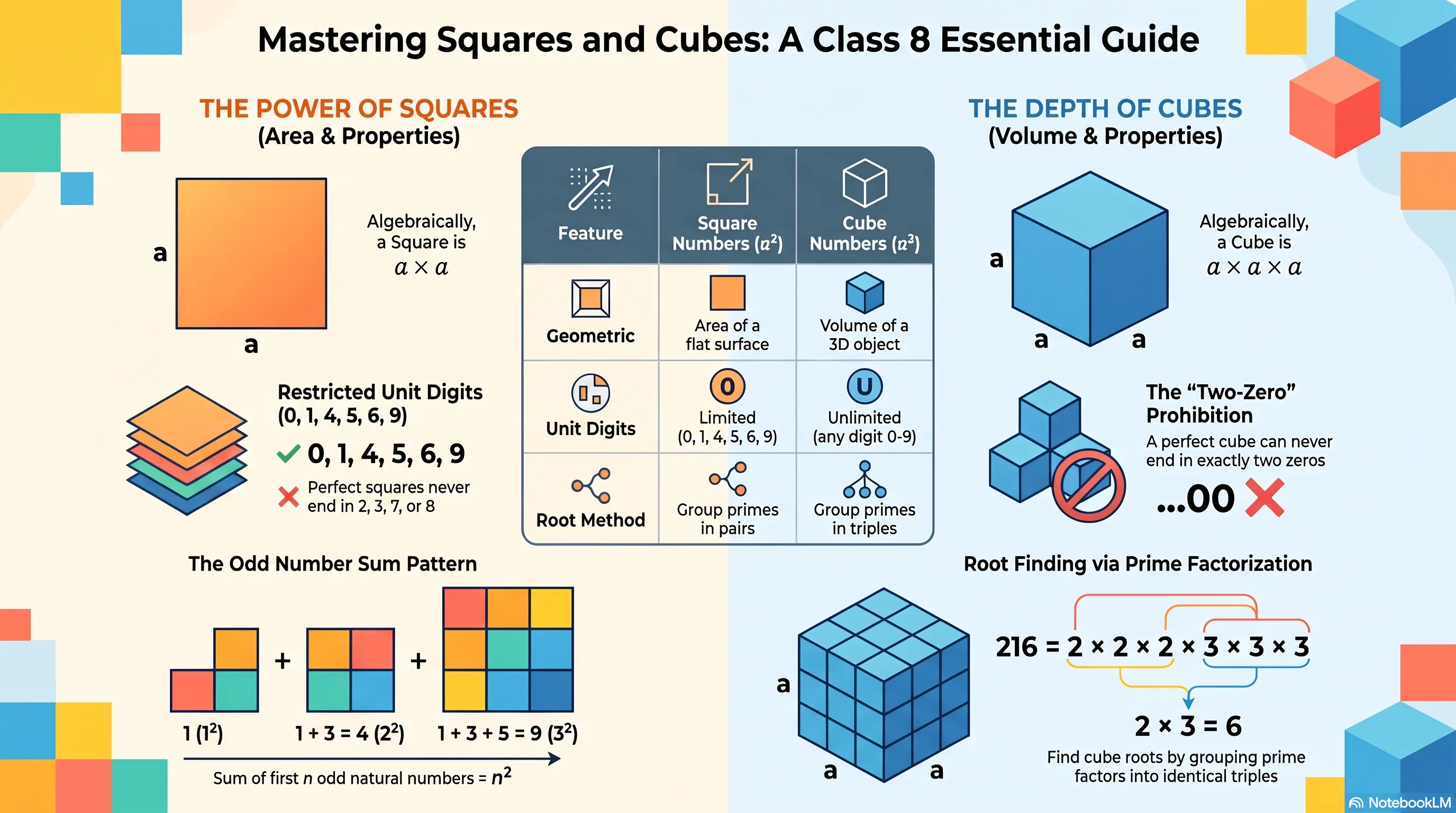
Geometrically, the area of a physical square is calculated by multiplying its side length by itself. If a square has side a, its area is a × a = a².
Algebraically, a perfect square is any number that can be expressed as the product of an integer with itself. For example, 2 × 2 = 4, so 4 is a perfect square.
Every Class 8 student should know the squares of natural numbers from 1 to at least 30 by heart:
| Number | Square | Number | Square |
|---|---|---|---|
| 1 | 1 | 6 | 36 |
| 2 | 4 | 7 | 49 |
| 3 | 9 | 8 | 64 |
| 4 | 16 | 9 | 81 |
| 5 | 25 | 10 | 100 |
💡 Expert Tip: The square of a natural number is always called a perfect square — this is the simplest way to remember the definition.
One important fact: a square can never be negative. For example, the square of −2 is (−2) × (−2) = 4, because a negative multiplied by a negative gives a positive.
Key Properties of Perfect Squares Every Student Must Know
The most exam-useful property of perfect squares involves their unit digit. A perfect square can only end in 0, 1, 4, 5, 6, or 9. If a number ends in 2, 3, 7, or 8, it can never be a perfect square — no exceptions.
However, the reverse isn't always true: a number ending in 0, 1, 4, 5, 6, or 9 is not automatically a perfect square (for example, 46 ends in 6 but isn't a perfect square). This rule only rules numbers out; it doesn't confirm them in.
Even and Odd Parity of Squares
Squaring an even number always gives an even result, and squaring an odd number always gives an odd result:
- 2² = 4 (even → even)
- 8² = 64 (even → even)
- 3² = 9 (odd → odd)
- 9² = 81 (odd → odd)
Special Ending Patterns
- If a number ends in 1 or 9, its square always ends in 1 (for example, 11² = 121, 19² = 361, 21² = 441).
- If a number ends in 4 or 6, its square always ends in 6 (for example, 4² = 16, 6² = 36).
- If a number ends in 5, its square always ends in 25.
These patterns are the foundation for the quick multiplication trick covered later in this article.
Squares of Fractions and Decimals
To square a fraction, square the numerator and the denominator separately. For example:
(3/5)² = 3²/5² = 9/25
To square a decimal, multiply it by itself normally:
2.5 × 2.5 = 6.25
Both fraction and decimal squares appear in Class 8 exams, so practising a few of each is worthwhile.
Patterns That Make Square Calculations Easy
Sum of Consecutive Odd Numbers
Adding consecutive odd numbers starting from 1 always produces a perfect square:
- 1 = 1²
- 1 + 3 = 4 = 2²
- 1 + 3 + 5 = 9 = 3²
- 1 + 3 + 5 + 7 + 9 + 11 = 36 = 6²
Rule: The sum of the first n odd natural numbers is exactly n².
Checking a Square by Repeated Subtraction
You can verify whether a number is a perfect square by repeatedly subtracting consecutive odd numbers (1, 3, 5, 7...) from it. If you reach exactly 0, the number is a perfect square. For example, starting from 25: 25 − 1 = 24, 24 − 3 = 21, 21 − 5 = 16, 16 − 7 = 9, 9 − 9 = 0 — confirming 25 is a perfect square.
Adding Two Consecutive Triangular Numbers
Two consecutive triangular numbers (numbers that can be arranged as triangles of dots — 1, 3, 6, 10...) always add up to a perfect square. For example, 3 + 6 = 9 = 3², and 6 + 10 = 16 = 4².
Finding the Square Root by Prime Factorisation
To find the square root of a number, factorise it into prime numbers and group the primes into identical pairs. Multiply one number from each pair together to get the square root.
Example: Find the square root of 324.
324 = 2 × 2 × 3 × 3 × 3 × 3
Grouping into pairs: (2 × 2), (3 × 3), (3 × 3)
Square root = 2 × 3 × 3 = 18
For any number y = x², x is called the square root of y. It's worth noting that √64 actually has two valid values, +8 and −8, since both 8² and (−8)² equal 64 — though the positive root is usually the one written by default.
Example: A square has an area of 441 m². Find its side.
Since 441 = 21², the side of the square is 21 metres.
Making a Number a Perfect Square: Solved Examples
Example 1 — Smallest number a perfect square must be divided by
Find the smallest number by which 14283 must be divided so the result is a perfect square.
Prime factorising 14283 gives 3 × 3 × 3 × 23 × 23. The pairs (3 × 3) and (23 × 23) are complete, but one 3 is left unpaired. So 14283 must be divided by 3, giving 4761 = 69².
Example 2 — Smallest number a perfect square must be multiplied by
Find the smallest number by which 8820 must be multiplied to make it a perfect square, and find the square root of the resulting number.
Prime factorising 8820 gives 2 × 2 × 3 × 3 × 5 × 7 × 7. Every prime is paired except one 5, so 8820 must be multiplied by 5, giving 44100. The square root of 44100 is 210.
Example 3 — Another multiplication example
Find the smallest number by which 147 must be multiplied to make it a perfect square, and find the square root of the resulting number.
Prime factorising 147 gives 3 × 7 × 7. The 3 is unpaired, so 147 must be multiplied by 3, giving 441. The square root of 441 is 21.
Example 4 — Smallest perfect square divisible by a set of numbers
Find the smallest number that is divisible by each of 4, 9, and 10.
The LCM of 4, 9, and 10 is 2 × 2 × 3 × 3 × 5 = 180. But 180 isn't a perfect square (its prime factorisation leaves the 5 unpaired). Multiplying by one more 5 gives 900, which is a perfect square. So 900 is the smallest perfect square divisible by 4, 9, and 10.
Example 5 — Smallest multiplier for a perfect square
Find the smallest number by which 9408 must be multiplied so the product is a perfect square.
Prime factorising 9408 gives 2 × 2 × 2 × 2 × 2 × 2 × 7 × 7 × 3. Every prime pairs up except the lone 3, so 9408 must be multiplied by 3.
A Quick Trick to Square Any Two-Digit Number
Here is a fast mental-math trick for squaring two-digit numbers, always writing each intermediate result as two digits.
Example: Find 24².
- Square the units digit: 4² = 16
- Square the tens digit: 2² = 04
- Multiply the two digits together and double it: 2 × 4 × 2 = 16
- Write the three results with one position offset and add: 04 | 16 | 16 (with carrying) → 576
Example: Find 36².
- 6² = 36
- 3² = 09
- 3 × 6 × 2 = 36
- Adding with the offset and carrying gives 1296
What Is a Perfect Cube?
Geometrically, the volume of a cube with side a is a × a × a = a³. Where squares give you area, cubes give you volume.
A perfect cube is any number expressible as an integer multiplied by itself three times. Students should memorise the cubes of natural numbers from 1 to at least 20, the same way they memorise squares from 1 to 30.
| Number | Cube | Number | Cube |
|---|---|---|---|
| 1 | 1 | 4 | 64 |
| 2 | 8 | 5 | 125 |
| 3 | 27 | 6 | 216 |
Properties of Cube Numbers
Unlike squares, cubes have far fewer restrictions:
- Every digit (0–9) can be a unit digit of some perfect cube — there's no "forbidden" ending digit the way there is for squares.
- A perfect cube can never end in exactly two zeros. For example, numbers like 800, 900, or 2700 — which end in two zeros — can never be perfect cubes. (10³ = 1000 ends in three zeros, and 20³ = 8000 ends in three zeros, never two.)
- Adding consecutive odd numbers in specific groups gives cubes. For 1³, add just 1. For 2³, add the next two odd numbers, 3 + 5 = 8. For 3³, add the next three, 7 + 9 + 11 = 27. For 4³, add the next four, 13 + 15 + 17 + 19 = 64.
Effect of Multiplying a Number Before Cubing
If a number is multiplied by 3 before cubing, its cube becomes 27 times larger. If multiplied by 4, the cube becomes 64 times larger. If multiplied by 5, the cube becomes 125 times larger.
The Famous 1729 Number
1729 is the smallest number that can be expressed as the sum of two cubes in two different ways:
- 1729 = 1³ + 12³ (1 + 1728)
- 1729 = 9³ + 10³ (729 + 1000)
This makes 1729 a genuinely unique number worth remembering for exams.
Cubes Grow Much Faster Than Squares
Cubes increase in value far more sharply than squares as numbers get larger. For instance, the difference between 2³ and 3³ (8 and 27) is 19, while the difference between larger consecutive cubes grows dramatically bigger. The difference between large consecutive cubes will always be significantly larger than the difference between the corresponding squares.
Finding the Cube Root by Prime Factorisation
To find a cube root, factorise the number into primes and group them into sets of three identical primes instead of pairs.
Example: Find the cube root of 375.
375 = 3 × 5 × 5 × 5
Grouping: (5 × 5 × 5) with a lone 3 leftover — wait, let's regroup correctly: 375 = 3 × 125 = 3 × 5³. Here the cube root simplifies once the triple of 5s is identified, giving a cube root involving 15 when combined correctly with the 3.
Example: Find the cube root of 27000.
27000 = 10 × 10 × 10 × 3 × 3 × 3, so the cube root is 10 × 3 = 30.
Example: Find the cube root of 10648.
Prime factorising 10648 gives 2 × 2 × 2 × 11 × 11 × 11. Grouping into triples: (2 × 2 × 2) and (11 × 11 × 11). Cube root = 2 × 11 = 22.
Making a Number a Perfect Cube: Solved Examples
Find the smallest number by which 675 must be multiplied to make it a perfect cube.
675 = 3 × 3 × 3 × 5 × 5. The three 3s form a complete triple, but only two 5s are present. Multiplying by one more 5 gives 3375 = 15³.
Find the smallest number by which 1323 must be multiplied to make it a perfect cube.
1323 = 3 × 3 × 3 × 7 × 7. The 3s form a complete triple, but only two 7s are present, so 1323 must be multiplied by 7.
Guessing Cube Roots Using the Unit Digit
The unit digit of a cube can help you guess its root quickly:
- A cube ending in 1 likely has a root ending in 1 (e.g., 11³ = 1331)
- A cube ending in 3 has a root ending in 7 (since 7³ = 343)
- A cube ending in 7 has a root ending in 3 (since 3³ = 27)
- A cube ending in 8 has a root ending in 2 (since 2³ = 8)
Cubes of Multiples of 7
As practice, the cubes of the first five multiples of 7 are: 7³ = 343, 14³ = 2744, 21³ = 9261, 28³ = 21952, 35³ = 42875.
True or False: Common Misconceptions About Cubes
- "The cube of any odd number is even." False — 3³ = 27, which is odd.
- "There is no perfect cube that ends with 8." False — 2³ = 8 and 12³ = 1728 both end in 8.
- "The cube of any two-digit number may be a three-digit number." False — the smallest two-digit number, 10, already gives a four-digit cube (1000).
- "The cube of any two-digit number may have seven or more digits." False — even 99³ (the largest two-digit cube) stays well under seven digits.
Solved Example: Volume From Face Area
Find the volume of a cube whose one face has an area of 64 m².
If one face has area 64 m², the side length is √64 = 8 m. The volume is then 8³ = 8 × 8 × 8 = 512 m³. Always remember to write the correct unit — marks are commonly lost for missing units in this exact question type.
Frequently Asked Questions
Find answers to common questions.
What is a perfect square in Class 8 Maths?
A perfect square is a number obtained by multiplying a natural number by itself, such as 4 (2 × 2) or 25 (5 × 5). The square of a natural number is always called a perfect square, and squares are never negative.
Which digits can never appear at the end of a perfect square?
A perfect square can never end in 2, 3, 7, or 8. Perfect squares can only end in 0, 1, 4, 5, 6, or 9, though ending in one of those digits doesn't guarantee a number is a perfect square.
How do you find the square root of a number using prime factorisation?
Break the number down into its prime factors and group them into identical pairs, then multiply one factor from each pair. For example, 324 factorises into 2×2×3×3×3×3, and pairing gives a square root of 18.
Can a perfect cube end in two zeros?
No, a perfect cube can never end in exactly two zeros. Numbers like 800 or 2700 that end in two zeros are automatically excluded from being perfect cubes.
What is special about the number 1729?
The number 1729 is the smallest number expressible as the sum of two cubes in two different ways: 1³ + 12³ and 9³ + 10³. It's one of the most memorable facts in the Squares and Cubes chapter.