3D Geometry Part 1 Class 12 Formulas | Download Mind Maps
3D Geometry Class 12 Mind Maps provide a concise visual summary of key formulas, concepts, and coordinate geometry techniques in three-dimensional space, helping students quickly revise this high-weightage chapter for CBSE Boards and JEE Main.
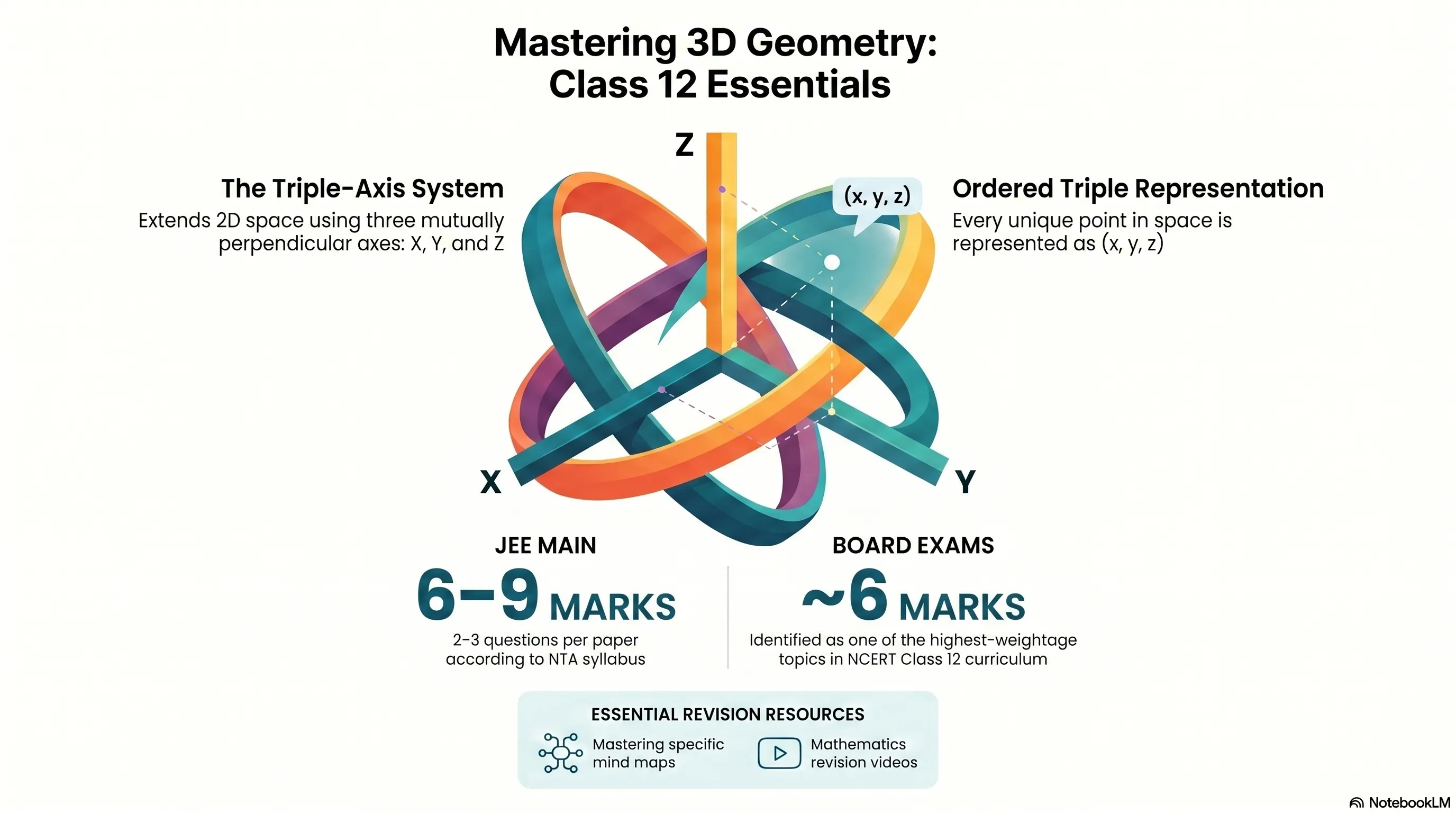
Table of Contents

eSaral › Class 12 ›3D Geometry Part 1 Class 12 Formulas | Download Mind Maps
🚀 Checkout eSaral Courses
What Is 3D Coordinate Geometry in Class 12?
3D Coordinate Geometry, covered in Chapter 11 of the NCERT Class 12 Mathematics textbook, extends the familiar 2D coordinate system into three-dimensional space using three mutually perpendicular axes: X, Y, and Z. Every point in space is represented as an ordered triple (x, y, z).
This chapter is one of the highest-weightage topics in both CBSE Board exams and JEE Main. According to the official NTA JEE Main syllabus, 3D Geometry consistently contributes 2–3 questions (6–9 marks) per paper. For Board exams, it carries approximately 6 marks.
India's Best Exam Preparation for Class 12th - Download Now
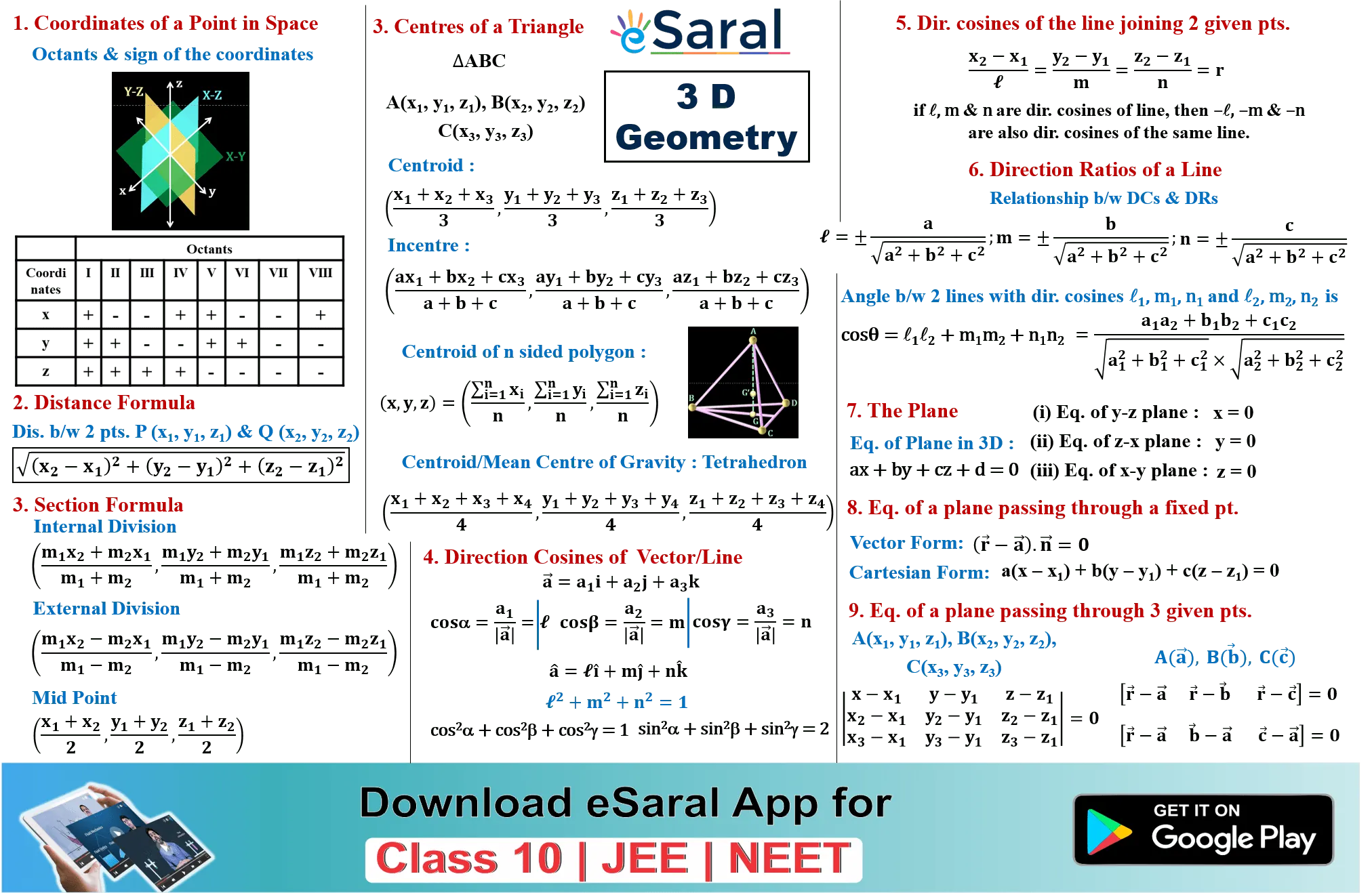
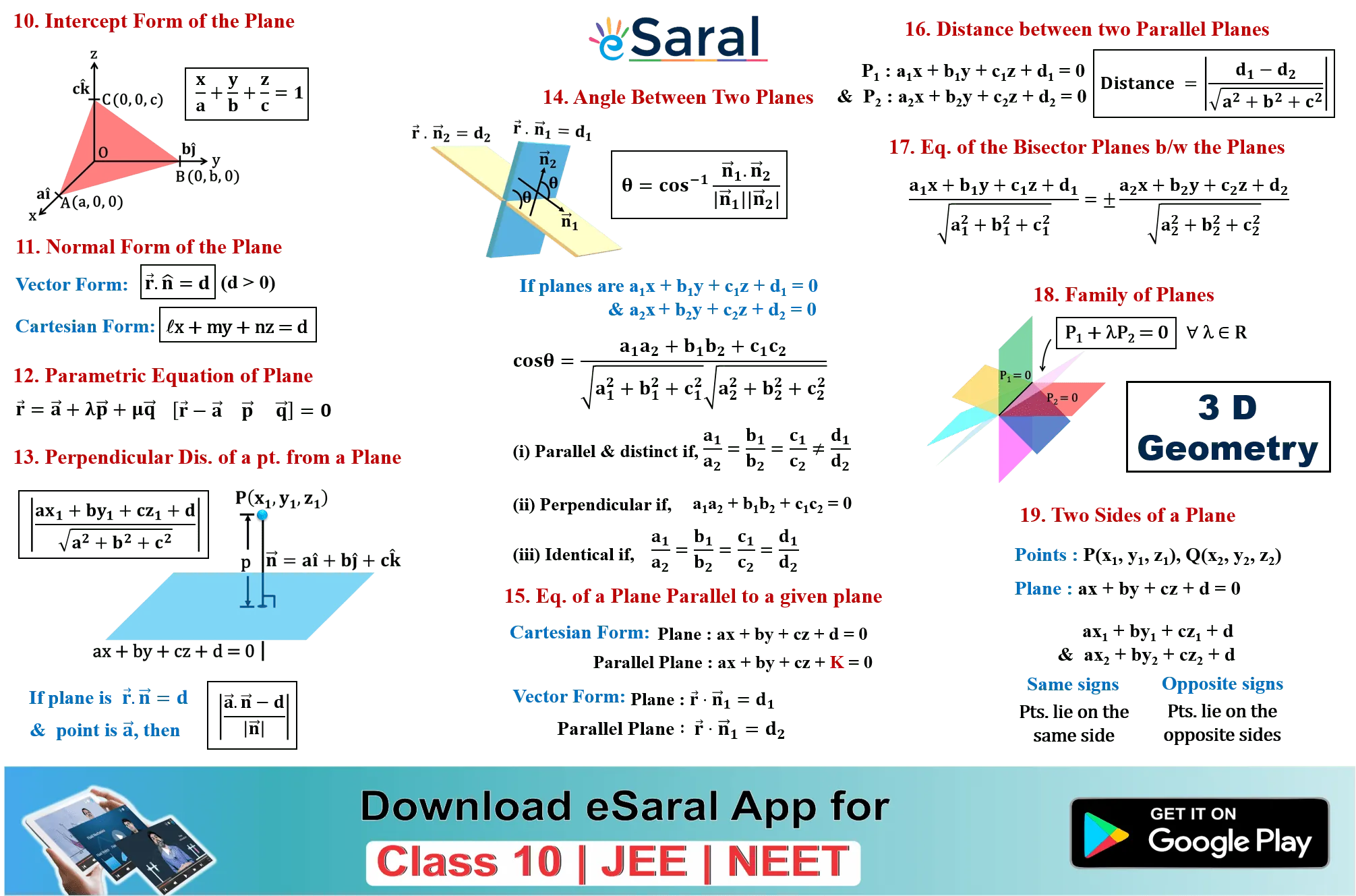
3D Geometry Class 12 Formulas: Mind Map 1
Frequently Asked Questions
Find answers to common questions.
What are the most important formulas in 3D Geometry Class 12?
The most important formulas are: (1) the direction cosine identity l²+m²+n²=1, (2) the Cartesian equation of a line, (3) the general equation of a plane ax+by+cz+d=0, (4) the angle formula between two lines or planes, and (5) the distance of a point from a plane. These five results cover approximately 80% of exam questions from this chapter.
How many marks does 3D Geometry carry in JEE Main?
According to the official NTA JEE Main syllabus and past paper analysis, 3D Geometry typically contributes 2–3 questions worth 6–9 marks per paper. Both Part 1 (lines and planes) and Part 2 (shortest distance, coplanarity) are tested. Consistent practice with formula application gives you a reliable score in this topic.
What is the difference between direction cosines and direction ratios?
Direction cosines (l, m, n) are the actual cosines of the angles a line makes with the X, Y, Z axes, and they always satisfy l²+m²+n²=1. Direction ratios (a, b, c) are any three numbers proportional to the direction cosines — they do not need to satisfy that identity. You convert from DRs to DCs by dividing each DR by √(a²+b²+c²).
Are 3D Geometry formulas the same for the CBSE Board and JEE Main?
Yes. The core formulas — direction cosines, line equations, plane equations, and distance formulas — are identical for both CBSE Board (Chapter 11, Class 12) and JEE Main. JEE Main additionally tests more complex applications like shortest distance between skew lines and coplanarity conditions, which are covered in Part 2 of the chapter.
What is the formula for the distance between a point and a plane?
The distance from point (x₀, y₀, z₀) to plane ax+by+cz+d=0 is |ax₀+by₀+cz₀+d| divided by √(a²+b²+c²). This formula is used frequently in both Board exams and JEE Main, often combined with a condition that the distance equals a specific value to find an unknown constant in the plane's equation.