CBSE Class 11 Revision Notes 2026-2027: Subject-wise PDF & Video Guide
Class 11 revision notes are concise, chapter-wise summaries covering Physics, Chemistry, Maths, Biology, and English, built on the latest NCERT syllabus. They condense formulas, definitions, and diagrams into an exam-ready format, and pair with video lectures for faster, more effective revision before tests and annual exams.
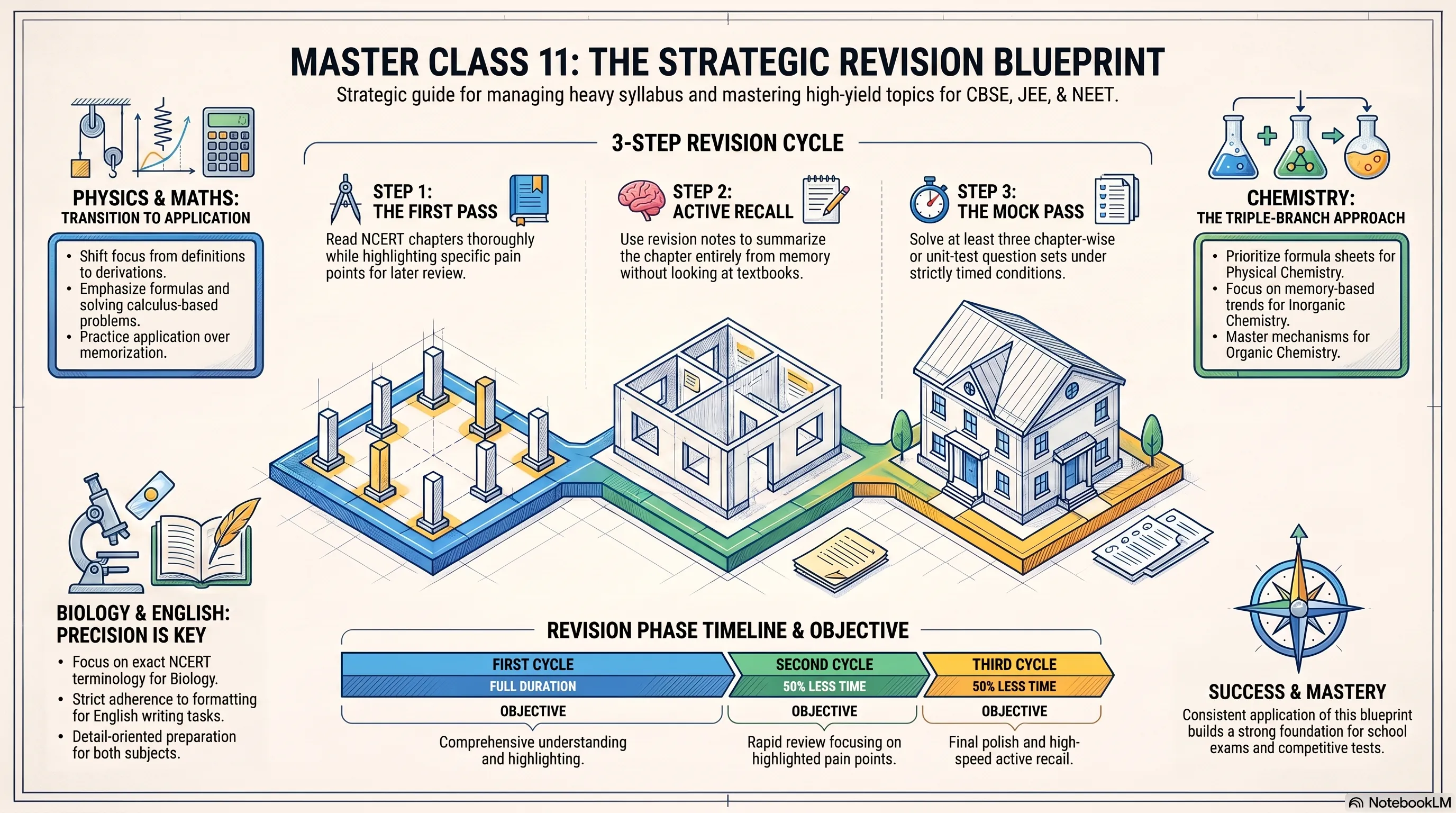
Table of Contents
- Why Class 11 Revision Notes Matter More Than You Think
- Download Subject-wise Revision Notes PDF
- Physics: Building the Base for Mechanics and Beyond
- Chemistry: Three Branches, One Foundation
- Mathematics: New Concepts, New Habits
- Biology: Diagrams and Definitions
- English: The Score Booster Students Skip
- Revision Notes Plus Video Lectures: Why Both Matter
- How to Use These Notes: A Revision Strategy

eSaral › NEET › JEE› CBSE Class 11 Revision Notes 2026-2027: Subject-wise PDF & Video Guide

Why Class 11 Revision Notes Matter More Than You Think
Class 11 syllabus is noticeably heavier than Class 10 — new concepts arrive faster, and unit tests come around before a student has even finished the chapter properly. Students who rely purely on rereading NCERT textbooks often run out of time before their exams and end up skimming instead of revising.
Before starting revision, check the NCERT Books for Class 11 so your notes map to the exact syllabus your school follows.
Class 11 revision notes fix this problem directly. Built chapter by chapter and cross-checked against NCERT, they give students a structured, time-efficient path through every subject — telling them exactly what to revise, in what order, and why it matters for the exam.
💡 Expert Tip by eSaral Academic Team: Class 11 is also the year your Physics, Chemistry, and Maths foundation starts overlapping directly with JEE Main topics. Revision notes built with this overlap in mind save students significant relearning time later.
Download Subject-wise Revision Notes PDF
- 👉 CBSE Class 11 Physics Revision Notes
- 👉 CBSE Class 11 Chemistry Revision Notes
- 👉 CBSE Class 11 Maths Revision Notes
- 👉 CBSE Class 11 Biology Revision Notes
- 👉 CBSE Class 11 English Notes
Cross-check every note against the NCERT Solutions for Class 11 to confirm your written method matches the correct approach for each chapter.
Physics: Building the Base for Mechanics and Beyond
Physics in Class 11 shifts from Class 10's definitions-and-diagrams style toward derivations and problem-solving — a jump many students underestimate. Revision notes break each unit into Definitions → Derivations → Formulas → Application Questions, so nothing important gets lost in a 40-page chapter.
Key Units to Focus On
- Laws of Motion: Free-body diagrams, friction, and Newton's laws applied to real problems.
- Work, Energy and Power: Conservation of energy — one of the highest-weightage topics all year.
- Rotational Motion: Torque, moment of inertia, and angular momentum derivations.
- Thermodynamics: The first law and its application to PV diagrams.
- Oscillations and Waves: SHM equations and wave superposition.
Chemistry: Three Branches, One Foundation
Class 11 Chemistry splits cleanly into Physical, Organic, and Inorganic — and revision notes work best when they respect that split rather than treating Chemistry as one long list.
Sectional Breakdown
- Physical Chemistry: Mole Concept, Equilibrium, and Redox Reactions — numerical-heavy, so formula sheets matter most here.
- Inorganic Chemistry: Periodic Table trends and Chemical Bonding — memory-heavy, benefits from repeated short revision passes.
- Organic Chemistry: Basic Principles and Hydrocarbons — mechanism-based, needs pattern recognition more than memorisation.
💡 Expert Tip by eSaral Academic Team: Equilibrium and Chemical Bonding are the two Class 11 Chemistry chapters students revise the least, yet they carry consistent weightage in both CBSE exams and JEE Main a year later.
Mathematics: New Concepts, New Habits
Maths in Class 11 introduces territory most students have never seen — Sets, Limits, and Permutations have no direct Class 10 equivalent. Revision notes here focus less on reading and more on remembering the conditions of formulas and identities, since Maths is a subject you revise by solving, not rereading.
Critical Success Pillars
- Trigonometric Functions: Heavy numerical weightage — keep an identity sheet within reach at all times.
- Sequences and Series: Formula-based and genuinely high-scoring once practised.
- Straight Lines and Conic Sections: Direct overlap with JEE-level Coordinate Geometry.
- Limits and Derivatives: First calculus exposure — revisit this unit more often than others.
Biology: Diagrams and Definitions
Biology in Class 11 rewards precision — in terminology, in diagrams, and in exact NCERT phrasing. Revision notes here emphasise the chapters that carry the most weightage rather than treating every chapter equally.
High-Yield Topics
- Diversity in the Living World: Classification-based, heavily NCERT-line dependent.
- Structural Organisation in Animals and Plants: Tissue diagrams appear almost every year.
- Cell: Structure and Function: Labelled diagrams of the cell and its organelles are near-mandatory.
- Human Physiology: Detailed, high-weightage, and directly useful for NEET aspirants later.
English: The Score Booster Students Skip
English often gets ignored until the week before exams — which is exactly why it's the easiest subject to lose easy marks in.
Composition of Revision Notes
- Hornbill (Prose & Poetry): Theme analysis and central ideas, summarised chapter by chapter.
- Snapshots: Character and subtext notes for supplementary reader stories.
- Writing Skills: Exact formats for notices, formal letters, and article writing.
Revision Notes Plus Video Lectures: Why Both Matter
Reading a formula sheet and watching a faculty member derive that same formula on screen are two different learning experiences — and Class 11 students benefit from both. A short video lecture on a difficult derivation, like rotational motion or limits, often clears in ten minutes what an hour of rereading notes cannot.
Explore eSaral's JEE and NEET foundation courses, where every Class 11 revision note is paired with a matching video lecture, so students can watch before they revise, not instead of it.
This hub gives you the finished product; our how to make notes for JEE guide teaches the process that gets you there on your own.
How to Use These Notes: A Revision Strategy
To make Class 11 revision genuinely effective, follow the 3-Step Revision Cycle:
- The First Pass: Read the chapter from NCERT and highlight your specific pain points.
- The Active Recall Pass: Use the revision notes to summarise the chapter without looking at the textbook.
- The Mock Pass: Solve at least 3 chapterwise or unit-test-style question sets under timed conditions.
How Many Times Should You Revise Each Subject Before an Exam?
Most consistent scorers complete three full revision cycles per subject before a major exam. The first pass is the slowest; each following pass takes roughly half the time, so starting six weeks before an exam comfortably allows all three cycles, even for heavier subjects like Physics and Chemistry.
Frequently Asked Questions
Find answers to common questions.
Are Class 11 revision notes enough to prepare for exams without NCERT?
Revision notes alone are not enough — they work best alongside the NCERT textbook, not as a replacement for it. Use them to consolidate what you've already studied through the three-step revision cycle: first read, active recall, then timed practice.
Where can I download Class 11 revision notes PDF for free?
Free subject-wise Class 11 revision notes PDFs for Physics, Chemistry, Maths, Biology, and English are available on eSaral, alongside matching video lectures and NCERT solutions for cross-checking your answers.
How many times should I revise each Class 11 subject before an exam?
Three full revision cycles per subject is typical among consistent scorers. Starting about six weeks before a major exam allows enough time for all three passes, even for heavier subjects like Physics and Chemistry.
Which Class 11 Physics chapters carry the most weightage?
Laws of Motion, Work-Energy-Power, and Thermodynamics consistently carry the highest weightage in Class 11 Physics exams, and the same three chapters return with even greater weight in JEE Main a year later.
Is Class 11 revision important for JEE and NEET preparation later?
Yes, significantly. Class 11 Physics, Chemistry, and Maths form the direct foundation for JEE Main and JEE Advanced, while Class 11 Biology overlaps heavily with NEET, making thorough revision now a time-saver for competitive exam preparation later.