Class 9 PYQs: A Complete Guide to Previous Year Question Papers for Better Results
Class 9 previous year question papers (PYQs) are past annual and periodic exam papers used by CBSE-affiliated schools, covering Maths, Science, Social Science, and English. This guide breaks down subject-wise PYQ strategy, explains how PYQs differ from sample papers and NCERT Exemplar, lists common mistakes students make while practicing, and shows how consistent PYQ practice in Class 9 builds study habits that carry forward into JEE and NEET preparation.
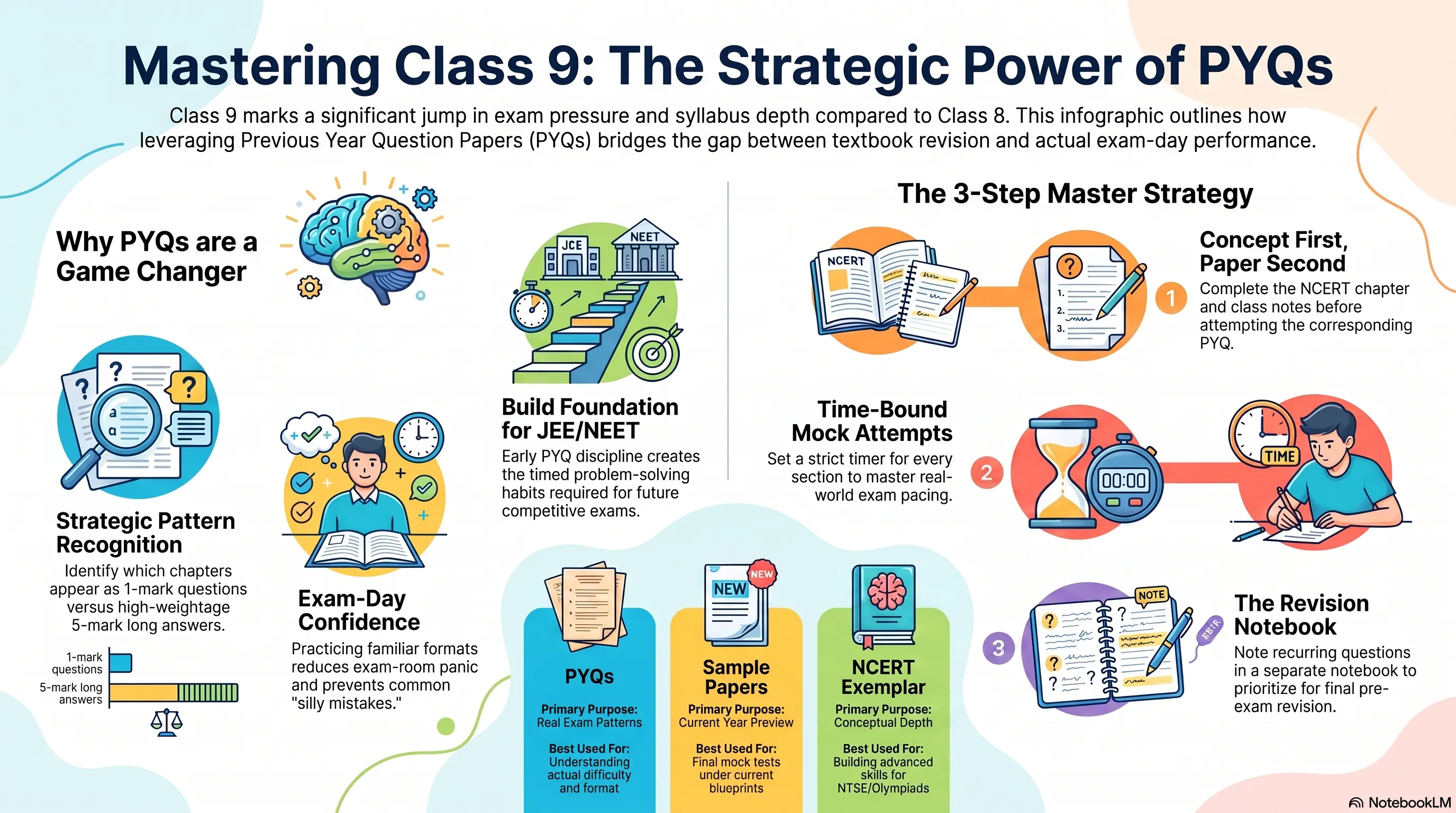
Table of Contents
- Introduction
- What Are Class 9 Previous Year Question Papers (PYQs)?
- Why Class 9 PYQs Matter for CBSE Exam Preparation
- Subject-Wise Class 9 PYQ Breakdown {#subject-wise-breakdown}
- How to Use Class 9 PYQs Effectively
- Class 9 PYQs vs Sample Papers vs NCERT Exemplar: What's the Difference?
- Common Mistakes Students Make While Solving PYQs
- How Class 9 PYQ Practice Builds a Foundation for JEE and NEET

eSaral ›Foundation courses ›Class 9 PYQs: A Complete Guide to Previous Year Question Papers for Better Results

Introduction
Class 9 is the year most students first feel real exam pressure. Periodic tests, half-yearly exams, and the final annual paper all carry weight, and the syllabus suddenly feels heavier than Class 8. Many students revise the whole textbook but still lose marks because they never practiced under exam-like conditions.
This is exactly where the previous year's question papers help. They show you what schools actually ask, how marks are distributed across chapters, and which NCERT concepts show up year after year. eSaral's academic team has reviewed multiple years of Class 9 exam patterns to put together a practical, subject-wise approach you can start using today.
Once you know what to expect on paper, the next step is knowing how to prepare for it — which is what the rest of this guide covers.
What Are Class 9 Previous Year Question Papers (PYQs)?
Class 9 PYQs are question papers from earlier academic sessions, typically periodic tests, half-yearly exams, and annual exams, set according to the CBSE Class 9 syllabus. Unlike Class 10 or Class 12, Class 9 has no centralized board exam, so PYQs are usually school-set papers that still follow the CBSE marking scheme and blueprint.
They cover four core subjects:
- Mathematics — number systems, polynomials, coordinate geometry, triangles, and mensuration
- Science — Physics, Chemistry, and Biology chapters from the NCERT Class 9 textbook
- Social Science — History, Geography, Civics, and Economics
- English — grammar, writing skills, and literature reader chapters
Because these papers are built directly from the NCERT syllabus, practicing them alongside your NCERT Solutions for Class 9 gives you both the concept clarity and the exam-pattern familiarity you need.
Why Class 9 PYQs Matter for CBSE Exam Preparation
Solving PYQs is not about memorizing old answers. It is about training yourself to think the way an exam paper is structured.
Three things happen when you practice PYQs consistently:
- Pattern recognition — you start noticing which chapters get asked as 1-mark questions versus 5-mark long answers.
- Time management — you learn how long a typical paper actually takes to attempt under real conditions.
- Confidence — walking into an exam that "looks familiar" reduces panic and silly mistakes.
💡 Expert Tip from eSaral's Academic Team: Don't just read PYQ answers — write them out by hand, then check them against your NCERT textbook. This builds the same muscle memory you'll need for Class 10 board exams and, eventually, for JEE and NEET.
Students preparing at eSaral's foundation courses are encouraged to treat every school exam as practice for bigger competitive exams later, and PYQ discipline built now pays off directly then.
Subject-Wise Class 9 PYQ Breakdown {#subject-wise-breakdown}
Each subject rewards a slightly different PYQ strategy. Here's how the four core subjects typically break down by question type.
| Subject | High-Weightage Chapters | Common Question Types | Recommended Resource |
|---|---|---|---|
| Mathematics | Number Systems, Polynomials, Triangles, Mensuration | Numerical problems, proofs, and construction | NCERT Solutions Class 9 Maths |
| Science | Matter in Our Surroundings, Cell Structure, Motion, Force | Diagram-based, numericals, short answers | NCERT Solutions Class 9 Science |
| Social Science | French Revolution, Physical Features of India, Democracy | Map-based, source-based, descriptive | School-issued CBSE guidelines |
| English | Grammar, Writing Skills, Beehive/Moments chapters | Comprehension, letter/essay writing | NCERT Beehive and Moments textbooks |
Where Maths and Science PYQs Differ Most
Maths PYQs test accuracy and method — partial marks are awarded for correct steps even with a wrong final answer. Science PYQs, on the other hand, reward precise definitions and labeled diagrams. Treating both subjects the same way is one of the most common reasons students underperform despite hours of revision.
How to Use Class 9 PYQs Effectively
Simply reading through old papers does not build exam readiness. Follow this sequence instead:
- Finish the chapter first using your NCERT textbook and class notes.
- Attempt the related PYQ questions without looking at the solution.
- Time yourself — even a 10-mark section should be attempted under a rough time limit.
- Check answers against NCERT Solutions, not just the answer key, so you understand why an answer is correct.
- Note recurring question types in a separate notebook — these are your revision priorities before the actual exam.
- Repeat with a fresh paper two weeks before the exam to measure improvement.
Following this cycle for even 3–4 previous-year papers per subject builds far more retention than passively re-reading the textbook a fifth time.
Class 9 PYQs vs Sample Papers vs NCERT Exemplar: What's the Difference?
Students often confuse these three resources. They serve different purposes, and using all three correctly matters more than picking just one.
| Resource | Purpose | Best Used For |
|---|---|---|
| Previous Year Papers (PYQs) | Actual past exam papers | Understanding real exam pattern and difficulty |
| Sample Papers | Model papers designed to preview the current year's format | Practicing under exam blueprint before it's officially tested |
| NCERT Exemplar | Higher-difficulty conceptual questions from NCERT | Building depth for top scores and future competitive exams |
💡 Expert Tip from eSaral's Academic Team: Use PYQs for pattern familiarity, sample papers for a final mock test, and NCERT Exemplar if you're also eyeing NTSE, Olympiads, or an early JEE/NEET foundation track.
Common Mistakes Students Make While Solving PYQs
Even motivated students lose marks due to avoidable habits:
- Skipping diagrams in Science answers, even when the question doesn't explicitly ask for one
- Copying answers directly instead of attempting first, which creates false confidence
- Ignoring word limits in Social Science and English descriptive answers
- Not revising NCERT back exercises, even though many PYQ questions are directly adapted from them
- Leaving Maths steps incomplete, losing method marks even when the final answer is correct
Fixing even two of these habits before your next exam can noticeably improve your score.
How Class 9 PYQ Practice Builds a Foundation for JEE and NEET
Class 9 might feel disconnected from JEE Main or NEET UG, but the study habits formed now carry forward directly. Students who build consistent PYQ practice, careful diagram work in Science, and step-wise accuracy in Maths at this stage adapt far more smoothly to the pace of Class 11 and 12 competitive preparation.
At eSaral, students who begin structured practice from Class 9 through foundation courses typically enter Class 11 already comfortable with timed problem-solving — a habit that traditional last-minute Class 11 crash courses can't fully replace.
If you're also revising with the full NCERT Books for Class 9, pairing that with regular PYQ practice covers both concept clarity and exam readiness at once.
Frequently Asked Questions
Find answers to common questions.
Where can I find Class 9 previous year question papers?
Class 9 PYQs are usually available through your school, CBSE-affiliated resource portals, and educational platforms like eSaral. Since Class 9 has no centralized board exam, papers vary by school, so cross-checking a few different sources gives a fuller picture of common question patterns.
How many years of PYQs should a Class 9 student solve?
Solving 3 to 5 years of previous papers per subject is usually enough to spot recurring patterns without over-practicing. Focus more on understanding why an answer is correct than on solving a large volume of papers superficially.
Are Class 9 PYQs the same as sample papers?
No, PYQs are actual past exam papers, while sample papers are model papers designed to preview the current session's format. Both are useful, but PYQs are better for understanding real exam difficulty and pattern.
Is NCERT enough for Class 9 exams, or do I also need PYQs?
NCERT builds your concept foundation, but PYQs show you how those concepts are actually tested in an exam setting. Using both together, rather than either alone, gives the most complete preparation.
Do Class 9 PYQs help with JEE or NEET preparation later?
Yes, indirectly. The discipline of timed practice, diagram accuracy, and step-wise Maths solutions built through Class 9 PYQs carries forward into the study habits needed for JEE Main, JEE Advanced, and NEET UG in later years.
How should I revise Science using PYQs?
Attempt the PYQ question first, then verify your answer against NCERT Solutions rather than a generic answer key. Pay close attention to diagram labeling and definitions, since Science PYQs reward precision over length.
How is the syllabus and revision structured across Brahmos, Prahaar, and Warrior batches?
eSaral Gurukul builds in 3 to 4 times syllabus completion through repeated revision cycles rather than a single linear pass. Prahaar batch students specifically get a 4-times revision of Class 11 and 12 content alongside board exam preparation, so JEE/NEET prep and board prep run in parallel instead of competing for time.