How Many Mock Tests Should I Attempt Before JEE Main?
Table of Contents

eSaral › JEE Main › How Many Mock Tests Should I Attempt Before JEE Main

You open your phone at 11 PM and search: How many mock tests before JEE Main? You see one student saying they gave 40 mocks. Another says 10 was enough for them. Now you're more anxious than before. Sound familiar?
This confusion is incredibly common in the weeks leading up to JEE Main. The number you're chasing isn't even the right thing to chase — but nobody explains that clearly. The eSaral Academic Team has worked with thousands of JEE aspirants across dropper and foundation batches, and this guide gives you the honest, structured answer that your coaching might not have time to explain.
Let's clear the noise and give you a plan that actually works.
Why Students Worry About Mock Test Count
This worry comes from a very human place—the fear of falling behind. When your classmate casually mentions they've already given 25 mock tests and you've given 8, it feels like a crisis. But that number comparison is almost always misleading.
The Social Comparison Trap
JEE aspirants are, by nature, competitive. Group chats during the preparation phase become unintentional anxiety generators. Someone shares their mock score, someone else shares how many tests they've attempted, and suddenly the metric shifts from "am I improving?" to "am I keeping up with others?"
NTA's own data from recent JEE Main sessions shows that over 11 lakh students appear for each session. The preparation journeys vary wildly. Comparing your mock count to a peer's is like comparing your sleep schedule—what works for one body doesn't work for another.
The "More = Better" Myth
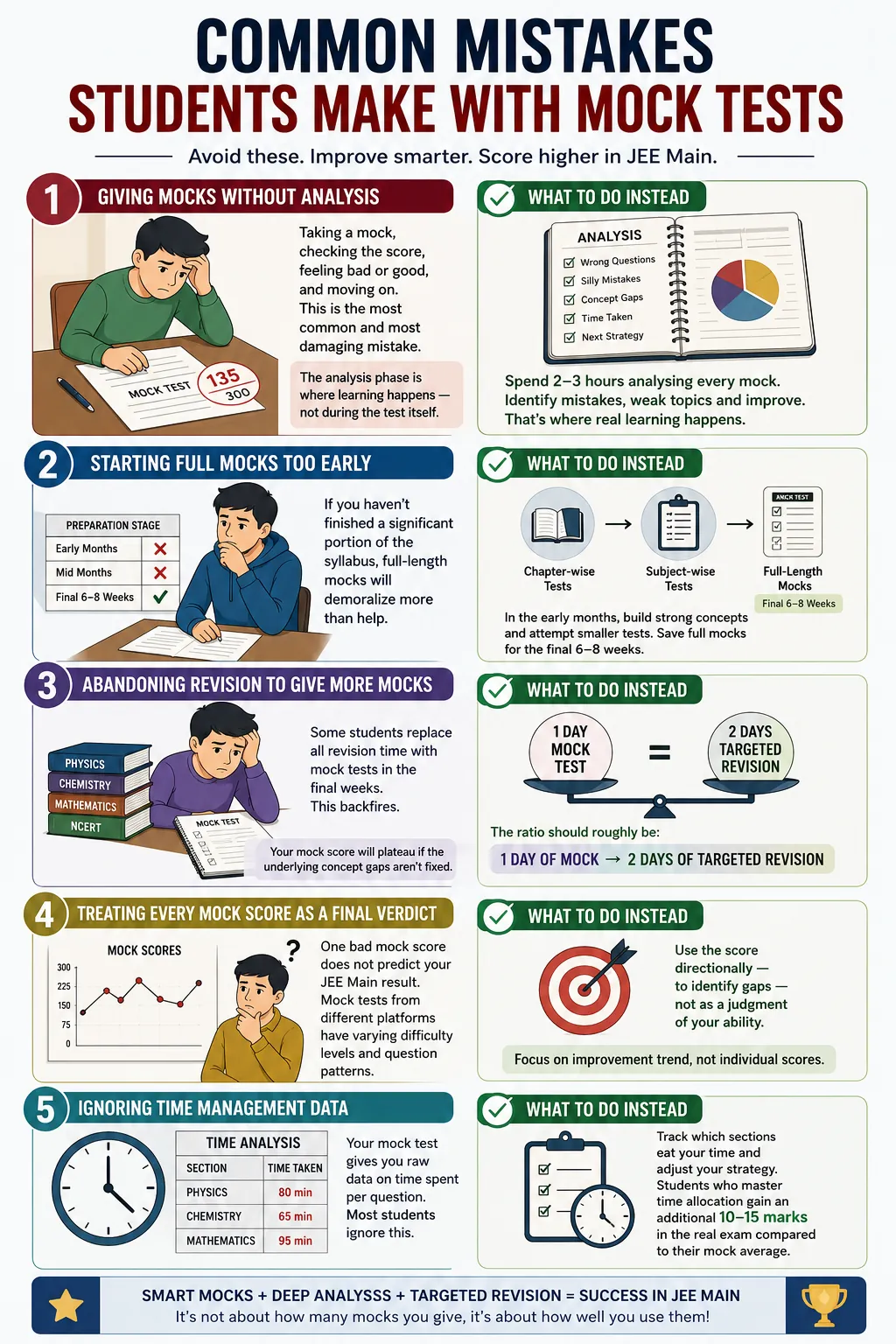
Indian competitive exam culture often glorifies quantity. More hours, more tests, more practice sets. But mock tests are diagnostic tools, not endurance events. Giving a mock test without a proper post-test analysis is like going to a doctor, getting a blood test done, and then throwing the report in the bin.
The Honest Answer: How Many Mock Tests Is Enough?
15 to 20 full-length mock tests in the 6–8 weeks leading up to JEE Main are the target for most students. This is the evidence-backed range that balances enough exam-condition exposure with enough time for meaningful analysis and revision.
Here's a simple breakdown by preparation phase:
| Time Before JEE Main | Recommended Mock Frequency | Weekly Count |
|---|---|---|
| 8–6 weeks out | One full mock per week | 1 per week |
| 6–4 weeks out | Two full mocks per week | 2 per week |
| Final 2 weeks | One mock every 2–3 days | 2–3 per week |
| Final 3 days | No new full mocks—only review | 0 |
Expert Tip by eSaral Academic Team: "Do not attempt a full mock test in the 48 hours before your actual JEE Main date. Your brain needs consolidation time, not more input. Use those final days to revise your error log and formulae sheets."
If you're starting this journey now and have already checked the JEE Main exam date to calculate your runway — good. That's exactly where planning starts.
What Actually Matters More Than the Number
Here is the truth that top rankers consistently report: the quality of analysis after each mock matters far more than the total number of mocks attempted.
Exam-Condition Discipline
Every mock test must be taken under real exam conditions—same time slot as your actual JEE Main session, no phone, no breaks beyond what the exam allows. This trains your body clock and builds the psychological stamina the real exam demands. Students who skip this step often experience a "I knew this but blanked out" feeling on exam day.
Your Error Log Is Your Real Asset
After every mock, the highest-value activity is building and updating an error log. This is a simple document (a notebook works fine) where you record:
- Questions you got wrong
- Why you got them wrong (concept gap, silly error, time pressure, guessed wrong)
- The correct approach, in your own words
In eSaral's 2025 JEE batch, students who maintained a structured error log from their mock tests improved their scores by an average of 18–22 marks between their first mock and exam day. That's not a small jump—in JEE Main, 26+ marks can shift your percentile significantly.
Subject-Wise Weakness Tracking
Use your mock data to track patterns. If you're consistently dropping marks in Organic Chemistry or Coordinate Geometry, that's actionable information. You can review the JEE Main Syllabus and identify which chapters those weak areas map to—then fix them between mocks.
Your Realistic Mock Test Roadmap (6–8 Weeks Before JEE Main)
Here is a numbered, time-bound plan. Follow this sequence from today.
- Week 1: Baseline Mock. Take one full-length mock under strict exam conditions. Don't worry about the score—this is your baseline. Spend 2–3 hours analysing it afterward.
- Week 2: Chapter Repair. Based on Week 1 analysis, spend 4–5 days revisiting your two weakest chapters (one from Maths, one from Physics or Chemistry). Then take your second mock at the end of the week.
- Weeks 3–4: Increase Frequency. Move to two mocks per week. After each mock, update your error log. Dedicate the days between mocks to fixing the errors you found—not starting fresh topics.
- Weeks 5–6: Simulate Real Conditions. Schedule mocks at the exact time of day your JEE Main session is booked. Practice your time allocation strategy—most toppers spend no more than 40–45 minutes per subject in a 3-hour paper.
- Final Week: Consolidation Only. Take one or two light mocks early in the week. Spend the last 3–4 days only on your error log, formula revision, and light reading of JEE Main Question Papers. You can browse JEE Main Question Papers to familiarise yourself with NTA's question style.
- Day Before Exam: Full Rest. No mock tests. No new topics. Sleep early. This is not laziness—it is strategy.
Expert Tip by eSaral Academic Team: "JEE ki taiyari mein consistency beats intensity. One well-analysed mock per week for 8 weeks will outperform 5 rushed mocks in the final week every single time. Trust the process."
Alongside mock tests, remind readers that solving previous years JEE Main question papers is just as valuable and link to the page directly.
How to Analyse a Mock Test Properly
What to Do in the First 30 Minutes After Submitting
Immediately after your mock, before checking answers, write down 3–5 questions you found difficult or spent too long on. This captures your real-time thinking before the answer key influences your memory.
The 3-Category Sort
Divide every wrong answer into exactly three buckets:
- Concept Gap — you didn't know the underlying concept.
- Application Error — you knew the concept but applied it wrong under pressure.
- Silly Mistake — calculation error or misread question.
Your action for each is different. Concept gaps need re-study. Application errors need more practice on that question type. Silly mistakes need a pre-exam checklist habit.
Reviewing JEE Main Question Papers alongside your mock analysis helps you spot which NTA question types keep tripping you up—because NTA recycles patterns, even if not exact questions.
Frequently Asked Questions
Find answers to common questions.
Which platform's mock tests are closest to the actual JEE Main pattern?
NTA's official mock tests on the NTA website are the most accurate for interface and format. For content-level difficulty and question variety, eSaral's test series and past JEE Main question papers from 2019–2024 are highly reliable. You can access official JEE Main question papers to supplement your mock practice.
When should I start giving full-length mock tests for JEE Main?
Start full-length mock tests when you have completed at least 70–75% of the JEE Main syllabus. Before that, subject-wise and chapter-wise tests are more efficient. For most students on a regular schedule, this means beginning full mocks about 8–10 weeks before the exam date.
Is 10 mock tests enough for JEE Main?
Ten well-analysed mock tests are significantly better than 25 poorly analysed ones. If each of your 10 mocks is followed by thorough error analysis and targeted revision, you will see real score improvement. The number 10 is not a ceiling — it is a floor. Aim for 15–20 if time allows.
Should I stop mock tests in the last week before JEE Main?
In the final 3–4 days before your exam, do not take new full-length mocks. Your brain needs consolidation, not more data input. Use the last few days for light revision of your error log, formula sheets, and quick review of high-weightage chapters. One or two light sectional tests early in the final week are acceptable.
How many hours should I spend analysing each mock test?
Spend at least 2–3 hours on analysis for every 3-hour mock test you take. This is not optional. The analysis phase — reviewing wrong answers, updating your error log, and revising weak concepts — is where your JEE Main score actually improves. The test itself just shows you where to look.
My mock test scores are not improving even after 12 mocks. What should I do?
This almost always means you are not doing enough post-mock analysis. Stop taking new mocks for one week. Go back through your last 3–4 mock error logs, identify the 5–6 most repeated mistakes, and fix those concept gaps specifically. A score plateau is a signal to revise harder — not to take more tests.
Should I attempt mock tests for all three subjects together or separately?
Always attempt full-length mocks with all three subjects together, especially in the final 6–8 weeks. This trains your stamina, time allocation, and the mental endurance needed for a real 3-hour sitting. Subject-wise tests are useful for targeted practice but should not replace full-length integrated mocks.