How to Write Answers in Board Exams CBSE Class X | Tips & Topper's Answer Sheet
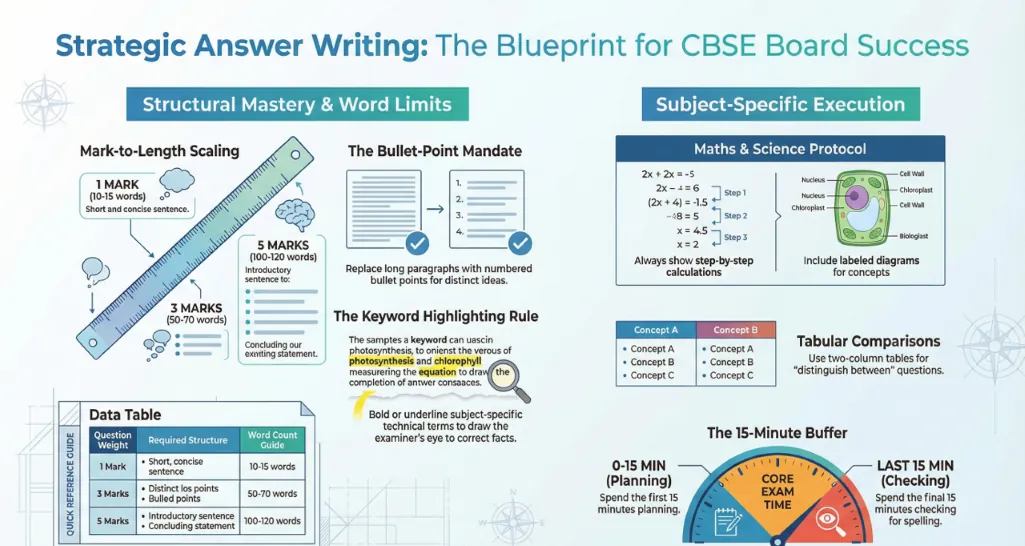
Table of Contents
- What You'll Master in the Next 10 Minutes:
- Why Answer Writing Skills Can Make or Break Your Class 10 Result
- The 3-Hour Battle Plan: How 95%+ Scorers Master Exam Time
- The 6 Golden Rules Every Topper Follows (95%+ Scorers Only)
- Subject-Wise Secrets: How Toppers Write Winning Answers
- 5 Deadly Mistakes That Kill Your Board Marks (Even Smart Students Do These!)
- Conclusion

"Sir, I know all the answers but still scored only 78% in boards. What went wrong?"
If this question haunts you after every exam, then beta, this blog will change everything. Every year, thousands of Class 10 students lose 15-20 marks not because they don't know the content, but because they never learned how to write answers that examiners actually want to see.
Here's the reality: Two students with identical knowledge can score 78% vs 94% — the only difference is how they present their answers on paper.
This blog gives you the exact answer writing formula used by 500+ CBSE toppers who consistently scored 95%+ in Class 10 boards. These aren't random tips. These are field-tested strategies that work every single time.
What You'll Master in the Next 10 Minutes:
The 180-Minute Battle Plan:
· First 15 minutes: Question paper analysis (not reading randomly)
· Next 90 minutes: Short questions that build your confidence
· Next 60 minutes: Long answers where toppers make their mark
· Last 15 minutes: Review strategy that saves 10-12 marks
The Mark-to-Time Formula: 1 mark = 1 precise point. 5 marks = intro + 3-4 detailed explanations. This isn't guesswork — this is exactly how CBSE marking schemes work.
Subject-Wise Winning Techniques:
- Maths demands step-by-step working.
- Science needs labeled diagrams.
- English requires proper paragraph structure.
- Social Science loves chronological organization.
The Costly Mistakes List: These four errors cost students more marks than wrong answers.
- Writing irrelevant content.
- Skipping math steps.
- Missing diagrams.
- Messy presentation.
CBSE Topper Answer Sheet
| Subject | Answer Sheet |
|
English |
Download English Topper answer Sheet |
| Hindi | |
| Science | Download Science Topper answer Sheet |
| Maths | Download Maths Topper Answer Sheet |
| Social Science | Download Social Science Topper Answer Sheet |
Why Most Students Fail at Answer Writing
The truth is harsh: Examiners spend 2-3 minutes per answer sheet. They scan, they don't read every word. If your key points aren't visible within seconds, you lose marks — even when your content is perfect.
CBSE evaluation follows a strict "value point" system. Examiners tick off specific keywords and concepts from their marking scheme. If they can't spot these quickly in your messy handwriting or buried paragraphs, those marks are gone.
But here's the good news: Presentation skills can boost your score by 10-15% without changing a single fact you write. The same content, presented correctly, jumps from B+ to A+.
This isn't theory. This is exactly how the system works, and smart students use it to their advantage.
Your board exams class 10 success depends more on how you write than what you write. Master this skill, and you'll never lose marks to poor presentation again.
The difference between scoring 85% and 95% often comes down to answer writing technique. Students who understand the "step-marking" system — where partial marks are awarded for correct methods even with wrong final answers — consistently outperform those who focus only on getting the right answer.
Most importantly, examiners are human. They evaluate hundreds of papers under time pressure. Clean, organized answers create a positive first impression that influences their marking psychology.
When toppers write answers, they think like examiners. They highlight keywords using underlining. They structure responses to match exactly what marking schemes expect. They make evaluation effortless.
This blog reveals every single technique they use — no secrets held back.
Why Answer Writing Skills Can Make or Break Your Class 10 Result
"Sir, I know everything but still got low marks in boards!"
If you've heard this complaint before, you're about to discover why it happens to thousands of students every year.
CBSE 2026 has introduced a multi-layer verification system where answer sheets pass through evaluators, assistant head examiners, head examiners, coordinators, and regional checks before finalization. This structured process makes your answer writing skills more crucial than ever.
What Actually Happens When Examiners Check Your Paper
Here's the reality most students don't know:
CBSE now follows a competency-oriented evaluation system where examiners assess your ability to:
· Interpret questions correctly
· Organize responses logically
· Present ideas with clarity
But here's the game-changer:
Examiners scan rather than read every word — checking dozens of answer sheets daily under time pressure. They're hunting for specific value points or keywords that match the marking scheme, and examiners are trained to award marks accordingly.
Think about it: An examiner has 2-3 minutes per answer. If your correct points are buried in messy paragraphs, they might miss them completely.
The 2026 exams will introduce on-screen marking for Class 12, where answer sheets will be scanned and uploaded digitally. This means clear organization isn't just helpful — it's essential for getting your answers evaluated properly.
The 15-Mark Difference That Presentation Makes
Research confirms what toppers have known for years — presentation directly influences scores. When identical answers were presented in different formats, neatly organized work consistently received higher marks.
Why this happens:
Examiners form impressions within seconds of viewing your answer sheet. A clean, structured response creates a positive bias that prevents strict marking.
Here's what costs students marks: answers that are correct but difficult to read often fail to receive full marks. Your handwriting doesn't need to be perfect, but it must be readable, with proper spacing between answers and clear paragraph breaks.
Bottom line: Two students with identical knowledge can receive different scores based solely on presentation. With CBSE moving toward digital evaluation, scanned answers must be easily interpretable on screen.
Knowledge vs. Writing: The Skills Gap That Kills Marks
Most students excel at memorizing content but struggle to convert that knowledge into well-structured answers. Understanding material and expressing it effectively are completely different skills.
What separates 85% students from 95% students:
1. Decoding question directives — words like "describe," "explain," "analyze" signal different approaches
2. Smart answer structure — introduction addressing the question directly, clearly separated points in the body, and a concise conclusion
3. Mastering the step-marking system — showing your work systematically, especially in subjects like mathematics
Remember this: CBSE examiners don't evaluate how much you know — they evaluate how well you present what you know. When you paraphrase information in your own words rather than copy directly, you demonstrate real understanding and often earn higher marks.
The truth is simple: knowing your syllabus is only half the battle. The other half is presenting that knowledge effectively on paper within time constraints.
Master this skill, and you don't just score better — you develop clearer thinking that will help you beyond exams.
The 3-Hour Battle Plan: How 95%+ Scorers Master Exam Time
"Sir, I know everything but always run out of time in exams."
Sound familiar? Every year, thousands of Class 10 students lose 15-20 marks just because they couldn't manage their 180 minutes properly. Time management separates average scorers from toppers more than subject knowledge does.
Let me break down the exact strategy 95%+ scorers follow in those crucial 3 hours.
Phase 1: The First 15 Minutes – Your Foundation
Never start writing immediately. This is the biggest mistake average students make.
The first 15 minutes decide your entire paper. Here's what toppers do:
· Scan the entire paper – understand the difficulty level
· Mark questions as Easy/Medium/Hard – creates your attack sequence
· Circle directive words – "Explain," "Justify," "Compare" tell you exactly what to write
· Choose internal options wisely – don't just pick the first one
· Time allocation planning – roughly 1.5 minutes per mark
Golden Rule: Those 15 minutes of planning save you 30 minutes of confusion later.
Phase 2: Next 90 Minutes – Short Questions Domination
This is your scoring zone. 90 minutes for short and medium questions gives you maximum marks with minimum risk.
The winning sequence:
Start with objective questions – finish in 15-20 minutes max. These are free marks if you know the basics.
Move to short answers (2-5 marks) – spend 5-7 minutes per question. Don't overthink. Write what's asked and move on.
Time checkpoints: After every 30 minutes, see where you stand. Are you on track? Ahead? Behind?
What toppers never do: Waste 20 minutes on one tough short question. Skip it, come back later.
Phase 3: Next 60 Minutes – Long Answer Territory
Now comes the real test. Long answers need 12-15 minutes each.
Structure every long answer like this:
· Brief intro addressing the question directly
· 3-4 main points with examples
· Quick conclusion if time permits
· Always include diagrams where needed – they carry serious marks
Smart strategy: If you're stuck on a long question, don't panic. Write whatever you know, draw the diagram, and move ahead. Partial marks are better than zero marks.
Phase 4: Last 15 Minutes – The Mark Saver
These final minutes can boost your score by 8-10 marks easily.
Your review checklist:
· Unanswered questions – did you miss any?
· Math calculations – one silly error costs 3-4 marks
· Diagram labels – unlabeled diagrams get zero marks
· Question numbers – wrong numbering = no marks
· Careless mistakes – the marks you can save right now
Remember: You can attempt questions in any order, but always write the correct question number.
The difference between 75% and 90% often comes down to these 180 minutes, not the 2 years of preparation.
Master your time. Master your marks.
The 6 Golden Rules Every Topper Follows (95%+ Scorers Only)
If you follow only these 6 rules in your board exam, you can add 15-20 marks to your final score.
This is not theory. This is the exact method used by students who scored 95%+ in CBSE board exams . Every single one of them followed these rules religiously.
Bhai, listen carefully: knowing your syllabus is only 50% of the battle. The other 50% is how you present that knowledge on paper.
Let's break down each rule:
Rule 1: Read Every Question Like Your Marks Depend On It
Most students lose 10-15 marks just because they misread questions.
Read the question twice. Not once. Twice.
First reading: Understand what is being asked. Second reading: Identify the exact approach needed.
Look for command words:
· "Define" = Give exact definition
· "Explain" = Give reasons with examples
· "Compare" = Show similarities and differences
· "Analyze" = Break down into parts and examine
If you answer a "compare" question by just explaining, you lose marks no matter how correct your content is.
Rule 2: The Marks-to-Content Formula
Here's the secret formula every topper uses:
· 1 Mark = 1 precise point
· 2 Marks = 2 clear points
· 3 Marks = 3 points with brief examples
· 5 Marks = Brief intro + 3-4 detailed points + conclusion
Golden Rule: Spend 1.5 minutes per mark maximum.
Don't write 2 pages for a 2-mark question. Don't write 2 lines for a 5-mark question.
Rule 3: Bullet Points = Your Best Friend
Examiners check 100+ papers daily. They don't have time to hunt for your key points in long paragraphs.
Bullet points make your answers examiner-friendly.
For factual questions, advantages/disadvantages, or listing features:
· Use crisp bullet points
· 4-6 points for a 5-mark answer
· Each point should be complete but concise
Save paragraphs only for explanations where flow matters.
Rule 4: Underline Like a Topper
Underlining is not decoration. It's strategy.
Underline:
· Key terms and definitions
· Important formulas
· Final answers in calculations
· Names, dates, and technical terms
This helps examiners spot value points quickly and ensures you don't miss easy marks.
Rule 5: Handwriting That Doesn't Kill Your Marks
Your handwriting doesn't need to be beautiful. It needs to be readable.
Simple rules:
· Write consistently throughout the paper
· Leave proper spacing between words
· If you make mistakes, cross out with one clean line
· Don't scribble or overwrite
Remember: Examiners can't give marks for content they can't read.
Rule 6: Spacing = Professional Presentation
CBSE has made this crystal clear: Mixed answers will NOT be evaluated.
· Leave 2 lines between different answers
· Use a ruler to draw lines after each section
· Write question numbers clearly
· Stay within designated spaces for each section
This isn't just about looking neat. Poor spacing can cost you marks during evaluation.
Follow these 6 rules in your next practice test. You'll see the difference immediately.
Subject-Wise Secrets: How Toppers Write Winning Answers
Each subject has its own language, its own rules. Master these subject-specific techniques and watch your marks jump by 15-20 points instantly.
English: The Art of Perfect Expression
English is different, beta. Here, your thoughts matter as much as your knowledge.
For literature questions, always give context first. Don't jump straight into analysis. Tell the examiner which chapter, which character, which situation you're discussing. English examiners love students who can connect ideas smoothly through proper paragraphs—not bullet points.
Your grammar and spelling? Non-negotiable. One spelling mistake in English costs more than three calculation errors in Math.
Format secrets that toppers use:
· Letters need proper addresses (don't skip the sender's address)
· Articles must have headlines + by-lines
· Underline book titles, poem names—but never underline your article headlines
Science: Where Precision Meets Marks
Science answers are like mathematical equations—every word has value.
The golden rule: Always define first, explain later. Write "Photosynthesis is the process by which green plants..." not "Plants make food using sunlight...".
Physics diagram mastery:
· Use sharp pencil + ruler for straight lines
· Mark EVERY component: principal axis, optical center, foci
· Small diagrams = lost marks. Make them big enough to label clearly.
Biology diagram secrets:
· HB pencil only—never use pen
· Label lines must be horizontal and straight
· No shading unless the question specifically asks for it
Chemistry equations = easy marks: Your balanced chemical equations need proper state symbols (s, l, g, aq) and reaction conditions clearly written. This is free marks that most students throw away.
Mathematics: Every Step = Marks in Your Pocket
Here's what most students don't know: In Math, the journey matters more than the destination.
The step-marking system means you can score 3 out of 5 marks even with a wrong final answer—if you show your working properly.
The winning formula:
4. Write "Given:" in symbolic form
5. State the formula you're using
6. Substitute values with units
7. Show calculations step by step
8. Box your final answer with proper units
Keep your equations aligned vertically. Equal signs should form a straight line down the page.
Geometry goldmine: Even if you can't solve the problem, a correct, labeled diagram earns you 1-2 marks automatically.
Social Science: Stories, Maps, and Smart Organization
Social Science rewards students who think like storytellers and present like professionals.
History answers = chronological gold: Arrange events in time order. Highlight important dates. Examiners love students who can connect cause and effect across time periods.
Geography map mastery: Every map needs three elements: distance, direction, symbols. Use conventional symbols—they're like a universal language that works globally. Large-scale maps for small areas, small-scale maps for big regions.
Economics + Civics power move: Always include real-world examples. Connect textbook concepts to current events. This shows the examiner you understand application, not just theory.
The secret? Each subject rewards different thinking patterns. Master these patterns, and you'll see your marks climb consistently across all papers.
5 Deadly Mistakes That Kill Your Board Marks (Even Smart Students Do These!)
Beta, listen carefully. Even toppers lose 15-20 marks not because they don't know answers, but because of silly presentation mistakes. These errors are completely avoidable, yet thousands of students repeat them every year.
Let's fix these right now.
Writing Everything You Know (Instead of What's Asked)
You see a question about "photosynthesis" and you write 2 pages covering respiration, nitrogen cycle, and plant diseases.
Result? Zero marks.
Examiners are looking for direct, focused answers. When you add irrelevant information, you're not impressing anyone — you're wasting precious time and confusing the examiner.
Stick to exactly what the question demands. A 3-mark question needs 3 clear points, not 3 paragraphs of random biology facts.
The Mathematics Disaster: Skipping Steps
"Bhai, answer toh sahi hai na?"
Yes, your final answer might be correct. But you just lost 3 out of 5 marks because you didn't show your problem-solving process
Mathematics follows strict step-marking. Even with the right answer, missing steps can cost you 50-80% of total marks. Every formula, every substitution, every calculation step — write it down clearly.
Science Without Diagrams = Marks Gone
Here's a harsh truth: In Science papers , a well-drawn diagram can save you even when your written answer is weak.
Students who skip diagrams in Biology lose 2-4 marks per question. That's 20-40 marks lost across the entire paper just because you thought "diagram toh optional hai".
It's not optional. It's often the difference between passing and failing.
Time Management Chaos
You spend 45 minutes on one tough 5-mark question, then rush through five easy 3-mark questions in the last 10 minutes.
Outcome? You lose 15 easy marks trying to save 5 difficult ones.
Smart students leave hard questions and return later. They secure easy marks first, then fight for the tough ones.
Messy Handwriting = Hidden Marks
Your answer is 100% correct, but it looks like a battlefield. Scribbled corrections, cramped spacing, illegible words.
Reality check: If the examiner can't read it, you get zero marks.
Your handwriting doesn't need to be beautiful, but every word must be readable. Draw diagrams with proper proportions — not too small to see, not too large to fit properly.
Remember this: These mistakes cost students more marks than wrong answers do. Fix your presentation, and your scores will jump immediately.
Conclusion
Mastering the art of answer writing stands as the crucial difference between average and exceptional scores in your CBSE Class 10 board exams. Throughout this guide, you've learned that correct knowledge alone doesn't guarantee top marks—presentation matters significantly. Your neat handwriting, proper spacing, and organized structure can boost your score by 10-15% even when content remains identical.
Time management certainly plays a vital role in your exam success. Remember the strategic breakdown—15 minutes for reading and planning, 90 minutes for short and medium questions, 60 minutes for long answers, and 15 minutes for review. This approach ensures you address every question thoroughly without rushing through important sections.
Additionally, following the golden rules will set you apart from other students. Read questions twice, write according to marks allocated, use bullet points strategically, underline keywords, maintain readable handwriting, and leave proper spacing between answers. These techniques help examiners identify key points quickly, directly affecting your final score.
Subject-specific strategies further enhance your performance. English requires proper paragraphs and flawless grammar, Science demands precise definitions and well-drawn diagrams, Mathematics needs step-by-step solutions, while Social Science benefits from headings and proper map work.
Last but not least, avoid common pitfalls that cost precious marks. Resist adding irrelevant information, never skip steps in Mathematics, always include required diagrams, manage your time wisely, and maintain a clean presentation throughout.
After all, board exam success combines what you know with how effectively you express it. These proven techniques from toppers transform your knowledge into maximum marks. Practice these strategies regularly before your exams, and you'll face the CBSE Class 10 boards with confidence, clarity, and the skills needed to achieve your best possible results.