JEE Advanced Preparation Strategy: Complete Study Plan by IIT Faculty
JEE Advanced preparation requires a structured study system built on consistent sleep, focused problem-solving, rigorous test analysis, smart revision cycles, physical fitness, and disciplined error tracking to maximize performance and achieve a top rank.


Table of Contents
- Why Your JEE Advanced Preparation Strategy Matters
- The Daily Study Schedule Framework
- Test Analysis and Error Tracking System
- Sleep, Rest, and Peak Mental Performance
- Subject-Specific Preparation Techniques
- Managing Negativity and Building Unshakeable Motivation
- Revision Cycles and Pre-Exam Discipline
- Common Mistakes to Avoid in JEE Advanced Prep

eSaral › JEE › JEE Main ›JEE Advanced Preparation Strategy

🚀 Checkout eSaral Courses
Why Your JEE Advanced Preparation Strategy Matters
Every year, only 2,50,000 students qualify from JEE Main to take JEE Advanced. Among them, fewer than 16,000 score under AIR 100. The difference between a rank of 500 and AIR 79? Not raw intelligence—it's systematic preparation.
When eSaral's top students compare their success stories, one pattern emerges: those who scored AIR 79 and other top ranks didn't work harder than others. They worked smarter. They built systems.
This guide distills the exact preparation methodology that brought AIR 79 scorers and IIT Bombay AIR-41 faculty to their ranks. You'll learn not just what to study, but how to study in a way that compounds results.
💡 Expert Insight by Saransh Gupta, IIT Bombay AIR-41: "I see this every year—students who start with lower mock scores than their peers end up scoring higher in the actual exam. The difference? They tracked their mistakes obsessively and built a personal data-driven study system. That's the hidden advantage."
The Daily Study Schedule Framework
How Much Time Do Top JEE Students Actually Study?
Most students assume AIR 79 scorers studied 12–14 hours daily. Reality is different.
AIR 79 scorer Vishruth tracked his study time and found a sweet spot: 8–9 hours of focused study during Class 11 and 12 mid, scaling to 10+ hours after mid-Class 12 when the syllabus was nearly complete.
Here's why this matters: After your syllabus is complete (typically mid-Class 12), your study time transforms from learning new concepts to pure problem-solving and revision. That's when effective study hours jump naturally.
The Fixed Sleep Schedule Advantage
Before diving into study schedules, understand this critical insight: Your sleep schedule determines your study quality far more than your study duration.
Vishruth initially had a chaotic sleep schedule:
- Sometimes sleeping at 3:00 AM, sometimes at 11:00 PM
- Sleeping 5–6 hours irregularly
- Waking up mentally foggy, unable to focus on problems
The result? Lower mock scores, mental fatigue, and careless mistakes.
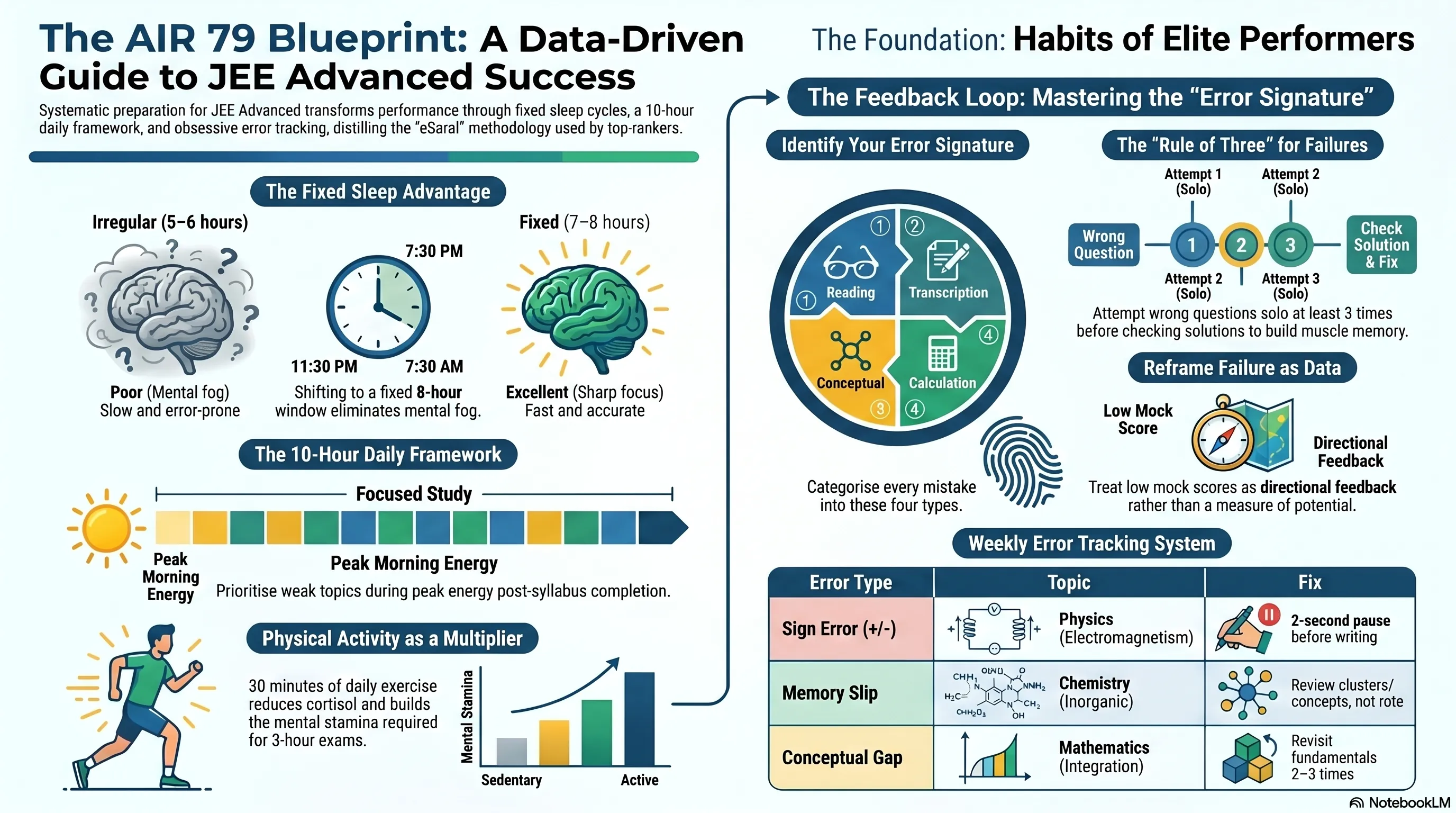
Once he committed to a fixed schedule (11:30 PM to 7:30 AM = 8 hours), everything changed:
- Mental clarity improved in mock exams
- Complex problem-solving became faster
- Careless errors dropped significantly
| Sleep Habit | Mock Score Impact | Mental Clarity | Problem-Solving Speed |
|---|---|---|---|
| Random sleep, 5–6 hours | Low (mental fog) | Poor | Slow, error-prone |
| Fixed schedule, 7–8 hours | High (sharp focus) | Excellent | Fast, accurate |
💡 Expert Tip by eSaral Faculty: "We tell every student: Your body clock is a tool. When your exam is at fixed timings, your brain must be trained to peak at that exact time. Sleep at 11:30 PM and wake at 7:30 AM during your entire preparation. Your JEE exam performance will thank you."
Sample 10-Hour Study Schedule (Post-Syllabus Completion)
Use this framework, but customize based on your weak topics:
| Time Slot | Activity | Duration | Purpose |
|---|---|---|---|
| 7:30–8:30 AM | Wake up, exercise, breakfast | 1 hour | Physical activation, mental clarity |
| 8:30–11:00 AM | Self-study: Problem-solving (weak topics) | 2.5 hours | Peak mental energy — tackle difficult problems |
| 11:00–11:30 AM | Break, snack | 30 min | Recharge |
| 11:30 AM–1:00 PM | Classroom session or online course | 1.5 hours | Structured learning |
| 1:00–2:00 PM | Lunch, rest | 1 hour | Physical recharge |
| 2:00–4:30 PM | Self-study: Mock tests or practice tests | 2.5 hours | Applied learning, time management practice |
| 4:30–5:00 PM | Break, walk, hydration | 30 min | Mental reset |
| 5:00–7:00 PM | Revision: Previous day's errors + test analysis | 2 hours | Error tracking, systematic improvement |
| 7:00–8:00 PM | Dinner, family time | 1 hour | Recovery |
| 8:00–9:30 PM | Light revision or leisure (no social media) | 1.5 hours | Consolidate learning, wind down |
| 9:30–11:30 PM | Prepare for bed, sleep preparation | 2 hours | Sleep hygiene |
| 11:30 PM–7:30 AM | Sleep | 8 hours | Neural consolidation, memory formation |
Total study time: 10 hours. Total focused work: 8–10 hours. Sleep: 8 hours (non-negotiable).
Test Analysis and Error Tracking System
Why Test Analysis Beats Re-Studying
Here's what separates AIR 79 scorers from the pack: They don't just take mock tests. They autopsy them.
After every mock test or practice paper, top scorers ask four questions:
- Did I read the question correctly? (Reading mistakes)
- Did I solve it correctly but write the wrong answer? (Transcription errors)
- Did I solve it with the wrong concept? (Conceptual gap)
- Did my calculation go wrong? (Arithmetic error)
Vishruth maintained a Test Analysis Notebook where, after every test, he categorized every wrong answer. Over weeks, patterns emerged:
- Physics: Mostly careless sign errors (writing +q instead of −q)
- Chemistry: Memory slips in inorganic reactions
- Math: Calculation errors under time pressure
Once he identified these patterns, he could target them specifically rather than re-studying entire chapters.
How to Build Your Test Analysis System
Step 1: After Every Mock, Redo Wrong Questions (Alone, 3–4 Times)
Don't check the answer key immediately. Try the question solo, three times minimum. This builds your problem-solving muscle memory.
Only after struggling should you see the solution. Why? Because the struggle itself improves your brain's ability to tackle similar problems.
Step 2: Document Every Wrong Answer in a Spreadsheet
Create a simple table (digital or paper):
| Test Date | Question # | Topic | Error Type | Why It Happened | Concept Review Needed? |
|---|---|---|---|---|---|
| 15-May | Q15 (Phys) | Electromagnetism | Sign error (−B vs +B) | Rushed reading | No |
| 15-May | Q23 (Chem) | Coordination Compounds | Memory slip | Weak inorganic revision | Yes |
| 15-May | Q32 (Math) | Integration | Conceptual gap | Didn't understand limits properly | Yes |
Step 3: Weekly Review Cycle
Every Sunday, review your error spreadsheet:
- Redo all "Conceptual gap" problems once
- Do one fresh problem on the same topic
- Mark when you feel ready to move on
This is where Vishruth's breakthrough happened. He scored 335 in JEE Main (solid but not spectacular). Instead of panicking, he reviewed his error notebook and realized most mistakes were preventable. He tightened his process.
Three months later, in JEE Advanced, his AIR was 79—a 15+ percentile jump.
💡 Expert Tip by eSaral Faculty: "We ask every student in our courses: Do you know your personal error signature? Most don't. Once you do—once you know 'I always mess up sign conventions in electromagnetism'—you can train yourself to pause for 2 seconds before writing the answer. That 2-second check prevents 5 marks lost. Over a 300-mark exam, this compounds."
Sleep, Rest, and Peak Mental Performance
The Science Behind Sleep in JEE Prep
Your brain consolidates memory during sleep. When you sleep, your brain replays problem-solving pathways, converting short-term learning into long-term retention.
Inadequate sleep (5–6 hours)? Your brain never consolidates. You forget formulas, struggle with familiar problems, and make careless errors.
Proper sleep (7.5–8.5 hours)? You wake up fresh, problems feel easier, and your focus is laser-sharp.
Vishruth noticed this acutely. In his 11th-grade chaotic sleep phase:
- Mock exams felt overwhelming
- Same problems he'd solved before felt unfamiliar
- Mental fog during exams led to mistakes
After fixing his sleep schedule in 12th grade:
- Familiar problems felt routine
- Complex topics became accessible
- His mental stamina during 3-hour exams improved dramatically
Physical Activity: The Underrated Multiplier
Most JEE students skip physical activity, thinking it wastes study time. This is backwards.
Physical exercise:
- Increases oxygen flow to the brain (sharper thinking)
- Reduces cortisol (stress hormone) — lowers anxiety before exams
- Improves sleep quality (deeper, more restorative sleep)
- Builds mental resilience (trains you to push through discomfort)
Vishruth regrets not doing this more. His advice: 30 minutes of daily physical activity (running, sports, gym) is non-negotiable. It's not a luxury—it's infrastructure for your brain.
Subject-Specific Preparation Techniques
Physics: Speed Comes From Problem-Solving Repetition, Not Rushing
Most students sacrifice accuracy for speed. Vishruth learned the opposite works better.
His physics strategy:
- Understand the concept deeply (spend time here—no shortcuts)
- Solve problems slowly, perfectly, understanding every step
- Only after mastery, practice problems under time pressure
By practicing this way, his speed naturally increased. He wasn't rushing; he was recognizing patterns faster.
For weak topics (Vishruth's was initially Kinematics and Electrodynamics):
- Revisit the fundamental concept 2–3 times (each time, a new angle)
- Solve basic problems first, then medium, then hard
- Track time: record how long each problem took, review where time was lost
Chemistry: Memorization is Necessary, But Do It Smart
Organic Chemistry: Don't just memorize reactions. Understand the why—the electron flow, the intermediate steps. This way, you can deduce reactions you've never seen.
Inorganic Chemistry: Yes, memorization is unavoidable (salt analysis, coordination compounds, exceptions). But memorize in clusters, not randomly.
Example: Instead of memorizing "Ammonia is trigonal pyramidal," understand the cluster:
- Why is NH₃ pyramidal? (lone pair on N)
- Why is BF₃ trigonal planar? (no lone pair on B)
- Why is PCl₅ trigonal bipyramidal? (expanded octet)
Vishruth's regret: "I memorized inorganic reactions like a robot initially. Once I understood the why, my confidence doubled and I retained far more."
Mathematics: Understand, Then Practice, Then Speed
Math in JEE is about recognition + execution, not brilliance.
When you see an integral problem, you should instantly recognize: "This is a standard integral," or "This needs substitution u=...", or "This is integration by parts."
Vishruth's math strategy:
- Weeks 1–2: Understand concept deeply, solve 5–10 problems very slowly
- Weeks 3–4: Practice 20–30 problems at medium speed, focus on accuracy
- Weeks 5–6: Solve 50+ problems under timed conditions, focus on speed and accuracy
By Week 6, the problem type becomes a reflex. Your brain recognizes the pattern and executes.
💡 Expert Insight: "Many students do 100 problems in a week. AIR 79 scorers do 50 problems in a week but spend 3x longer understanding why each step works. Deep understanding beats volume every single time."
Managing Negativity and Building Unshakeable Motivation
The Breakthrough Insight About Failure
Vishruth's most important learning: Failure is not demotivating—it's directional feedback.
When his JEE Main score came in at 335, people around him said, "You won't make AIR 100. Forget Advanced."
But Vishruth's mindset was different: "335 means I have a 15+ percentile gap to close. I know exactly what went wrong. Advanced is my real chance to prove myself."
This isn't motivational fluff. This is a skill—the skill of reframing failure as useful data.
How to Build This Mindset
Practice 1: Weekly Failure Review Every Sunday, list three things you did wrong that week:
- Mock exam score was low
- Didn't finish a chapter
- Made careless errors in a test
Next to each, write: "This shows I need to [improve/practice/focus on]..."
This converts abstract failure into concrete, solvable problems.
Practice 2: Compare Progress, Not Perfection Don't ask, "Am I good enough?" Ask, "Am I better than last week?"
Vishruth tracked this religiously:
- Week 1 JEE Main mock: 280
- Week 2 JEE Main mock: 298
- Week 3 JEE Main mock: 315
- Week 4 JEE Main mock: 335
Each improvement was small (15–20 points), but it was consistent. This consistency bred confidence.
Practice 3: Protect Your Self-Talk When you make an error, your inner voice matters.
Bad self-talk: "I'm stupid. I'll never crack JEE." Good self-talk: "I made a mistake. I know how to fix this. Let me redo it."
The second one keeps you in a problem-solving mindset instead of a shame spiral.
The Humility Paradox
Here's Vishruth's most powerful observation: Even after scoring AIR 79, he still believes:
- His juniors are impressive and capable
- His success is 70% hard work, 30% favorable circumstances
- There's much more to life than a JEE rank
This humility is not false modesty. It's a realistic assessment that keeps him motivated without arrogance.
Top JEE scorers don't think, "I'm a genius." They think, "I worked hard and got lucky. I can help others do the same."
Revision Cycles and Pre-Exam Discipline
The Revision Framework
Most students revise wrong. They re-read chapters or re-solve easy problems—both wastes of time.
Effective revision targets your weak points obsessively.
Vishruth's weak topics (Mechanics, Electrodynamics) were revised 3–4 times across his preparation. His stronger topics were revised 1–2 times.
Smart Revision Schedule
| Timeline | Revision Focus |
|---|---|
| Weeks 1–8 (after syllabus complete) | Deep revision of weak topics (3 times each) |
| Weeks 9–12 | All topics, 1 time each (quickly identify new weak spots) |
| Weeks 13–16 | Final targeted revision of remaining weak areas |
| Week 17 (exam week) | Light review of key formulas, strategies, solved examples only |
Critical rule: In the final week before the exam, do not solve new problems. Only review what you know. New problems right before exam day tank your confidence.
Pre-Exam Mental Conditioning
5 Days Before Exam:
- Solve one full mock test under exact exam conditions (3 hours)
- Review your mistakes
- Sleep 8 hours nightly (non-negotiable)
2 Days Before Exam:
- Review formula sheets and key concepts
- Solve 10–15 moderate-difficulty problems
- Visualize yourself solving the exam calmly
1 Day Before Exam:
- Light review only (30 minutes)
- Prepare exam hall (pens, calculator, admit card)
- Sleep early (bed by 10:30 PM)
- Eat light, nutritious food
Exam Day Morning:
- Wake at 6:30 AM (aligned with your sleep schedule)
- Eat a light breakfast with carbs (fuel for 3-hour focus)
- Arrive 30 minutes early
- Breathe: 5 seconds in, 5 seconds out, 5 times
Common Mistakes to Avoid in JEE Advanced Prep
Mistake 1: Social Media Distractions
Vishruth deliberately avoided Instagram and heavy social media during his prep.
Why? Because social media is engineered to be addictive. One "quick scroll" becomes 30 minutes. You've lost productive study time and your mental state is fragmented.
The rule: Delete Instagram, TikTok, YouTube Shorts from your phone. Seriously. The 30 minutes you'd spend scrolling daily compounds to 150 hours over a year—equivalent to 3 weeks of full-time study.
Mistake 2: Backlog Accumulation
Students tell themselves, "I'll catch up during revision." This almost never works.
Why? As new topics add up, old topics fade from memory. Revision becomes overwhelming.
The fix: Spend extra time during the study week on backlog, not during revision. Sacrifice leisure time, not sleep. As Vishruth learned: "Sacrifice free time, not sleep time."
Mistake 3: Skipping Board Exams Prep
JEE students often think, "Board exams don't matter. I'll just focus on JEE."
But here's the reality: Board exam questions share 60% of their DNA with JEE questions (same NCERT content, similar problem types). Preparing for boards reinforces JEE concepts.
Vishruth scored 95.8% in 12th boards while preparing for JEE. Why? Because board revision was actually advanced concept review.
Mistake 4: Ignoring Physical Fitness
This is serious. Exam hall stamina matters.
If you're sitting and studying for 8 hours daily but never exercising, when you sit in the exam hall for 3 hours straight, your body rebels. Restlessness, fatigue, difficulty focusing—all due to lack of physical conditioning.
The fix: 30–60 minutes of daily exercise (running, sports, gym). This is not optional.
Mistake 5: Comparing Your Preparation to Others'
Social media has made this worse. You see someone's mock score and panic.
Remember: You're only seeing their score, not their:
- Weak topics (which they'll improve)
- Test anxiety (they might score lower in actual exams)
- Family support, coaching access, study hours, sleep quality
Compare only with your past self. "Am I better than last month?" That's the only comparison that matters.
🚀 Checkout eSaral Courses
Frequently Asked Questions
Find answers to common questions.
How many hours of study do top JEE scorers really do?
8–10 hours of focused study is typical, not 14–16 hours. Quality beats quantity. One 3-hour focused session beats six 30-minute distracted sessions. Top scorers like AIR 79 scorer Vishruth emphasize that 8–9 hours during Class 11–12 mid, scaling to 10 hours post-syllabus-completion, with 8 hours of sleep nightly, is the sustainable sweet spot.
Is it better to study for long hours with one day off, or study less daily?
Daily consistency beats sprint study. Your brain consolidates learning during sleep and rest. If you study 2 hours daily, your brain processes and retains it. If you study 10 hours once a week, your brain can't consolidate that volume in one day, and you forget most of it. eSaral's faculty recommend 8–10 daily hours, seven days a week (with lighter Sunday revision).
How important is sleep for JEE preparation?
Critical. Sleep is when your brain converts short-term learning into long-term memory and builds neural connections for problem-solving. Students who sleep 5–6 hours feel foggy during exams and make careless errors. Those who sleep 7.5–8 hours are sharp, focused, and accurate. Never sacrifice sleep for study—if you have too much to study, the problem is not your sleep; it's your study system.
What should I do if I'm always demotivated?
Reframe how you interpret failure. When you score low in a mock, don't say, "I'm not good enough." Say, "Here are 5 specific areas I can improve." Convert emotional pain into directional feedback. Also, track your improvement week-to-week (even if small—15-point increases). Seeing progress, not perfection, builds real motivation.
What's more important for JEE Advanced—understanding or speed?
Understanding, without question. Speed comes naturally after deep understanding. If you understand concepts deeply, your brain recognizes problem patterns faster, and speed follows. But if you prioritize speed without understanding, you'll make conceptual errors that cost marks. Prioritize understanding first; speed second.