JEE Main 2026 January 22 Shift 2 Paper Analysis – Difficulty, Weightage & Student Reactions
JEE Main 2026 Jan 22 Shift 2 was a moderate-to-tough, concept-heavy paper with challenging Mathematics, tougher Physics, balanced Chemistry, and a strong emphasis on Calculus, Electrodynamics, and problem-solving skills.
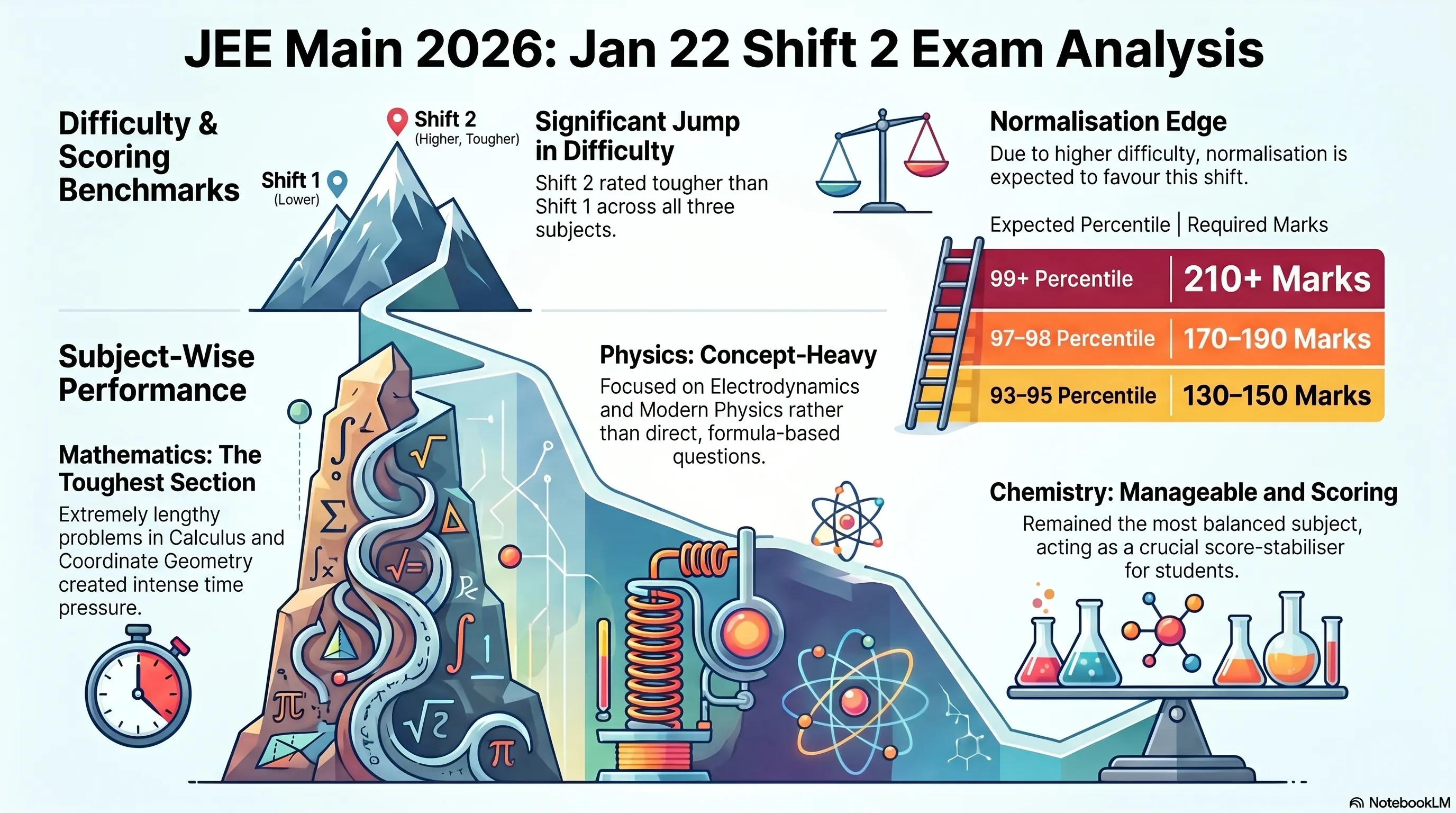
Table of Contents

eSaral › JEE › JEE Main ›JEE Main 2026 January 22 Shift 2 Paper Analysis

🚀 Checkout eSaral Courses
The JEE Main 2026 January 22 Shift 2 paper was one of the most discussed shifts of the session, as students felt a noticeable change in difficulty level compared to earlier shifts. Aspirants were keen to know whether this shift was tougher and how normalization might play a role. If you are preparing for upcoming sessions or JEE Advanced, joining a focused JEE Crash Course can help you revise effectively and boost your score in a short time.
Here is a complete, student-friendly and SEO-optimized analysis of JEE Main 2026 Jan 22 Shift 2 based on student feedback and expert review.
Overall Difficulty Level – Jan 22 Shift 2
The overall difficulty level of JEE Main 2026 Jan 22 Shift 2 is rated as:
⚠️ Moderate to Tough
This shift leaned more towards conceptual depth and lengthy calculations, making it tougher than Jan 22 Shift 1.
|
Parameter |
Verdict |
|
Overall Difficulty |
Moderate to Tough |
|
Time Management |
Tight |
|
Length of Paper |
Moderate |
|
Conceptual Level |
High |
|
Surprise Elements |
Some tricky questions |
Subject-wise Paper Analysis
Physics Analysis – Jan 22 Shift 2
Physics was more conceptual and tougher compared to the morning shift.
Physics Highlights:
- Strong focus on Electrodynamics and Modern Physics
- Fewer direct formula-based questions
- Multi-concept questions tested deeper understanding
Physics Difficulty: 🟡 Moderate to Tough
Chemistry Analysis – Jan 22 Shift 2
Chemistry was balanced but slightly trickier than Shift 1.
Chemistry Highlights:
- Inorganic was NCERT-based but with tricky options
- Organic involved conceptual reaction mechanisms
- Physical Chemistry was calculation-oriented
Chemistry Difficulty: 🟡 Moderate
Mathematics Analysis – Jan 22 Shift 2
Mathematics emerged as the toughest section of this shift.
Mathematics Highlights:
- Lengthy, time-consuming problems
- Dominance of Calculus and Coordinate Geometry
- Required strong problem selection strategy
Mathematics Difficulty: 🔴 Tough
Chapter-wise Weightage – Jan 22 Shift 2
Based on memory-based questions:
Physics Weightage
|
Chapter |
Weightage |
|
Electromagnetic Induction |
2 |
|
Alternating Current |
2 |
|
Modern Physics |
2–3 |
|
Rotational Motion |
1–2 |
|
Thermodynamics |
1–2 |
|
Wave Optics |
1–2 |
Chemistry Weightage
|
Chapter |
Weightage |
|
Coordination Compounds |
2 |
|
Chemical Kinetics |
1–2 |
|
Electrochemistry |
1–2 |
|
Alcohols, Phenols & Ethers |
2 |
|
Periodic Table |
1–2 |
|
Biomolecules |
1 |
Mathematics Weightage
|
Chapter |
Weightage |
|
Differential Calculus |
3 |
|
Definite Integration |
2 |
|
Conic Sections |
2 |
|
Vector & 3D Geometry |
2 |
|
Complex Numbers |
1–2 |
|
Permutation & Combination |
1–2 |
Toughness Level Compared to Jan 22 Shift 1
|
Parameter |
Shift 1 |
Shift 2 |
|
Physics |
Easy-Moderate |
Moderate-Tough |
|
Chemistry |
Easy |
Moderate |
|
Mathematics |
Moderate |
Tough |
|
Overall |
Moderate |
Moderate-Tough |
👉 Jan 22 Shift 2 was clearly tougher than the morning shift.
Students’ Reactions – Jan 22 Shift 2
What Students Liked 👍
- Conceptual quality of questions
- Chemistry remained manageable
- Fair paper without surprises
What Troubled Students 👎
- Maths was very lengthy
- Physics needed deep understanding
- Time pressure was high
Common Student Opinion:
“Maths was exhausting, but Chemistry helped balance the paper.”
If you are preparing for upcoming sessions or JEE Advanced, joining a focused JEE Crash Course can help you revise effectively and boost your score in a short time.
Expected Percentile vs Marks – Jan 22 Shift 2
Since this was a tougher shift, normalization may be favorable.
|
Marks |
Expected Percentile |
|
210+ |
99+ |
|
170–190 |
97–98 |
|
130–150 |
93–95 |
|
90–110 |
88–90 |
(Indicative only)
What This Shift Teaches Future Aspirants
Based on Jan 22 Shift 2:
- Focus on high-level Calculus
- Strengthen Electrodynamics & EMI
- Practice multi-concept Physics problems
- Improve question selection strategy
Final Verdict – JEE Main 2026 Jan 22 Shift 2
The paper was challenging, concept-heavy, and time-consuming, making it one of the tougher shifts of the session. Students with strong conceptual clarity and exam temperament performed better.
Frequently Asked Questions
Find answers to common questions.
Was JEE Main Jan 22 Shift 2 tougher than Shift 1?
Yes, Jan 22 Shift 2 was clearly more difficult than the morning shift. Physics moved from Easy–Moderate to Moderate–Tough, Chemistry from Easy to Moderate, and Mathematics from Moderate to Tough. Overall, the afternoon shift demanded more time and deeper conceptual preparation than the morning paper.
Which subject was the toughest in JEE Main Jan 22 Shift 2?
Mathematics was the toughest section by a significant margin. The problems were lengthy, calculation-heavy, and required multi-step approaches — particularly in Differential Calculus, Definite Integration, and Conic Sections. Many students reported leaving several Maths questions unattempted due to time pressure.
Was Chemistry scoring in JEE Main Jan 22 Shift 2?
Yes, Chemistry was the most manageable section in this shift and helped students balance their overall scores. Inorganic was largely NCERT-based, Organic tested reaction mechanisms, and Physical Chemistry required careful calculation. Students with thorough NCERT preparation found Chemistry to be their strongest section.
Was the paper based on NCERT?
Partly — especially in Chemistry and some parts of Physics. Inorganic Chemistry questions were closely tied to NCERT, and Biomolecules was straightforward for students who had read NCERT carefully. However, Mathematics and Physics went well beyond NCERT in terms of problem complexity and application depth.
Will NTA normalisation favour students from this shift?
Likely yes. NTA uses a percentile-based normalisation method across all shifts to ensure no student is disadvantaged for appearing in a tougher paper. Since Jan 22 Shift 2 was harder than several other shifts in the session, the raw-score-to-percentile conversion should be relatively more generous for this shift.