JEE Main 2027 Preparation Strategy: Honest Guide by IIT Faculty
JEE Main 2027 success depends on building strong concepts, solving challenging JEE Advanced-level questions, taking regular mock tests, practicing PYQs early, and maintaining balanced preparation across all three subjects.

Table of Contents
- Why JEE Main 2027 Will Not Be Easy
- The Real Competition: How Many Students Are Actually Preparing?
- Theory: Why "Everything Feels Clear in Class" Is a Warning Sign
- Questions: What Level Should You Be Practising Daily?
- Tests: The 6-Per-Month Rule That Changes Everything
- Subject-Wise Breakdown: Physics, Chemistry, and Maths for JEE 2027
- Common Mistakes That Cost Students Their JEE Rank

eSaral › JEE › JEE Main ›JEE Main 2027 Preparation Strategy

🚀 Checkout eSaral Courses
Why JEE Main 2027 Will Not Be Easy
Many students approach JEE Main with a dangerous assumption: that it is significantly easier than JEE Advanced, so NCERT-level preparation will be enough. The 2026 data destroys that assumption.
Here is what actually happened in JEE Main 2026 and JEE Advanced 2026:
| Metric | JEE Main 2025 | JEE Main 2026 | Change |
|---|---|---|---|
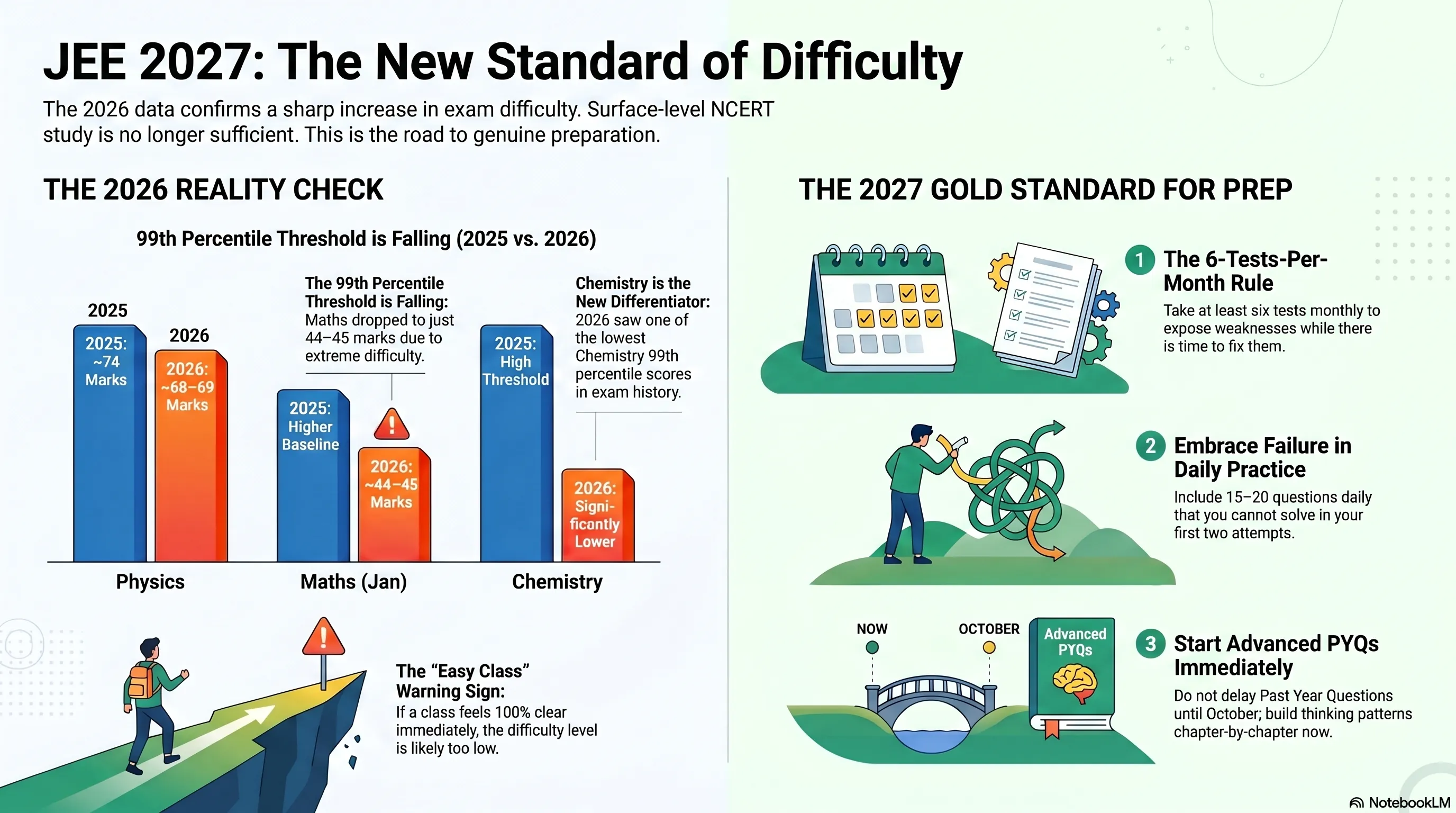
| Physics 99 percentile marks | ~74 | ~68–69 | ↓ 5 marks |
| Chemistry 99 percentile marks | ~63–64 | Among the lowest in history | ↓ Significant |
| Maths 99 percentile marks (Jan) | Higher baseline | ~44–45 | ↓ Sharp drop |
The pattern is clear. In JEE Main 2026, Maths 99 percentile came at just 44–45 marks in January. Chemistry saw one of the lowest individual 99th percentile scores in the history of the exam. Physics dropped 5 marks at the 99th percentile threshold in a single year.
JEE Advanced 2026 took difficulty even further — one of the toughest Chemistry papers ever set, conceptually deep Physics, and a Maths paper that required genuine problem-solving, not formula application.
If you are preparing for JEE Main 2027, understand this: the exam now has 4–5 shifts every session where the difficulty approaches the advanced level. At 55% marks, you reach the top 1% nationally. That means the paper is hard — but the bar to top it is actually reachable if you prepare at the right level.
Join eSaral's Droppers Batch – Available in both Online & Offline modes. Get expert guidance, structured preparation, and personalised mentorship to crack JEE/NEET with confidence!
The Real Competition: How Many Students Are Actually Preparing?
The number of 16 lakh registered JEE candidates sounds terrifying. It should not be.
Of those 16 lakh students, approximately 2–3 lakh are genuinely preparing. The rest are caught in a cycle of social media scrolling, gaming, and inconsistent study sessions with no real strategy. That is not cynicism — it is an honest observation drawn from coaching data and year-after-year patterns in results.
What Does "Genuinely Preparing" Mean?
Even among the 2–3 lakh serious students, a large majority are preparing incorrectly. They are:
- Studying easy-level theory and feeling satisfied
- Avoiding hard questions because they do not solve immediately
- Skipping JEE Advanced PYQs until "later" (which never comes)
- Taking tests only occasionally, or taking tests that are far too easy
So the real competition for a top rank in JEE Main 2027 and a seat in IIT is a few thousand students who are studying at the right level, right now.
The window is open. The question is whether you will use it.
Join eSaral's Droppers Batch – Available in both Online & Offline modes. Get expert guidance, structured preparation, and personalised mentorship to crack JEE/NEET with confidence!
Theory: Why "Everything Feels Clear in Class" Is a Warning Sign
This might be the most important section in this entire article. Read it carefully.
If you are sitting in a JEE Advanced-level class and everything is making complete sense, something is wrong.
A genuinely Advanced-level class — taught by the best faculty in India — should leave 20–30% of the content requiring re-thinking at home. You should sit with your notes afterwards, ask yourself why a particular concept works the way it does, and reach your own understanding through effort. That is how Advanced-level mastery is built.
What Happens When You Study at the Wrong Level
Consider Chemistry's VSEPR topic. Many students memorise the shapes — tetrahedral, trigonal bipyramidal, trigonal planar — and move on. They have "studied" the chapter.
JEE Advanced asks why. Why is a molecule tetrahedral and not planar? What changes the geometry when lone pairs are involved? A student who memorised shapes will not be able to answer. A student who understood the electron pair repulsion principle from first principles will answer instantly.
This depth cannot come from spoon-feeding in class. It has to come from self-study at home.
How to Fix Your Theory Approach
- After every class, close your notes and write down what you understood — in your own words
- For every concept, ask "why" at least twice before moving on
- If everything is making sense in class without effort, the level is too low — find harder material
- Study NCERT line by line for Chemistry — but go beyond it with concept questions
Students in eSaral's 2026 batch who followed this approach scored 248, 252, 273, and 279 in JEE Advanced. Those marks come from months of deep theory work, not surface-level revision.
Questions: What Level Should You Be Practising Daily?
Here is a benchmark. One of eSaral's top students — who scored 202 marks in JEE Advanced 2026 with AIR around 932 — could solve only 4–5 questions out of 10 from eSaral's Exercise 2A module. That is the level of material that produces top 1000 ranks.
If every question in your daily practice feels doable on the first attempt, you are not growing.
The Daily Question Standard for JEE 2027
Every day, your practice session should include:
- At least 15–20 questions that you cannot solve in one or two attempts
- Questions that require you to combine concepts from multiple chapters
- At least some questions from JEE Advanced PYQs — starting now, not in January
Why You Cannot Delay JEE Advanced PYQs
Many students plan to do JEE Advanced question papers "later." Here is why that plan fails:
- After October, focus naturally shifts entirely to JEE Main
- Class 12 students add board preparation from November onwards
- Dropper students want to clear JEE Main in the January attempt and move on
- By the time "later" arrives, there are 6–8 weeks left for Advanced — not enough to build the thinking patterns that PYQs develop
Start JEE Advanced PYQs now. Do them chapter by chapter as you complete each topic. They are not just practice questions — they train you to think in the way JEE Advanced demands.
| Question Type | When to Do It | Purpose |
|---|---|---|
| Chapter-wise JEE Main questions | After every chapter | Concept consolidation |
| JEE Advanced PYQs (chapter-wise) | Alongside each chapter | Deep thinking development |
| Full JEE Main mock tests | Every 21–28 days | Exam stamina and time management |
| Full JEE Advanced mock tests | Every term | Advanced exam pattern familiarity |
Also study JEE Main 2026 papers — not 2021–2024. The 2026 Chemistry paper had questions where a single question covered an entire chapter of inorganic chemistry across 6–7 statements. If even one sub-topic is weak, that question is gone.
Tests: The 6-Per-Month Rule That Changes Everything
Minimum 6 tests per month. No exceptions.
This is not a suggestion. It is a preparation standard that separates students who crack JEE from students who regret their preparation.
Why Students Avoid Tests
The most common reasons students delay taking tests:
- "My revision is not complete yet"
- "My marks are low in tests, so let me study more first"
- "I will start giving tests from October/November"
Every one of these reasons is a trap. Tests done before your preparation feels "ready" are the most valuable tests you will ever take — because they show you exactly where your preparation is weak while there is still time to fix it.
What Happens Without Regular Tests
Students who avoid tests make all their mistakes in the actual JEE Main. A 26 or 30 percentile in January is the result of problems that were always there — just never identified and fixed in time.
What the Data Shows
A student who scored 235 marks in JEE Advanced 2026 — placing in approximately the top 300 ranks nationally — never scored more than 180–200 in eSaral's internal test series in the 6 weeks before the exam. That gap between internal test score and actual exam performance is normal when the internal tests are harder than the real paper.
Take tough tests. Score lower than expected. Fix the gaps. Score higher in the real exam.
This is the process. Check JEE Advanced marks vs rank data to understand what score you need for your target IIT — and reverse-engineer your test performance goals from there.
Join eSaral's Droppers Batch – Available in both Online & Offline modes. Get expert guidance, structured preparation, and personalized mentorship to crack JEE/NEET with confidence!
Subject-Wise Breakdown: Physics, Chemistry, and Maths for JEE 2027
How Should You Prepare for Physics for JEE 2027?
Physics in JEE Main 2026 had one of the sharpest difficulty increases in recent years — the 99 percentile threshold dropped by 5 marks in a single year. JEE Advanced 2026 Physics was described as one of the most conceptually demanding papers in recent history.
Focus areas:
- Conceptual derivations over formula memorisation
- Numerical problems that require multi-step reasoning
- Calculation speed and accuracy — a 5-mark drop at 99 percentile means precision matters
How Should You Prepare Chemistry for JEE 2027?
Chemistry was the biggest differentiator in both JEE Main and JEE Advanced 2026. The JEE Main 2026 Chemistry 99 percentile was among the lowest ever recorded.
Focus areas:
- Inorganic Chemistry: Every reaction, every exception, every trend — no shortcuts
- Organic Chemistry: Mechanism-based understanding, not product memorisation
- Physical Chemistry: Calculation-heavy topics need daily practice
Study the JEE Main syllabus carefully and map every Chemistry chapter to its weightage before planning your schedule.
How Should You Prepare Maths for JEE 2027?
Maths in JEE Main January 2026 saw 99 percentile at just 44–45 marks. This means even top students found the paper difficult. JEE Advanced Maths, while slightly more accessible than Physics and Chemistry in 2026, still required genuine problem-solving.
Focus areas:
- Calculus — both conceptual understanding and speed
- Coordinate Geometry and Algebra — high-weightage areas every year
- Practice problems that cannot be solved in under 3 minutes without shortcuts
Common Mistakes That Cost Students Their JEE Rank
After working with thousands of JEE students, these are the patterns that consistently produce regret:
- Ignoring one subject — the student who is strong in Physics and Maths but weak in Chemistry loses JEE Advanced on Chemistry alone. All three subjects must be balanced every week.
- Switching between teachers and batches — changing your primary teacher every few weeks means you never build depth in any one system. Pick your faculty, commit, and go deep.
- Studying from four different teachers' notes simultaneously — more sources does not mean more learning. It means more confusion and less time for actual problem-solving.
- Easy tests in coaching — if your internal test always gives you 160–180 out of 300 and that feels good, check whether the test itself is at the right level. A soft test paper gives false confidence that collapses on exam day.
- Delaying PYQs — as covered above, this one mistake alone costs many students their Advanced rank.
- Being a "fan" instead of a student — time spent in comment sections defending your coaching or your favourite teacher is time not spent on Exercise 2A. Your career does not care who you are loyal to.
If your last revision cycle felt slow, the notes you were working from were probably the bottleneck — our how to make short notes for JEE guide addresses that directly.
🚀 Checkout eSaral Courses
Frequently Asked Questions
Find answers to common questions.
How to prepare for JEE Main 2027 from scratch if I am in Class 11?
Start with NCERT for all three subjects, then move immediately to Advanced-level theory — do not stay at easy level. Begin JEE Advanced PYQs chapter by chapter as you finish each topic. Give at least 4–6 tests per month from Class 11 itself. Students who start at the right level in Class 11 consistently produce top 500 ranks.
Is JEE Main getting harder every year?
Yes, based on recent data. JEE Main 2026 saw Physics 99 percentile drop to 68–69 marks from 74 in 2025. Chemistry produced one of the lowest 99 percentile scores in history. Maths 99 percentile came at just 44–45 marks in the January session. The trend is clear — JEE Main now regularly features Advanced-level questions in 4–5 shifts per session.
How many tests should I give per month for JEE 2027?
Minimum 6 tests per month — a combination of chapter-wise JEE Main tests, chapter-wise JEE Advanced tests, and full-length 3-hour and 6-hour mock papers. Tests should be taken at the correct difficulty level. Easy tests that give inflated scores do not prepare you for actual exam conditions.
Should I study JEE Advanced PYQs even if I am only targeting JEE Main?
Yes. JEE Main 2026 difficulty in multiple shifts was close to Advanced level. Students who only practiced easy-level questions found several shifts extremely difficult. Advanced PYQs build the thinking depth needed to handle tough JEE Main shifts comfortably. Access JEE Advanced question papers and start chapter by chapter.
How much time is left to prepare for JEE Main January 2027?
Approximately 7 months from June 2026 to January 2027. That is enough time to cover the full syllabus from zero and reach Advanced level — but only if you start immediately and study at the right difficulty level. Each week of delay reduces the buffer for revision and test practice.