NEET Drop Year 2027: Complete Strategy to Reach AIIMS in One Year


Table of Contents
- Is AIIMS Delhi Possible in One NEET Drop Year?
- Real Drop Year Student Results: From Average to AIIMS
- When Should You Start Your NEET Drop Year Preparation?
- 13-Month NEET Drop Year Roadmap: Month-by-Month
- NEET Drop Year Daily Timetable: 12 Hours That Work
- Practice & Test Strategy for NEET Drop Year Students
- Why Mentorship Is the Hidden Factor Behind Top NEET Ranks


Is AIIMS Delhi Possible in One NEET Drop Year?
The short answer is yes — and it is not just theoretical. Before discussing strategy, understand what makes a drop year succeed or fail. Most drop-year students fail not because they aren't smart, but because they repeat the same patterns that caused failure the first time: an incomplete syllabus, no revision, no consistent testing, and no one tracking their progress.
Why do most students who scored 200–300 not automatically improve with a drop year?
Low NEET scores almost always trace back to three root causes:
- Incomplete syllabus — Biology depth is missing, Physics was ignored, or Chemistry organic reactions were never properly covered.
- No revision system — Topics were studied once and never reviewed. NEET requires you to retain everything across three subjects simultaneously on exam day.
- Insufficient practice — Low exposure to past-year questions and no timed practice means speed and accuracy are both underdeveloped.
A drop year fixes all three — if and only if you follow a system. A second year of the same approach gives the same result.
"When my own exam didn't go as planned, I started preparing for the next year right after my boards — because I already knew this year wasn't mine. Be honest with yourself. If you know your current score won't get you into AIIMS, start preparing for the drop year now. Every day from today counts"
Real Drop Year Student Results: From Average to AIIMS
The most powerful evidence for what a structured drop year can achieve comes not from promises — but from students who have already done it. These are real eSaral students from the NEET Warrior batch:
Drop Year: Yes
From the NEET 2026 batch currently in preparation, the numbers are equally compelling:
| Student Profile | Previous NEET Rank / Score | Current Test Scores | Status |
|---|---|---|---|
| Girl, 70% in Class 12 boards | Low score, not qualified | 700+ in some tests | On track for AIIMS |
| Male student | NEET 2025 rank: 15,00,000 | 650+ consistently | On track for top AIIMS |
| Female student | NEET 2025 rank: 6,00,000 | 600+ consistently | On track for AIIMS |
A student with a 15-lakh NEET rank scoring 650+ consistently in tests — that's a transformation of 400+ marks in under a year. This is only possible with the right syllabus coverage, revision system, and testing frequency working together. Tum kyun nahi kar sakte?
When Should You Start Your NEET Drop Year Preparation?
The single most impactful decision in a drop year is when you begin. Students who start immediately after their current attempt — even before NEET 2026 results are out — get a 13-month preparation window. Students who wait for results and then wait some more get 9–10 months. That gap in preparation time translates directly to rank.
Should you attempt NEET 2026 even if you know you won't qualify?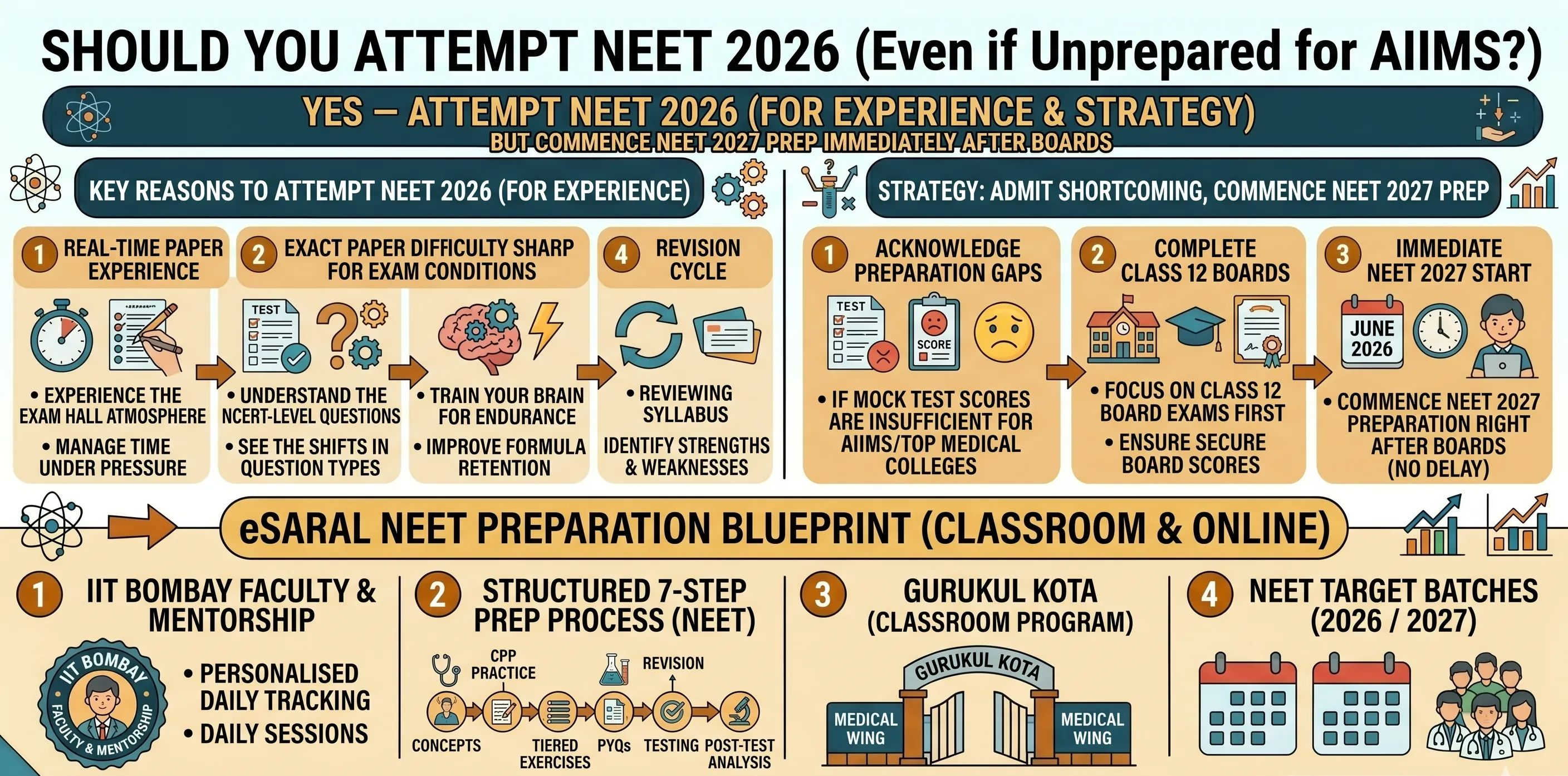
Yes — attempt NEET 2026 if you are eligible. Appearing for the exam gives you real-time paper experience, shows you the exact difficulty and pattern, and keeps your mind sharp for exam conditions. But simultaneously, if you already know from test scores that your current preparation is insufficient for AIIMS, begin your NEET 2027 preparation right after your boards.
Every single day from today to the first Sunday of May 2027 matters. Each day of structured study can move your rank by 3,000–4,000 positions up or down. Students who start their drop year preparation in April–May 2026 complete full syllabus coverage by December 2026 — giving them 4+ months of pure revision and mock testing before NEET 2027.
13-Month NEET Drop Year Roadmap: Month-by-Month
This is the broad 13-month plan that eSaral's NEET Warrior batch follows — from starting preparation after NEET 2026 to walking into NEET 2027 with 4 complete revisions under your belt.
| Phase | Timeline | Focus | Target |
|---|---|---|---|
| Phase 1 — Foundation | May – August 2026 | Complete Class 11 syllabus — Physics, Chemistry, Biology | All Class 11 concepts done with homework |
| Phase 2 — Build | September – December 2026 | Complete Class 12 syllabus — all three subjects | Full syllabus completed by the end of December |
| Phase 3 — Revision 1 & 2 | January – February 2027 | First two full syllabus revisions + chapter-wise tests | 300 questions per subject revised |
| Phase 4 — Revision 3 & 4 | March – April 2027 | Third and fourth revision + All India Mock Tests | 650+ score in mocks consistently |
| Phase 5 — Final Prep | First week of May 2027 | Short notes revision, most-expected questions | Walk into NEET 2027 at peak readiness |
The key milestone: syllabus must be fully completed by December 2026. Any student who still has pending chapters in January is at a significant disadvantage — their revision time gets consumed finishing the syllabus instead of revising what's already been studied.
NEET Drop Year Daily Timetable: 12 Hours That Work
A drop year student's advantage over a Class 12 student is time — no school, no board exam stress (for most), and full days available for preparation. This advantage is only real if the 12 hours are structured, not just present.
| Time Slot | Activity | Duration |
|---|---|---|
| 5:30–6:00 AM | Wake up + morning routine | 30 min |
| 6:00–8:00 AM | Self-study — Biology revision / previous day notes | 2 hours |
| 8:00–8:45 AM | Exercise + pranayama + breakfast | 45 min |
| 9:00–11:00 AM | Self-study — Chemistry homework/problem practice | 2 hours |
| 11:00–11:30 AM | Break — walk, light activity | 30 min |
| 11:30 AM–1:30 PM | Self-study — Physics/formula revision | 2 hours |
| 1:30–2:30 PM | Lunch + short break (no nap) | 1 hour |
| 3:00–8:00 PM | Live coaching classes (NEET Warrior batch) | 5 hours |
| 8:00–9:00 PM | Dinner + relax — let class content absorb | 1 hour |
| 9:00–10:30 PM | Class notes review — 30 min per subject | 1.5 hours |
| 10:30 PM | Sleep — 7 hours minimum | 7 hours |
That is 12 hours of combined study — 6 hours of self-study, 5 hours of live classes, and 1.5 hours of notes review. This is the schedule that eSaral's NEET Warrior batch students follow. Mentors track actual study hours, attendance, and note-completion to ensure this schedule stays on track throughout the year.
Practice & Test Strategy for NEET Drop Year Students
Raw study time means very little without the right practice system. NEET rewards both depth of knowledge and speed of retrieval. Most drop year students build knowledge but never develop the exam speed needed to score 650+ in 3 hours. Here is how a proper practice system is structured:
5-Level Progressive Practice System
| Level | Material Type | Difficulty | When Used |
|---|---|---|---|
| Level 1 | CPP — Concept Practice Problems | Basic foundation level | Immediately after each concept |
| Level 2 | Module Exercise 1 | NEET 2024 + 1 level | After completing the topic |
| Level 3 | Module Exercise 2 | NEET 2025 level | After Exercise 1 is solid |
| Level 4 | Special 26 Material | NEET 2026-level (projected) | Revision phase |
| Level 5 | SPP — Super Practice Problems | NEET 2025 + 2 levels | Final month preparation |
How many tests should a NEET drop year student attempt?
A drop year student should attempt a minimum of 250 tests across the year — chapter tests after every chapter, 3-hour full mock tests in NEET pattern, score tests during revision, and All India Test Series in the final 2 months. The most critical aspect is test analysis, not just test-taking. After every mock, spend equal time analysing: which questions were concept gaps vs. silly mistakes vs. time management issues.
NEET 2025 Physics was the toughest ever in NEET history. Yet eSaral students had questions directly from their module exercises and lecture examples appearing in the actual paper. 1 in every 10 eSaral students scored 550+ — the highest selection ratio in India. This happens because eSaral teaches at the toughest level from Day 1, not easy questions that give false confidence.
Why Mentorship Is the Hidden Factor Behind Top NEET Ranks
Every serious NEET drop year student studies hard. The difference between those who reach AIIMS and those who don't isn't always preparation quality — it is often the presence or absence of someone actively monitoring, correcting, and guiding them throughout the year.
What does a NEET drop year mentor actually do?
In eSaral's NEET Warrior batch, every student is assigned two dedicated mentors. Here is what they track and intervene on:
- Daily attendance — If a student misses a live class, an immediate call goes to the student and their parents.
- Notes and homework checking — Regular sessions where mentors verify that all three subjects' homework is being completed.
- Test analysis — Every test is analysed individually: which chapters are weak, what the score improvement trajectory looks like, and what to target next.
- Focus efficiency tracking — Mentors track sleep hours, distraction hours, and productive study hours. Students receive updated targets based on this data.
- Backlog recovery sessions — Dedicated sessions when any chapter or topic falls behind schedule.
- Motivation and strategy calls — A drop year is mentally tough. Mentors are available for guidance calls when students feel stuck, demotivated, or confused about strategy.
The most common reason past drop year students failed was never getting this individual attention. Teachers in large batches didn't know them by name, doubts accumulated, backlogs grew, and preparation collapsed. A two-way interactive class with limited students — where teachers observe every individual's performance — is the environment where real rank improvement happens. Check the NEET syllabus and NEET exam pattern to understand the full scope of what needs to be covered.
Frequently Asked Questions
Find answers to common questions.
Is one drop year enough to crack AIIMS Delhi in NEET 2027?
Yes, one drop year is enough to crack AIIMS Delhi — provided you start immediately after NEET 2026, complete the full syllabus by December 2026, finish 4 revisions, and attempt 250+ tests. Real students have moved from a rank of 12,22,000 to 2,410 in a sin
When should I start my NEET drop year preparation for 2027?
Start in April or May 2026 — immediately after NEET 2026, regardless of whether results are out. Students who start in May get a 13-month window and can complete the syllabus by December. Students who wait until August get roughly 9–10 months and often run out of revision time. Every additional month of preparation is worth approximately 3,00,000 rank positions.
When should I start my NEET drop year preparation for 2027?
Start in April or May 2026 — immediately after NEET 2026, regardless of whether results are out. Students who start in May get a 13-month window and can complete the syllabus by December. Students who wait until August get roughly 9–10 months and often run out of revision time. Every additional month of preparation is worth approximately 3,00,000 rank positions.
How many hours should a NEET drop year student study per day?
A NEET drop year student should target 12 structured hours daily — 6 hours of self-study, 5 hours of live classes, and 1.5 hours of notes review. Total hours matter less than consistency and structure. Twelve organised hours every day for 13 months is more effective than 16 unstructured hours for 6 months.
What is the minimum score needed to get into AIIMS Delhi through NEET 2027?
Based on NTA's historical cutoff data, AIIMS Delhi through NEET requires a rank inside the top 50–100 out of 26 lakh+ candidates. This typically corresponds to a NEET score of 700–720 out of 720. In practical terms, a mock test score of 650+ consistently by March–April 2027 puts a student on track for this rank range.