Reproduction
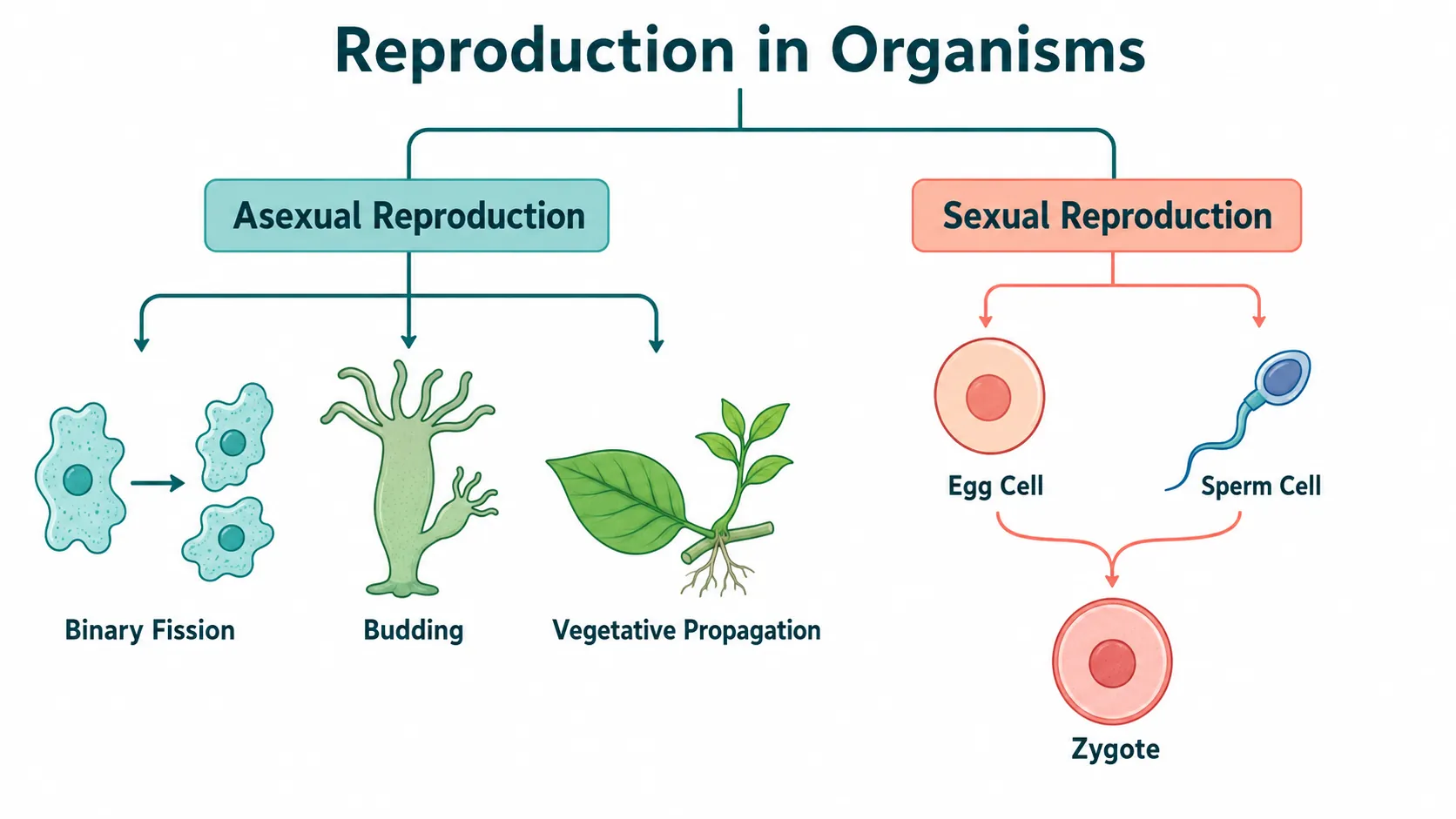
Table of Contents

eSaral › Class 12 › Biology › Reproduction

What Is Reproduction?
Reproduction is one of the fundamental characteristics of all living organisms — from a single-celled bacterium to a multicellular human being. It is the biological process through which an organism gives rise to new individuals of the same species, ensuring that the species survives across generations even though every individual organism eventually dies. Unlike growth or nutrition, reproduction is not essential for the survival of a single organism, but it is essential for the survival of the species as a whole.
Every species has a genetically fixed life span — the time period between birth and natural death — which can range from less than a day in some mayflies to thousands of years in certain trees. Reproductive events, in most organisms, are tied closely to this life span: an organism typically reproduces only after reaching a stage of maturity, and in many species, reproduction occurs at a specific, favourable time of year.
If you're covering this chapter for the first time, the NCERT Solutions for Class 12 Biology Chapter 1: Reproduction in Organism walks through every textbook question with a complete explanation — start here if you want the NCERT-exact answers.
Reproduction in Organisms: Asexual vs Sexual Reproduction
This is the central classification tested at every level, from Class 10 boards to NEET. Organisms reproduce through one of two broad strategies:
| Basis | Asexual Reproduction | Sexual Reproduction |
|---|---|---|
| Number of parents | One parent | Two parents (in most cases) |
| Gametes involved | No fusion of gametes | Fusion of male and female gametes |
| Offspring | Genetically identical to parent (clone) | Genetically varied due to gene recombination |
| Speed | Faster; occurs frequently | Slower; involves specific reproductive events |
| Genetic variation | Little to none | High — a key driver of evolution |
| Common examples | Amoeba (binary fission), yeast (budding), Hydra (budding), Bryophyllum (vegetative propagation) | Humans, most animals, flowering plants |
Types of Asexual Reproduction
Asexual reproduction does not involve the fusion of gametes, and since only one parent is involved, the offspring are genetically identical copies of that parent. Common types include:
- Binary fission – a single-celled organism (e.g., Amoeba, bacteria) splits into two equal daughter cells
- Budding – a new individual grows out as an outgrowth of the parent's body (e.g., Hydra, yeast)
- Fragmentation – the parent body breaks into fragments, each of which grows into a new individual (e.g., Spirogyra)
- Spore formation – organisms like fungi and some algae produce spores that develop into new individuals under favourable conditions
- Vegetative propagation – new plants grow from vegetative parts like roots, stems, or leaves (e.g., Bryophyllum leaves)
What Is Sexual Reproduction?
Sexual reproduction is the mode of reproduction in which two parents — usually one male and one female — contribute a gamete each, and the fusion of these gametes (a process called fertilisation) produces a zygote that develops into a new individual. Because the offspring inherits genetic material from both parents, sexual reproduction generates genetic variation, which is one of the biggest advantages it holds over asexual reproduction: this variation gives populations a better chance of adapting to changing environments over time.
Sexual reproduction in most organisms unfolds across three broad phases:
- Pre-fertilisation events – gametogenesis (formation of male and female gametes) and gamete transfer
- Fertilisation – the actual fusion of male and female gametes to form a zygote
- Post-fertilisation events – development of the zygote into an embryo, and finally into a new organism
For flowering plants specifically, the chapter that follows this one covers this process in full detail — see the Sexual Reproduction in Flowering Plants NEET PYQs page, which is one of the highest-scoring NEET chapters. Practice it next. Before moving there, test your grasp on this foundational chapter with NEET Chapterwise PYQ.
Sexuality in Flowering Plants: Unisexual and Bisexual Organisms
In biology, the term "sexuality" (as used in the context of reproduction) does not refer to identity — it refers to whether an organism's flowers or individuals carry male reproductive parts, female reproductive parts, or both. This distinction matters a great deal when studying sex and reproduction across the plant and animal kingdom:
- Unisexual organisms – have only male or only female reproductive organs in a single individual/flower (e.g., papaya, cucumber; most animals)
- Bisexual organisms – carry both male and female reproductive structures in the same individual/flower (e.g., hibiscus, earthworm)
- Monoecious plants – bear both male and female flowers on the same plant (e.g., cucumber, maize)
- Dioecious plants – bear male and female flowers on separate plants (e.g., papaya, date palm)
This classification directly determines whether an organism relies on self-fertilisation or cross-fertilisation, which in turn affects the amount of genetic variation produced in offspring.
Why Is Reproduction Important for Organisms?
Reproduction is important because it is the only biological process that guarantees the continuity of a species beyond the life span of any single individual. Without reproduction, every species would become extinct the moment its existing members died of natural causes. Sexual reproduction specifically adds genetic variation to a population, which improves a species' ability to survive environmental changes, diseases, and predators over long time scales — this variation is also the raw material on which natural selection and evolution act.
Reproduction in Organisms: Life Span and Reproductive Events
| Concept | Explanation |
|---|---|
| Life span | Genetically determined time period from birth to natural death; varies widely across species |
| Juvenile phase | Growth period before an organism becomes capable of reproducing |
| Reproductive phase | The period during which an organism is capable of and actively reproduces |
| Senescent phase | The phase following reproduction, leading toward the end of the life span |
| Reproductive event timing | Many organisms reproduce only at a specific, favourable season of the year |
To connect this chapter with the very next one in the syllabus — how the human body specifically carries out sexual reproduction — the Human Reproduction NEET Previous Year Questions page has detailed, NTA-style solved questions. Solve them now to see how this foundational chapter connects to human biology.
Reproduction in Organisms for Class 10, Class 12 and NEET
This topic is taught at two levels in the CBSE/NCERT curriculum:
- Class 10 Science introduces the basics under the chapter "How Do Organisms Reproduce" — covering asexual and sexual reproduction with simple examples.
- Class 12 Biology, Chapter 1: Reproduction in Organisms builds on this with a deeper, exam-oriented treatment of modes of reproduction, life span, and the three phases of sexual reproduction — and this chapter directly feeds into NEET.
Once confident, test your speed and accuracy with eSaral's NEET Test Series, which includes topic-wise mock sections for this exact chapter."
NEET has historically drawn heavy weightage from this unit — in NEET 2021 alone, "Reproduction in Organisms" was one of the highest-weightage Biology chapters, contributing close to a fifth of the total Biology-chapter-wise questions that year. To see exactly how this weightage compares across the full Biology syllabus, check the NEET Syllabus.
If you're starting from Class 10, revisit the How Do Organisms Reproduce Class 10 Notes first — read the notes, then move to the Class 12 chapter above. For full-syllabus revision once you've covered this chapter, the NCERT Class 12 Biology Book PDF gives you every chapter in one place, and the NEET Biology Revision Notes hub organises every high-weightage chapter for quick revision. To push beyond textbook-level recall, work through the NCERT Exemplar Class 12 Biology Chapter 1 – Reproduction in Organisms.
Want a structured revision plan covering this chapter along with the rest of NEET Biology? Explore eSaral's NEET Course, taught by Kota's top faculty with chapter-wise doubt support.
Frequently Asked Questions
Find answers to common questions.