Squares and Square Roots Class 8 Maths Formulas
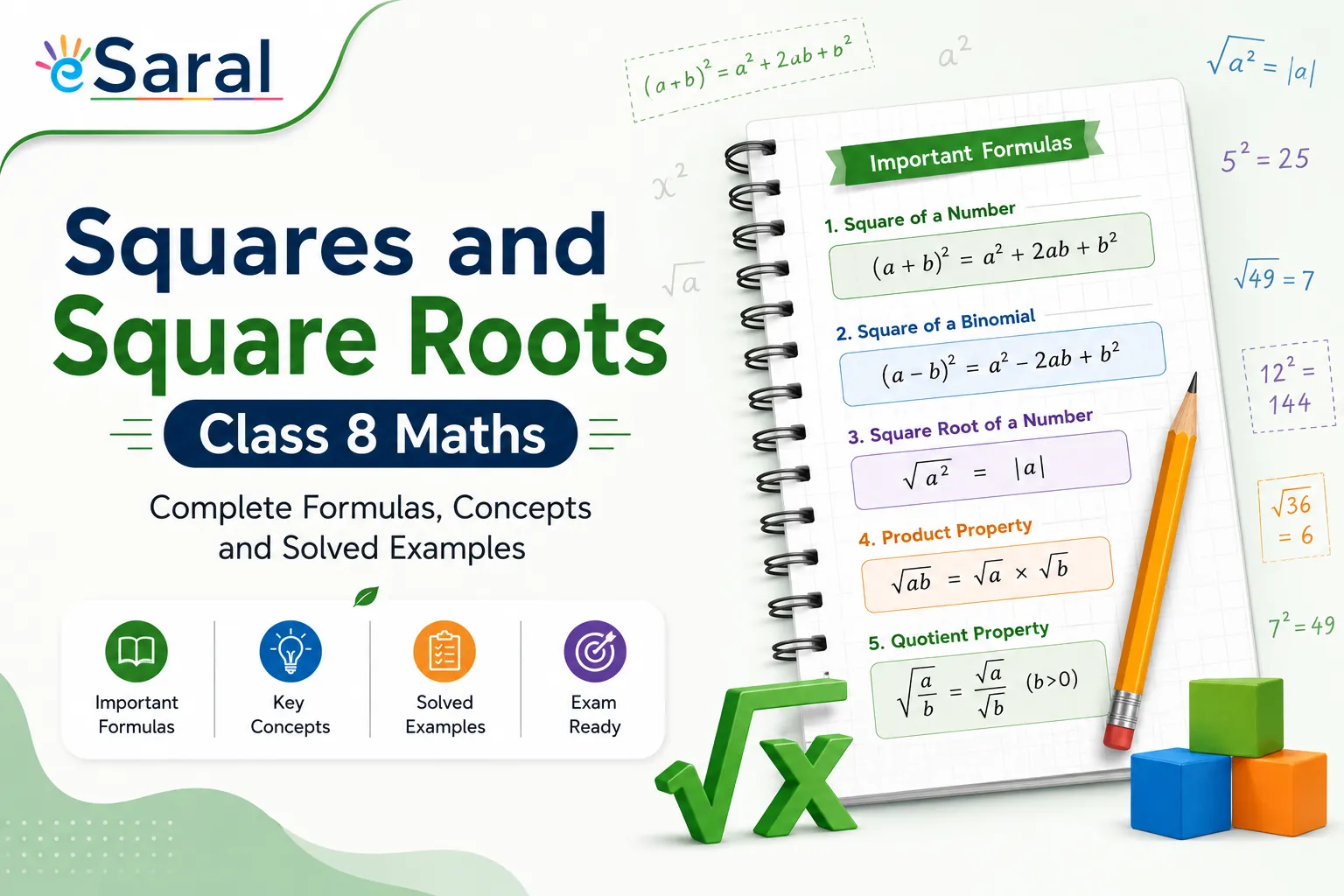
Table of Contents
- Squares and Square Roots Class 8 Maths Formulas
- What Are Square Numbers and Perfect Squares?
- Square Root — Definition and Core Formulas
- Properties of Square Numbers
- Perfect Squares from 1 to 20 — Quick Reference Table
- What Are Pythagorean Triplets?
- How Do You Find the Square Root of a Number?
- Worked Examples

Home > Class 8 Maths > Squares and Square Roots Class 8 Maths Formulas

Squares and Square Roots Class 8 Maths Formulas
Square Number: The square of a number is the product of the number with the number itself The, square of x = (x × x), denoted by x 2.
A natural number n is a perfect square, if n = m2 for some natural number m.{1 = 1 × 1 = 12, 4 = 2 × 2 = 22}
Square Root: Square root is the inverse operation of square, i.e., the positive square root of a number is denoted by the symbol $\sqrt{ }$
For example, $3^{2}=9$ gives $\sqrt{9}=3$ or $\left(3^{2}\right)^{1 / 2}=3 .$
For positive numbers $a$ and $b$, we have
(i) $\sqrt{a b}=\sqrt{a} \times \sqrt{b}$,
(ii) $\sqrt{\frac{a}{b}}=\frac{\sqrt{a}}{\sqrt{b}}$ or $\sqrt{\frac{a}{b}}=\left(\frac{a}{b}\right)^{\frac{1}{2}}$
What Are Square Numbers and Perfect Squares?
Square of a number is the product of that number multiplied by itself.
Square of x = x × x = x²
A natural number n is called a perfect square if n = m² for some natural number m.
Examples of Perfect Squares
- 1 = 1 × 1 = 1²
- 4 = 2 × 2 = 2²
- 9 = 3 × 3 = 3²
- 16 = 4 × 4 = 4²
- 25 = 5 × 5 = 5²
How to Identify If a Number Is a Perfect Square
A number is a perfect square only when:
- Every prime factor in its prime factorisation appears an even number of times
- It does not end in 2, 3, 7, or 8
- It does not end in an odd number of zeros
Square Root — Definition and Core Formulas
The square root is the inverse operation of squaring. The positive square root of a number n is written as √n.
If 3² = 9, then √9 = 3
Core Square Root Formulas
For positive numbers a and b:
| Formula | Expression |
|---|---|
| Product rule | √(ab) = √a × √b |
| Division rule | √(a/b) = √a ÷ √b |
| Exponential form | √a = a1/2 |
| Combined | √(a/b) = (a/b)1/2 |
The product and division rules for square roots are the most frequently tested formulas in Class 8 exams. Practise splitting larger numbers — for example, √(36 × 25) = √36 × √25 = 6 × 5 = 30. This shortcut saves valuable time in exams and becomes even more useful in JEE-level simplification problems.
Properties of Square Numbers
Understanding these properties helps you instantly identify perfect squares — a skill that saves time in both school tests and competitive exams.
Properties Related to the Unit Digit
- A number ending in 2, 3, 7, or 8 is never a perfect square
- A number ending in an odd number of zeros is never a perfect square
- A perfect square ending in 1 has a square root ending in 1 or 9
- A perfect square ending in 4 has a square root ending in 2 or 8
- A perfect square ending in 9 has a square root ending in 3 or 7
- A perfect square ending in 6 has a square root ending in 4 or 6
- A perfect square ending in 5 has a square root ending in 5
Properties Related to Even and Odd Numbers
- The square of an even number is always even
- The square of an odd number is always odd
- The square of a proper fraction is always smaller than the original fraction
Pattern Properties
- For every natural number n: (n+1)² − n² = (n+1) + n
- Sum of the first n odd natural numbers = n²
- Example: 1 + 3 + 5 + 7 = 4² = 16
- There are 2n non-perfect-square numbers between n² and (n+1)²
Perfect Squares from 1 to 20 — Quick Reference Table
| Number (n) | Square (n²) | Number (n) | Square (n²) |
|---|---|---|---|
| 1 | 1 | 11 | 121 |
| 2 | 4 | 12 | 144 |
| 3 | 9 | 13 | 169 |
| 4 | 16 | 14 | 196 |
| 5 | 25 | 15 | 225 |
| 6 | 36 | 16 | 256 |
| 7 | 49 | 17 | 289 |
| 8 | 64 | 18 | 324 |
| 9 | 81 | 19 | 361 |
| 10 | 100 | 20 | 400 |
Memorising squares up to 20 is strongly recommended — it directly helps in factorisation, geometry, and CBSE board questions.
What Are Pythagorean Triplets?
A Pythagorean triplet is a set of three natural numbers (m, n, p) such that:
m² + n² = p²
The most common example is (3, 4, 5) because 9 + 16 = 25.
Formula to Generate Pythagorean Triplets
For every natural number m > 1:
(2m, m² − 1, m² + 1) is a Pythagorean triplet
Examples
| m | 2m | m² − 1 | m² + 1 | Triplet |
|---|---|---|---|---|
| 2 | 4 | 3 | 5 | (3, 4, 5) |
| 3 | 6 | 8 | 10 | (6, 8, 10) |
| 4 | 8 | 15 | 17 | (8, 15, 17) |
| 5 | 10 | 24 | 26 | (10, 24, 26) |
Pythagorean triplets link Chapter 5 directly to geometry and, later, trigonometry. Students preparing for JEE from Class 8 should note that the triplet (3, 4, 5) and its multiples appear constantly in coordinate geometry and right-triangle problems. Building this pattern recognition early makes those problems effortless later.
How Do You Find the Square Root of a Number?
Two standard methods are taught in CBSE Class 8 for finding square roots.
Method 1 — Prime Factorisation
Steps:
- Write the number as a product of its prime factors
- Group the prime factors in pairs
- Take one factor from each pair
- Multiply the selected factors — the result is the square root
Example: √324
- 324 = 2 × 2 × 3 × 3 × 3 × 3
- Pairs: (2, 2), (3, 3), (3, 3)
- √324 = 2 × 3 × 3 = 18
Method 2 — Long Division Method
The long division method is used for larger numbers or decimals where prime factorisation is not practical.
Steps:
- Group digits in pairs from the decimal point outward (right to left for whole number part)
- Find the largest integer whose square ≤ the first group
- Subtract, bring down the next pair
- Double the current quotient to form the new divisor, find the next digit
- Repeat until the required precision is reached
Example: √625 = 25 (verified: 25 × 25 = 625)
For detailed step-by-step NCERT solutions on this method, visit the NCERT Solutions for Class 8 Maths page on eSaral.
Worked Examples
Example 1 — Using the Sum of Odd Numbers Property
Q: Express 49 as a sum of consecutive odd numbers.
- 49 = 7² = 1 + 3 + 5 + 7 + 9 + 11 + 13 ✓ (7 odd numbers)
Example 2 — Identifying a Perfect Square
Q: Is 2028 a perfect square?
- 2028 ends in 8 → A number ending in 8 is never a perfect square.
- Answer: No.
Example 3 — Pythagorean Triplet
Q: Find the Pythagorean triplet with m = 6.
- 2m = 12, m² − 1 = 35, m² + 1 = 37
- Triplet: (12, 35, 37)
- Check: 144 + 1225 = 1369 = 37² ✓
Example 4 — Applying the Square Root Division Rule
Q: Simplify √(144/169)
- √144 / √169 = 12/13
For more practice, explore NCERT Solutions for Class 11 Maths and NCERT Solutions for Class 12 Maths to see how square root concepts extend into higher-level algebra.
- A number ending in 2, 3, 7 or 8 is never a perfect square.
- A number ending in an odd number of zeros is never a perfect square.
- The square of an even number is even.
- The square of an odd number is odd.
- The square of a proper fraction is smaller than the fraction.
- For every natural number $n$, we have $\left\{(n+1)^{2}-n^{2}\right\}=\{(n+1)+n\}$.
- Sum of first $n$ odd natural numbers $=n^{2}$.
- If $m, n, p$ are natural numbers such that $\left(m^{2}+n^{2}\right)=p^{2}$, then $(m, n, p)$ is called a Pythagorean triplet.
- For every natural number $m>1,\left(2 m, m^{2}-1, m^{2}+1\right)$ is a Pythagorean triplet.
- There are $2 n$ non-perfect square numbers between the squares of the number $n$ and $(n+1)$
- The numbers which can be expressed as the product of the number with itself are called square numbers or perfect squares. For example, $1,4,9,16,25, \ldots .$
- If a natural number $m$ can be expressed as $n^{2}$, where $n$ is also a natural number, then, $m$ is called a square number.
Also Read,
NCERT Class 8 Maths Book Download
NCERT Class 8 Science Book Download
NCERT Class 8 Science Exemplar Download
NCERT Class 8 Maths Exemplar Download
If you have any Confusion related to Squares and Square Roots Class 8 Maths Formulas, then feel free to ask in the comments section down below.
To watch Free Learning Videos on Class 8 Maths by Kota’s top Faculties, install the eSaral App
Frequently Asked Questions
Find answers to common questions.
Can a number ending in 3 ever be a perfect square?
No. A number ending in 2, 3, 7, or 8 can never be a perfect square. This is because squaring any single-digit number (0–9) only produces unit digits of 0, 1, 4, 5, 6, or 9. So if you see a number ending in 3, you can immediately conclude it is not a perfect square without any calculation.
How many non-perfect square numbers lie between two consecutive perfect squares?
Between the squares of n and (n+1), there are exactly 2n non-perfect square numbers. For example, between 4² = 16 and 5² = 25, there are 2 × 4 = 8 numbers (17, 18, 19, 20, 21, 22, 23, 24). This is a direct application of the formula from Chapter 5.
What is the difference between a square number and a perfect square?
A square number and a perfect square mean the same thing in Class 8 Maths. A perfect square is a natural number that equals another natural number multiplied by itself. For example, 36 = 6 × 6, so 36 is a perfect square. Every perfect square has an integer as its square root.
Why is the sum of the first n odd natural numbers equal to n²?
This is a fundamental pattern in number theory. When you add the first n consecutive odd numbers (1, 3, 5, … up to the nth odd number), the total is always n². For example, 1 + 3 + 5 = 9 = 3². This pattern can be proved visually using dot arrangements (square dot arrays) and is a key formula to remember for Class 8 and beyond.
What are the two methods to find the square root of a number in Class 8 Maths?
The two methods taught in CBSE Class 8 are the prime factorisation method and the long division method. Prime factorisation works best for smaller, "clean" perfect squares. The long division method is used for larger numbers, decimals, and cases where the number is not a perfect square. Both methods are covered in NCERT Chapter 5.
What is the formula for generating Pythagorean triplets in Class 8?
For any natural number m greater than 1, the set (2m, m² − 1, m² + 1) forms a Pythagorean triplet. This means the sum of the squares of the first two numbers always equals the square of the third. For m = 2, the triplet is (4, 3, 5), which satisfies 16 + 9 = 25. This formula covers all standard triplets tested in Class 8.