Trigonometry Formula: Complete List, SOHCAHTOA, Identities & Solved Examples (Class 11 Maths)
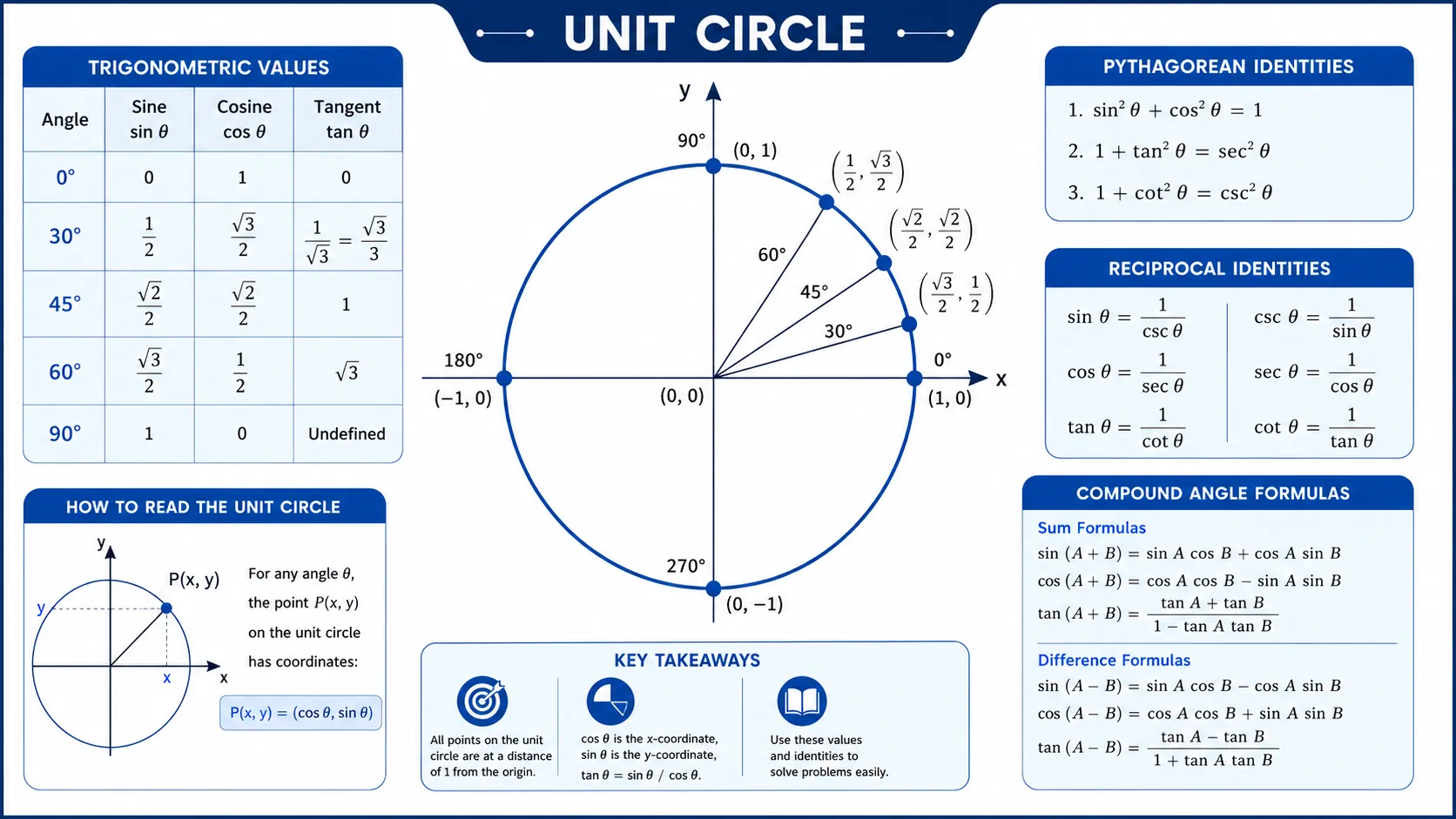
Table of Contents
- What Is the Trigonometry Formula? (SOHCAHTOA and the Six Basic Ratios)
- Trigonometric Ratios of Standard Angles (0°, 30°, 45°, 60°, 90°)
- What Are the Pythagorean Trigonometric Identities?
- Reciprocal Trigonometric Identities
- Basic Trigonometry Formula for Complementary and Supplementary Angles
- Compound Angle (Sum and Difference) Trigonometry Formulas
- Double, Triple and Half-Angle Trigonometry Formulas
- Sum-to-Product and Product-to-Sum Trigonometry Formulas
- General Solution Formulas for Trigonometric Equations
- Basic Inverse Trigonometric Formulas (Class 12 Preview)
- Solved Examples Using the Trigonometry Formula List
- How Should Students Use This Trigonometry Formula List for Exam Preparation?

eSaral › Class 11 Maths › Trigonometry Formula: Complete List, SOHCAHTOA, Identities & Solved Examples (Class 11 Maths)

What Is the Trigonometry Formula? (SOHCAHTOA and the Six Basic Ratios)
The most basic trigonometry formula defines six ratios between the sides of a right triangle relative to an angle θ. The easiest way to remember the first three is the mnemonic SOHCAHTOA:
- SOH — Sin θ = Opposite / Hypotenuse
- CAH — Cos θ = Adjacent / Hypotenuse
- TOA — Tan θ = Opposite / Adjacent
| Ratio | Trigonometry Formula | Reciprocal Of |
|---|---|---|
| sin θ | Opposite / Hypotenuse | cosec θ |
| cos θ | Adjacent / Hypotenuse | sec θ |
| tan θ | Opposite / Adjacent = sin θ / cos θ | cot θ |
| cosec θ | Hypotenuse / Opposite = 1 / sin θ | sin θ |
| sec θ | Hypotenuse / Adjacent = 1 / cos θ | cos θ |
| cot θ | Adjacent / Opposite = 1 / tan θ = cos θ / sin θ | tan θ |
Every other trigonometry formula on this page — identities, compound angles, multiple angles — is ultimately built from these six ratios.
Want the guided version with derivations? See Trigonometry Class 11 Notes →
Is There a Trigonometry Formula PDF Available?
Yes, every trigonometry formula on this page is organised so you can screenshot or print it as a single-page formula sheet for quick revision before CBSE boards or JEE Main.
Download The Trigonometry Formula PDF
Trigonometric Ratios of Standard Angles (0°, 30°, 45°, 60°, 90°)
This standard-angle trigonometry formula table is one of the most frequently tested pieces of recall in Class 11 exams and JEE Main.
| θ | 0° | 30° | 45° | 60° | 90° |
|---|---|---|---|---|---|
| sin θ | 0 | 1/2 | 1/√2 | √3/2 | 1 |
| cos θ | 1 | √3/2 | 1/√2 | 1/2 | 0 |
| tan θ | 0 | 1/√3 | 1 | √3 | undefined |
| cosec θ | undefined | 2 | √2 | 2/√3 | 1 |
| sec θ | 1 | 2/√3 | √2 | 2 | undefined |
| cot θ | undefined | √3 | 1 | 1/√3 | 0 |
What Are the Pythagorean Trigonometric Identities?
| Identity |
|---|
| sin²θ + cos²θ = 1 |
| 1 + tan²θ = sec²θ |
| 1 + cot²θ = cosec²θ |
These three identities are derived directly from the Pythagorean theorem and are the most frequently used trigonometry formulas in simplification and proof-based questions.
Reciprocal Trigonometric Identities
| Identity |
|---|
| sin θ = 1 / cosec θ |
| cos θ = 1 / sec θ |
| tan θ = 1 / cot θ |
| cosec θ = 1 / sin θ |
| sec θ = 1 / cos θ |
| cot θ = 1 / tan θ |
What Is the Sign Convention (Quadrant Rule) for Trigonometric Ratios?
| Quadrant | Positive Ratios |
|---|---|
| I (0°–90°) | All (sin, cos, tan, and their reciprocals) |
| II (90°–180°) | sin, cosec |
| III (180°–270°) | tan, cot |
| IV (270°–360°) | cos, sec |
Remember to use the mnemonic "All Silver Tea Cups" for quadrants I–IV.
Basic Trigonometry Formula for Complementary and Supplementary Angles
| Angle Transformation | Trigonometry Formula |
|---|---|
| sin (90° − θ) | cos θ |
| cos (90° − θ) | sin θ |
| tan (90° − θ) | cot θ |
| sin (180° − θ) | sin θ |
| cos (180° − θ) | − cos θ |
| tan (180° − θ) | − tan θ |
| sin (−θ) | − sin θ |
| cos (−θ) | cos θ |
| tan (−θ) | − tan θ |
Compound Angle (Sum and Difference) Trigonometry Formulas
| Formula |
|---|
| sin (A + B) = sin A cos B + cos A sin B |
| sin (A − B) = sin A cos B − cos A sin B |
| cos (A + B) = cos A cos B − sin A sin B |
| cos (A − B) = cos A cos B + sin A sin B |
| tan (A + B) = (tan A + tan B) / (1 − tan A tan B) |
| tan (A − B) = (tan A − tan B) / (1 + tan A tan B) |
Frequently tested in JEE Main Chapterwise PYQ.
Double, Triple and Half-Angle Trigonometry Formulas
Double Angle:
sin 2θ = 2 sin θ cos θ
cos 2θ = cos²θ − sin²θ = 2cos²θ − 1 = 1 − 2sin²θ
tan 2θ = 2 tan θ / (1 − tan²θ)
Triple Angle:
sin 3θ = 3 sin θ − 4 sin³θ
cos 3θ = 4 cos³θ − 3 cos θ
tan 3θ = (3 tan θ − tan³θ) / (1 − 3 tan²θ)
Half-Angle:
sin (θ/2) = ±√[(1 − cos θ)/2]
cos (θ/2) = ±√[(1 + cos θ)/2]
tan (θ/2) = ±√[(1 − cos θ)/(1 + cos θ)]
Sum-to-Product and Product-to-Sum Trigonometry Formulas
Sum-to-Product:
| Formula |
|---|
| sin A + sin B = 2 sin[(A+B)/2] cos[(A−B)/2] |
| sin A − sin B = 2 cos[(A+B)/2] sin[(A−B)/2] |
| cos A + cos B = 2 cos[(A+B)/2] cos[(A−B)/2] |
| cos A − cos B = −2 sin[(A+B)/2] sin[(A−B)/2] |
Product-to-Sum:
| Formula |
|---|
| 2 sin A cos B = sin(A+B) + sin(A−B) |
| 2 cos A sin B = sin(A+B) − sin(A−B) |
| 2 cos A cos B = cos(A+B) + cos(A−B) |
| 2 sin A sin B = cos(A−B) − cos(A+B) |
General Solution Formulas for Trigonometric Equations
| Equation | General Solution |
|---|---|
| sin θ = sin α | θ = nπ + (−1)ⁿα, n ∈ ℤ |
| cos θ = cos α | θ = 2nπ ± α, n ∈ ℤ |
| tan θ = tan α | θ = nπ + α, n ∈ ℤ |
Essential for Class 11 trigonometric equations — a guaranteed CBSE board question type. See these in JEE Advanced Chapterwise PYQ.
Basic Inverse Trigonometric Formulas (Class 12 Preview)
| Formula |
|---|
| sin⁻¹x + cos⁻¹x = π/2 |
| tan⁻¹x + cot⁻¹x = π/2 |
| sec⁻¹x + cosec⁻¹x = π/2 |
| tan⁻¹x + tan⁻¹y = tan⁻¹[(x+y)/(1−xy)], when xy < 1 |
Though formally a Class 12 topic, inverse trigonometric formulas build directly on this Class 11 trigonometry formula list.
Solved Examples Using the Trigonometry Formula List
Example 1: If sin θ = 3/5 and θ is in Quadrant I, find cos θ.
Solution: sin²θ + cos²θ = 1 → cos²θ = 16/25 → cos θ = 4/5
Example 2: Find sin 75° using the trigonometric formula sin(A+B).
Solution: sin(45°+30°) = sin45°cos30° + cos45°sin30° = (√6 + √2)/4
Example 3: If cos θ = 3/5, find cos 2θ.
Solution: cos 2θ = 2cos²θ − 1 = 18/25 − 1 = −7/25
Example 4: Solve sin θ = 1/2.
Solution: sin θ = sin 30° → θ = nπ + (−1)ⁿ(π/6), n ∈ ℤ
How Should Students Use This Trigonometry Formula List for Exam Preparation?
- Memorise the six basic ratios (SOHCAHTOA) and Pythagorean identities first — everything else is derived from them.
- Practice deriving compound angle formulas at least once instead of only memorising — JEE Main often tests proof-based application.
- Revise the standard-angle table and quadrant sign rules the day before your exam — these resolve most careless mistakes.
- Use general solution formulas only once you're confident solving basic trigonometric equations.
- Test recall speed under timed conditions with eSaral's JEE Test Series →, which includes a dedicated Trigonometry mock section.
Test your fluency directly with JEE Main PYQ →
Related eSaral Resources for Class 11 Maths Students
- Trigonometry Class 11 Notes
- Trigonometric Ratio Class 11 Notes
- NCERT Solutions Class 11 Maths Chapter 3
- Mind Maps for Trigonometric Equations
- Mind Maps for Compound Angles
These compound angle formulas are one of the most frequently tested derivation-based questions in JEE Main Chapterwise PYQ
Want to master trigonometry formulas beyond just memorising them? eSaral's Class 11 Maths course covers every identity with derivations, solved examples, and JEE-level practice, taught by Kota's top IITian faculty. Explore Class 11 Maths Courses on eSaral →
Frequently Asked Questions
Find answers to common questions.
How do you remember the sign of trigonometric ratios in each quadrant?
"All Silver Tea Cups" — All positive in Quadrant I, Sin (and cosec) in II, Tan (and cot) in III, Cos (and sec) in IV.
What is the general solution of sin θ = sin α?
θ = nπ + (−1)ⁿα, n ∈ ℤ. Similarly, cos θ = cos α gives θ = 2nπ ± α, and tan θ = tan α gives θ = nπ + α.
Why is the trigonometry formula important for JEE Main and NEET?
It's tested directly in JEE Main and also appears embedded within Calculus, Coordinate Geometry, and Vector problems — fluency with the complete formula sheet is essential across multiple chapters.
What is the SOHCAHTOA trigonometry formula?
SOHCAHTOA is a mnemonic for the three primary trigonometry formulas: Sin = Opposite/Hypotenuse (SOH), Cos = Adjacent/Hypotenuse (CAH), and Tan = Opposite/Adjacent (TOA).
What are the three Pythagorean identities in trigonometry?
sin²θ + cos²θ = 1, 1 + tan²θ = sec²θ, and 1 + cot²θ = cosec²θ — each derived from the Pythagorean theorem.
What is the trigonometry formula for sin(A+B) and cos(A+B)?
sin(A+B) = sin A cos B + cos A sin B, and cos(A+B) = cos A cos B − sin A sin B — the foundation for double, triple, and half-angle formulas.
What is the trigonometry formula for sin 2θ, cos 2θ, and tan 2θ?
sin 2θ = 2 sin θ cos θ, cos 2θ = cos²θ − sin²θ, and tan 2θ = 2 tan θ / (1 − tan²θ).
What is the basic trigonometry formula?
The basic trigonometry formula defines six ratios in a right triangle: sin θ = Opposite/Hypotenuse, cos θ = Adjacent/Hypotenuse, tan θ = Opposite/Adjacent (SOHCAHTOA), plus their reciprocals cosec θ, sec θ, cot θ.
What is the trigonometry formula for Class 11?
The Class 11 trigonometry formula list covers the six basic ratios, Pythagorean and reciprocal identities, compound angle formulas, double/triple/half-angle formulas, sum-to-product/product-to-sum conversions, and general solutions of trigonometric equations.