Mind Maps for Trigonometric Ratio: Compound Angles Revision - Class 11, JEE
Revise Class 11 Trigonometric Ratio: Compound Angles quickly with comprehensive mind maps covering essential formulas, identities, and key concepts for JEE Main & Advanced preparation.

eSaral › JEE › JEE Main ›Mind Maps for Trigonometric Ratio: Compound Angles Revision

🚀 Checkout eSaral Courses
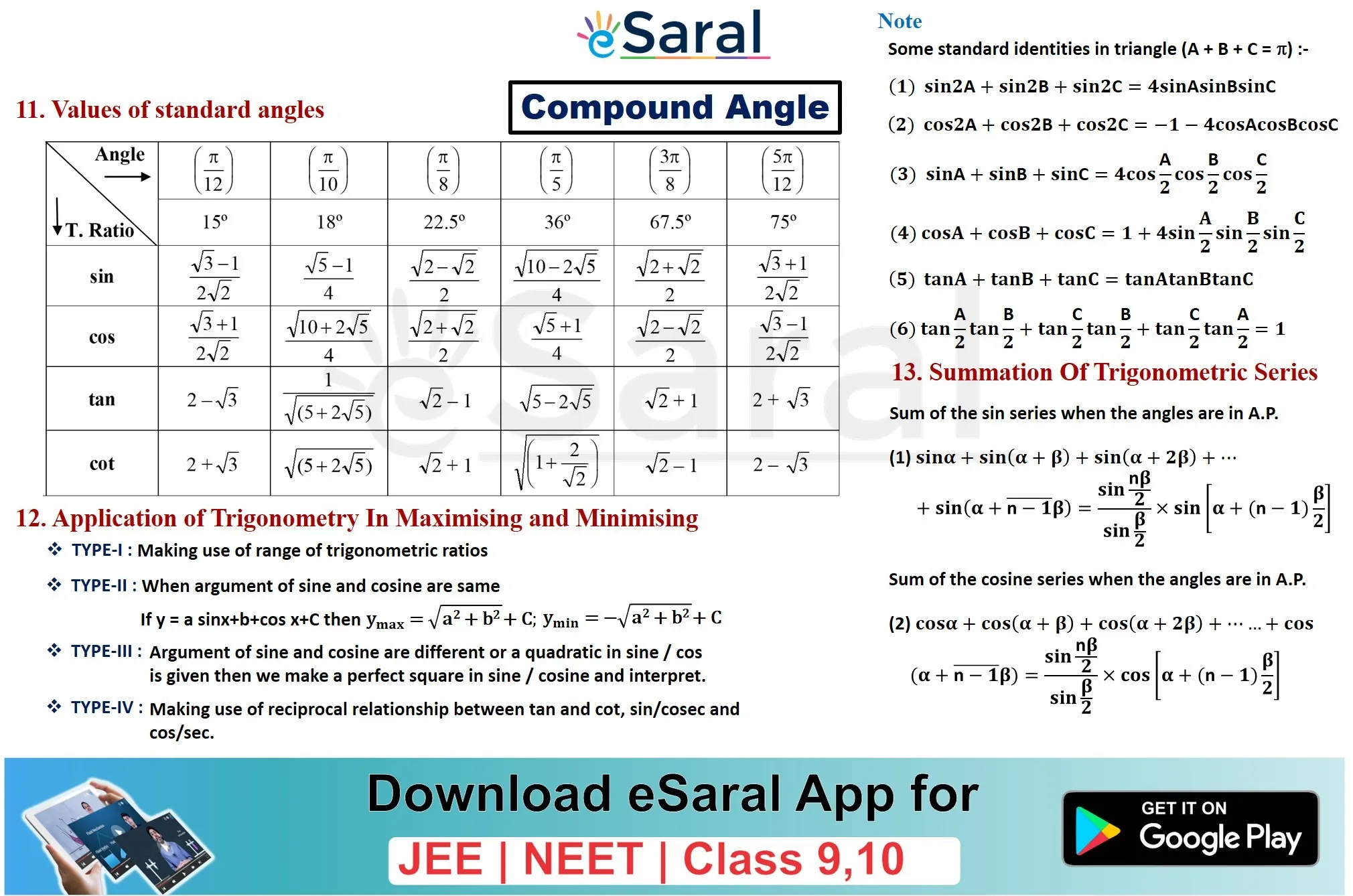
Get to learn all the formulae and important points of Trigonometric Ratio: Compound Angles in Mathematics Class 11 through this Mind Map. Download and share with your friends also.
MIND MAP 1
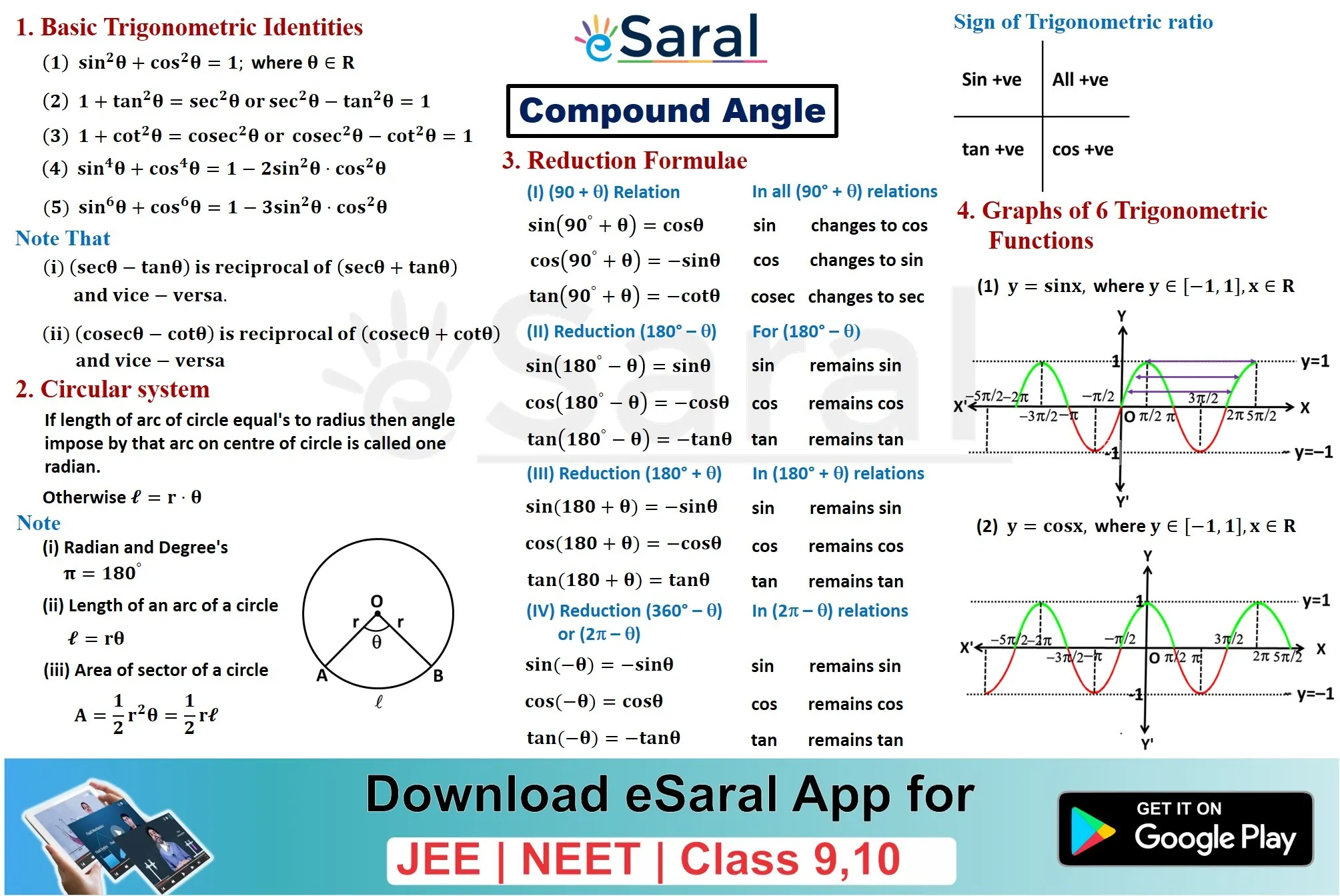
MIND MAP - 2
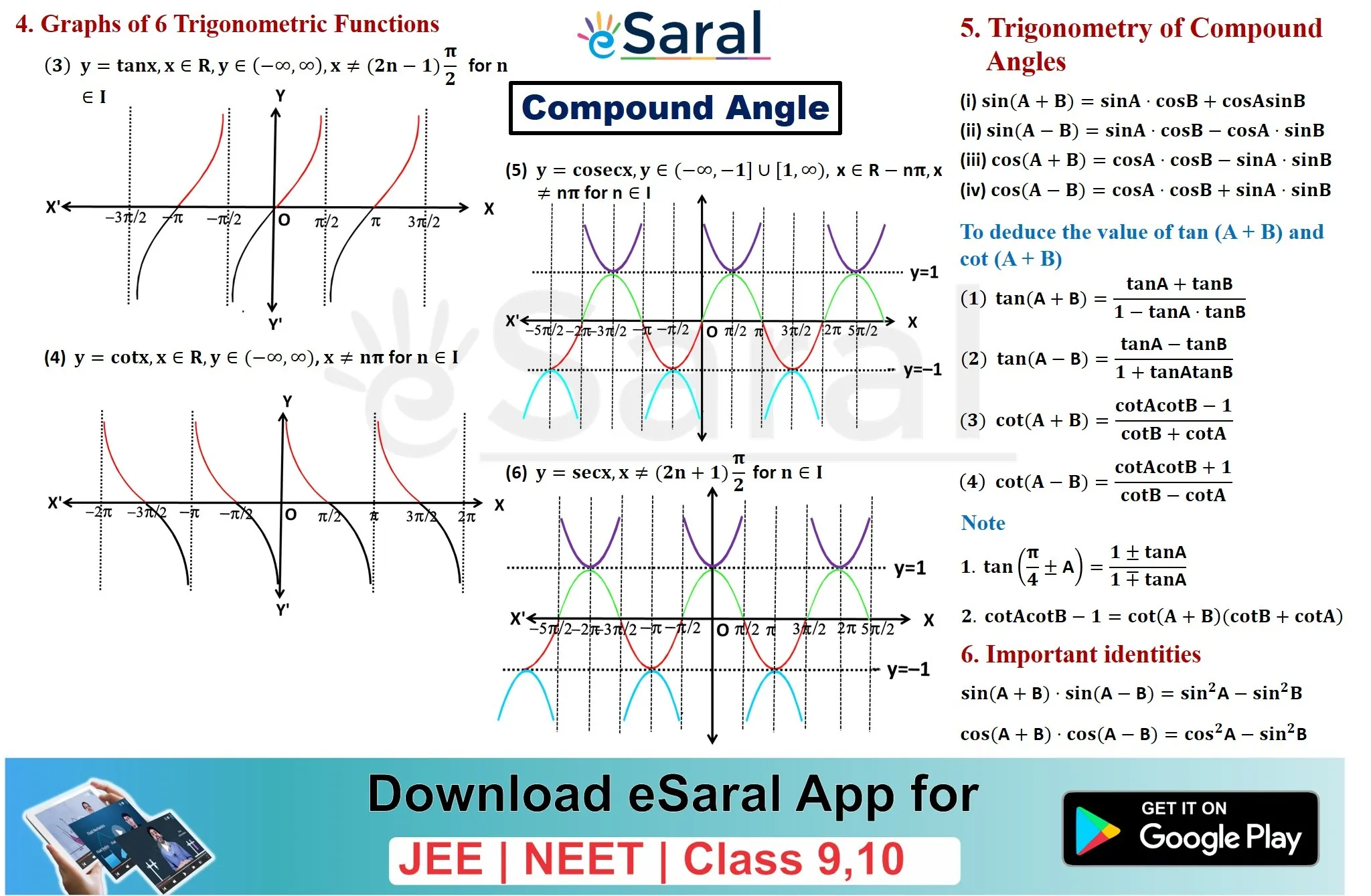
MIND MAP - 3
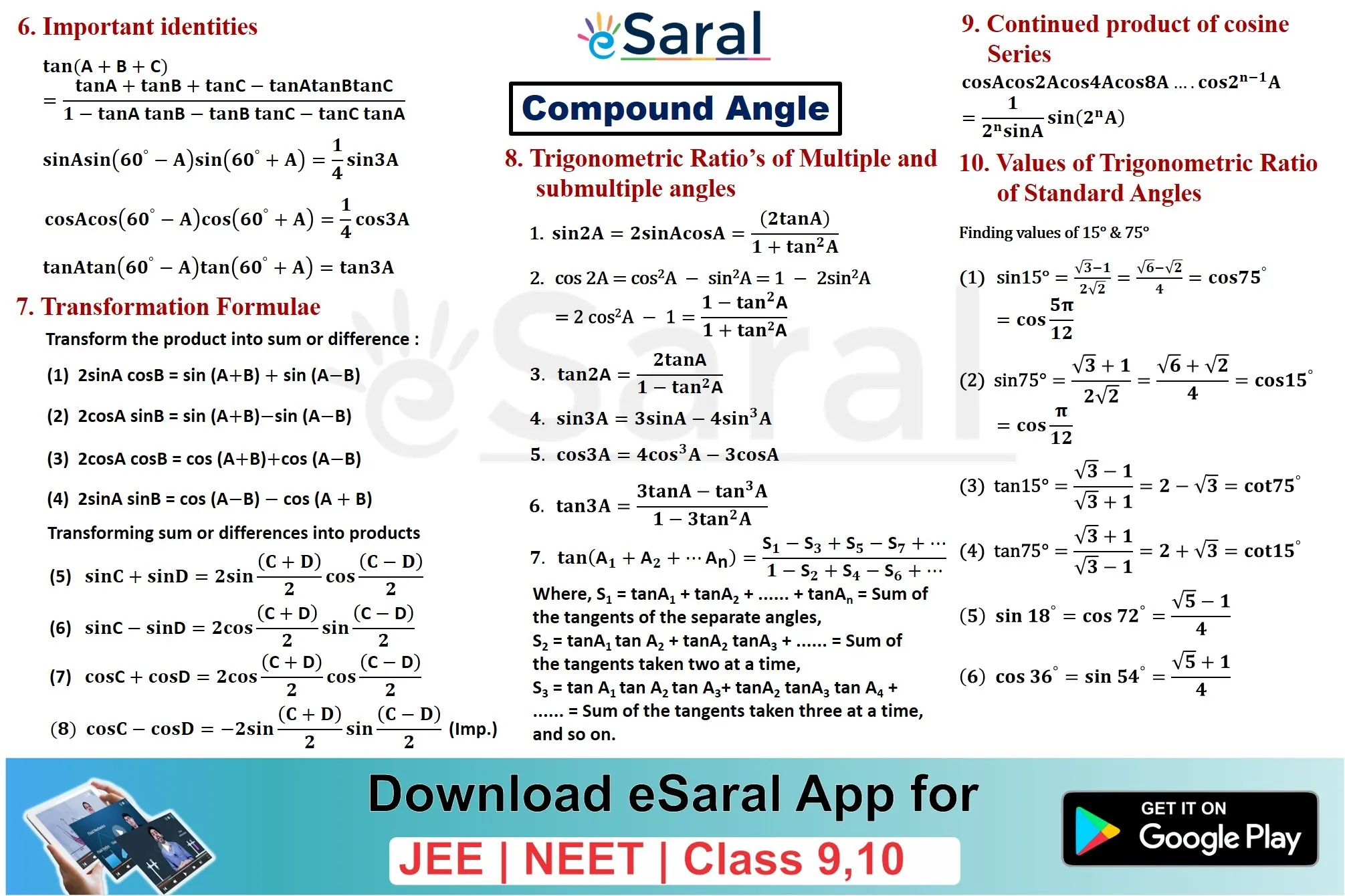
MIND MAP - 4
Compound angle formulas are one of the densest sections on the trigo class 11 formula page — worth revisiting after this topic.
Prepare for JEE & NEET with the Kota's Top IITian & Doctor Faculties !
Physics Revision Series by Saransh Gupta Sir (AIR-41, IIT-BOMBAY)
Chemistry Revision Series by Prateek Gupta Sir (IIT-BOMBAY, Metallurgy)
Frequently Asked Questions
Find answers to common questions.
What is the compound angle formula for sin(A+B)?
sin(A+B) = sin A cos B + cos A sin B. This is the most fundamental compound angle identity. Every other addition formula is derived from or parallel to this structure. For JEE, you must also know its companion: sin(A−B) = sin A cos B − cos A sin B, where only the sign between the two terms changes.
How many questions on compound angles appear in JEE Main?
JEE Main typically includes 2–3 direct questions from Trigonometric Functions, with compound angle formulas tested in at least one. Based on NTA's official question paper releases from 2021–2024, double angle identities and addition formulas appear most frequently. Questions are usually single-correct or numerical answer type.
Is Class 11 trigonometry enough for JEE Main compound angle questions?
Yes, Class 11 NCERT Chapter 3 covers all compound angle identities tested in JEE Main. JEE Advanced may use these identities in deeper problem contexts — particularly in integration and coordinate geometry — so understanding derivations (not just formulas) gives you an edge at that level.
What is the difference between compound angles and multiple angles?
Compound angles involve the sum or difference of two different angles, such as sin(A+B). Multiple angles express a trig function of a multiple of the same angle, such as sin 2A or cos 3A. Multiple angle formulas are actually derived from compound angle formulas by setting B = A, so mastering compound angles first is the correct sequence.
How do I remember the sign in cos(A+B) vs sin(A+B)?
For sin(A+B), the sign matches the operation — sin of a sum gives a plus between the two product terms. For cos(A+B), the sign flips — cos of a sum gives a minus between cos A cos B and sin A sin B. A useful memory anchor: cosine "opposes" addition. This pattern is consistent across all four compound angle formulas.