Units of Measurement in Physics: Types, Properties & Examples for JEE/NEET
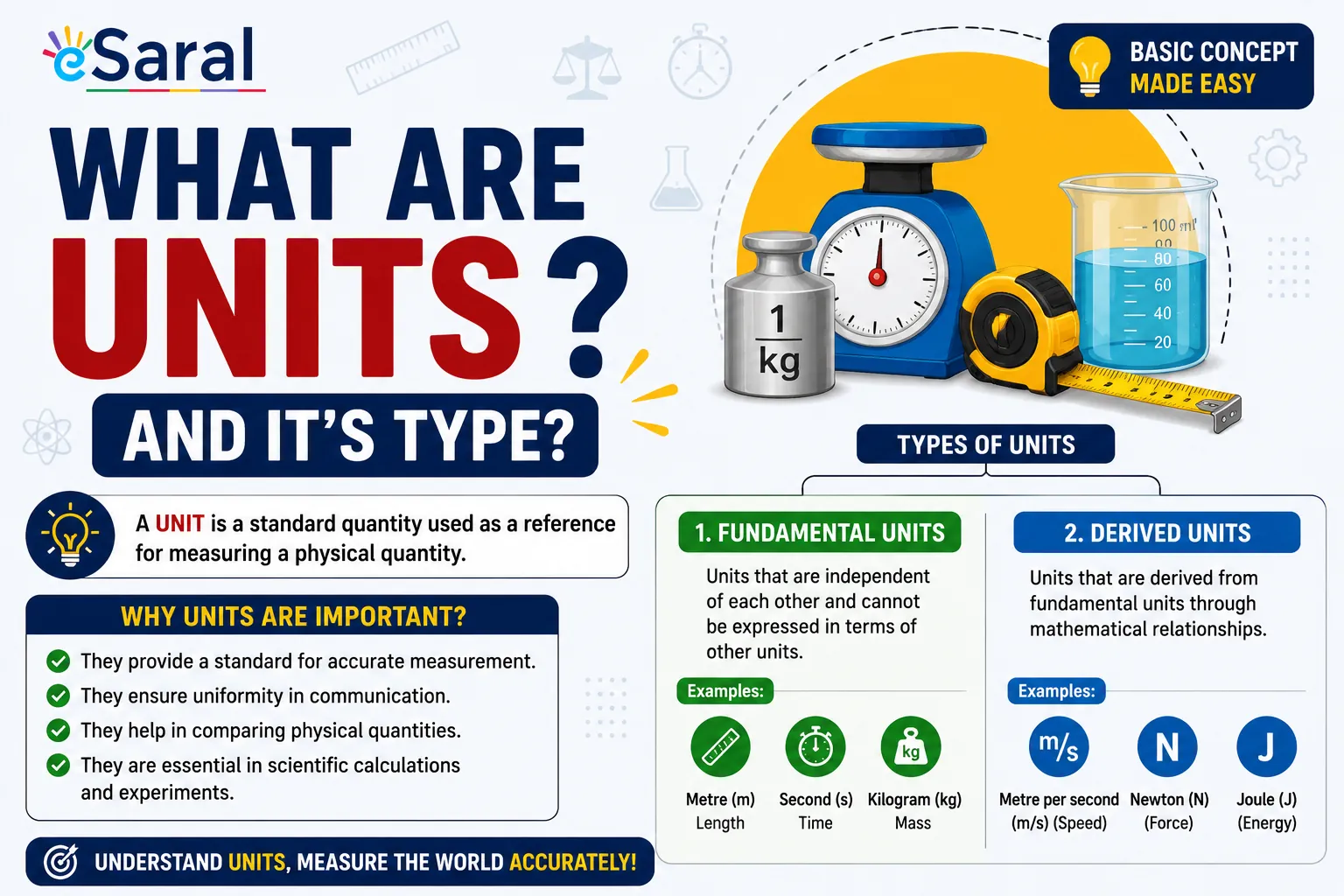
Table of Contents
- What Is a Unit of Measurement?
- What Is a Unit of Measurement?
- What Are the Essential Properties of a Good Unit?
- What Are the Types of Units in Physics?
- The SI System: 7 Fundamental Units You Must Know
- Fundamental vs. Derived Units: Key Differences
- How Are Derived Units Formed?
- Why Do Units Matter for JEE and NEET?

Home » Physics Notes » Units of Measurement in Physics

What Is a Unit of Measurement?
Every measurement in physics requires two things: a number and a unit. Saying "the car travels 60" means nothing — "the car travels 60 km/h" means everything. Units give numbers their physical meaning.
For students preparing for JEE Main, JEE Advanced, or NEET, a solid understanding of units and measurement is non-negotiable. NTA (National Testing Agency) consistently tests this topic in the first chapter of the Class 11 Physics syllabus. Questions on dimensional analysis, unit conversion, and error analysis appear in almost every JEE paper.
This guide covers what a unit is, the properties every valid unit must have, the difference between fundamental and derived units, and the internationally accepted SI system — all explained clearly with examples. Whether you are starting Class 11 or revising before your board exams, mastering this topic will strengthen your foundation for every physics chapter that follows.
Pair this article with the NCERT Solutions for Class 11 Physics to practise NCERT questions on units and measurement alongside the theory.
What Is a Unit of Measurement?
A unit is a definite magnitude of a physical quantity, adopted by convention or law, that is used as a standard for measuring other quantities of the same kind.
In simpler terms, a unit is the "yardstick" you compare everything else against.
Breaking Down the Definition
- Physical quantity — Anything that can be measured (mass, length, time, temperature, etc.).
- Standard magnitude — The unit must represent a fixed, agreed-upon amount.
- Same nature — You measure mass in kilograms, not in metres, because units must match the type of quantity.
A Quick Example
To measure a table's length, you need a standard called the metre (m). If the table is 1.5 m long, you are saying its length is 1.5 times the standard metre. The metre is the unit, while 1.5 is the numerical value.
What Are the Essential Properties of a Good Unit?
Not every arbitrary quantity can serve as a unit. Scientists have agreed on a set of properties that every reliable unit must satisfy. These are directly asked in Class 11 board exams and occasionally appear as MCQs in JEE.
The Six Core Properties
| Property | Meaning | |
|---|---|---|
| 1 | Well-defined | Its definition must be unambiguous. |
| 2 | Suitable in size | Neither too large nor too small for practical measurement. |
| 3 | Easily reproducible | Any laboratory worldwide can recreate it. |
| 4 | Invariant with time | It must not change over years or centuries. |
| 5 | Independent of physical conditions | Unaffected by temperature, pressure, or humidity. |
| 6 | Internationally accepted | Recognised and used across countries. |
Why These Properties Matter
If a unit changed with temperature, every measurement made on a hot day would differ from one made on a cold day, making scientific measurements unreliable. The modern SI system was redesigned in 2019 to define all seven base units in terms of fundamental physical constants, ensuring long-term consistency and accuracy.
What Are the Types of Units in Physics?
Units in physics are divided into two broad categories: Fundamental Units and Derived Units.
Fundamental Units (Base Units)
Fundamental units are the units of base physical quantities—quantities that cannot be expressed in terms of other physical quantities. They form the building blocks of all measurement.
Examples of Fundamental Units
- Kilogram (kg) — Mass
- Metre (m) — Length
- Second (s) — Time
- Ampere (A) — Electric Current
- Kelvin (K) — Temperature
Derived Units
Derived units are formed by combining two or more fundamental units through multiplication or division. They represent quantities defined in terms of base quantities.
Examples of Derived Units
- Velocity = Distance/Time → m s-1
- Force = Mass × Acceleration → kg m s-2 (Newton, N)
- Energy = Force × Distance → kg m2 s-2 (Joule, J)
The SI System: 7 Fundamental Units You Must Know
The International System of Units (SI) is the globally accepted measurement system used in scientific and technical work. It defines seven base units, from which all other units are derived.
| Physical Quantity | SI Unit | Symbol |
|---|---|---|
| Length | Metre | m |
| Mass | Kilogram | kg |
| Time | Second | s |
| Electric Current | Ampere | A |
| Temperature | Kelvin | K |
| Amount of Substance | Mole | mol |
| Luminous Intensity | Candela | cd |
Two Supplementary Units
The SI system also includes two supplementary units used for angular measurements.
| Quantity | Unit | Symbol |
|---|---|---|
| Plane Angle | Radian | rad |
| Solid Angle | Steradian | sr |
These units appear in topics such as circular motion and wave optics, both of which are important for JEE and NEET preparation. You can also practise related problems using NCERT Solutions for Class 11 Physics.
Fundamental vs. Derived Units: Key Differences
| Parameter | Fundamental Units | Derived Units |
|---|---|---|
| Definition | Units of base physical quantities | Units formed by combining fundamental units |
| Independence | Cannot be expressed using other units | Always expressed in terms of fundamental units |
| Count in SI | 7 base units (+ supplementary angular units) | Unlimited |
| Examples | kg, m, s, A, K, mol, cd | N, J, W, Pa, m s-1, m s-2 |
| JEE Relevance | Foundation for dimensional analysis | Unit conversion and formula derivation |
How Are Derived Units Formed?
Step-by-Step Formation
Derived units are obtained directly from the mathematical formula that defines a physical quantity. By replacing each physical quantity with its SI base unit, the corresponding derived unit is obtained.
Example 1 – Velocity
- Formula: Velocity = Displacement ÷ Time
- SI Unit: m ÷ s = m s-1
Example 2 – Force (Newton)
- Formula: Force = Mass × Acceleration
- Acceleration = Velocity ÷ Time
- SI Unit: kg × (m s-1 ÷ s) = kg m s-2
- Special Name: Newton (N)
Example 3 – Pressure (Pascal)
- Formula: Pressure = Force ÷ Area
- SI Unit: N ÷ m2
- Substituting the unit of force:
$$ \text{Pressure}=\frac{\text{kg m s}^{-2}}{\text{m}^2} =\text{kg m}^{-1}\text{s}^{-2} $$
Special Name: Pascal (Pa)
Named vs. Unnamed Derived Units
Some derived units are used so frequently that they are assigned special names, while others are simply expressed as combinations of SI base units.
| Named Derived Units | Unnamed Derived Units |
|---|---|
| Newton (N) | m s-1 (Velocity) |
| Joule (J) | m s-2 (Acceleration) |
| Pascal (Pa) | kg m-3 (Density) |
| Watt (W) | m3 (Volume) |
Both forms are equally valid and frequently appear in JEE Main, JEE Advanced, and NEET questions. For higher-level applications involving electrostatics, current electricity, and electromagnetism, students can also refer to NCERT Solutions for Class 12 Physics.
Why Do Units Matter for JEE and NEET?
Direct Exam Weightage
The chapter Units and Measurements is the first chapter of the Class 11 Physics syllabus prescribed by the National Testing Agency (NTA) for both JEE Main and NEET. Questions from this chapter are asked almost every year.
The most commonly tested areas include:
- Dimensional analysis and checking the correctness of formulae
- Unit conversion between SI, CGS, and FPS systems
- Significant figures and error analysis
- Identifying physical quantities having the same dimensional formula
Foundation for All of Physics
Every formula used in mechanics, thermodynamics, electromagnetism, optics, and modern physics involves units. A student who is confident with units and dimensional analysis can quickly verify equations, detect calculation mistakes, and perform conversions accurately during the exam.
Developing the habit of writing dimensional formulae while solving problems significantly reduces errors in multi-step calculations. This approach is particularly useful in JEE Advanced, where unit checking can often eliminate incorrect options and save valuable time.
Before moving to advanced problem-solving, study the official NCERT chapter carefully and practise all textbook exercises using NCERT Solutions for Class 11 Physics and the NCERT Books for Class 11. A strong command of units and measurements creates the foundation for every topic that follows in Physics.
- Every physical quantity consists of a numerical value and a unit.
- A good unit must be well-defined, reproducible, invariant, and internationally accepted.
- SI has 7 base units from which all derived units are formed.
- Derived units are obtained using mathematical relationships between physical quantities.
- Units and dimensional analysis are essential for solving Physics problems accurately in JEE Main, JEE Advanced, NEET, and Board examinations.
Frequently Asked Questions
Find answers to common questions.
What is a unit of measurement in simple words?
A unit of measurement is a standard quantity used to express how much of a physical property an object has. For example, the metre is the unit for length — if a rod is 3 metres long, it means its length equals three times the standard metre. All units must be fixed, internationally agreed upon, and reproducible.
What are the 7 fundamental SI units?
The 7 fundamental SI units are: metre (m) for length, kilogram (kg) for mass, second (s) for time, ampere (A) for electric current, kelvin (K) for thermodynamic temperature, mole (mol) for amount of substance, and candela (cd) for luminous intensity. These seven form the foundation of all scientific measurement worldwide.
How many types of units are there in physics?
There are two main types of units in physics: fundamental units and derived units. Fundamental units (like kg, m, s) measure base quantities that cannot be broken down further. Derived units (like N, J, Pa) are formed by combining fundamental units and measure quantities defined through physical formulas.
Are units and dimensions the same thing in physics?
No, units and dimensions are related but different concepts. A unit is the specific standard used to measure a quantity (e.g., metre, kilogram). A dimension describes the physical nature of a quantity expressed in terms of base quantities (e.g., [L] for length, [M] for mass). The same quantity can be measured in different units (m, cm, km) but always has the same dimensions.
Why should a unit not change with physical conditions?
If a unit changed with temperature or pressure, measurements taken under different conditions would be inconsistent and incomparable. Science depends on reproducibility — an experiment done in Delhi must give the same results as one done in Tokyo. Units defined by universal physical constants (as in the 2019 SI revision) are immune to environmental variation, ensuring global consistency.
What is the difference between a fundamental unit and a derived unit?
A fundamental unit measures a base physical quantity and cannot be expressed in terms of other units — for example, the kilogram measures mass independently. A derived unit is formed by combining two or more fundamental units — for example, the newton (kg m s⁻²) combines kilogram, metre, and second. There are 7 fundamental units but unlimited derived units.