CBSE Class 11 Exam Pattern 2026-27: Marking Scheme Explained
The CBSE Class 11 Exam Pattern 2026-27 splits every theory paper into 50% competency-based questions, 20% direct MCQs, and 30% short and long constructed-response questions, with a minimum of 33% required in both theory and practical or internal assessment to pass. This applies across Physics, Chemistry, Maths, Biology, and English.
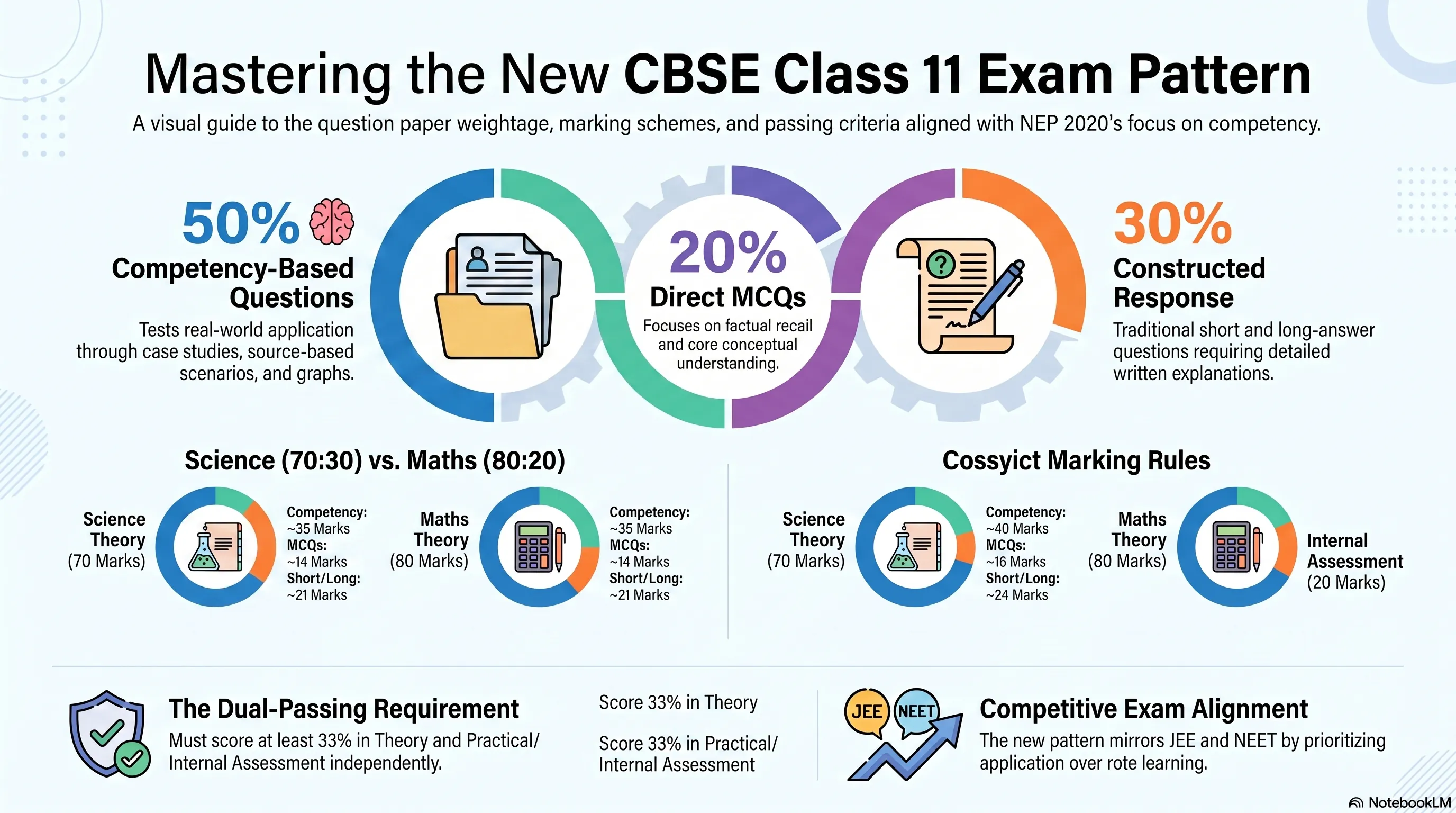
Table of Contents
- What Is the CBSE Class 11 Exam Pattern 2026-27?
- CBSE Class 11 Physics Exam Pattern
- CBSE Class 11 Chemistry Exam Pattern
- CBSE Class 11 Maths Exam Pattern
- CBSE Class 11 Biology Exam Pattern
- How Are Competency-Based Questions Different From MCQs?
- CBSE Class 11 Passing Criteria
- How the Class 11 Exam Pattern Connects to JEE and NEET
- How to Prepare for the New Class 11 Exam Pattern

eSaral › NEET › JEE› CBSE Class 11 Exam Pattern 2026-27: Marking Scheme Explained

What Is the CBSE Class 11 Exam Pattern 2026-27?
CBSE's Class 11 and 12 question papers now follow a fixed three-way split across every major subject: 50% competency-based questions, 20% direct MCQs, and 30% constructed-response short and long answer questions.
| Question Type | Weightage | What It Tests |
|---|---|---|
| Competency-Based Questions | 50% | Case-based, source-based, and application questions that test understanding, not memory |
| Multiple Choice Questions (MCQs) | 20% | Direct factual and conceptual recall |
| Constructed Response Questions | 30% | Short and long answer questions requiring written explanation |
Science subjects with a lab component — Physics, Chemistry, and Biology — additionally split total marks 70:30 between theory and practical. Maths carries no practical but has a 20-mark internal assessment component alongside an 80-mark theory paper.
Why Did CBSE Change the Class 11 Question Paper Design?
CBSE restructured the Class 11 and 12 exam pattern to reduce rote memorisation and reward students who can apply concepts to unfamiliar situations, aligning school assessment with the competency-based approach the National Education Policy 2020 mandates.
This matters beyond just board-style scoring. JEE Main, JEE Advanced, and NEET have always tested application over recall — so a Class 11 paper built the same way is, in a real sense, better practice for competitive exams than the older memorisation-heavy format ever was.
CBSE Class 11 Physics Exam Pattern
Physics is a 100-mark subject: 70 marks theory and 30 marks practical. The theory paper follows the standard 50-20-30 competency split.
| Section | Marks |
|---|---|
| Competency-Based Questions (case-based, application) | ~35 |
| MCQs | ~14 |
| Short & Long Answer Questions | ~21 |
| Theory Total | 70 |
| Practical / Internal Assessment | 30 |
Numerically heavy chapters — Laws of Motion, Work Energy and Power, and Thermodynamics — tend to show up most often in the constructed-response section, since these lend themselves to multi-step problems that MCQs can't fully test.
💡 Expert Tip by eSaral Academic Team: Don't just solve numericals for the final answer. CBSE's constructed-response marking awards partial credit for correct steps, formula selection, and units — a habit that also directly carries over to JEE Main and JEE Advanced numerical-answer questions.
CBSE Class 11 Chemistry Exam Pattern
Chemistry follows the same 70:30 theory-practical split, with the theory paper covering Physical, Organic, and Inorganic Chemistry in roughly equal proportion to their unit weightage.
| Section | Marks |
|---|---|
| Competency-Based Questions | ~35 |
| MCQs | ~14 |
| Short & Long Answer Questions | ~21 |
| Theory Total | 70 |
| Practical / Internal Assessment | 30 |
Which Chemistry Topics Get the Most Competency-Based Questions?
Organic Chemistry basics, Chemical Bonding, and Equilibrium tend to carry the highest share of case-based and application questions, since these topics lend themselves naturally to real-world scenarios and multi-step reasoning that pure recall can't test.
Chemistry practicals (30 marks) include volumetric analysis, salt analysis, and a project — all internally assessed by the school, which means consistent lab attendance directly protects a meaningful chunk of the final grade.
CBSE Class 11 Maths Exam Pattern
Maths has no practical component. Instead, it carries an 80-mark theory paper plus a 20-mark internal assessment, split between periodic tests and lab activities or projects.
| Section | Marks |
|---|---|
| Competency-Based Questions | ~40 |
| MCQs | ~16 |
| Short & Long Answer Questions | ~24 |
| Theory Total | 80 |
| Internal Assessment (periodic tests + activities) | 20 |
Algebra and Coordinate Geometry, being the highest-weightage units in the Class 11 Maths syllabus, typically draw the largest share of long-answer questions, while Sets and Functions and Statistics and Probability lean more heavily toward MCQs and short-answer formats.
💡 Expert Tip by eSaral Academic Team: Maths internal assessment is 20 marks you fully control through the year — periodic test performance and completed activities. Students who treat these as "not real marks" routinely lose 8-10 marks they never needed to.
CBSE Class 11 Biology Exam Pattern
Biology mirrors Physics and Chemistry with a 70:30 theory-practical split, but leans more heavily on diagram-based and descriptive questions than pure numerical problem-solving.
| Section | Marks |
|---|---|
| Competency-Based Questions | ~35 |
| MCQs | ~14 |
| Short & Long Answer Questions | ~21 |
| Theory Total | 70 |
| Practical / Internal Assessment | 30 |
Are Diagrams Compulsory in the Class 11 Biology Exam?
Yes, several constructed-response questions in Biology specifically require labelled diagrams — of cell structures, the human heart, or plant tissues — and marks are awarded strictly based on labelling accuracy, not just the written explanation.
Human Physiology and Cell Structure and Function, the highest-weightage units in the syllabus, are also where most diagram-based competency questions concentrate — directly relevant for students also preparing for NEET, where Biology carries the largest single share of marks.
How Are Competency-Based Questions Different From MCQs?
A regular MCQ tests whether you remember a fact or formula directly. A competency-based question wraps that same concept inside a case, a passage, a graph, or a real-world scenario, and asks you to apply what you know to answer it — often across multiple linked sub-questions.
For example, instead of asking "What is Newton's Second Law?", a competency-based question might describe a car's braking scenario with given values and ask you to calculate deceleration, identify the force involved, and predict what happens if mass doubles — all from one case. This format rewards students who understand why a concept works, not just what it states.
CBSE Class 11 Passing Criteria
To pass any subject in Class 11, a student needs a minimum of 33% marks in theory and 33% separately in practical or internal assessment — scoring high in one section cannot compensate for failing the other.
| Component | Minimum Passing Marks |
|---|---|
| Theory (out of 70 or 80) | 33% of theory marks |
| Practical / Internal Assessment (out of 30 or 20) | 33% of practical/IA marks |
This dual-passing rule is exactly why practicals and internal assessment can't be treated as an afterthought — a student can score 60% in theory and still fail the subject overall by scoring under 33% in practicals.
How the Class 11 Exam Pattern Connects to JEE and NEET
Class 11 syllabus content directly overlaps with the first year of JEE and NEET preparation, and the shift toward competency-based, application-heavy questions in the CBSE pattern means school exam practice and competitive exam practice now reinforce each other more than they used to.
Understanding the JEE Main syllabus alongside your Class 11 board syllabus helps you see exactly where the overlap is — Mechanics in Physics, Organic Chemistry basics, and Algebra in Maths are core to both. Students on the NEET track will find a similar overlap, especially in Human Physiology and Cell Biology.
💡 Expert Tip by eSaral Academic Team: Solving CBSE-style competency-based questions well is genuinely good JEE and NEET practice — both test application over recall. Students who treat board prep and competitive exam prep as two separate tracks usually end up doing twice the work for the same concepts.
How to Prepare for the New Class 11 Exam Pattern
- Build NCERT line-by-line first. Roughly 80-90% of the Class 11 question paper draws directly from NCERT content, so this remains the single highest-leverage resource regardless of question format. Use NCERT Solutions for Class 11 Physics, Chemistry, and Maths to check your understanding chapter by chapter.
- Practice case-based questions specifically, not just end-of-chapter exercises. Competency-based questions have a distinct format — read a passage or scenario, then answer linked sub-questions — and this format needs its own practice, separate from standard numericals.
- Don't skip practicals or internal assessment. With a hard 33% passing threshold on both theory and practical, treating labs as optional risks failing a subject you're otherwise doing well in.
- Time your papers realistically. With 50% of marks now in competency-based format, papers take longer to read and interpret than the older, more direct question style — practice under actual time constraints, not just untimed problem-solving.
- Keep an eye on the competitive exam calendar alongside your school exams. Knowing the JEE Main exam date and eligibility criteria early in Class 11 helps you plan school exams and competitive prep without last-minute clashes.
If you want structured Class 11 preparation that builds both strong board exam performance and JEE or NEET readiness at the same time, eSaral's JEE Online & Offline Courses and NEET Online & Offline Courses are worth exploring, taught by IIT Bombay faculty who've been through this exact transition themselves.
Frequently Asked Questions
Find answers to common questions.
What is the CBSE Class 11 exam pattern for 2026-27?
The CBSE Class 11 Exam Pattern 2026-27 splits every theory paper into 50% competency-based questions, 20% MCQs, and 30% constructed-response short and long answer questions, with Physics, Chemistry, and Biology also carrying a separate 30-mark practical component.
How many MCQs are there in the Class 11 board exam?
MCQs make up 20% of the theory paper in every major subject — around 14 marks out of 70 in Physics, Chemistry, and Biology, and around 16 marks out of 80 in Maths.
What are the passing marks for Class 11 CBSE?
Students need a minimum of 33% marks in theory and a separate minimum of 33% in practical or internal assessment to pass each subject — scoring well in one section cannot make up for failing the other.
What are competency-based questions in CBSE Class 11?
Competency-based questions are case-based or source-based questions that test whether a student can apply a concept to a real-world or scenario-based situation, rather than simply recalling a fact or formula, and they make up 50% of every Class 11 theory paper.
Does Class 11 have practical exams?
Yes, Physics, Chemistry, and Biology each carry a 30-mark practical component alongside the 70-mark theory paper, while Maths has a 20-mark internal assessment instead of a practical exam.
Is the Class 11 exam pattern the same as Class 12?
Yes, CBSE applies the same 50% competency-based, 20% MCQ, and 30% constructed-response structure to both Class 11 and Class 12 theory papers, keeping the assessment style consistent across both years.