
In the newton force formula, one newton is defined as the force that produces an acceleration of 1 m/s² in a body of mass 1 kg.
Force Formula – Formula for Force, Derivation, Units & Examples
The force formula is F = ma, where F is the net force acting on a body, m is its mass, and a is the acceleration produced. This is Newton's second law of motion. Force is a vector quantity measured in newton (N) in the SI system, and its dimensional formula is [M¹L¹T⁻²].
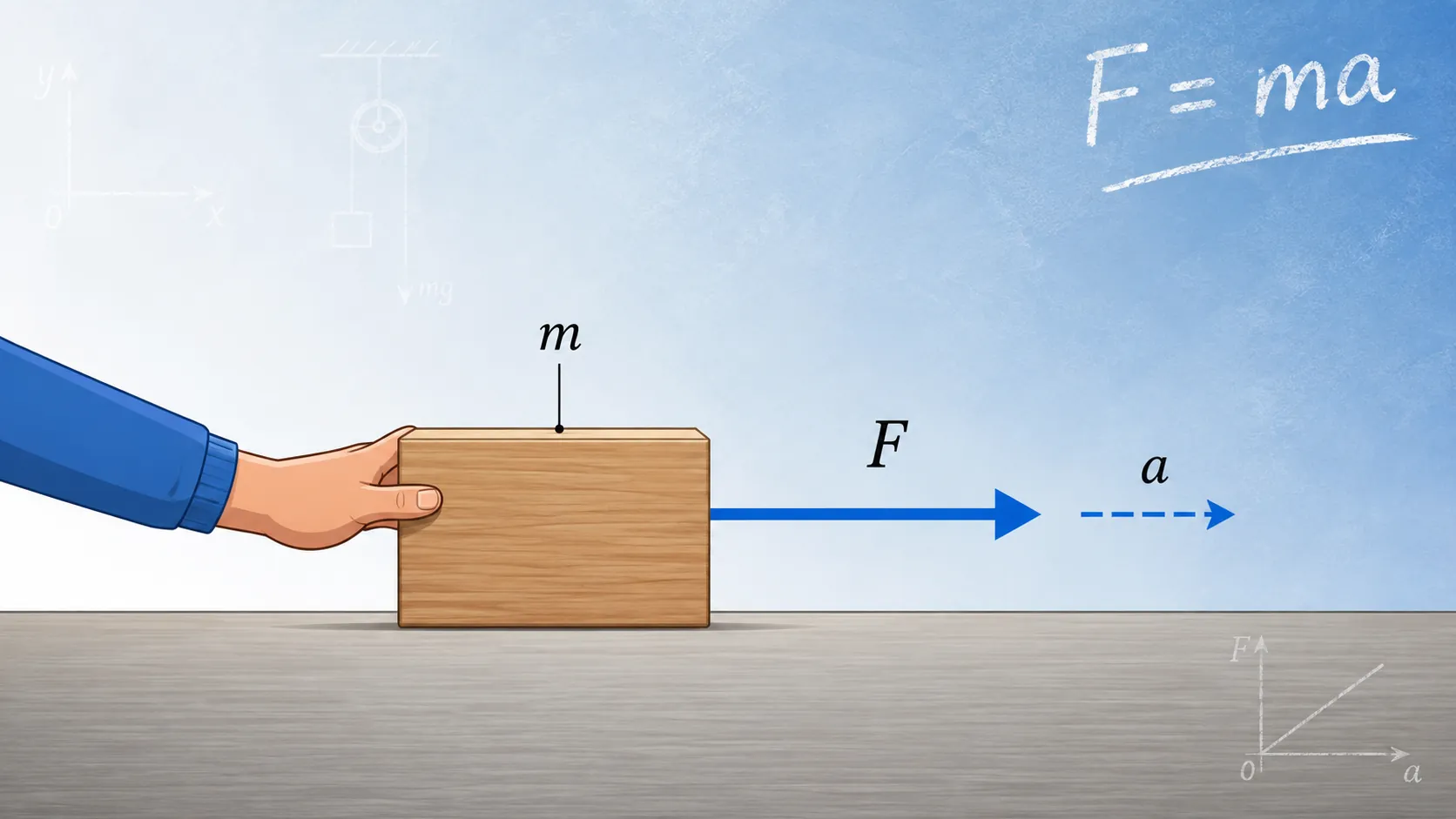
Table of Contents
- What Is Force?
- What Is the Formula for Force?
- How Is the Force Formula Derived from Newton's Second Law?
- What Is the SI Unit and Dimensional Formula of Force?
- What Are the Different Types of Force in Physics?
- What Is the Formula for Net Force When Multiple Forces Act on a Body?
- What Is the Force Formula in Terms of Pressure and Area?
- Solved Examples on the Force Formula
- Quick Revision: Force Formula at a Glance
eSaral › Class 11 Physics › Force Formula – Formula for Force, Derivation, Units & Examples

The force formula is F = ma — force equals mass multiplied by acceleration. This is the mathematical form of Newton's second law of motion, where F is the net force in newton (N), m is the mass of the body in kg, and a is the acceleration in m/s². Force is a vector quantity, and its dimensional formula is [M¹L¹T⁻²].
This is the single most important equation in the Class 11 Laws of Motion notes chapter, and it forms the base of almost every numerical asked in JEE Main, JEE Advanced, and NEET Physics — from simple block-on-a-surface problems to friction, tension, and circular motion questions.
What Is Force?
Force is a push or a pull acting on an object that can change its state of rest or motion, change its direction, or change its shape. Force is a vector quantity — it has both magnitude and direction — and it is the physical cause behind acceleration, as described by Newton's second law of motion.
- Force can start, stop, speed up, slow down, or change the direction of a moving body.
- Force can deform an object (change its shape or size).
- Every force acts as an interaction between two bodies — a single isolated force cannot exist without a source and a receiver.
- The SI unit of force is the newton (N), and the CGS unit is the dyne.
What Is the Formula for Force?
The formula for force comes directly from Newton's second law of motion, which states that the rate of change of momentum of a body is directly proportional to the net external force applied on it, and this change takes place in the direction of the applied force.
F = ma
Where:
- F = net force acting on the body (newton, N)
- m = mass of the body (kilogram, kg)
- a = acceleration produced in the body (metre/second², m/s²)
In vector form, the force formula is written as $\vec{F} = m\vec{a}$, since both force and acceleration are vector quantities acting in the same direction, while mass is a scalar.
How Is the Force Formula Derived from Newton's Second Law?
The formula of force is derived using the concept of linear momentum. Momentum (p) of a body is the product of its mass and velocity: p = mv.
According to Newton's second law, force is directly proportional to the rate of change of momentum:
F ∝ dp/dt
F = k · d(mv)/dt
For a body of constant mass, this simplifies to:
F = k · m · (dv/dt)
Since dv/dt is acceleration (a), this becomes F = kma. Choosing the value of the proportionality constant k = 1 (this defines the unit of force — one newton is the force that produces unit acceleration in unit mass), the equation reduces to the final forces formula used across all of mechanics:
F = ma
What Is the SI Unit and Dimensional Formula of Force?
| Quantity | Value |
|---|---|
| SI unit of force | newton (N) |
| 1 newton equals | 1 kg × 1 m/s² |
| CGS unit of force | dyne |
| 1 newton in dyne | 1 N = 10⁵ dyne |
| Gravitational unit of force | kilogram-force (kgf) |
| 1 kgf equals | 9.8 N |
| Dimensional formula of force | [M¹L¹T⁻²] |
| Nature of force | Vector quantity |
What Are the Different Types of Force in Physics?
Forces are broadly classified into two categories based on whether physical contact between bodies is required.
Contact Forces
These forces act only when two objects are physically touching each other.
- Applied force – force applied directly by a person or object (a push or pull).
- Frictional force – opposes relative motion between two surfaces in contact.
- Normal force – the perpendicular reaction force exerted by a surface.
- Tension force – the pulling force transmitted through a string, rope, or cable.
- Spring force – the restoring force exerted by a stretched or compressed spring.
Non-Contact Forces (Field Forces)
These forces act at a distance, without any physical contact between the bodies.
- Gravitational force – the force of attraction between any two masses.
- Electrostatic force – the force between charged particles.
- Magnetic force – the force experienced by a moving charge in a magnetic field.
- Nuclear force – the strong short-range force that holds the nucleus together.
Practice how these force types are tested numerically with JEE Main Chapterwise PYQ.
Common Forces and Their Formulas
| Type of force | Formula | Where it is used |
|---|---|---|
| Newton's second law (net force) | F = ma | General motion problems |
| Gravitational force (weight) | F = mg | Free-fall, apparent weight problems |
| Universal gravitation | F = Gm₁m₂/r² | Planetary and satellite motion |
| Frictional force | f = μN | Motion on rough surfaces |
| Centripetal force | F = mv²/r | Circular motion |
| Spring force (Hooke's law) | F = −kx | Spring-block systems |
| Electrostatic force (Coulomb's law) | F = kq₁q₂/r² | Charged particle interactions |
| Force from pressure | F = P × A | Fluid mechanics, hydraulics problems |
Quick-revision summary. For the full derivation, sign conventions, and solved numericals for each of these forces, see the detailed breakdown on our types of forces in nature page.
What Is the Formula for Net Force When Multiple Forces Act on a Body?
When more than one force acts on a body, the net force (or resultant force) is the vector sum of all individual forces:
F_net = F₁ + F₂ + F₃ + ... + Fₙ
- If all forces act along the same line and in the same direction, magnitudes are simply added.
- If forces act in opposite directions, the smaller magnitude is subtracted from the larger one, and the net force acts in the direction of the larger force.
- If forces act at an angle to each other, the net force is found using vector addition (parallelogram or component method).
- A body remains in equilibrium — at rest or moving with constant velocity — only when the net force acting on it is zero. This is the condition used in every free-body diagram question in the Newton's Laws of Motion chapter.
Free-body diagram and net-force questions are a recurring pattern in JEE Advanced Chapterwise PYQ, especially in multi-body pulley and incline systems.
What Is the Force Formula in Terms of Pressure and Area?
Force can also be expressed using pressure: F = P × A, where P is the pressure applied and A is the area over which it acts. This is the inverse relationship of the pressure formula (P = F/A), and it's commonly used in fluid mechanics and hydraulics problems.
Example: A pressure of 200 Pa acts on a surface of area 0.5 m². Find the force exerted.
Solution: F = P × A = 200 × 0.5 = 100 N
Solved Examples on the Force Formula
Example 1: A body of mass 5 kg is accelerating at 2 m/s². Find the force acting on it.
Solution: F = ma = 5 × 2 = 10 N
Example 2: A net force of 20 N acts on a body of mass 4 kg. Find its acceleration.
Solution: a = F/m = 20/4 = 5 m/s²
Example 3: A force of 15 N produces an acceleration of 3 m/s² in a body. Find the mass of the body.
Solution: m = F/a = 15/3 = 5 kg
Example 4: Find the weight of a body of mass 10 kg on Earth. (g = 9.8 m/s²)
Solution: F = mg = 10 × 9.8 = 98 N
Example 5: A block of mass 2 kg is pulled with a force of 12 N on a rough horizontal surface with a coefficient of friction μ = 0.3 (g = 10 m/s²). Find the net acceleration of the block.
Solution: Friction force f = μmg = 0.3 × 2 × 10 = 6 N Net force = Applied force − Friction = 12 − 6 = 6 N Acceleration a = F_net/m = 6/2 = 3 m/s²
Example 6: A ball of mass 0.5 kg moving in a circle of radius 2 m has a speed of 4 m/s. Find the centripetal force acting on it.
Solution: F = mv²/r = (0.5 × 4²)/2 = (0.5 × 16)/2 = 4 N
Since these patterns feel familiar, test your speed with eSaral's JEE Test Series, which includes a dedicated Laws of Motion mock section.
Quick Revision: Force Formula at a Glance
| Concept | Formula |
|---|---|
| Force formula (Newton's second law) | F = ma |
| Force from momentum | F = dp/dt |
| Weight (gravitational force) | F = mg |
| Frictional force | f = μN |
| Centripetal force | F = mv²/r |
| SI unit | newton (N) |
| Dimensional formula | [M¹L¹T⁻²] |
Which Other eSaral Physics Resources Should Class 11 Students Check Next?
- Class 11 Laws of Motion Notes for JEE & NEET
- Types of Forces in Nature
- Newton's Laws of Motion
- Momentum Formula — Definition, Derivation & Solved Examples
- Practice force and Laws of Motion questions from previous years: JEE Main Chapterwise PYQ with Solutions →
Want to master force, friction, and Newton's laws with solved JEE and NEET problems? eSaral's Class 11 Physics course covers Laws of Motion in depth with concept videos by IIT Bombay faculty and chapter-wise practice tests. Explore Class 11 Physics Courses on eSaral →
Frequently Asked Questions
Find answers to common questions.
What is the dimensional formula of force?
The dimensional formula of force is [M¹L¹T⁻²]. This is obtained by substituting the dimensions of mass [M] and acceleration [LT⁻²] into the force formula F = ma.
What is the SI unit of force?
The SI unit of force is the newton (N). One newton is the force required to produce an acceleration of 1 m/s² in a body of mass 1 kg, so 1 N = 1 kg·m/s².
What is the formula of force in terms of momentum?
The formula of force in terms of momentum is F = dp/dt, the rate of change of momentum with respect to time. For a body of constant mass, this reduces to the simpler form F = ma.
What is the formula for force?
The formula for force is F = ma, where F is the net force, m is the mass of the body, and a is the acceleration produced. This equation comes directly from Newton's second law of motion.
What is the formula for frictional force?
The formula for frictional force is f = μN, where μ is the coefficient of friction between the two surfaces and N is the normal force pressing them together.
What is the formula for gravitational force or weight?
The weight of a body is given by F = mg, where m is the mass of the body and g is the acceleration due to gravity (9.8 m/s² on Earth). This is a direct application of the general force formula F = ma.
What is the formula for net force (resultant force)?
The formula for net force is F_net = F₁ + F₂ + F₃ + ... + Fₙ, found by taking the vector sum of every individual force acting on the body. A body stays in equilibrium only when this net force equals zero.
Is force a scalar or a vector quantity?
Force is a vector quantity because it has both magnitude and direction. Two or more forces are always combined using vector addition, not simple arithmetic addition, unless they act along the same line.
What is the formula for centripetal force?
The formula for centripetal force is F = mv²/r, where m is the mass of the body, v is its speed, and r is the radius of the circular path it follows.
What is 1 newton force equal to?
1 newton is equal to the force needed to accelerate a 1 kg mass at 1 m/s². In terms of the CGS unit, 1 newton equals 10⁵ dyne, and in the gravitational unit, 1 newton equals approximately 0.102 kgf.
How do you find force if mass and acceleration are given?
To find force when mass and acceleration are given, simply multiply the two values using the force formula F = ma. For example, a 3 kg body accelerating at 4 m/s² experiences a force of F = 3 × 4 = 12 N.
What is the dimension of the force formula?
The dimension of the force formula F = ma is [M¹L¹T⁻²], obtained by multiplying the dimension of mass [M] by the dimension of acceleration [LT⁻²].
What is the force formula for Class 9?
In CBSE Class 9 Science (Force and Laws of Motion), the force formula is the same F = ma from Newton's second law. Class 9 students use it for basic numericals, while Class 11 and JEE/NEET extend it to momentum, friction, and circular motion problems. eSaral's Class 9 syllabus page covers this chapter in full detail.