How Shubham Turned His JEE Journey Around : From 13 Percentile to IIT Delhi
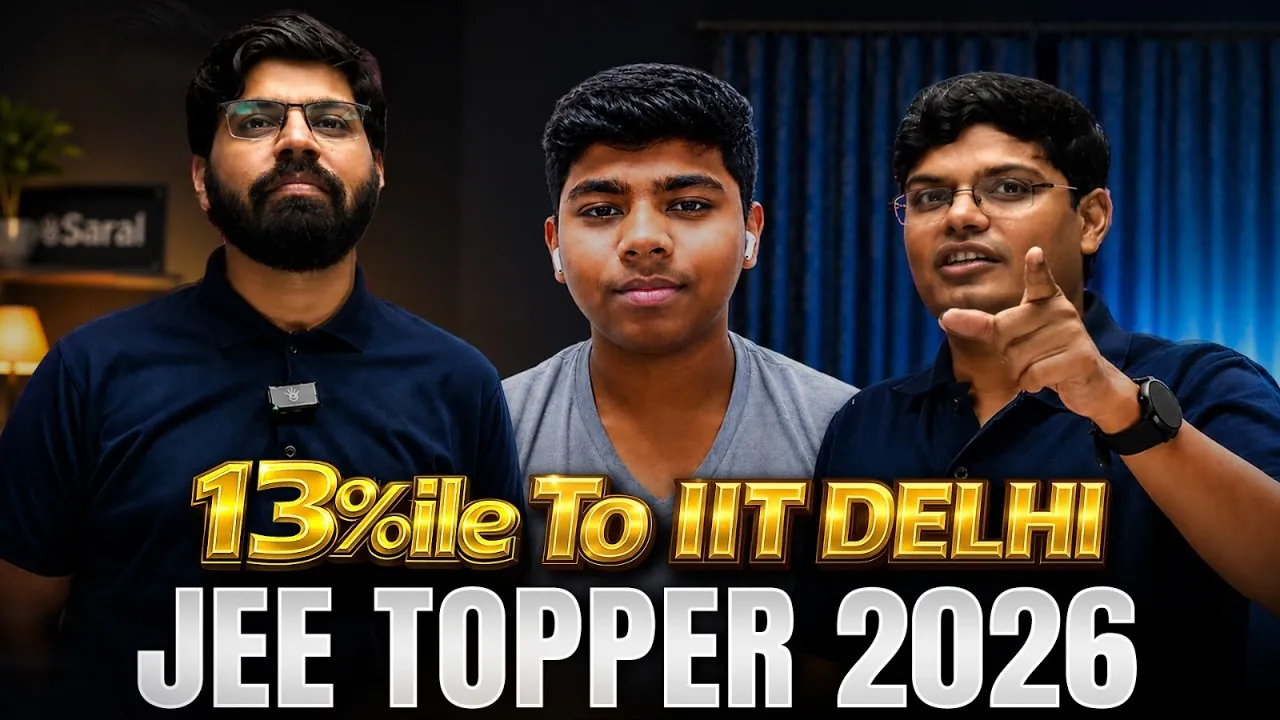
Table of Contents
- Why Do Some JEE Aspirants Score Very Low in Their First Attempt?
- Should You Restart JEE Preparation After a Very Poor First Attempt?
- What Changed After Shubham Joined eSaral?
- How Should You Balance Board Exams and JEE Preparation?
- How To Build a Serious JEE Study Routine From Scratch?
- Did the Aspirant Complete the Entire JEE Advanced Syllabus?
- What Should You Do After Getting Negative Marks in a Mock Test?
- The Role of Shubham’s Mother in His Comeback
- Can Your IIT Seat Upgrade After the First Counselling Round?
- How Does eSaral Support Students Recovering From a Weak Start?

eSaral › Success stories › How Shubham Turned His JEE Journey Around: From 13 Percentile to IIT Delhi

When Shubham received his first counselling allotment, he was getting a seat at IIT Roorkee. In a later round, that seat was upgraded to an IIT Delhi.
For most students, receiving an IIT Delhi seat would already be a major achievement. In Shubham’s case, the result carried an entirely different meaning because his JEE journey had started from a point where even he had stopped expecting much from himself.
In his first JEE Main attempt, Shubham secured 13 percentile.
This was not simply a disappointing score. He felt that even a suitable private college might not be possible and had mentally started preparing to take a drop year. People around him said that studying was not meant for him. Some advised him to leave academics and start working.
A few months later, the same student qualified for JEE Advanced and received admission to IIT Delhi.
A clarification is important here: a JEE Main percentile is not the same as the percentage of marks scored. NTA follows a percentile-based normalisation procedure for papers conducted across multiple sessions. Nevertheless, 13 percentile clearly represented a very weak starting position in Shubham’s preparation.
His comeback did not happen because of one motivational session or a secret study technique. It began when his mother refused to let one result become the final judgement on his ability.
Why Do Some JEE Aspirants Score Very Low in Their First Attempt?
Shubham had performed well academically until Class 10. According to his mother, his studies began declining after he entered Class 11.
He stopped attending his offline JEE classes regularly and became heavily involved in online gaming. He would spend time at gaming cafés, where he rented computers to play games. His mother sometimes had to search for him and bring him back.
By the time of his first JEE Main attempt, Shubham was studying for barely two hours a day.
His mother also observed how strongly his friend circle affected him. One of the students with whom he spent time secured a much higher JEE Main percentile and later mocked Shubham for receiving only 13 percentile.
The result left Shubham embarrassed and convinced that another preparation attempt would only waste more money.
This is an important part of the story because it prevents the final IIT Delhi result from looking artificial. Shubham was not an already disciplined student who simply needed better study material. His first task was to change his daily behaviour.
Should You Restart JEE Preparation After a Very Poor First Attempt?
After the 13-percentile result, Shubham told his mother that spending more money on another course would be pointless. He believed that the money already spent on his preparation had been wasted and that an additional course fee would produce the same outcome.
His mother disagreed.
She reminded him that if he planned to take a drop year anyway, it was better to use the remaining time before the next attempt and make an honest effort. She enrolled him in an eSaral batch even when Shubham himself was reluctant.
Her decision did not come from certainty that he would reach an IIT. She simply believed that he deserved another chance before giving up.
This difference matters. She was not demanding an IIT result from him. She was asking him to try seriously once.
What Changed After Shubham Joined eSaral?
The transcript gives a clear comparison between Shubham’s situation before joining and the support he received afterward.
| Timestamp | Before or initial situation | Change after joining eSaral |
|---|---|---|
| 1:26–2:09 | Shubham had scored 13 percentile and believed that spending more money would be useless. | His mother enrolled him in a batch, and he made it to IIT Delhi |
| 2:09–2:33 | He was confused about managing boards and JEE together. | His mentor called and explained that serious board preparation would also support parts of his JEE preparation. |
| 2:33–2:51 | His initial test scores were sometimes negative. | Mentors encouraged him to keep attempting tests until his scores became positive and gradually improved. |
| 3:14–4:03 | He had been studying for only about two hours and spending time gaming. | He progressed to around six hours, then 8–10 hours before JEE Main and claimed around 12 hours during Advanced preparation. |
| 13:23–14:17 | People around him repeatedly said that he could not succeed. | His mother says eSaral mentor repeatedly called and told him, “You will be able to do it,” even after negative test scores. |
| 0:00–0:20 | His journey began with a weak first-attempt result. | His IIT Roorkee allotment was later upgraded to IIT Delhi. |
The table does not suggest that joining a batch automatically converted 13 percentile into an IIT seat. It shows how structured tests, mentor follow-ups, and encouragement supported the changes Shubham was making himself.
How Should You Balance Board Exams and JEE Preparation?
When Shubham joined the batch, his board examinations were also approaching. He was unsure whether he should focus on boards or JEE.
His mentor helped him see that the two preparations were not completely separate. Studying Class 12 Physics, Chemistry, and Mathematics properly for boards could strengthen the concepts that would also be needed in JEE.
Instead of abandoning one examination for the other, he first concentrated on board preparation and continued attempting tests.
Download JEE Main 2026 Papers →
This is relevant for JEE aspirants who believe that board preparation is automatically a break from JEE preparation. The writing style and depth required may differ, but the underlying syllabus overlaps substantially. The more useful strategy is to identify what can be prepared together and which JEE-specific areas require separate question practice.
How To Build a Serious JEE Study Routine From Scratch?
Shubham openly admitted that he was not accustomed to studying.
Initially, sitting for even two hours felt difficult. After the January attempt, he began gradually increasing the time spent on preparation.
He described the following progression:
- Around two hours of daily study before the comeback
- Approximately six hours when he restarted
- Around 8–10 hours after boards, when JEE Main was close
- Around 12 hours during the JEE Advanced phase
See the JEE Main 2026 Syllabus & Pattern →
These figures are Shubham’s own account, not a recommended timetable for every student. Studying for long hours is useful only when those hours include focused learning, revision, problem-solving and rest.
The transcript also mentions that he sometimes studied until early morning. His mother became worried and asked him to sleep because she knew that exhaustion could affect his ability to think during the examination.
Therefore, the lesson from Shubham’s story is not that every aspirant must study for 12 hours. The real change was that he moved from irregular, distracted preparation to consistently spending most of his available time on a clear goal.
Did the Aspirant Complete the Entire JEE Advanced Syllabus?
No.
Shubham says that during the limited time available, he focused mainly on chapters and topics with greater relevance or weightage. He admitted that there were several Advanced-level chapters he still did not know well.
His strategy was selective: complete fewer areas properly rather than superficially touching every remaining chapter.
He also acknowledged that the paper favoured him because several questions appeared from the areas he had prepared.
This honesty is important. Selective preparation worked in his specific situation because he had very little time. It should not be treated as the ideal strategy for a student beginning preparation one or two years earlier.
JEE 2027 and JEE 2028 aspirants should aim for complete syllabus coverage wherever possible. Selective study is better used as a recovery strategy when time is already limited, not as the starting plan.
Students can use the official JEE Advanced archive, which contains Paper 1 and Paper 2 from multiple years, to identify recurring concepts and practise the actual examination format. The official site also provides computer-based practice tests.
What Should You Do After Getting Negative Marks in a Mock Test?
Shubham’s early test scores were sometimes below zero.
For a student who had already received 13 percentile, these scores could easily have confirmed his fear that nothing would improve.
His mentors responded differently. They told him to continue attempting tests. If two tests produced negative marks, another test could eventually produce a positive score. The immediate objective was not a top score; it was to keep participating long enough to begin improving.
Shubham says that his marks gradually increased.
His mother particularly remembers calls from his mentor. Even when his test performance was poor, the message remained the same:
“Beta, tum kar paoge.”
This was different from the feedback he received elsewhere. Outside the programme, people repeatedly said that he was incapable of succeeding. Within the eSaral system, poor performance was treated as a current condition that could be worked upon, not as a permanent description of the student.
Explore eSaral's JEE Test Series →
The Role of Shubham’s Mother in His Comeback
Shubham’s IIT Delhi story cannot be separated from his mother’s role.
When others advised him to give up, she asked him to try. When he did not want to spend money on another batch, she enrolled him. When he studied until 4 AM, she worried about his sleep. When his JEE Advanced centre was allotted in Goa, she fought to ensure that a long train journey before the examination did not exhaust him.
The family was not financially comfortable. Shubham’s father worked with a lawyer as an assistant. Paying for flights to Goa was difficult, and the family could not afford to take Shubham’s younger brother along.
His mother travelled with him by flight so that he could reach the centre without spending several days on a train. After the examination, they returned by train to control expenses. Explore eSaral's JEE Dropper & Comeback Batch →
She did all this without knowing whether Shubham would qualify.
When the JEE Advanced result finally appeared, both mother and son initially found it difficult to believe.
Can Your IIT Seat Upgrade After the First Counselling Round?
Shubham was initially receiving an IIT Roorkee seat. After an upgrade in counselling, he received an IIT Delhi.
IIT Delhi officially lists Production and Industrial Engineering among its B.Tech programmes. The programme is offered through the Mechanical Engineering department and covers broad areas including production engineering, industrial engineering and design, with an emphasis on manufacturing, analytical skills and problem-solving.
For Shubham’s family, IIT Delhi also carried a practical advantage: they lived in Delhi, so he would not need to move far away from home.
eSaral JEE Advanced 2026 Result
How Does eSaral Support Students Recovering From a Weak Start?
It would be inaccurate to say that eSaral alone took Shubham from 13 percentile to IIT Delhi.
Shubham had to stop gaming, build a study habit, prepare for boards, attempt tests, study for long periods and sit for both JEE examinations. His mother had to continue supporting him financially and emotionally even when there was no guarantee of success.
The role of eSaral, as described by the family, was more grounded:
- Mentors called after his poor result.
- They helped him decide how to handle boards and JEE.
- They continued following up when test scores were negative.
- Teachers did not label him as incapable.
- mentor repeatedly encouraged him to continue.
- The tests gave him opportunities to move gradually from negative to positive scores.
For aspirants evaluating eSaral, this is the most useful takeaway. A course cannot study on a student’s behalf, but a structured system can prevent a struggling student from being left alone with confusion and poor scores.
Watch the full video on YouTube
Frequently Asked Questions
Find answers to common questions.
Is 13 percentile the same as scoring 13% marks in JEE Main?
No. JEE Main uses an NTA percentile score and a normalisation process for multi-session papers. A percentile should not be interpreted as the percentage of raw marks obtained.
Can a student improve after receiving a very low JEE Main percentile?
Improvement is possible, but it requires identifying why the first attempt went poorly and changing those behaviours. Shubham reduced gaming, increased study time, took regular tests and followed mentor guidance.
Is selectively studying only high-weightage chapters a good strategy for JEE Advanced?
It works mainly as a recovery strategy when time is genuinely limited, not as a starting plan — students with more preparation time should aim for full syllabus coverage. eSaral's structured course plans are designed to help students cover the complete syllabus well before this kind of selective narrowing becomes necessary.
Should JEE aspirants treat board exam preparation as separate from JEE preparation?
No — studying board-level Physics, Chemistry, and Mathematics thoroughly strengthens the same concepts needed for JEE, so the two can be prepared together rather than treated as competing priorities. eSaral's mentors help students plan this overlap instead of abandoning one exam for the other.
Can a JEE Advanced seat upgrade after the first counselling round?
Yes — allotments can improve in later rounds of JoSAA counselling based on seat availability and choice filling. eSaral's guidance helps students understand the float and upgrade process during counselling.