Mole Concept - NEET Previous Year Questions with Solutions
Table of Contents

eSaral › NEET Chemistry › Mole Concept Previous Year Questions with Solutions
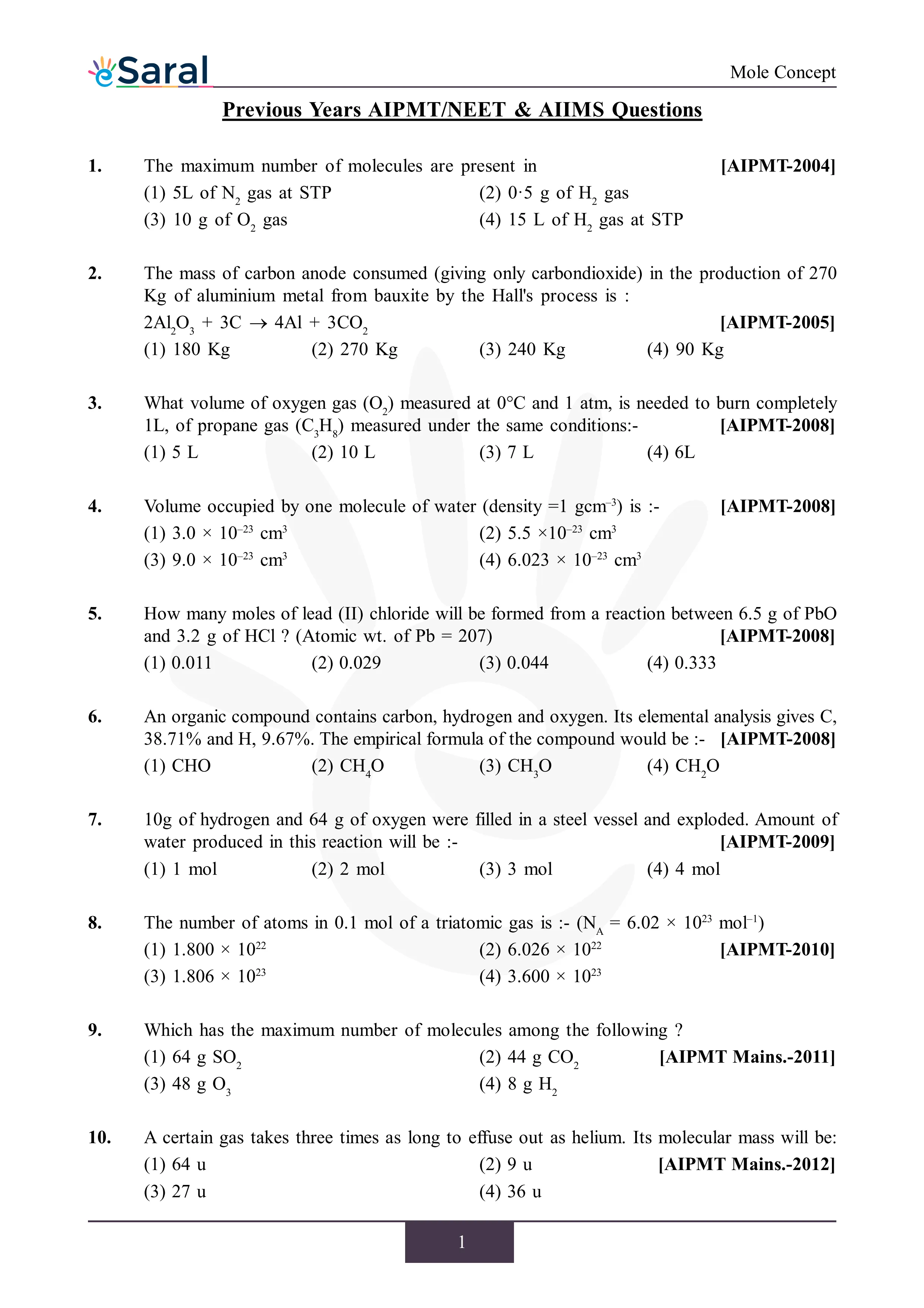
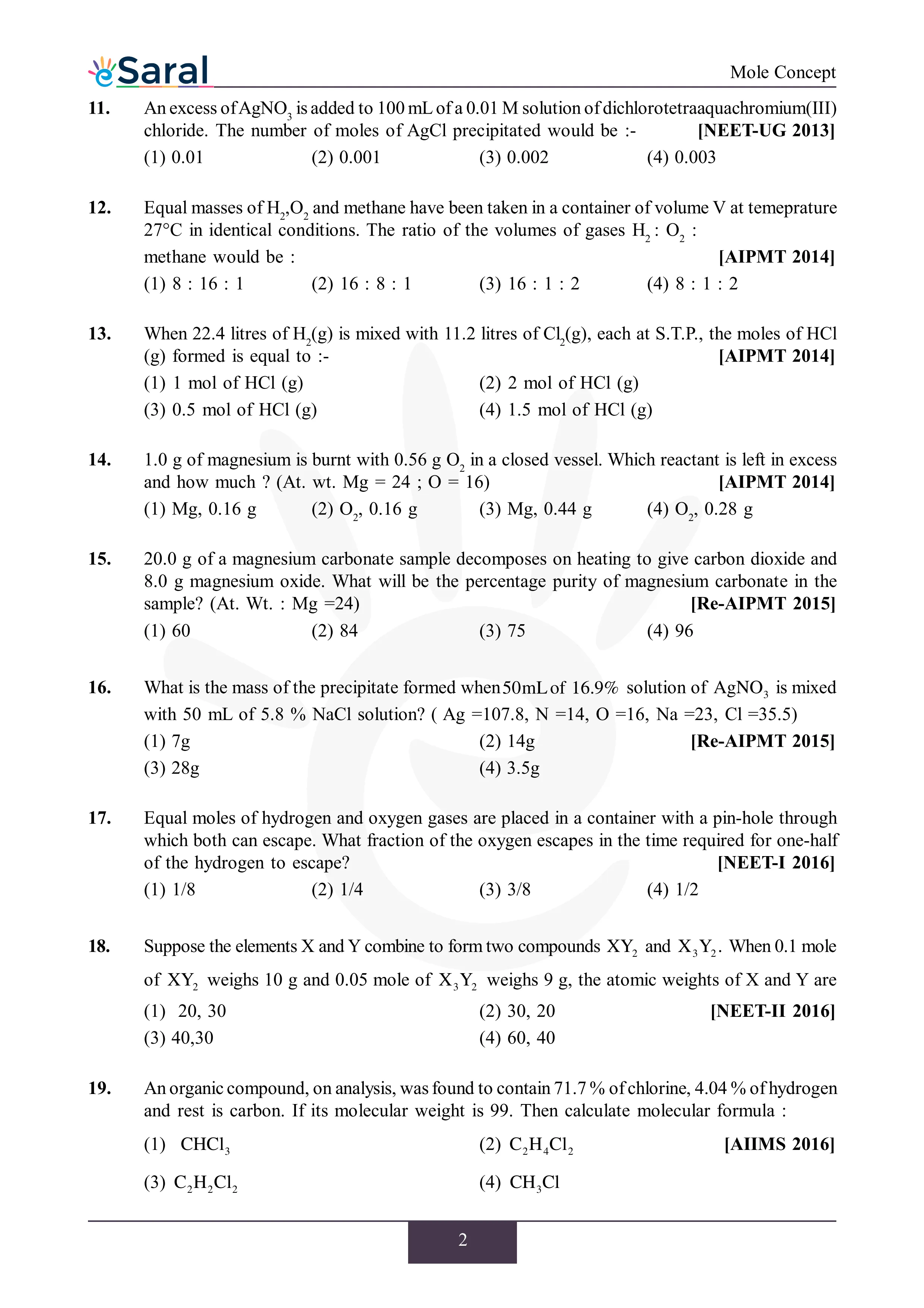
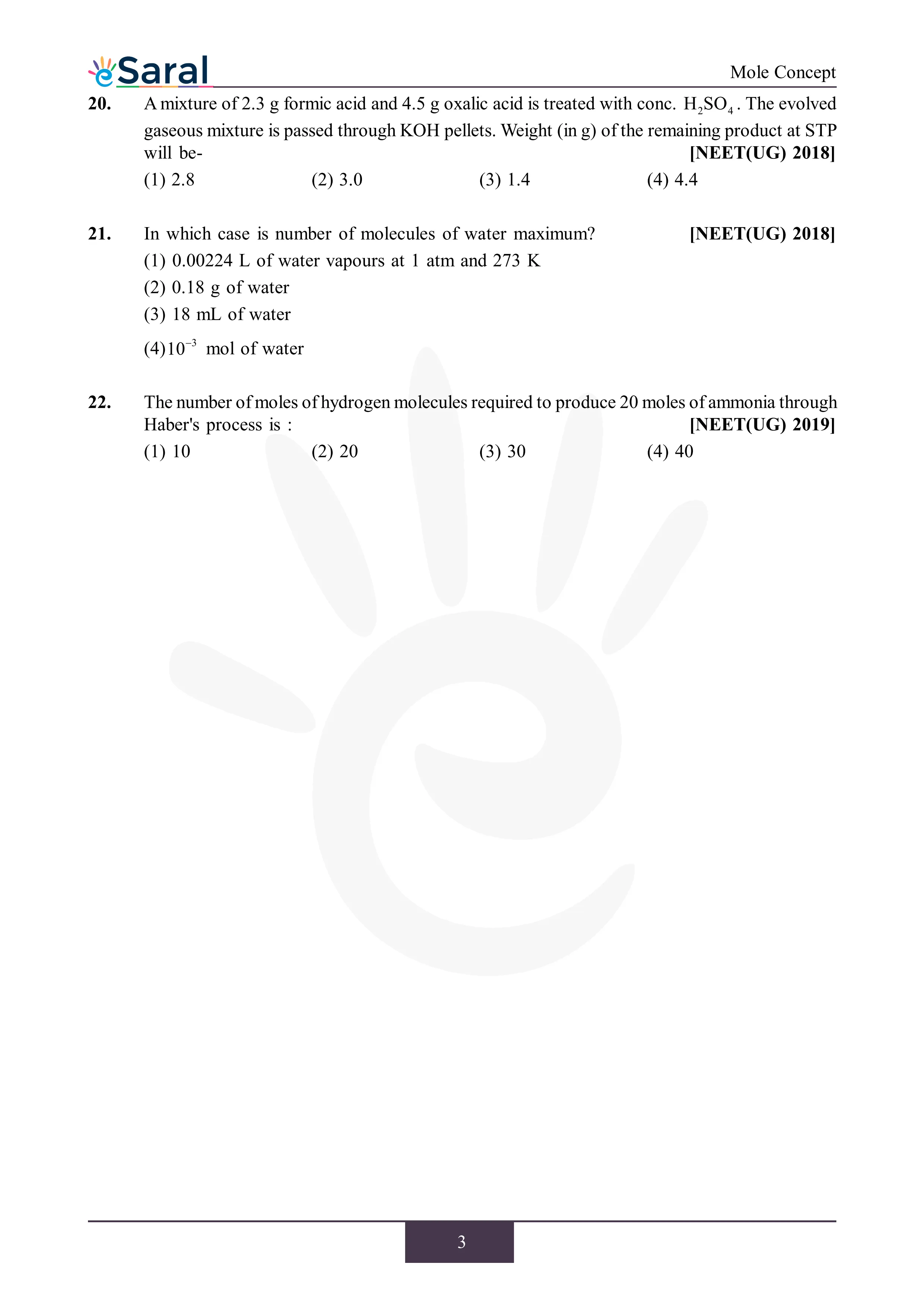
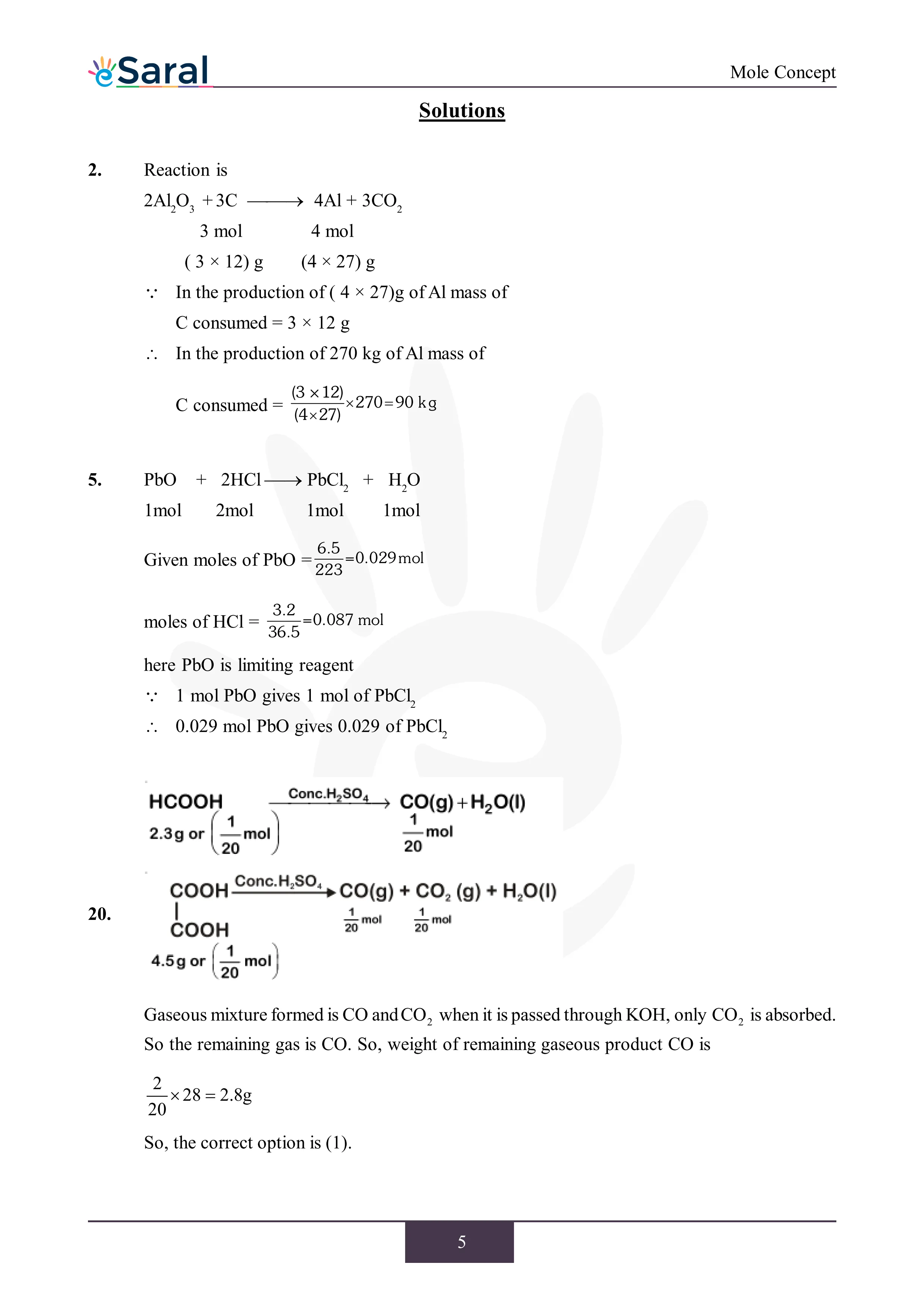
Here you will get Complete Mole Concept NEET Previous Year Questions with complete and detailed solutions. Get complete NEET previous year questions for Physics, Chemistry and Biology. You will find all the solutions at the end of this page:
What Is the Mole Concept and Why Does It Matter for NEET?
The mole concept is the backbone of quantitative chemistry. It connects the atomic world (atoms, molecules) to measurable quantities in the lab (grams, litres). For NEET-UG, it falls under Chapter 1: Some Basic Concepts of Chemistry in Class 11 Chemistry.
This chapter is deceptively simple — students often underestimate it and lose easy marks. NTA (National Testing Agency) has consistently placed 2–4 questions from this chapter in NEET, making it one of the highest-scoring low-effort chapters in the entire Chemistry syllabus.
A student who thoroughly practices mole concept PYQs can lock in 8–16 marks without much calculative burden — compared to chapters like Organic Chemistry that demand far more time.
To build a strong foundation alongside PYQ practice, also refer to the NCERT Solutions for Class 11 Chemistry where every textbook problem is solved with full reasoning. The NCERT text alone covers nearly 80% of what NTA tests in this chapter.
Why Do NEET Students Struggle with This Chapter?
Most errors happen not from lack of knowledge but from unit confusion and skipping steps. Students mix up "moles of atoms" with "moles of molecules," or forget to divide by 2 for diatomic gases. Practicing PYQs — exactly as NTA frames them — is the single best fix.
NEET Mole Concept Weightage — Year-wise Analysis (2018–2024)
Based on official NTA NEET-UG question papers, here is how many questions appeared from Some Basic Concepts of Chemistry each year:
| NEET Year | Questions Asked | Marks (×4 each) | Key Subtopic Tested |
|---|---|---|---|
| 2018 | 3 | 12 | Molar mass, stoichiometry |
| 2019 | 2 | 8 | Empirical formula, limiting reagent |
| 2020 | 3 | 12 | Avogadro's number, molarity |
| 2021 | 2 | 8 | Percentage composition |
| 2022 | 4 | 16 | Mole–mole ratio, normality |
| 2023 | 3 | 12 | Stoichiometry, molar volume |
| 2024 | 2 | 8 | Molecular formula, limiting reagent |
Average: ~2.7 questions / ~11 marks per year

Which Subtopics Are Asked Most in NEET?
Not all subtopics have equal NEET representation. Focus your PYQ practice in this order:
High-Priority Subtopics (Asked Almost Every Year)
- Mole calculations — converting between grams, moles, and number of particles
- Stoichiometry — mole ratios from balanced chemical equations
- Limiting reagent — identifying which reactant gets consumed first
- Molecular and empirical formula — deriving from percentage composition data
Medium-Priority Subtopics (Asked Every 2–3 Years)
- Concentration terms — molarity and mole fraction calculations
- Molar volume at STP — 22.4 L for ideal gases
- Percentage yield and theoretical yield
Lower-Priority Subtopics (Occasionally Asked)
- Normality and equivalents
- Vapour density and molecular mass relationship
- Parts per million (ppm) concentration
Key Formulae You Must Know Before Solving PYQs
Memorising these before attempting PYQs will cut your solving time by half:
| Formula | Expression | Units |
|---|---|---|
| Number of moles | $n = \frac{\text{mass (g)}}{\text{molar mass (g/mol)}}$ | mol |
| Number of particles | $N = n \times 6.022 \times 10^{23}$ | — |
| Molar volume at STP | $1\ \text{mol gas} = 22.4\ \text{L}$ | L/mol |
| Molarity | $M = \frac{\text{moles of solute}}{\text{volume of solution (L)}}$ | mol/L |
| Empirical formula mass | $\sum (\text{atomic mass} \times \text{subscript})$ | g/mol |
| Molecular formula | $\text{Molecular formula} = n \times \text{Empirical formula}$ | — |
| Percentage composition | $\text{Percentage} = \left(\frac{\text{mass of element}}{\text{molar mass of compound}}\right) \times 100$ | % |
| Limiting reagent check | $\frac{\text{given moles}}{\text{stoichiometric coefficient}}$ → smallest = limiting | — |
Common Mistakes to Avoid
| Mistake | Correct Approach |
|---|---|
| Using atomic mass instead of molecular mass | Always check: molecule or atom? |
| Forgetting Avogadro's number has $10^{23}$ | Write it in full: $6.022 \times 10^{23}$ |
| Assuming STP = $25^\circ\text{C}$ $(298\ \text{K})$ | NEET uses STP = $0^\circ\text{C}$ $(273\ \text{K})$, $22.4\ \text{L/mol}$ |
| Mixing molarity with molality | Molarity uses volume $(\text{L})$; molality uses mass of solvent $(\text{kg})$ |
| Not identifying limiting reagent | Always divide moles by coefficient first |
Conclusion
For deeper concept clarity, pair your PYQ practice with the NCERT Solutions for Class 11 Chemistry and download the NCERT Class 11 Books for reference — NTA stays closely within NCERT boundaries for this chapter.
If you want structured guidance through the entire NEET Chemistry syllabus — taught by IIT Bombay faculty at Kota-quality standards — explore eSaral's NEET courses designed for both first-attempt and dropper students.
Bookmark this page and return as you progress through your preparation. New PYQs are added after every NEET exam.
Frequently Asked Questions
Find answers to common questions.
Where can I find NEET Mole Concept PYQs with detailed solutions?
You can find complete NEET Mole Concept previous year questions with step-by-step solutions on this page (eSaral). The questions are sorted chapter-wise and tagged by year, exactly as they appeared in official NTA papers. For textbook theory, also check NCERT Solutions for Class 11 Chemistry
Is Mole Concept important for NEET 2025?
Yes, Mole Concept is important for NEET 2025. It is part of the NTA-prescribed Class 11 Chemistry syllabus and appears every year without exception. It also forms the foundation for Physical Chemistry topics like Equilibrium, Electrochemistry, and Solutions — so mastering it pays dividends across multiple chapters.
How many questions come from Mole Concept in NEET?
NTA asks 2–4 questions from the Mole Concept (Some Basic Concepts of Chemistry) in NEET each year. Based on papers from 2018 to 2024, the average is approximately 3 questions worth 12 marks. This makes it one of the most marks-efficient chapters in NEET Chemistry for focused preparation.
What is the difference between empirical formula and molecular formula in NEET questions?
The empirical formula shows the simplest whole-number ratio of atoms in a compound. The molecular formula shows the actual number of atoms. For example, glucose has empirical formula CH₂O and molecular formula C₆H₁₂O₆. NEET frequently asks students to derive one from the other using percentage composition data and molar mass — a standard 2-step calculation.
What is the difficulty level of Mole Concept questions in NEET?
Mole Concept questions in NEET are generally easy to moderate in difficulty. Most questions test direct formula application — mole calculations, stoichiometry ratios, and empirical formula derivation. Rarely does NTA ask multi-step problems from this chapter. Students who practice 15–20 PYQs typically find this chapter fully predictable.