Momentum Formula: p = mv — Definition, Dimensional Formula, Derivation & Solved Examples
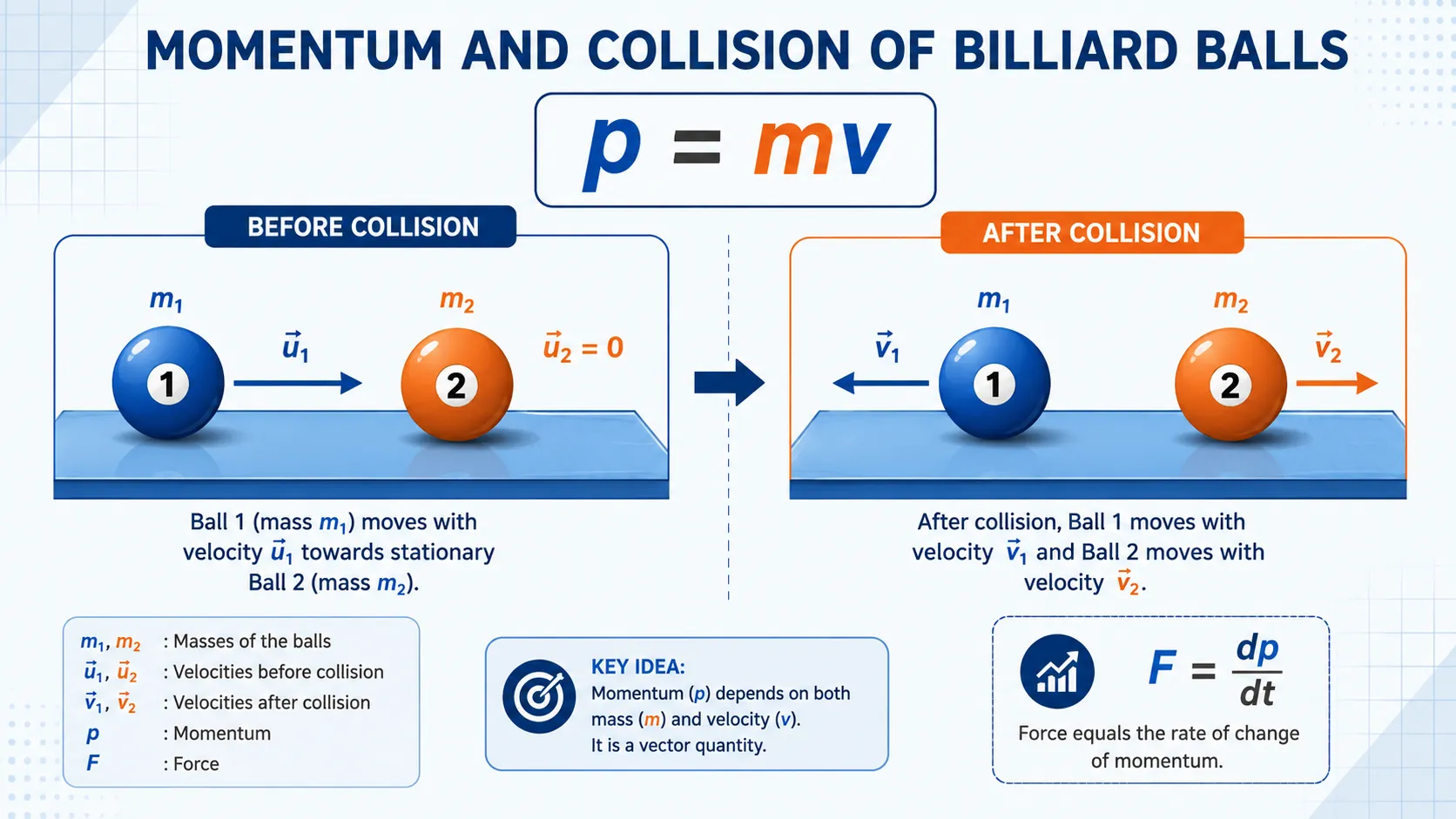
Table of Contents
- What Is the Momentum Formula?
- SI Unit and Dimensional Formula of Momentum
- Momentum Formula for Class 9, Class 11, and Class 12 — What Changes at Each Level
- Momentum Formula for Collision — Elastic vs Inelastic
- What Is the Difference Between Linear Momentum and Angular Momentum?
- How Do You Solve Problems Using the Momentum Formula? (Solved Examples)
- Why Is Understanding the Momentum Formula Important for JEE and NEET?
- How Should Students Practice Momentum Formula Problems?

eSaral › Class 11 Physics › Momentum Formula: p = mv — Definition, Dimensional Formula, Derivation & Solved Examples

What Is the Momentum Formula?
The momentum formula defines momentum as the product of an object's mass and velocity:
p = mv
where p is momentum (kg·m/s), m is mass (kg), and v is velocity (m/s). Since velocity is a vector, the momentum formula also makes momentum a vector — it always points in the same direction as the object's velocity. A heavier object and a faster object can have identical momentum if their mass × velocity product is equal; the momentum formula in physics depends on both quantities together, never on either alone.
New to this chapter? Start with Class 11 Laws of Motion Notes →
Linear Momentum Formula — Is It the Same as "Momentum"?
Yes. When physics problems say "momentum formula" without qualification, they almost always mean the linear momentum formula, p = mv, as opposed to angular momentum (L = Iω), which applies to rotating bodies. This page covers linear momentum in full.
SI Unit and Dimensional Formula of Momentum
| Property | Value |
|---|---|
| SI Unit | kg·m/s (equivalently, N·s) |
| CGS Unit | g·cm/s |
| Dimensional formula of momentum | [M¹L¹T⁻¹] |
| Linear momentum dimensional formula | [M¹L¹T⁻¹] (same — "linear" simply clarifies it's not angular momentum) |
| Type of Quantity | Vector |
What is the dimensional formula of linear momentum, and how is it derived?
Since p = mv, and mass has dimension [M¹] while velocity has dimension [L¹T⁻¹], multiplying the two gives the momentum dimensional formula: [M¹L¹T⁻¹]. This exact question is a recurring one-mark question in CBSE boards and JEE Main.
Momentum Formula for Class 9, Class 11, and Class 12 — What Changes at Each Level
| Class | What's covered | Formula |
|---|---|---|
| Class 9 (NCERT, Force and Laws of Motion) | Basic definition and units only | p = mv |
| Class 11 (Laws of Motion) | Full vector treatment, impulse-momentum theorem, conservation of momentum, collisions | p = mv, F = dp/dt |
| Class 12 (contextual use) | Reappears in Electromagnetic Induction, photon momentum, Modern Physics | p = mv, p = h/λ (de Broglie) |
If you're revising for Class 9 boards, only the basic momentum formula and its SI unit matter. JEE Main and NEET aspirants need the full Class 11 treatment below — impulse, collisions, and conservation — since that's where the actual numerical questions come from.
How Is the Momentum Formula Derived from Newton's Second Law?
Newton's second law states that the rate of change of momentum is directly proportional to the net applied force, in the direction of that force:
F = dp/dt
For a constant-mass system, substituting p = mv gives:
F = d(mv)/dt = m(dv/dt) = ma
This shows F = ma is a special case of the more general momentum formula F = dp/dt — the rate of change of momentum formula — which also holds when mass changes, such as in rocket propulsion problems.
Momentum Formula with Force — Quick Reference
| Situation | Formula |
|---|---|
| Constant mass | F = ma |
| Variable mass | F = dp/dt = m(dv/dt) + v(dm/dt) |
| Impulsive force | F = Δp/Δt (average force over a short time) |
What Is the Impulse-Momentum Theorem?
Impulse (J) uses the change in momentum formula directly:
J = FΔt = Δp = m(v − u)
The impulse delivered to an object equals its change in momentum — a direct consequence of the momentum formula and Newton's second law. This is why airbags reduce injury: increasing impact time (Δt) reduces average force for the same change in momentum. Practice this pattern with JEE Main Chapterwise PYQ →
Momentum Formula in Terms of Kinetic Energy
p = √(2mKE), or equivalently, KE = p²/2m
Derived by substituting v = p/m into KE = ½mv². This is a frequent JEE Main shortcut for problems where velocity isn't given directly but kinetic energy is.
Law of Conservation of Momentum
m₁u₁ + m₂u₂ = m₁v₁ + m₂v₂
This conservation of momentum formula is applied extensively to elastic and inelastic collisions. Collision numericals recur throughout JEE Advanced Chapterwise PYQ →
Total Momentum Formula for a System of Particles
For more than two bodies, the total momentum formula generalises to:
P(total) = p₁ + p₂ + p₃ + ... = m₁v₁ + m₂v₂ + m₃v₃ + ...
This is what's actually conserved in any closed system — the two-body version above is the simplest case.
Momentum Formula for Collision — Elastic vs Inelastic
| Collision Type | What's Conserved | Formula |
|---|---|---|
| Elastic | Momentum and kinetic energy | m₁u₁+m₂u₂ = m₁v₁+m₂v₂, and ½m₁u₁²+½m₂u₂² = ½m₁v₁²+½m₂v₂² |
| Perfectly inelastic | Momentum only (bodies stick together) | m₁u₁ + m₂u₂ = (m₁ + m₂)v |
| Inelastic (not perfectly) | Momentum only | m₁u₁+m₂u₂ = m₁v₁+m₂v₂, KE is lost |
This distinction is one of the most common error sources in JEE Main numericals — both types conserve momentum, but only elastic collisions conserve kinetic energy too.
What Is the Difference Between Linear Momentum and Angular Momentum?
| Feature | Linear Momentum | Angular Momentum |
|---|---|---|
| Formula | p = mv | L = Iω (or L = r × p) |
| Applies to | Objects moving in a straight line or general translation | Objects rotating about an axis |
| SI Unit | kg·m/s | kg·m²/s |
| Quantity Type | Vector | Vector (pseudo-vector) |
This page covers linear momentum. For rotational problems, see Angular Momentum Formula →
How Do You Solve Problems Using the Momentum Formula? (Solved Examples)
Example 1: Basic momentum calculation. A ball of mass 0.5 kg moves with a velocity of 10 m/s. Find its momentum. Solution: p = mv = 0.5 × 10 = 5 kg·m/s
Example 2: Momentum change using impulse. A cricket ball of mass 0.15 kg moving at 12 m/s is hit back at 20 m/s in the opposite direction. Find the change in momentum. Solution: Δp = m(v − u) = 0.15 × [20 − (−12)] = 0.15 × 32 = 4.8 kg·m/s
Example 3: Conservation of momentum in collision. A 2 kg object moving at 3 m/s collides with a stationary 1 kg object, and they stick together. Find their common velocity after collision. Solution: Using m₁u₁ + m₂u₂ = (m₁ + m₂)v 2(3) + 1(0) = (2+1)v → 6 = 3v → v = 2 m/s
Example 4: Force from rate of change of momentum. A force acting on a 4 kg object changes its velocity from 2 m/s to 10 m/s in 4 seconds. Find the average force. Solution: F = Δp/Δt = m(v−u)/t = 4(10−2)/4 = 4(8)/4 = 8 N
Why Is Understanding the Momentum Formula Important for JEE and NEET?
Momentum-based questions appear consistently in both JEE Main and NEET, not only within Laws of Motion but also embedded in Work-Energy-Power (collisions), System of Particles (center of mass and angular momentum), and even Rotational Motion. A clear grasp of the momentum formula, impulse-momentum theorem, and conservation of momentum is essential, since these concepts are rarely tested in isolation and often combined with energy conservation in multi-step numerical problems. Test this exact combination with NEET Chapterwise PYQ, since momentum-energy questions appear regularly in NEET Physics too.
How Should Students Practice Momentum Formula Problems?
- Start with direct substitution problems (p = mv) before attempting impulse or collision-based questions.
- Always define a positive direction before solving collision problems, since momentum is a vector and sign errors are the most common mistake.
- Practice both elastic and inelastic collision problems separately, since they use different conservation conditions (only inelastic collisions conserve momentum but not kinetic energy).
- Revisit the impulse-momentum theorem alongside Newton's second law, since exam questions often test the connection between the two rather than either formula in isolation.
Once confident, test recall speed under timed conditions with eSaral's JEE Test Series, which includes a dedicated Laws of Motion mock section.
Which Other eSaral Physics Resources Should Class 11 Students Check Next?
- Class 11 Laws of Motion Notes for JEE & NEET
- NCERT Solutions Class 11 Physics Chapter 4 — Laws of Motion
- What Is Impulse? — Definition, Formula & Solved Examples
- Applications of Impulse — Class 11 Physics
- Linear Momentum Questions and Answers for Class 11 Physics
- Laws of Motion Class 11 Questions with Answers
- Work Energy and Power Class 11 Physics Notes
- CBSE Class 11 Physics Revision Notes with Weightage
- Practice momentum and collision-based JEE Main questions: JEE Main Chapterwise PYQ with Solutions →
Want to master momentum, impulse, and collisions with solved JEE and NEET problems? eSaral's Class 11 Physics course covers Laws of Motion in depth with concept videos by IIT Bombay faculty and chapter-wise practice tests. Explore Class 11 Physics Courses on eSaral →
Frequently Asked Questions
Find answers to common questions.