NCERT Exemplar Class 12 Chemistry Chapter 12 - Aldehydes, Ketones and Carboxylic Acids - Free PDF Download
Table of Contents

eSaral > NCERT Exemplar > Class 12 Chemistry > Aldehydes, Ketones and Carboxylic Acids

Hey, are you a class 12 student? and looking for ways to download NCERT Exemplar Class 12 Chemistry Chapter 12 "Aldehydes, Ketones and Carboxylic Acids”? If yes. Then read this post till the end.
If you want to score high in your Class 12 Chemistry exam then it is very important for you to understand and learn the topics of Class 12 Chemistry thoroughly.
In this article, we have listed NCERT Exemplars Class 12 Chemistry Chapter 12 in PDF that you can download and start your Preparations easily.
So, without wasting more time let’s start.
What Is NCERT Exemplar Class 12 Chemistry Chapter 12?
NCERT Exemplar Problems for Class 12 Chemistry Chapter 12 is an official supplementary book published by the National Council of Educational Research and Training (NCERT). It is designed to go beyond standard textbook questions, testing a student's ability to apply concepts rather than simply recall them.
Chapter 12 — Aldehydes, Ketones and Carboxylic Acids — focuses on the chemistry of carbonyl-containing compounds. These are the functional groups that bridge the gap between basic organic chemistry and advanced reaction mechanisms, making them a favourite testing ground for both CBSE board paper setters and JEE question designers.
The exemplar for this chapter includes:
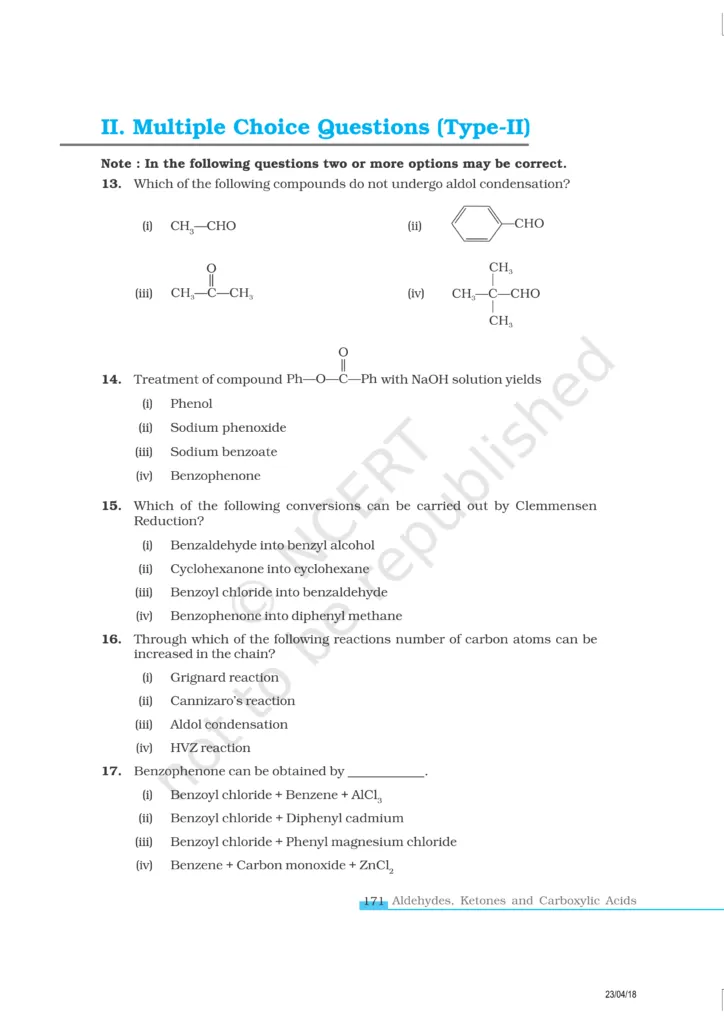
- Multiple Choice Questions (MCQs) — both single-correct and multi-correct
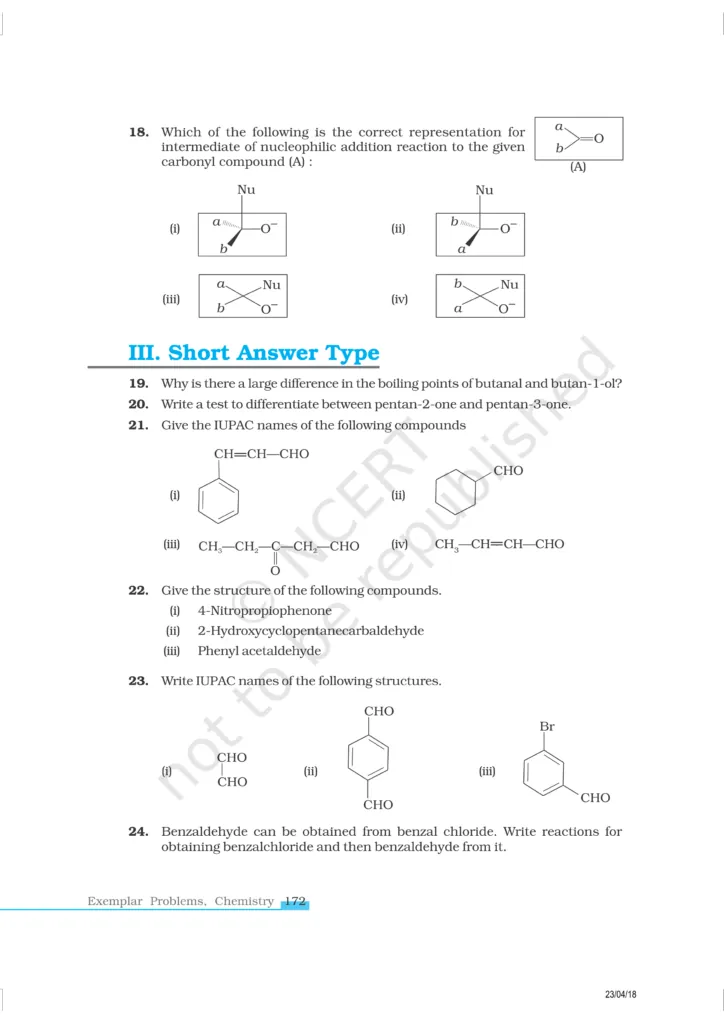
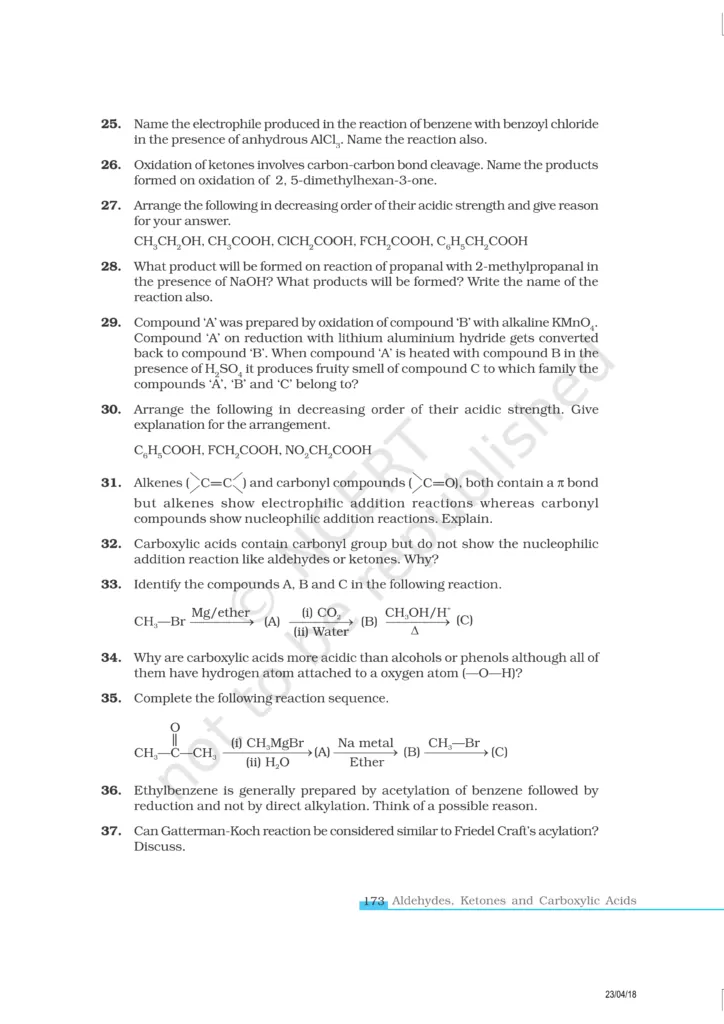
- Short Answer Questions — requiring mechanism-level understanding
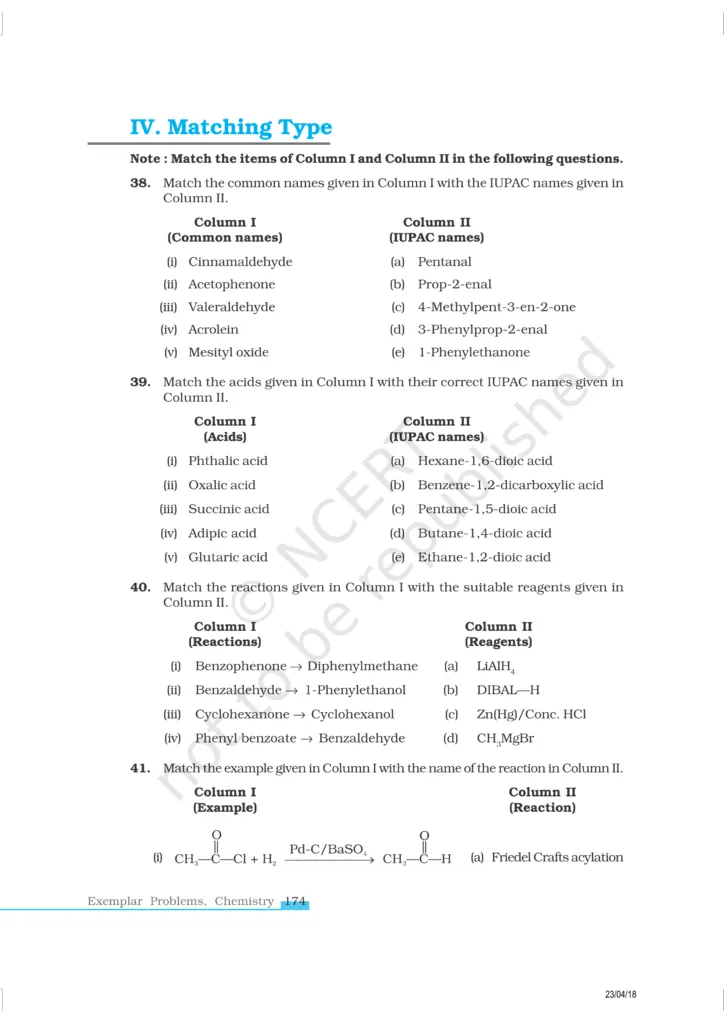
- Matching Type Questions — testing knowledge of reactions and reagents
- Assertion-Reason Questions — evaluating conceptual clarity
Working through these questions exposes you to the edge cases and tricky angles that rarely appear in the standard NCERT textbook but frequently show up in board exams and competitive entrance tests.
Why Is Chapter 12 Important for CBSE Boards and JEE?
Aldehydes, Ketones, and Carboxylic Acids consistently carry 5–8 marks in CBSE Class 12 board exams and appear in nearly every JEE Main and JEE Advanced paper in some form. Understanding this chapter deeply is not optional — it is one of the most direct score-builders available in Class 12 Chemistry.
Board Exam Weightage
According to the CBSE Class 12 Chemistry syllabus, Unit 6 (Aldehydes, Ketones and Carboxylic Acids) is allocated significant marks in the annual examination. Questions typically test:
- Nomenclature and structural differences between aldehydes, ketones, and carboxylic acids
- Preparation methods (from alcohols, alkenes, Grignard reagents)
- Chemical properties — nucleophilic addition, oxidation, reduction
- Named reactions: Aldol condensation, Cannizzaro reaction, Hell-Volhard-Zelinsky reaction
JEE Relevance
For JEE aspirants, carbonyl chemistry is the entry point to multi-step synthesis problems. Questions in JEE Advanced often require students to chain together 3–4 reactions, many of which pass through an aldehyde or ketone intermediate. Mastering exemplar-level questions here builds the mechanistic thinking needed to tackle those problems.
Most students lose marks in carbonyl chemistry not because they don't know the reactions, but because they confuse which reagents apply to aldehydes versus ketones. Make a two-column reagent table — aldehyde-specific on the left, common to both on the right — and revise it every week.
Complete Topic Breakdown: What Does Chapter 12 Cover?
The table below maps every major subtopic in Chapter 12 to its importance level for boards and JEE:
| Subtopic | Key Concepts | Board Importance | JEE Relevance |
|---|---|---|---|
| Nomenclature | IUPAC names for aldehydes, ketones, and acids | High | High |
| Structure & Nature of Carbonyl Groups | sp² hybridisation, polarity | High | High |
| Preparation of Aldehydes & Ketones | Oxidation, ozonolysis, Rosenmund, Stephen | High | High |
| Nucleophilic Addition Reactions | HCN, NaHSO₃, Grignard, water | High | High |
| Aldol Condensation | Mechanism, intramolecular aldol | High | High |
| Cannizzaro Reaction | Disproportionation, which aldehydes qualify for | Medium | High |
| Oxidation & Reduction | Tollens', Fehling's, LiAlH₄, NaBH₄ | High | High |
| Carboxylic Acids — Preparation | From alcohols, nitriles, Grignard + CO₂ | Medium | High |
| Acidity of Carboxylic Acids | Inductive effect, resonance, pKa comparison | High | High |
| Hell-Volhard-Zelinsky Reaction | α-halogenation of acids | Medium | Medium |
| Reactions of Carboxylic Acids | Esterification, acyl chloride, anhydride | High | Medium |
What Types of Questions Appear in the NCERT Exemplar Chapter 12?
NCERT Exemplar Chapter 12 contains four types of questions: MCQs (single and multiple correct), short answer questions involving reaction mechanisms, matching-type questions, and assertion-reason pairs. Each type tests a different cognitive skill and mirrors the pattern used in CBSE board papers.
Multiple Choice Questions (MCQs)
These test factual recall and concept application. Expect questions like:
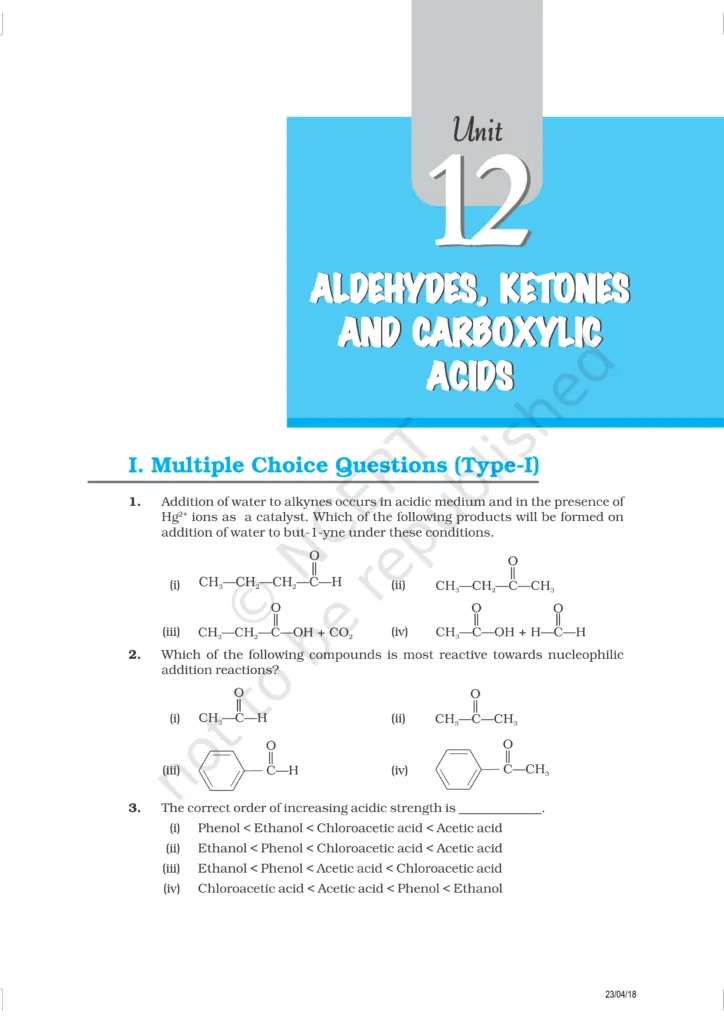
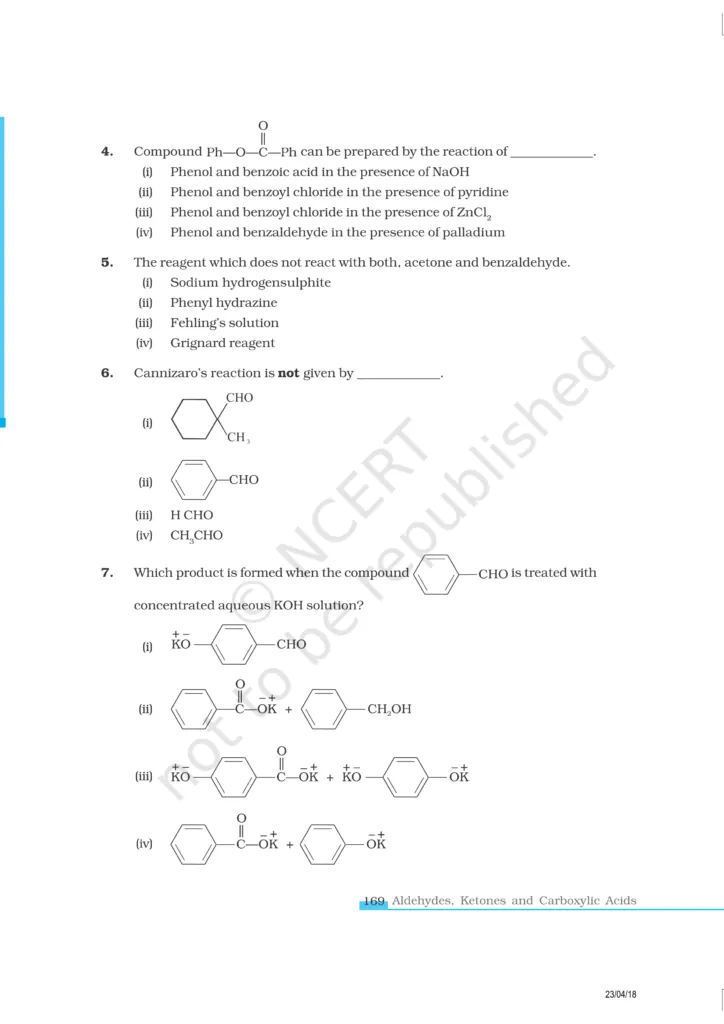
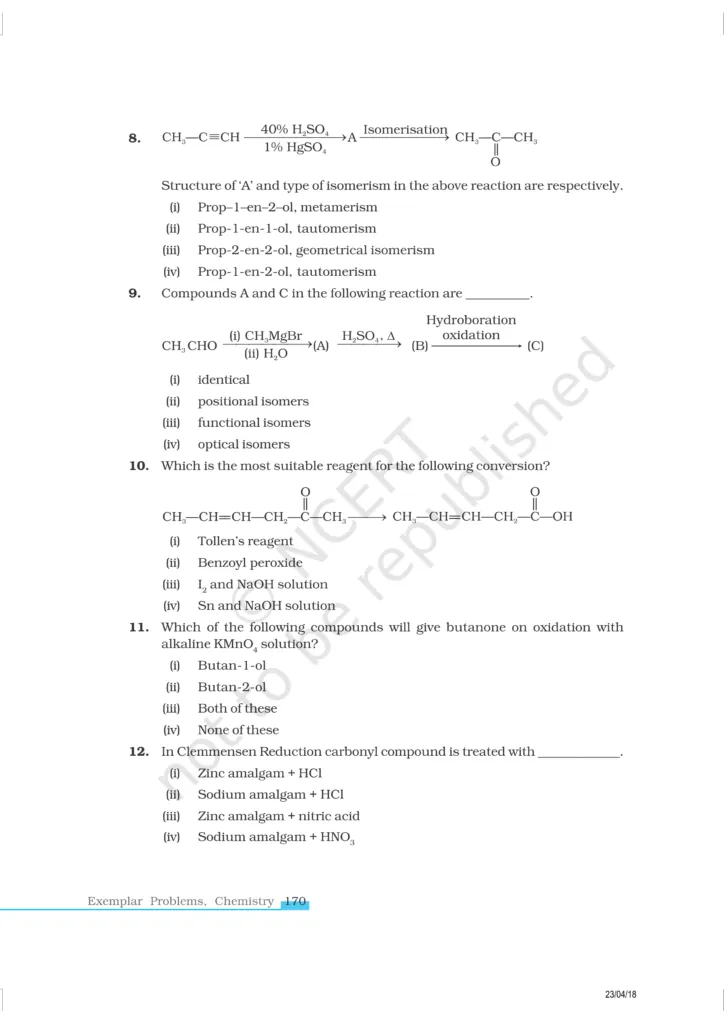
- Which of the following aldehydes does NOT undergo Cannizzaro reaction?
- The product of the reaction of acetaldehyde with excess HCN is…
- Arrange the following carboxylic acids in order of increasing acidity.
Tip: In multi-correct MCQs, elimination is your best friend. Identify one clearly wrong option and one clearly right one first.
Short Answer and Mechanism Questions
These carry higher marks in boards and require you to write:
- Step-by-step mechanisms (nucleophilic addition, aldol condensation)
- Reaction equations with correct products
- Explanations for reactivity trends
Matching and Assertion-Reason Questions
Assertion-Reason questions from Chapter 12 frequently appear in CBSE board papers. They test whether you understand why a reaction happens, not just what happens. Practice these from the exemplar to build the reasoning skill that separates 90+ scorers from average students.
For assertion-reason questions in carbonyl chemistry, always ask yourself: Is the assertion true? Is the reason true? Is the reason the correct explanation for the assertion? Answer these three sub-questions separately before choosing your option. Students trained in eSaral's 5-layer doubt-solving system learn to break complex questions into sub-steps — the same approach works perfectly here.
How Should You Use the Exemplar PDF to Maximise Your Score?
Using the exemplar effectively means more than just reading through it. Here is a structured approach used by students who consistently score 90+ in Class 12 Chemistry boards:
Step-by-Step Study Plan for Chapter 12
- First, finish the NCERT textbook chapter. Read every example and solved problem. Use NCERT Solutions for Class 12 Chemistry to verify your answers and understand solution methods.
- Attempt exemplar MCQs without looking at answers. Mark questions you are unsure about. Revisit after checking answers to understand your error pattern.
- Write out mechanisms by hand. For short-answer questions involving mechanisms, writing — not reading — is what builds memory and exam-ready fluency.
- Time yourself on matching and assertion-reason sections. These question types often feel easy until you are under exam time pressure.
- Revise the topic table above (Section 3) before every revision session to ensure you are not neglecting any subtopic.
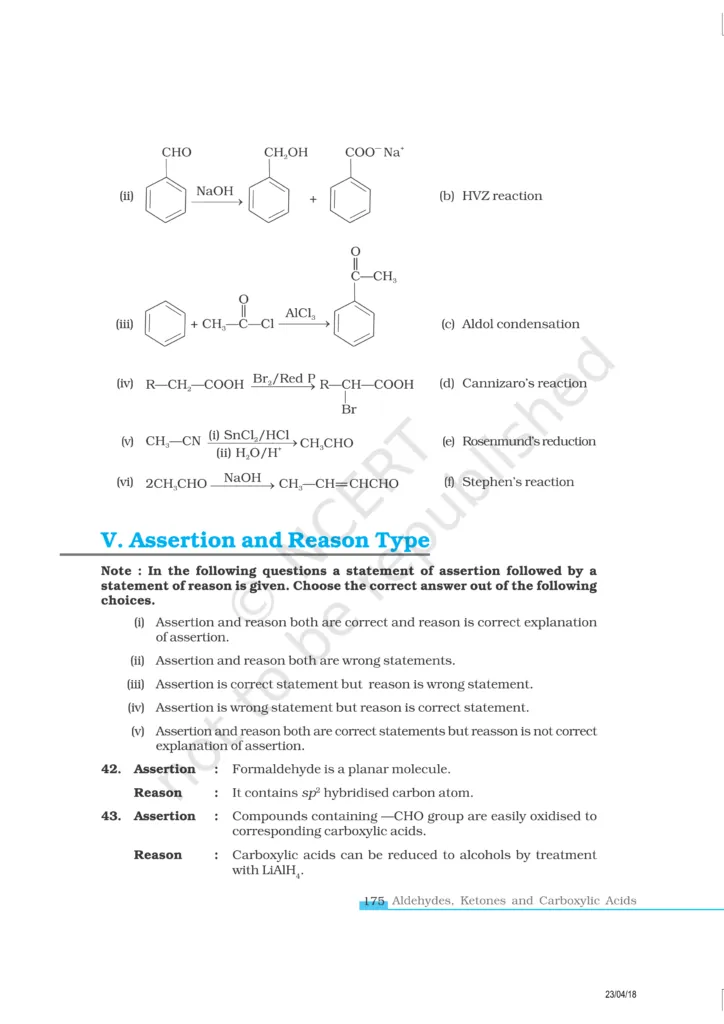
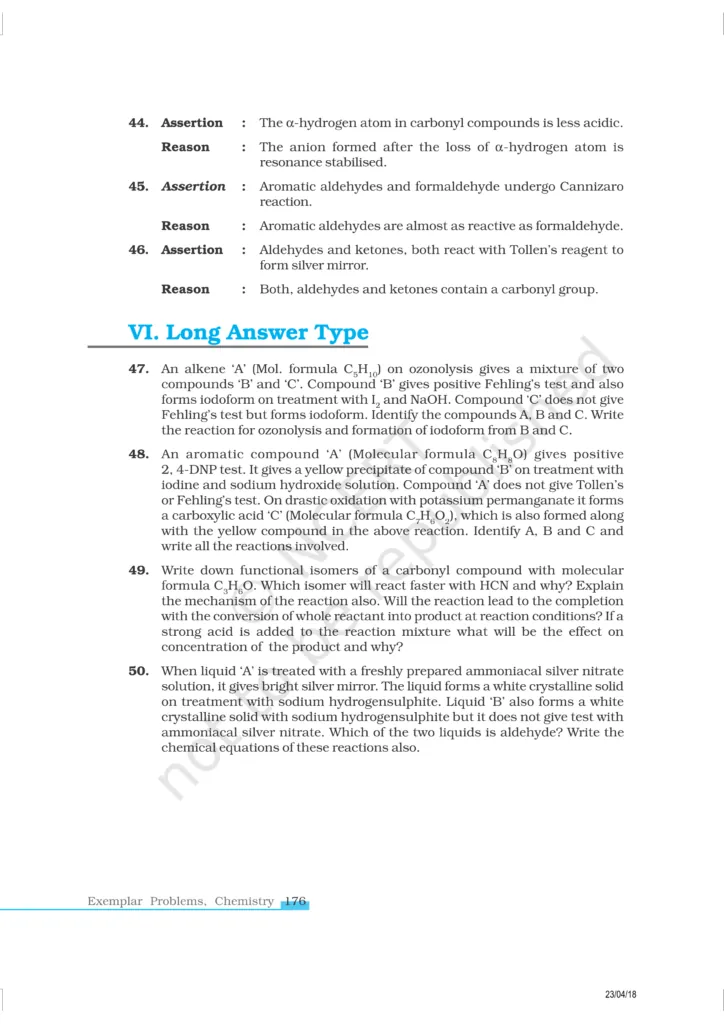
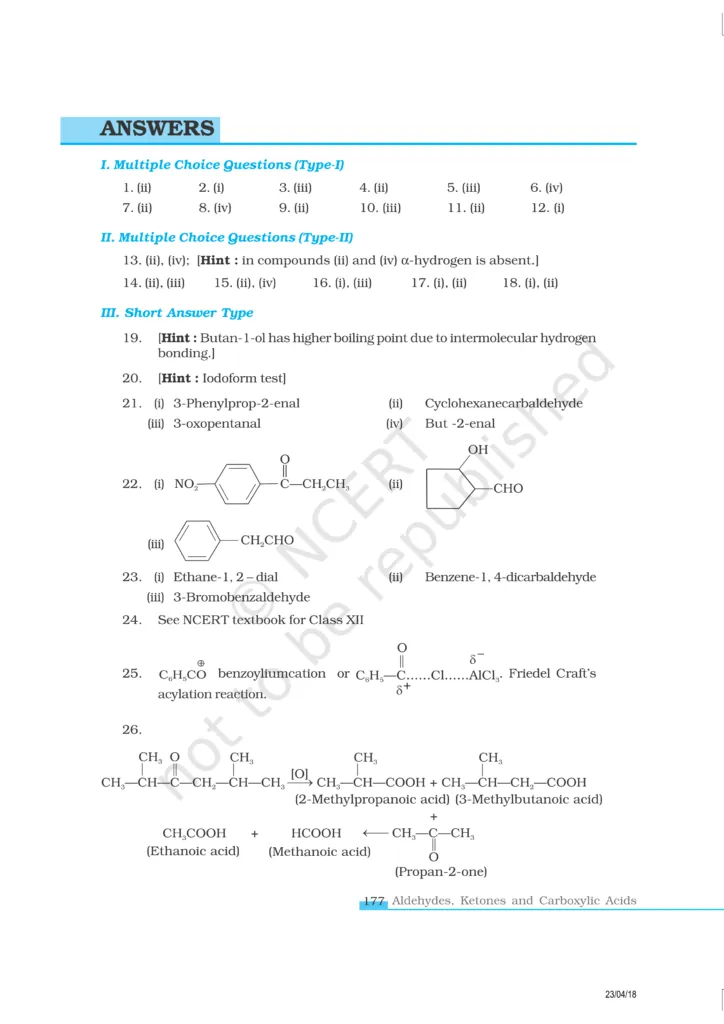
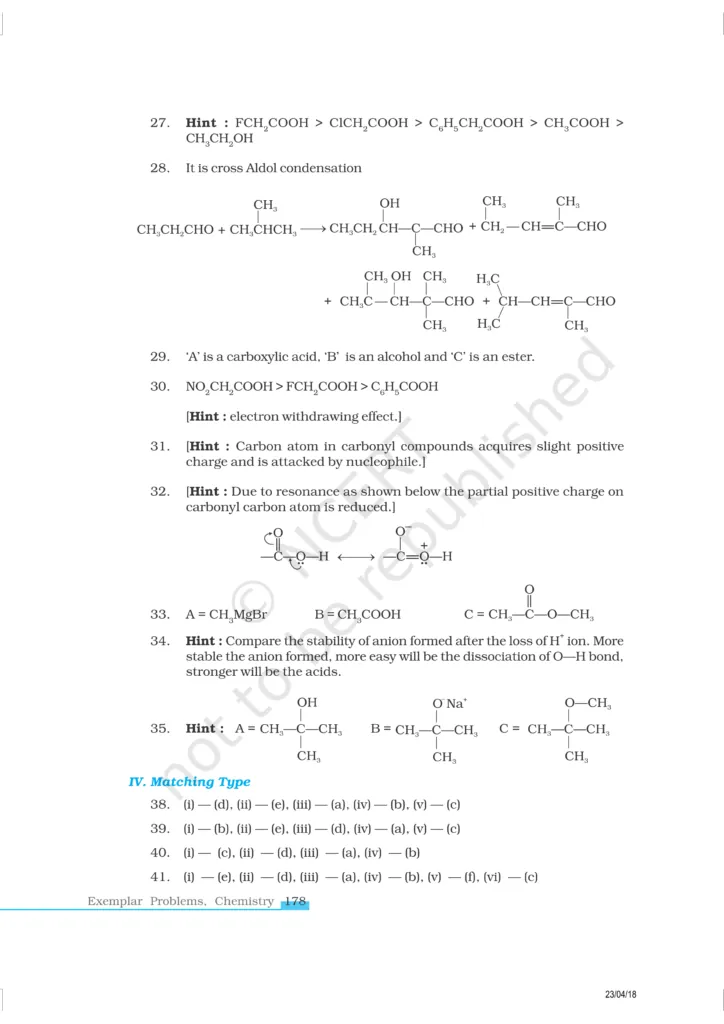
So, that’s all from this article. I hope you enjoyed this post. If you found this article helpful, then please share it with other students.
Also Read,
Class 12 Chemistry Revision Notes Free PDF Download
NCERT Class 12 Chemistry Book Free pdf Download
CBSE Class 12 Chemistry Syllabus Free pdf Download
NCERT Exemplar Class 12 Chemistry all chapters Free pdf Download
NCERT Exemplar Class 12 Physics all chapters Free pdf Download
NCERT Exemplar Class 12 Biology all chapters Free pdf Download
NCERT Exemplar Class 12 Maths all chapters Free pdf Download
If you have any Confusion related to NCERT Exemplar Class 12 Chemistry Chapter 12, then feel free to ask in the comments section down below.
To watch Free Learning Videos on Class 12 Chemistry by Kota’s top Faculties, install the eSaral App
Frequently Asked Questions
Find answers to common questions.
How many questions are in NCERT Exemplar Class 12 Chemistry Chapter 12?
NCERT Exemplar Chapter 12 contains approximately 60–70 questions in total, distributed across MCQs (single correct), MCQs (multiple correct), short answer questions, matching type, and assertion-reason questions. The exact number follows the official NCERT Exemplar book published by NCERT, New Delhi.
Is NCERT Exemplar enough for Class 12 Chemistry boards?
NCERT Exemplar is highly useful for board exam preparation and goes beyond standard textbook questions. For most students, completing the NCERT textbook, its exercises, and the exemplar questions for each chapter is sufficient to score 85–90+ in CBSE boards. For students targeting JEE, additional practice from past JEE papers is recommended on top of the exemplar.
What is covered in NCERT Exemplar Class 12 Chemistry Chapter 12?
NCERT Exemplar Chapter 12 covers Aldehydes, Ketones and Carboxylic Acids. It includes questions on nomenclature, preparation methods, nucleophilic addition reactions, named reactions (Aldol condensation, Cannizzaro reaction, Hell-Volhard-Zelinsky), oxidation-reduction reactions, and the acidity of carboxylic acids. The question types range from MCQs to mechanism-based short answers.
How is Chapter 12 Chemistry relevant for JEE Main and JEE Advanced?
Carbonyl compounds are central to JEE organic chemistry. Chapter 12 concepts appear in JEE Main almost every year through questions on reagent identification, product prediction, and distinguishing tests. In JEE Advanced, multi-step synthesis problems routinely include aldehyde or ketone intermediates. Students at eSaral, taught by faculty who cleared JEE with AIR-41, are specifically trained to connect these reactions to multi-concept JEE problems.
What are the most important reactions to learn in Chapter 12 for boards?
The most important reactions for board exams in Chapter 12 are: Aldol condensation (with mechanism), Cannizzaro reaction, Tollens' test and Fehling's test (to distinguish aldehydes from ketones), nucleophilic addition of HCN, reduction using LiAlH₄ vs NaBH₄, and the Hell-Volhard-Zelinsky reaction for carboxylic acids. Rosenmund reduction and Stephen reaction for preparation of aldehydes are also frequently tested.
Are NCERT Exemplar questions repeated in CBSE board exams?
Yes. CBSE board papers frequently draw inspiration from NCERT Exemplar questions, particularly assertion-reason and application-based MCQs. Several questions in recent board papers were either directly lifted or closely adapted from the exemplar. This makes solving the exemplar one of the highest-return revision activities for Class 12 boards.
Where can I find NCERT Solutions for Class 12 Chemistry to use alongside the exemplar?
You can find detailed, step-by-step NCERT Solutions for Class 12 Chemistry on eSaral's website. These solutions are written by IIT-trained faculty and cover every textbook exercise. Using NCERT Solutions alongside the exemplar gives you both conceptual grounding and higher-order practice.