NCERT Exemplar Class 12 Physics pdf download - Free PDF Download
Download chapter-wise NCERT Exemplar Class 12 Physics PDFs for all 15 chapters with conceptual MCQs, numericals, derivations, answer keys, and expert preparation tips for CBSE Boards, JEE Main, and NEET.
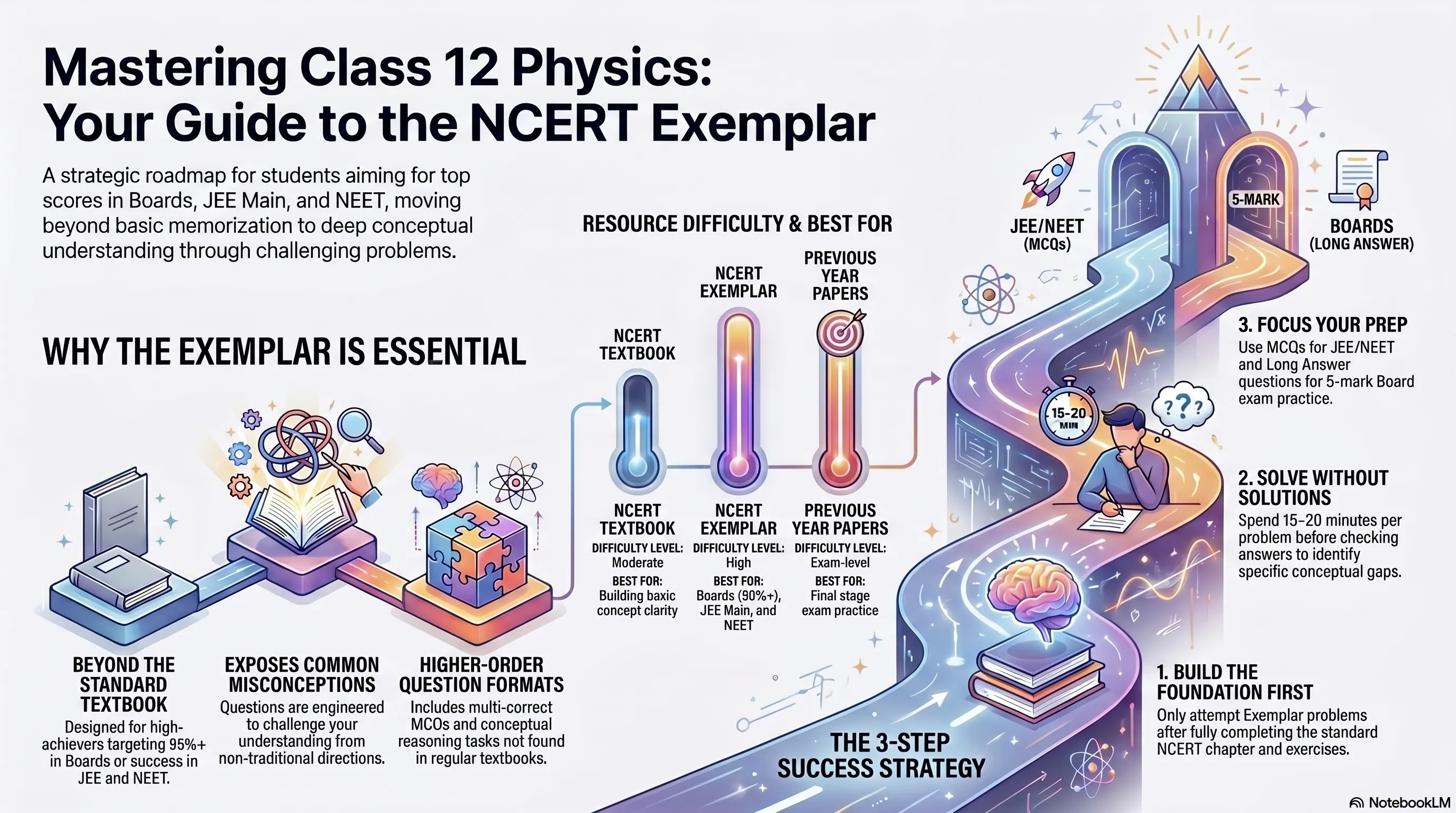
Table of Contents

eSaral › JEE › JEE Advanced ›NCERT Exemplar Class 12 Physics pdf download - Free PDF Download

What Is NCERT Exemplar and Why Does It Matter for Class 12 Physics?
NCERT Exemplar is a supplementary problem book published by NCERT alongside the standard textbook. It contains:
- Higher-order MCQs (single correct and multiple correct)
- Short answer questions requiring conceptual reasoning
- Long answer questions involving multi-step derivations
- Problems specifically designed to expose common misconceptions
| Resource | Difficulty | Best For |
|---|---|---|
| NCERT Textbook Exercises | Moderate | Building basic concept clarity |
| NCERT Exemplar Problems | High | Board exam above 90%, JEE Main, NEET |
| Previous Year Papers | Exam-level | Final stage practice |
💡 Expert Tip by Saransh Gupta Sir, IIT Bombay AIR-41: "NCERT Exemplar for Physics is not optional if you're targeting JEE Main or 95+ in boards. The questions test the same concepts as your textbook but from directions that require you to actually understand — not just remember. Solve exemplar only after you've completed the standard NCERT chapter."
Class 12 Physics has 15 chapters spread across two books. The Exemplar covers all 15 chapters in the same sequence — making it easy to use chapter by chapter alongside your regular study schedule.
So, that’s all from this article. I hope you enjoyed this post. If you found this article helpful then please share it with other students.
Chapter-Wise PDF Download Links — All 15 Chapters
Click any chapter link below to access the NCERT Exemplar Class 12 Physics PDF for that chapter:
| Chapter | Topic | Download |
|---|---|---|
| Chapter 1 | Electric Charges and Fields | Download PDF |
| Chapter 2 | Electrostatic Potential and Capacitance | Download PDF |
| Chapter 3 | Current Electricity | Download PDF |
| Chapter 4 | Moving Charges and Magnetism | Download PDF |
| Chapter 5 | Magnetism and Matter | Download PDF |
| Chapter 6 | Electromagnetic Induction | Download PDF |
| Chapter 7 | Alternating Current | Download PDF |
| Chapter 8 | Electromagnetic Waves | Download PDF |
| Chapter 9 | Ray Optics and Optical Instruments | Download PDF |
| Chapter 10 | Wave Optics | Download PDF |
| Chapter 11 | Dual Nature of Radiation and Matter | Download PDF |
| Chapter 12 | Atoms | Download PDF |
| Chapter 13 | Nuclei | Download PDF |
| Chapter 14 | Semiconductor Electronics | Download PDF |
| Chapter 15 | Communication Systems | Download PDF |
| Answers | Complete Answer Key | Download PDF |
All PDFs are free to download. No registration required.
Chapter-Wise Overview: What Each Section Covers
Part 1 — Electrostatics and Current Electricity (Chapters 1–3)
Chapter 1 — Electric Charges and Fields: Coulomb's law, electric field due to point charges, dipoles, continuous charge distributions, Gauss's law and its applications. Exemplar questions here push Gauss's law beyond symmetric cases.
Chapter 2 — Electrostatic Potential and Capacitance: Electric potential, potential due to dipoles, equipotential surfaces, capacitors in series and parallel, energy stored, dielectrics. Exemplar tests energy density and dielectric effect calculations at a deeper level.
Chapter 3 — Current Electricity: Ohm's law, drift velocity, resistivity, combinations of resistors, Kirchhoff's laws, Wheatstone bridge, potentiometer and meter bridge. Numerically intensive chapter — exemplar problems frequently involve multi-loop circuit analysis.
Part 2 — Magnetism and Electromagnetic Induction (Chapters 4–7)
Chapter 4 — Moving Charges and Magnetism: Biot-Savart law, Ampere's law, force on current-carrying conductors, cyclotron, galvanometer. Exemplar tests superposition of magnetic fields and circular motion of charged particles.
Chapter 5 — Magnetism and Matter: Magnetic dipole moment, bar magnets, Earth's magnetism, para/dia/ferromagnetism. Shorter chapter — exemplar questions tend to be conceptual and definitional.
Chapter 6 — Electromagnetic Induction: Faraday's and Lenz's laws, motional EMF, eddy currents, self and mutual inductance. Exemplar questions combine Faraday's law with circuit analysis in non-trivial ways.
Chapter 7 — Alternating Current: RMS values, impedance, resonance, power factor, LC oscillations, transformers. One of the most numerically tested chapters in JEE Main — exemplar is essential here.
Part 3 — Optics (Chapters 8–10)
Chapter 8 — Electromagnetic Waves: Displacement current, EM spectrum, properties of EM waves. Relatively short — exemplar focuses on conceptual clarity.
Chapter 9 — Ray Optics and Optical Instruments: Reflection, refraction, total internal reflection, lenses, mirrors, optical instruments (microscope, telescope). Numerically rich — exemplar has extensive ray diagram and formula-based questions.
Chapter 10 — Wave Optics: Huygens' principle, interference (Young's double slit experiment), diffraction, polarisation. Exemplar questions on YDSE are a regular source of JEE Main problems.
💡 Expert Tip by Saransh Gupta Sir, IIT Bombay AIR-41: "Ray Optics and Wave Optics together carry significant weight in both CBSE boards and JEE Main. Exemplar problems for these two chapters are among the most JEE-relevant in the entire Class 12 Physics syllabus. Prioritise them."
Part 4 — Modern Physics (Chapters 11–13)
Chapter 11 — Dual Nature of Radiation and Matter: Photoelectric effect, Einstein's equation, de Broglie wavelength, Davisson-Germer experiment. Exemplar tests photoelectric effect calculations and graph interpretation.
Chapter 12 — Atoms: Bohr's model, energy levels, hydrogen spectrum, spectral series. Exemplar includes problems on transition between energy levels and wavelength calculations.
Chapter 13 — Nuclei: Nuclear binding energy, radioactive decay, half-life, nuclear reactions. Numerically intensive — exemplar problems on decay chains and binding energy are frequently tested in JEE.
Part 5 — Electronics and Communication (Chapters 14–15)
Chapter 14 — Semiconductor Electronics: p-n junction, diodes, rectifiers, transistors, logic gates. Exemplar tests circuit analysis with diodes and transistor configurations.
Chapter 15 — Communication Systems: Propagation of EM waves, modulation (AM/FM), bandwidth, antennas. Conceptual chapter — exemplar questions are definition and application based.
How to Use NCERT Exemplar Class 12 Physics Effectively
Follow this sequence to get the maximum benefit from NCERT Exemplar:
- Complete the standard NCERT chapter first. Read the full chapter, understand all derivations, and solve all NCERT textbook exercises before opening the Exemplar for that chapter.
- Attempt exemplar questions without looking at solutions. Give yourself 15–20 minutes per question. If stuck, note exactly where you're stuck — is it the concept, the formula, or the calculation approach?
- Check answers using the answer key PDF provided above. For wrong answers, trace back to the concept gap — don't just read the solution and move on.
- For board exam preparation, focus on Short Answer and Long Answer exemplar questions. These match the 3-mark and 5-mark board question formats.
- For JEE Main preparation, focus on MCQ exemplar questions — both single correct and multiple correct types. Many JEE Main Physics questions are directly similar to NCERT Exemplar MCQs.
- Revise exemplar mistakes before exams. Keep a dedicated list of every exemplar question you got wrong. Revisit that list two weeks before your board or JEE exam.
For complete chapter-wise Physics notes, revision sheets, and video lectures covering every concept in Class 12 Physics, visit eSaral's Physics Notes page. For the standard NCERT Class 12 Physics textbook PDF, see NCERT Class 12 Physics Book PDF.
Frequently Asked Questions
Find answers to common questions.
Is NCERT Exemplar necessary for Class 12 Physics board exams?
NCERT Exemplar is not compulsory for passing Class 12 Physics board exams, but it is highly recommended for students targeting above 90 marks. CBSE often sets questions from exemplar-level difficulty in the higher-order thinking skills (HOTS) section of board papers. Students aiming for competitive exams like JEE Main or NEET should treat Exemplar as essential, not optional.
What is the difference between NCERT Class 12 Physics book and NCERT Exemplar?
The NCERT Class 12 Physics textbook contains chapter explanations, derivations, and standard exercise questions at moderate difficulty. NCERT Exemplar is a supplementary book with higher-difficulty problems — MCQs, short answers, and long answers — designed to deepen understanding and test application. Download the standard textbook from NCERT Class 12 Physics Book PDF and use the Exemplar after completing each chapter.
Which chapters of NCERT Exemplar Class 12 Physics are most important for JEE Main?
The most JEE Main-relevant NCERT Exemplar chapters for Class 12 Physics are Current Electricity (Chapter 3), Alternating Current (Chapter 7), Ray Optics (Chapter 9), Wave Optics (Chapter 10), and Nuclei (Chapter 13). These chapters consistently appear in JEE Main and the exemplar problems closely mirror the difficulty and style of actual JEE questions.
Can I use NCERT Exemplar Class 12 Physics for NEET preparation?
Yes. NEET Physics draws heavily from NCERT concepts at an application level. NCERT Exemplar MCQs for chapters like Dual Nature of Radiation (Chapter 11), Atoms (Chapter 12), Nuclei (Chapter 13), and Semiconductor Electronics (Chapter 14) are particularly useful for NEET preparation. Solving exemplar MCQs builds the conceptual accuracy NEET demands.
How many chapters are in NCERT Exemplar Class 12 Physics?
NCERT Exemplar Class 12 Physics has 15 chapters — the same as the standard NCERT Class 12 Physics textbook. It covers all topics from Electric Charges and Fields (Chapter 1) through Communication Systems (Chapter 15). All 15 chapter PDFs are available for free download on this page along with the complete answer key.